For a small business, the best Grin alternative isn't another piece of software—it's a managed influencer marketing service. While powerhouse platforms like Grin are packed with features, they also demand a significant investment of time, budget, and in-house expertise. These are luxuries most small teams simply don't have. A managed, or 'done-with-you', service flips the script by offering a strategic partnership that does the heavy lifting for you, delivering clear results without the steep learning curve.
The Small Business Challenge With Influencer Marketing
We see it all the time. Small businesses and restaurants know that influencer marketing is a powerful way to grow, but the path forward feels blocked. You can see the potential to drive sales, get more people through the door, and build genuine brand love, but the industry's top tools feel like they were built for another world. Platforms like Grin are designed for massive corporations with dedicated marketing departments and six-figure budgets, which puts them well out of reach for most.
This leaves you stuck in a frustrating loop of trying to do it all yourself. The reality of DIY influencer marketing is often a chaotic mess of manual tasks that eats away at your most precious resource: time.
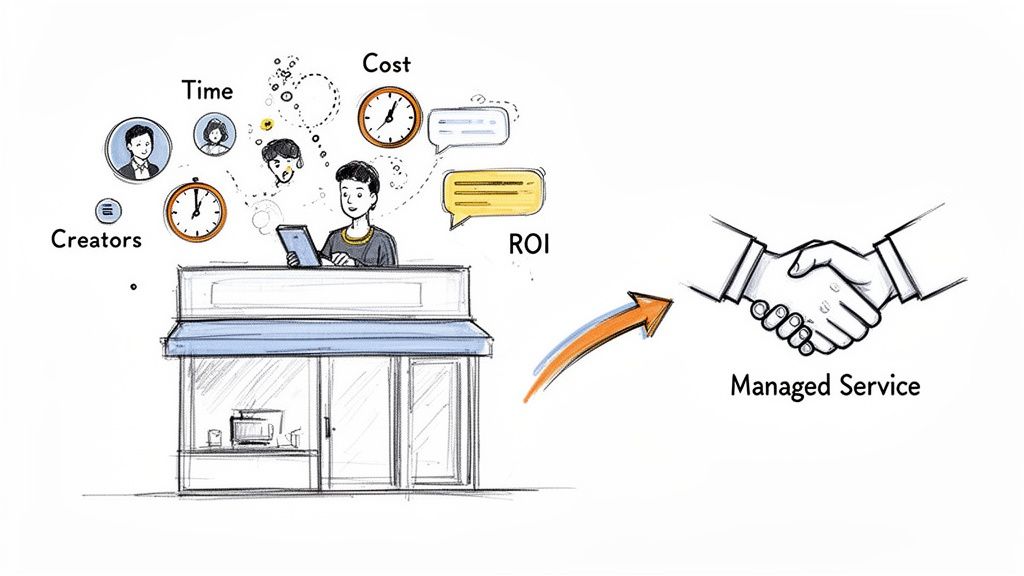
The Problem With DIY Campaign Management
When you go it alone, business owners and small marketing teams are forced to become full-time campaign managers. Does any of this sound familiar?
Endless Sourcing: Wasting hours scrolling through Instagram and TikTok, hunting for local creators who actually fit your brand’s vibe.
Negotiation Headaches: Getting trapped in back-and-forth DMs, trying to nail down rates, deliverables, and timelines with dozens of different people.
Manual Tracking: Juggling messy spreadsheets to keep track of who posted what, when, and trying to somehow link that content back to actual sales or bookings.
Murky ROI: Without proper tracking tools, you're left guessing. It’s nearly impossible to prove which influencers are driving revenue, making it hard to justify the effort.
The numbers show just how effective this channel can be. A staggering 84% of brands believe in its power, and for good reason. On average, brands generate $4.12 for every $1 spent on Instagram campaigns, and average annual budgets have shot up by 171% year-over-year. For a small business, that kind of return is incredibly appealing, especially when you realise most customers don't base their buying decisions on follower count alone.
Shifting from a Tool to a Partnership
This is precisely where a managed influencer marketing service shines as the most practical Grin alternative for small businesses. Instead of selling you a complicated piece of software and wishing you luck, a managed solution becomes an extension of your own team. It blends smart technology with real human expertise to manage the entire process for you—from finding creators and reaching out to running the campaign and reporting on the results.
The core decision for a small business isn't about which software to buy, but whether to invest in a tool that requires your time or a service that guarantees results.
This simple shift in thinking changes everything. The goal is no longer to find a "cheaper Grin" but to find a more efficient model that’s actually built for a team with limited resources. A 'done-with-you' service delivers scalable, measurable campaigns without you needing to become an influencer marketing guru overnight. To see how this works in practice, explore our complete guide to micro-influencer marketing for small businesses.
Comparing Grin SaaS vs A Managed Service Model
When you're looking for a Grin alternative, you’re not just comparing software features. The real choice is between two completely different ways of working: a do-it-yourself (DIY) software platform versus a 'done-with-you' managed service. Getting this distinction right is the most important step in finding a solution that actually fits your business.
Think of it like this. A powerful platform like Grin is like being handed the keys to a professional workshop. You get all the best tools, but you’re the one who has to build the car, tune the engine, and drive it to the finish line. Every part of the process, from finding creators and negotiating deals to tracking content and measuring results, rests on your team's shoulders.
A managed service, on the other hand, is your dedicated pit crew and driver all in one. It combines smart technology with human expertise to do the heavy lifting for you, acting as an extension of your own team. You get the strategy and the results, without having to build the car yourself.
The Operational Difference
The day-to-day reality of using a DIY tool versus a managed service couldn't be more different. With a SaaS platform, your team logs in and does all the work inside the software. It’s still a significant time commitment.
In a managed model, your main job is to provide direction, approve the strategy, and watch the campaign unfold. The service provider handles all the time-consuming tasks that can easily overwhelm a small team.
For a business owner, the choice really boils down to this: Are you buying a tool that needs your team to get a result, or are you investing directly in a guaranteed outcome?
This decision shapes your budget, your team's focus, and your path to ROI. A tool is an expense that requires more investment—your team's time—to generate a return. A managed service is designed from the start to be a profit centre, focusing entirely on delivering measurable results without draining your internal resources.
Here’s a practical breakdown of what that means.
This table highlights the fundamental difference between the two approaches.
Core Model Comparison Grin vs Sup Managed Service
Aspect | Grin (DIY SaaS Model) | Sup (Managed Service Model) |
|---|---|---|
Primary Role | You are the operator. You use the software to execute every step of the campaign yourself. | We are your partner. We execute the campaign for you using our platform and team. |
Time Investment | High. Your team must dedicate significant hours to sourcing, outreach, management, and reporting. | Low. Your involvement is mainly strategic approval; we handle the daily operational tasks. |
Expertise Needed | High. Requires in-house knowledge of influencer marketing strategy, negotiation, and analytics. | Low. You get access to a team of experts without having to hire them. |
Core Value | Provides a comprehensive toolkit to empower an existing, skilled marketing team. | Provides a complete, outsourced solution designed to deliver specific results. |
Ultimately, knowing which model is right depends entirely on your team's size, budget, and expertise. Thinking through the factors when choosing between influencer marketing platforms will help you make a decision that fits your real-world capacity. For most small businesses without a big marketing department, a managed approach offers a much clearer and more direct path to results.
Running the Campaign: Sourcing, Outreach, and Management
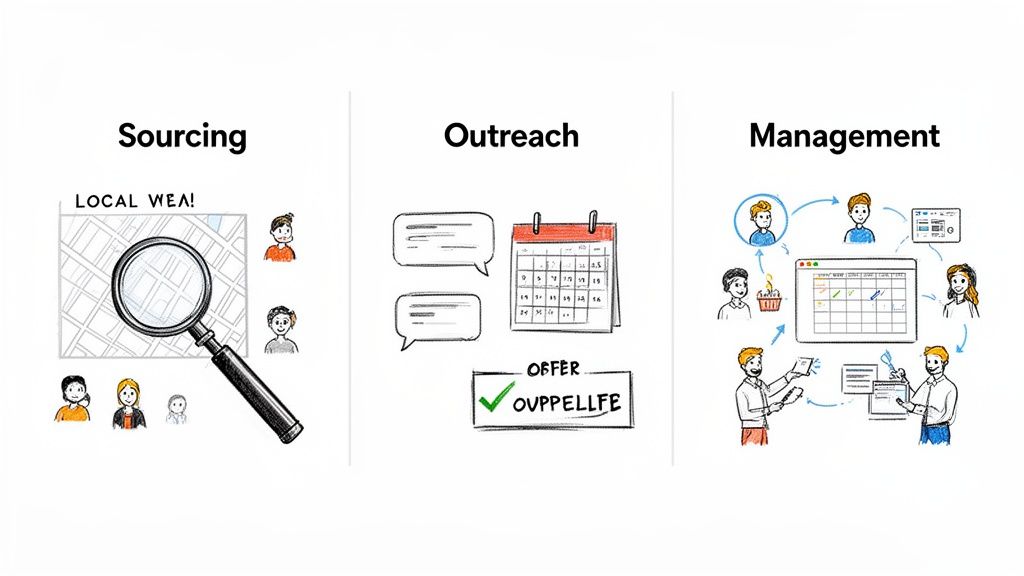
The true measure of any influencer marketing approach isn’t the flashy features—it’s how it holds up in the day-to-day grind of running a campaign. This is where the difference between a DIY tool and a managed service really hits home, especially during the three most time-heavy stages: finding creators, reaching out, and managing the entire project.
For a small business, this is where a great strategy can fall apart under the weight of its own logistics. It's one thing to have a powerful platform; it's another thing entirely to have the hours in the day to use it properly. Let’s break down the workload at each of these critical points.
Sourcing the Right Creators
With a platform like Grin, you gain access to a massive creator database, but the work of finding your perfect partners is all on you. If you’re a local café wanting to find ten food bloggers in Manchester, you’ll be the one setting filters, digging through hundreds of profiles, and vetting each person for brand fit. It's a meticulous, slow-moving task that demands a keen eye and a whole lot of patience.
A managed service like Sup, on the other hand, treats sourcing as a fundamental part of the service. We don't just give you a search bar and wish you luck. We use our own platform and our team's expertise to deliver a hand-picked list of hyper-local, niche creators who are already vetted and keen to collaborate. We don't just find names; we find ideal partners for your specific campaign, saving you dozens of hours right from the start.
This targeted approach is particularly powerful, with 54% of marketers now focusing on micro and nano-influencers. These creators can deliver up to 60% higher engagement, and with 88% of TikTok's creator base in this category, it’s a huge, cost-effective talent pool.
Managing Outreach and Negotiations
Once you've shortlisted creators in Grin, the outreach marathon begins. You’re in charge of every single conversation, writing initial DMs, sending follow-ups, negotiating rates, and formalising agreements through the platform. If you're aiming to work with 20 micro-creators, that's 20 separate conversations you need to start and juggle simultaneously.
A managed service completely takes this off your plate. Our team handles every bit of creator communication, from that first "hello" to the final signed contract.
The real difference isn't just about saving time; it's about expertise. A managed service brings professional negotiators to the table—people who know the market rates, understand what motivates creators, and can often secure better terms than a busy business owner could.
Let's imagine a new direct-to-consumer brand launching with a goal to partner with 50 niche micro-influencers.
The Grin Workflow: The marketing manager sinks weeks into sending hundreds of personalised emails and DMs, tracking every response, and trying to negotiate 50 individual deals.
The Managed Service Workflow: The marketing manager simply approves the campaign brief and creator list. The service team then manages all 50 negotiations at once, coming back with a fully confirmed roster, ready to go.
Campaign Logistics and Follow-Up
The final stage is actually managing the campaign itself. If you're using Grin, you become the project manager. It's on you to create schedules, send reminders about posting deadlines, check that content meets brand guidelines, and chase down anyone who’s running late. This admin work never stops, and it's absolutely crucial for getting results.
To keep creators engaged and producing authentic content, small businesses often explore different strategies like putting together thoughtful influencer gifting ideas.
With a managed service, this entire logistical headache is handled for you. A dedicated campaign manager takes care of all the scheduling, follow-ups, and content reviews. They’re the ones chasing deadlines and making sure every piece of the puzzle falls into place. For a small business, this is perhaps the biggest time-saver and the clearest reason to choose a managed Grin alternative for small businesses. It changes influencer marketing from a demanding, full-time responsibility into a scalable growth channel that works for you, not the other way around.
Proving Real ROI Tracking and Attribution
For any small business, every single pound spent on marketing has to count. Proving a direct return on investment (ROI) isn't just a nice-to-have; it's absolutely essential. This is where the difference between a DIY software platform and a managed service really comes into sharp focus, because they handle tracking and attribution in two completely different ways.
A powerful SaaS tool like Grin certainly offers robust attribution features, but there's a catch. To get them working properly, you often need a fair bit of technical know-how. This could mean wrestling with e-commerce integrations, building custom landing pages, or a lot of manual setup that a small team simply doesn't have the time or expertise for. The burden of building that attribution system falls squarely on your shoulders.
The Challenge of DIY Attribution
Once you start managing tracking yourself, you quickly realise how complex it can get. You're responsible for creating unique discount codes and UTM-tagged links for every single influencer. Then you have to get those out, make sure the creators are actually using them correctly, and finally, piece together data from different places—your Shopify dashboard, Google Analytics, the platform itself—just to figure out what's working.
Frankly, this manual approach is not only a huge time-drain, but it's also wide open to error. It’s far too easy to misattribute a sale or completely lose track of which creator is genuinely driving value for your business. For busy entrepreneurs, this is a major headache. You need clear answers, not more data puzzles to solve.
The Managed Service Approach to ROI
A managed service, which is a great Grin alternative for small businesses, is specifically designed to eliminate this problem. Instead of handing you a box of tools with an instruction manual, it gives you a ready-made attribution system that’s working from day one, with zero complex setup needed from you.
The real value of a managed service isn't just that someone runs the campaign for you; it's that they provide an attribution framework that makes your ROI immediately visible and easy to understand.
This approach is all about clarity. When a campaign kicks off, every bit of content is automatically assigned a unique tracking link or discount code. All that data then flows directly into a simple, clean dashboard where a business owner can see, at a glance, exactly what’s performing.
This is especially important when you consider how effective this channel can be. With e-commerce stores making up 54.1% of brands using influencer marketing and 89% of businesses saying it delivers better results than other marketing channels, clear attribution is non-negotiable. The average return is $5.20 for every dollar spent, but to truly grasp your campaign's performance, mastering the art of measuring content marketing ROI is key. In fact, 60% of marketers find that influencer content drives more engagement than their own branded posts. Read the full research about these influencer marketing findings.
Comparing Attribution Workflows
Let's look at how you'd actually track a campaign using each method.
Attribution Method Comparison
Metric | Tracking with Grin (DIY) | Tracking with a Managed Service (Sup) |
|---|---|---|
Sales Tracking | You have to manually set up affiliate links, unique discount codes, and often integrate with Shopify or other e-commerce platforms. | Automatically generates unique tracking links and promo codes for every creator. Sales are attributed in real-time on a central dashboard. |
Foot Traffic | Very difficult to track without a separate system. You might have to rely on creators using verbal calls-to-action or asking customers to show a post in-store. | Can easily track in-person redemptions (e.g., "Mention this post for a free drink"), with results logged directly in the campaign dashboard. |
Reporting | You’re responsible for pulling data from multiple sources (Grin, Shopify, Google Analytics) and compiling reports yourself to link influencer activity to sales. | A single, unified dashboard shows all key metrics: views, clicks, code redemptions, sales revenue, and ROI per creator, all updated live. |
For a restaurant owner or a small e-commerce brand, the difference here is night and day. With a managed service, you don't need to be a data analyst to see your return. The entire system is built to give you straightforward, actionable insights, helping you make smarter marketing decisions without the technical overhead. This focus on clear, immediate attribution is a huge reason why a managed service is such a compelling Grin alternative.
Analysing The True Cost and Scalability
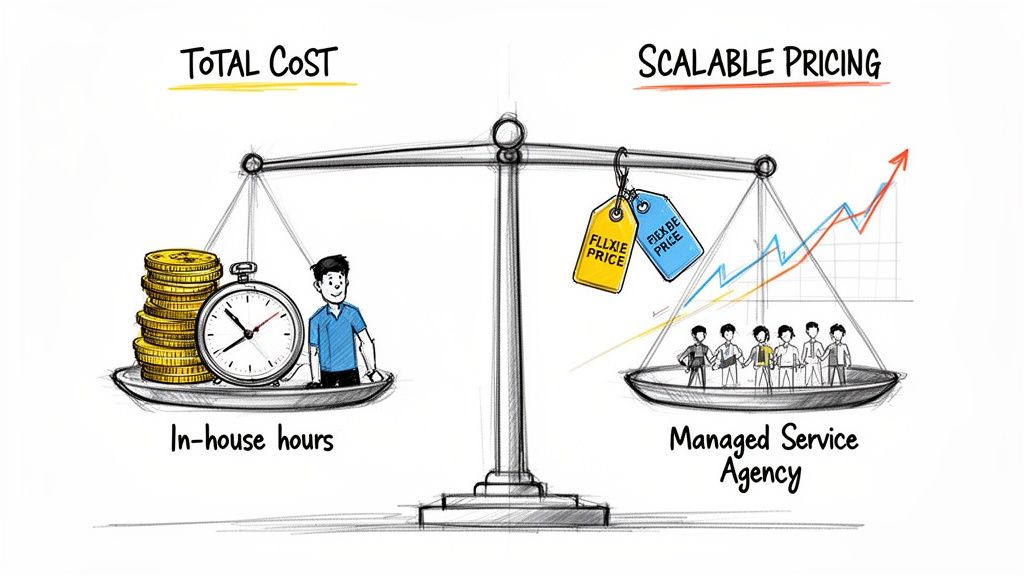
When you look at a platform like Grin, it’s easy to focus on the subscription price. But that figure is just the tip of the iceberg. For a small business, the biggest drain on your budget isn't the software itself—it's the massive amount of employee time needed to actually make it work.
Think about what it takes. Even with a powerful platform, someone on your team is spending dozens of hours every month finding creators, negotiating deals, managing all the back-and-forth, and trying to analyse the results. That’s not a quick side task; it’s practically a part-time job. Once you factor in that employee's salary, the total cost of running a DIY platform can easily double or triple the initial fee.
How the Total Costs Stack Up
To get a clear picture of the investment, you have to look beyond the licence fee and account for all the resources you're pouring in. It's a mix of financial spend and human capital.
Grin's Total Cost: You're looking at a hefty annual subscription, often starting around £20,000, and you're locked into a long-term contract. On top of that, you need to add the fully-loaded salary cost of at least one marketing employee's time, which can easily add another £20,000–£30,000 per year.
Managed Service's Total Cost: This model is completely different. It's flexible and pay-as-you-go, with pricing built around your specific campaign goals. The fee you pay covers everything—the tech, the expert team, and the full campaign execution—which means that hidden salary cost simply disappears.
This is the fundamental difference that makes a managed service such a smart Grin alternative for small businesses. You can align your spending directly with your marketing activity instead of getting saddled with a huge, fixed overhead. You can learn more by reading about the real cost of running influencer campaigns in-house.
Scaling to Fit Your Business Needs
The way each model scales is also worlds apart, especially for businesses that aren't enterprise-level. A DIY platform's high fixed cost makes it incredibly inefficient for smaller campaigns, whereas a managed service is built for that exact kind of flexibility.
The true value of a managed service is its ability to scale both up and down with your business. You only pay for what you need, when you need it, whether that’s a small local campaign or a national launch.
Let's look at a couple of real-world examples to see how this works in practice.
Scenario A: The Local Restaurant A single-location restaurant wants to team up with 10 local food bloggers to promote a new menu and get people through the door.
With Grin: The restaurant would be stuck with its massive annual fee. The owner or a manager would then have to sink weeks into finding and coordinating with local influencers. The cost is completely out of proportion for a small, local push.
With a Managed Service: The restaurant pays a single, one-off fee for the campaign. The service finds, vets, and manages all 10 bloggers, delivering the content and footfall they need for a predictable and manageable price.
Scenario B: The DTC Brand A new e-commerce brand is launching and wants to work with 50 niche micro-influencers to generate initial sales and buzz.
With Grin: The brand pays its annual fee, and its small marketing team is immediately buried under the weight of managing 50 different relationships, contracts, and content approvals. The platform gives them tools, but the team still has to do all the heavy lifting.
With a Managed Service: The brand pays for a campaign package that includes 50 creators. The service handles the entire process from start to finish—outreach, negotiation, reporting, everything. This frees up the brand's team to focus on all the other crucial launch activities.
In both scenarios, the managed service delivers better value and is far more efficient. It turns influencer marketing from a high-cost, high-effort headache into a scalable growth channel that’s perfectly suited to the realities of running a small business.
When to Choose a Managed Service Over Grin
Deciding between powerful software like Grin and a managed service isn't really a features-first decision. It’s about being honest about your team's time, resources, and what you’re truly trying to achieve. The best choice for your business comes down to context.
Let’s get straight to the point. A platform like Grin makes sense if you have an in-house marketing team ready to run with it and a hefty six-figure budget to cover both the software and the salaries of the people managing it. For almost everyone else, particularly small businesses, a managed service is simply the more direct and practical route to getting results.
You're a Small Team Wearing Many Hats
This is the reality for most small business owners and lean marketing departments. If you’re already juggling social media, emails, and day-to-day operations, the thought of adding a whole new job—because that's what influencer management is—is a non-starter. The hours you'd sink into finding creators, negotiating deals, and tracking results are a hidden cost that can easily dwarf the software subscription itself.
A managed service is your best bet if:
Your marketing 'team' is just one or two people.
You simply don't have someone who can dedicate 15+ hours per week to influencer marketing.
You need to see a return on investment without getting tangled up in the manual work.
Think of it as having an expert team on call. You get to focus on your business while they handle the entire campaign, from finding the right people to reporting on the results.
You Need to Activate Local Creators Across Multiple Locations
For businesses with more than one physical location—like a restaurant chain, a franchise, or a local retail group—finding good, relevant creators in each neighbourhood is a huge logistical headache. Trying to do this with a DIY platform means running dozens of separate searches, vetting each person individually, and managing it all without dropping any plates. It’s inefficient and incredibly hard to scale.
A managed service is built for exactly this scenario. They excel at finding, vetting, and activating hyper-local micro-influencers across several postcodes at once, making sure your brand message is consistent while driving real footfall to each specific location.
Imagine a café with five spots across London. A managed service can get five to ten creators posting about their local branch in Brixton, Shoreditch, and Notting Hill, all as part of one cohesive campaign. This is the kind of scalable, localised marketing that software alone just can't deliver easily.
Your Top Priority Is a Clear and Immediate Return on Investment
Let's be frank. If you don't have a data analyst on staff or the expertise to set up complex tracking, a DIY platform can become a frustratingly expensive dashboard. You need to see a clear line connecting what you spend to the sales, bookings, or new customers walking through your door—without having to stitch together data from five different places.
This is where a managed service shines and stands out as a leading Grin alternative for small businesses that need that clarity.
A managed service makes sense for ROI when:
You want one simple dashboard showing you everything from content views to actual revenue.
You're a restaurant or shop and need a reliable way to track in-person voucher redemptions.
You value a predictable, guaranteed outcome more than you value having a complex box of tools.
Ultimately, choosing a managed service isn’t just about swapping software for people. It's a strategic choice to invest directly in results, not just the tools to maybe get them. For the vast majority of small businesses, it’s the faster, more efficient, and financially sound way to make influencer marketing actually work.
Your Top Questions Answered
When you're exploring alternatives to a big platform like Grin, a lot of practical questions pop up. Let's get straight into the common concerns we hear from business owners considering a managed influencer marketing service.
How Much of My Time Will This Actually Take?
This is probably the biggest difference you'll notice. With a DIY platform, you're the one putting in the hours every week. A managed service, on the other hand, is built to be incredibly light on your schedule.
You can expect to spend about 20-30 minutes during the initial setup. This is where you'll brief us on your goals and what your ideal creator looks like. After that, your main job is simply to give the thumbs-up on the creators we've hand-picked and the campaign strategy we've built for you. All the heavy lifting—the endless outreach emails, the back-and-forth negotiations, scheduling content, and chasing up posts—is handled for you.
Will A Managed Service Work For My Niche Industry?
Absolutely. In fact, this is where a managed service often shines brighter than a massive software database. While a platform like Grin provides the search tools, the reality of finding genuinely influential creators in a specialised field can be a real grind.
A good managed service team has the expertise to dig deep and find people with real authority in your specific niche, whether that's sustainable vegan skincare or a hyper-local craft brewery. They know how to spot the micro-influencers who have those tight-knit, super-engaged audiences that can make or break a campaign. It's about finding the right people, not just any people.
This simple flowchart can help you think about which route makes sense for your team's current size.
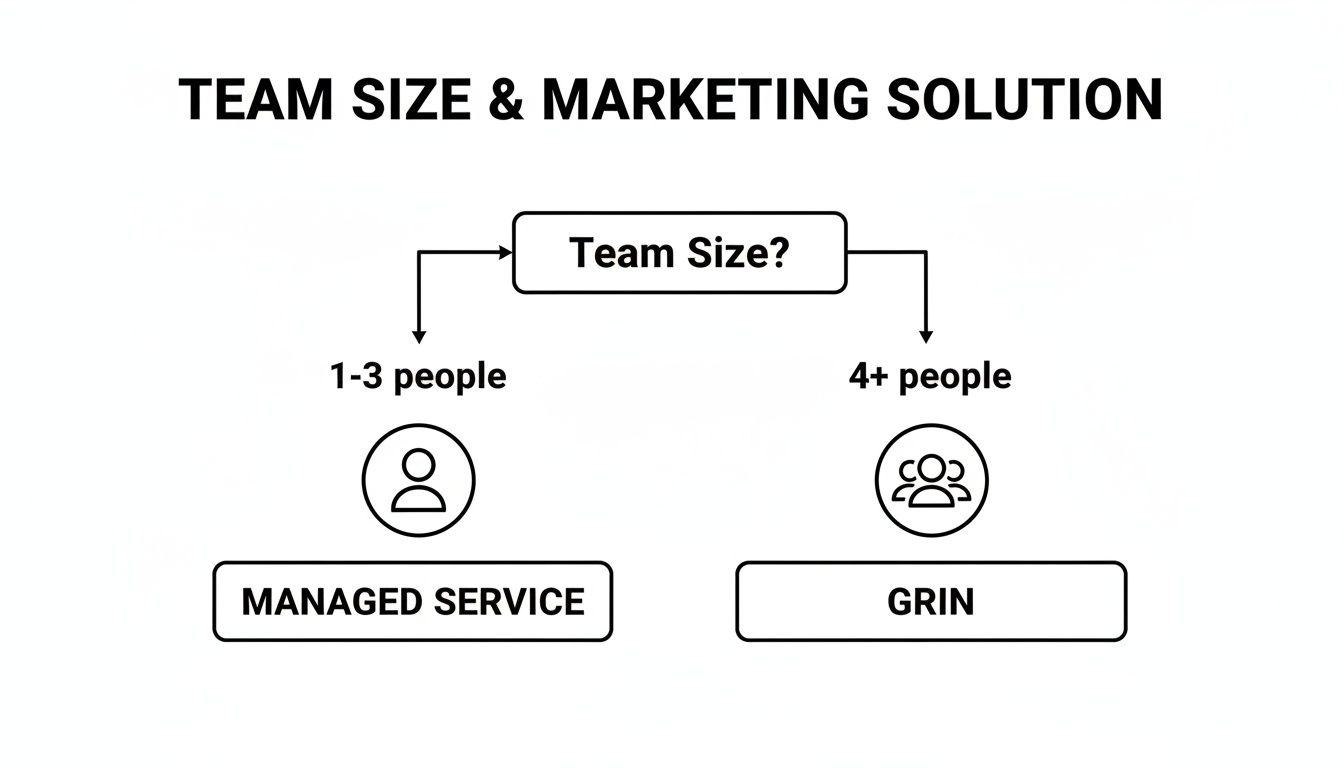
The key takeaway here is pretty clear: if you're running a lean team, the operational support from a managed service is almost always the more practical path.
What Should I Expect When I First Start?
We’ve designed the entire process to be quick and painless. It all kicks off with a short onboarding call where we'll get to grips with your campaign goals, target audience, and brand guidelines. From there, our team gets to work, building out a complete campaign plan for you to review.
Once you give us the green light, we take the reins. You'll get access to a live dashboard to see how everything's progressing, watch content go live, and check on key metrics like clicks, sales, and ROI—all without having to lift a finger. The whole point is to get you from sign-up to a live, results-driven campaign with as little fuss as possible.
Ready to see how a managed service can get your influencer marketing running without the heavy lifting? Sup combines smart sourcing with expert campaign management to deliver real, measurable results for businesses just like yours. Get started in minutes and launch your first campaign.

Matt Greenwell
Share