
The secret to scaling your agency’s influencer campaigns without bloating your payroll is to stop thinking about people and start thinking about processes. By building smart systems, embracing automation, and creating standardised operating procedures (SOPs), you can manage a much larger volume of campaigns with the team you already have. This isn't just about efficiency; it's about building a more profitable, resilient agency.
The Agency Growth Dilemma: Scaling vs. Hiring
Many agencies hit a wall they know all too well. Influencer marketing starts delivering incredible results for clients, and demand skyrockets. But here’s the catch: managing it all is incredibly labour-intensive. Finding the right creators, sliding into countless DMs, negotiating rates, chasing down content, and processing payments for dozens of influencers at once creates a logistical nightmare that can quickly burn out even the most dedicated team.
The knee-jerk reaction? Hire more campaign managers. While throwing more people at the problem seems logical, it’s a costly fix. New salaries, training, and management overhead eat directly into your profit margins. Suddenly, your agency’s growth is a double-edged sword—scaling your services means you’re also forced to scale your payroll and operational complexity.
The real bottleneck isn't a lack of people; it’s a lack of efficient systems. The endless, repetitive manual tasks are what truly cap an agency's ability to grow.
A Shift in Perspective
This is where you need to reframe the problem. It's not a personnel issue; it’s a process issue. The question shouldn't be, "Who can we hire to do this work?" but rather, "What parts of this work can we systematise?" This guide is built on that exact principle.
This is a journey most growing agencies go through. You hit a growth ceiling, try the old way of just hiring more people, and eventually realise there’s a much better way forward by building systems.

As you can see, relying on headcount offers linear growth at best. Implementing smart systems, on the other hand, gives you the foundation for exponential scale.
To help you build this more efficient engine for growth, we’re going to focus on three core pillars:
Smart Systems: Creating documented, repeatable workflows for every single stage of an influencer campaign.
Automation Tools: Using dedicated platforms to handle the grunt work, freeing your team for high-value strategic tasks.
Measurable Collaborations: Focusing on micro- and nano-influencers, where performance can be tracked with precision and campaigns can be scaled effectively.
Manual vs Automated Scaling at a Glance
Let's quickly compare the two approaches. The difference becomes stark when you lay it all out.
Aspect | Manual Approach (Hiring More People) | Automated Approach (Using Systems & Tools) |
|---|---|---|
Capacity | Limited by headcount; linear growth. | Scalable; can handle 10x the volume with the same team. |
Cost | High and recurring (salaries, benefits, overhead). | Lower and predictable (SaaS subscriptions). |
Efficiency | Low; bogged down by repetitive tasks and human error. | High; automation handles tedious work 24/7. |
Data & Reporting | Scattered in spreadsheets; difficult to analyse. | Centralised in a dashboard; real-time insights. |
Consistency | Varies by campaign manager; prone to errors. | Standardised processes ensure consistent quality. |
Profit Margin | Decreases as payroll increases. | Increases as you handle more work without adding headcount. |
The table makes it clear: one path leads to a constant cycle of hiring and shrinking margins, while the other leads to sustainable, profitable growth.
Thinking through the real cost of running influencer campaigns in-house often provides the final push agencies need to embrace this systemic shift. It’s not about making your team work harder; it’s about giving them the tools and processes to work smarter. By doing so, you build a more robust operation that can take on more clients and deliver better results, all without the constant pressure to hire.
Laying the Groundwork: Why Standard Operating Procedures Are Your Scaling Secret
Before you even think about automation tools, you need a solid blueprint. Trying to scale influencer campaigns without one is a recipe for chaos. You end up with inconsistent results, missed deadlines, and unhappy clients. This is where Standard Operating Procedures (SOPs) come in – they’re the foundation for scaling without simply throwing more people at the problem.
Think about it.## Laying the Groundwork: Why Standard Operating Procedures Are Your Scaling Secret
Before you even think about automation tools, you need a solid blueprint. Trying to scale influencer campaigns without one is a recipe for chaos. You end up with inconsistent results, missed deadlines, and unhappy clients. This is where Standard Operating Procedures (SOPs) come in – they’re the foundation for scaling without simply throwing more people at the problem.
Think about it. Right now, your best campaign manager probably has a treasure trove of knowledge locked in their head. SOPs get that knowledge out and turn it into a repeatable system anyone on your team can follow. This ensures every campaign, no matter who’s running it, hits the same high standard. That consistency is exactly what keeps clients coming back and what allows you to grow your capacity without growing your headcount.
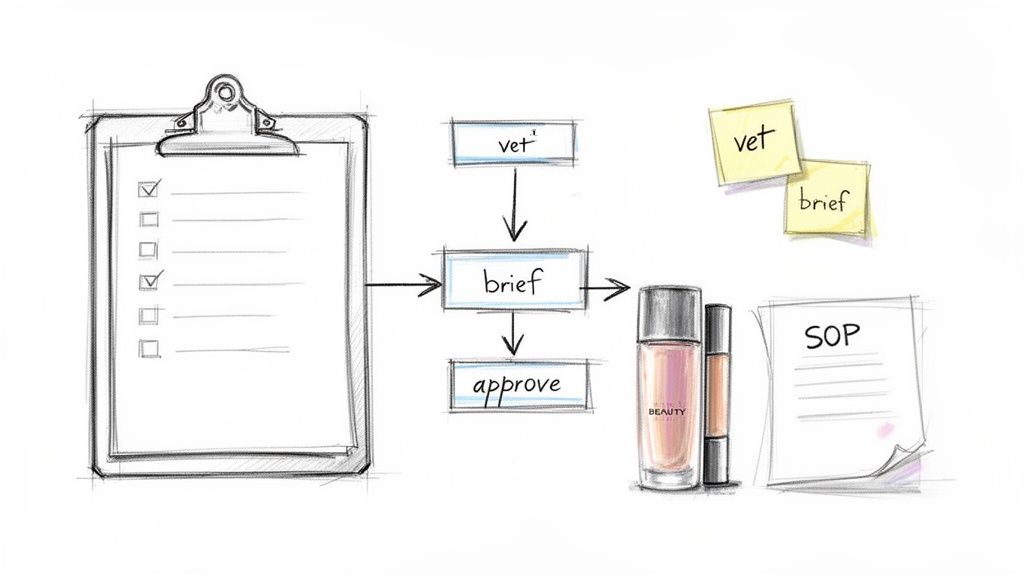
Of course, the trick is knowing how to write standard operating procedures that people actually want to use. These shouldn't be dusty, 100-page binders. They need to be living documents that genuinely make day-to-day work easier.
From Good Intentions to a Real-World Playbook
Let's make this practical. Imagine your agency is handling a new serum launch for a skincare brand. Without a clear process, one campaign manager might pick influencers based on follower count, while another focuses purely on aesthetics. The result? A disjointed campaign that doesn't tell a cohesive story.
With SOPs in place, everyone is on the same page. You've already defined the rules of the game. Your process would break the entire campaign down into clear phases, each with its own checklist. This eliminates the guesswork and stops things from slipping through the cracks. This is the very core of how successful agencies scale.
An effective SOP doesn’t stifle creativity. It builds a reliable framework that frees up your team to focus their energy on what really matters—strategy and creator relationships—instead of reinventing processes for every single task.
The Essential SOPs for Influencer Campaigns
You don't need to document everything at once. Start with the most critical, repeatable parts of your workflow. Your first set of SOPs should cover the absolute essentials for running a campaign from start to finish.
Creator Vetting Checklist: This is your non-negotiable list of criteria. For our skincare client, this SOP would mandate things like a minimum engagement rate of 3%, an audience authenticity score over 90%, and a strict rule against any collaborations with competitors in the last six months.
Campaign Brief Template: This is all about consistency. It makes sure every creator gets the exact same clear instructions. The template would detail the serum’s key benefits, specific talking points, required formats (e.g., one Reel, two Stories), and the mandatory FTC disclosure wording.
Content Approval Workflow: Define the exact approval process, step by step. For instance: Creator submits their draft content to a shared portal. The manager reviews it against the brief within 24 hours. Feedback is left using a standardised template. Final approval is logged in your project management tool.
These documents do more than just standardise your work; they make your quality predictable. They're also fantastic for training new team members or cross-training your current staff, making your whole operation more resilient. As you grow, you might even look into solutions like white label influencer marketing for agencies to take things a step further.
By taking the time to create these foundational documents, you're not just getting organised – you're building a real asset. This library of processes is what empowers a small, nimble team to deliver results with the volume and precision of a much larger agency. You’re essentially making excellence your default setting.
Let's be honest, the biggest time-drain for any agency trying to scale influencer marketing is the manual slog of finding creators. Scrolling through TikTok and Instagram, firing off DMs into the void—it's a reactive, frustrating process that simply won't grow unless you throw more people at it. This is the single biggest barrier to scaling your campaigns without bloating your headcount.
The only way out is to stop hunting and start automating discovery.
Think of it this way: modern influencer marketing platforms let you pivot from being a hunter-gatherer to a skilled curator. Instead of chasing down creators one by one for every single campaign, you build an evergreen, pre-vetted stable of talent. This single shift is what unlocks your agency’s capacity for real growth.
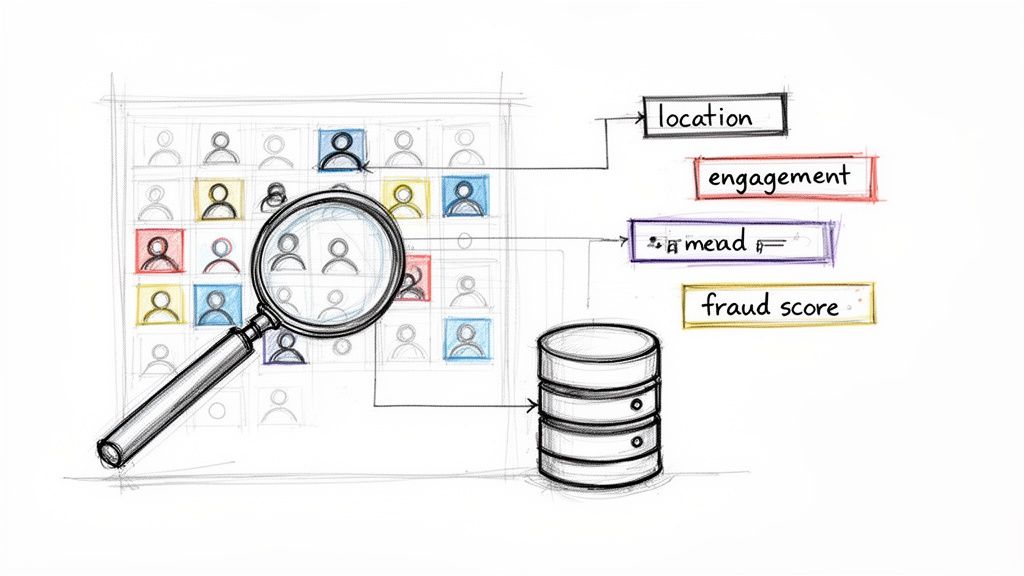
From Reactive Searching to Proactive Curation
The goal is to never start from a blank slate again. With the right tech, you can build a powerful, searchable library of creators who are a perfect fit for your clients. Your team's conversation shifts from a panicked "Who can we possibly find?" to a strategic "Who in our database is the best fit for this launch?".
This proactive approach is all about using smart filters and AI-driven insights. You can finally move beyond surface-level stats like follower count and dig into what really matters.
Here are the search parameters that make a real difference:
Niche and Keywords: Go beyond broad categories. Search for creators based on specific bio keywords and the topics they actually post about, like "vegan food Leeds" or "sustainable fashion London".
Audience Demographics: This is a game-changer. Filter by the location, age, and gender of a creator's audience, not just the creator. It’s absolutely vital for brands trying to reach a specific customer profile.
Performance Metrics: Instantly find the high-performers by sorting for engagement rate, average video views, or how often they post.
Setting up these filters allows you to pull a list of hundreds of ideal micro- and nano-creators in minutes—a task that would have eaten up days of manual work. As you dial in this process, it's a brilliant idea to document it. Learning how to create effective Standard Operating Procedures ensures everyone on your team finds quality creators the same way, every time.
Using Data to Vet Creators at Scale
Finding potential creators is one thing, but vetting them is where most agencies get bogged down. A big follower number can easily mask a disengaged audience or, even worse, outright fraud. Automation brings the critical data you need right to the surface, letting you qualify people quickly and accurately.
The real power of automated vetting is seeing a creator's audience health in a single glance. This data protects your client's budget and, just as importantly, your agency's reputation. It's how you avoid the duds and the fakes.
This data-driven approach takes the guesswork out of vetting. You can quickly run profiles against a checklist of quality signals, turning what was once a subjective gut-check into an objective, defensible decision.
Key Vetting Metrics to Automate
Audience Authenticity Score: Most platforms will give you a score that estimates the percentage of real followers. Anything above 90% is a great sign.
Engagement Rate vs. Niche Average: Don't look at engagement in a vacuum. A 2% engagement rate might be poor for a nano-creator but fantastic for a macro-influencer. Good tools compare a creator's stats to the average for their specific niche and size.
Follower Growth Velocity: Look for steady, organic growth. A massive, sudden spike in followers is a huge red flag that often points to bought followers.
Once you’ve found a solid group of vetted creators, organise them. Create curated lists inside your platform, like "London Foodies Under 20K Followers" or "UK Eco-Friendly Beauty Creators." If you need help choosing a tool with these features, our guide on influencer marketing platforms for restaurants is a good place to start.
This effort compounds over time. You’re not just finding influencers for one campaign; you’re building a valuable, proprietary asset that makes every future launch faster and more impactful.
From First Contact to Signed Contract: Nailing Your Communication Workflow
So, you've got your carefully selected list of creators. Fantastic. But now comes the part that trips up so many agencies: the actual communication. If there’s one place where campaigns stall and teams burn out, it’s in the endless back-and-forth of DMs, follow-up emails, and protracted negotiations.
Trying to manage all this manually isn’t just inefficient; it’s a direct cap on your growth. To really scale, you have to move away from one-off conversations and build a repeatable system for outreach and contracting. It’s about creating a smooth, professional journey for the creator that also frees up your team from inbox-sitting.
Ditch the Manual DMs and Automate Your Outreach
First things first: stop writing every single outreach message from scratch. The key is to build a library of proven message templates that your team can adapt for every stage of the conversation. These aren't just robotic copy-paste scripts, but powerful starting points that consistently get replies.
Your initial DM, for instance, should be short, sharp, and personal. A little bit of research goes a long way.
Initial DM Idea: “Hi [Creator Name], really enjoyed your recent Reel on [Specific Topic]! We're running a campaign for [Client Brand] and thought your authentic style would be a brilliant fit. Are you open to hearing about new collaborations?”
This approach is direct and shows you’ve actually looked at their work. But the real game-changer is automating the follow-ups. A staggering 80% of non-routine sales happen only after at least five follow-ups. Trying to manually track that across dozens of creators is a recipe for disaster.
This is where a good influencer platform earns its keep. It can be set up to send a polite, automated follow-up if a creator goes quiet for a few days. This simple step ensures no promising creator slips through the cracks, and your team doesn't have to live by their calendar reminders.
End the Negotiation Nightmare with Pre-Built Offers
The single biggest time-drain in the entire process? Negotiation. The weeks spent haggling over deliverables, payment, and usage rights can kill a campaign’s momentum before it even begins. You can sidestep this chaos entirely by creating standardised campaign offers inside your management platform.
Instead of starting every negotiation from a blank slate, you invite creators to a clearly defined package. Let's say you're running a standard "Product Unboxing" campaign for a skincare client. You’d have an offer ready to go.
Example Campaign Offer: "Skincare Serum Unboxing"
Deliverables: 1 Instagram Reel (30-60 seconds) & 2 Instagram Stories with a link sticker.
Compensation: £250 fixed fee + free product.
Timeline: Content must be submitted for approval within 7 days of receiving the product.
Usage Rights: The brand can repurpose content on their organic social channels for 6 months.
When you send this to a creator, the entire negotiation is framed from the start. They see a professional, well-thought-out offer, not an open-ended question. This flips the dynamic from a messy haggle into a straightforward "yes" or "no" decision. It saves you countless hours and immediately makes your agency look more organised and professional.
Get Contracts Signed in Minutes, Not Weeks
Once a creator says yes, the last thing you want is for the energy to fizzle out while you mess around with contracts. Emailing PDFs back and forth, waiting for someone to find a printer, sign, scan, and return it… it’s a relic of the past. It's slow, clunky, and adds a final, unnecessary layer of admin.
Digital contracts and e-signatures are non-negotiable for any agency looking to scale. The right software can automatically pull the details from your pre-built offer, generate a contract, and send it for a legally binding digital signature.
This means you can:
Generate a perfect contract in seconds with all the terms already in place.
Send it directly to the creator through your platform or via email.
Get it signed and returned in a matter of minutes.
By systemising your outreach, offers, and contracting, you eliminate the most frustrating bottlenecks in your workflow. It’s a system that allows a small team to manage communications with hundreds of creators at once, turning a formerly chaotic process into a smooth, scalable operation.
Executing Flawless Campaigns with Automated Attribution
This is where all the hard work you’ve put into building your systems really starts to pay off. You’ve sourced, vetted, and contracted your creators with slick, automated workflows. Now, it’s time to execute. This is your moment to show clients undeniable value, but it's also the stage where many agencies get completely swamped—drowning in a sea of spreadsheets, chasing missed posts, and trying to piece together fragmented data. If you want to scale without hiring, you absolutely must have a bulletproof system for managing live campaigns and, crucially, proving they actually work.
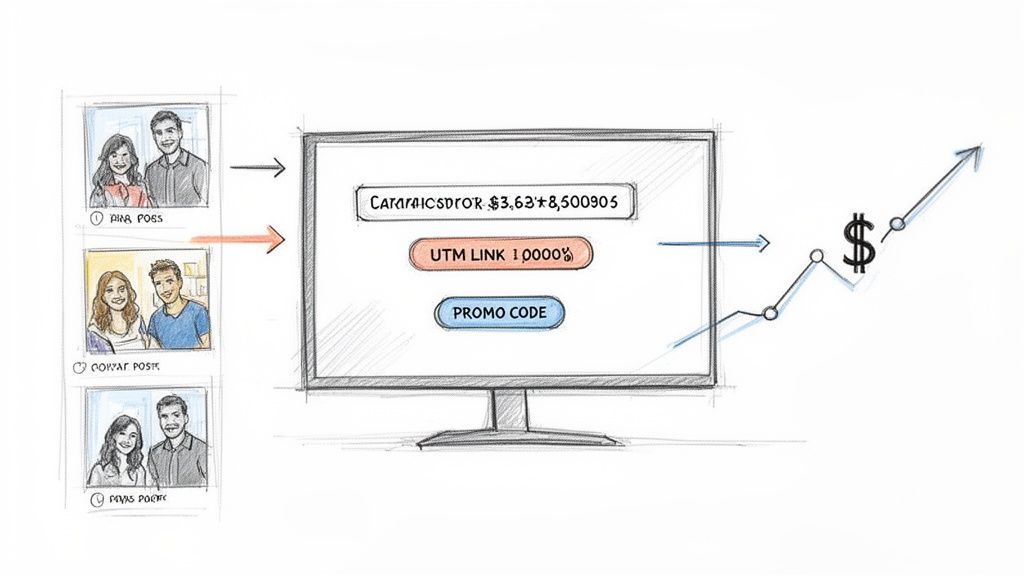
A centralised dashboard is your mission control. Forget trying to track content submissions, live post links, and performance metrics across dozens of creators with a manual spreadsheet. That isn't just inefficient; it's a fast track to burnout and making expensive mistakes. A modern platform gives you a bird's-eye view of every single campaign, all in one place.
Make Attribution Your North Star
The single most important part of proving a campaign’s success is attribution. Without it, you’re stuck reporting on vanity metrics like likes and comments, and clients are getting tired of hearing about those. To keep and grow your accounts, you have to connect influencer activity to real business results, like sales and sign-ups.
This is why giving every single creator their own unique tracking assets is completely non-negotiable.
Unique Promo Codes: Assign a distinct code like "TANYA15" to each influencer. This creates a direct, undeniable link between their posts and the sales they generate. You’ll know exactly who is driving revenue.
Custom UTM Links: Build specific URLs for each creator to pop in their bio, drop into Stories, or add to their descriptions. This lets you track clicks, website traffic, and conversions through tools like Google Analytics, showing you precisely where your results are coming from.
Manually creating and sending out hundreds of unique codes and links is a logistical nightmare. Honestly, it's a task that was practically designed for automation. Good influencer marketing platforms can generate these assets automatically during campaign setup and get them to creators without you lifting a finger. This saves your team countless hours of tedious work and cuts out the risk of human error.
By automating attribution, you completely change the conversation with your clients. Instead of saying, "The campaign got 500,000 views," you can confidently state, "The campaign drove £12,000 in direct sales and brought in 250 new customers." This is how you prove ROI and lock in bigger budgets for next time.
From Launch to Live Tracking
With a solid, automated system in place, the "live" phase of a campaign stops being about frantically chasing people and starts being about calmly monitoring progress. A centralised dashboard gives you real-time visibility, allowing you to manage dozens of campaigns at once with a small, focused team.
Picture this: a client pings you for a mid-campaign update. Instead of spending hours digging through emails and spreadsheets, you just pull up a dashboard that instantly shows you everything.
Content Status: See at a glance which creators have submitted drafts, which posts are approved, and which are scheduled to go live.
Live Post Tracking: The platform should automatically spot when content is published and pull the link directly into your dashboard for review.
Performance Metrics: Watch in real-time as the clicks, code redemptions, and sales roll in from each creator’s hard work.
This level of organisation not only makes your agency look incredibly professional but also gives you the data to make smart decisions on the fly. If you see one creator’s discount code is smashing it, you can quickly decide to put some ad spend behind their content or get them booked for another campaign right away.
Proving Value Beyond Vanity Metrics
Ultimately, the goal here is to build a more profitable and efficient agency. The key to that profitability is client retention, which is built on a foundation of solid, demonstrable results. Automated attribution is the tool that makes this possible.
When you can hand a client a clean, clear report that breaks down performance on a per-influencer basis, you remove any doubt about the value you're providing. You can show them exactly how their investment turned into tangible business outcomes.
Key Metrics for ROI-Focused Reporting:
Total Revenue Generated: The ultimate proof of a campaign’s financial success.
Customer Acquisition Cost (CAC): Show how cost-effective your campaigns are compared to other channels.
Conversion Rate: What percentage of clicks actually resulted in a sale or a lead?
Return on Ad Spend (ROAS): For every pound spent on the campaign, how much revenue did it generate?
Presenting this kind of detailed, bottom-line data elevates your agency from a simple service provider to a strategic growth partner. It justifies your fees, builds incredible trust, and gives you a powerful case study to win over new clients. This data-driven approach is the final, essential piece of the puzzle for scaling your influencer campaigns without having to scale your team.
Automating Payments and Maximising Your Content Library
Just because an influencer’s content has gone live doesn't mean your work is finished. In fact, what comes next is often what separates the agencies that scale smoothly from those drowning in admin.
The final two stages—paying your creators and reusing the content they’ve made—are where you can really lock in efficiency. Getting this right is how you multiply the value of every single campaign you run.
Manually paying dozens, or even hundreds, of creators is a recipe for disaster. It’s a tedious, error-prone task that eats up your team's time with chasing invoices and processing one-off bank transfers. This is a bottleneck that’s begging for automation, and it's a critical piece of the puzzle if you want to scale without hiring more people.
Getting Creator Payments Right
Automating your payments isn't just about saving a few hours. It’s about building a professional, reliable reputation that creators remember. Late or incorrect payments are one of the fastest ways to damage a relationship and tarnish your agency's name.
On the other hand, a slick, dependable payment process makes creators genuinely want to work with you again.
A modern influencer platform can handle this whole workflow from start to finish. Once a creator's post is approved and published, the system can automatically trigger their payment. No more manual checks, no more chasing, and no more human error.
Set up automated triggers: You can configure the system so that as soon as content is verified, payment is automatically scheduled. Simple.
Offer different payment options: The best platforms let creators choose how they want to be paid, whether it's PayPal or a direct bank transfer, which makes life easier for everyone.
Generate payment records automatically: The system should log every single transaction, giving you clean, auditable records for your accounts and for tax purposes.
This doesn't just free up countless hours; it shows every creator you work with that you're a reliable partner. It’s a simple change that makes a massive difference to your operations.
Building Your Evergreen Content Engine
Perhaps the most overlooked opportunity in any influencer campaign is what you do with all the fantastic user-generated content (UGC) you’ve just acquired. Every post is more than just a flash in the pan on a social feed; it’s a valuable content asset your clients can use for weeks, if not months.
The problem is that this content usually ends up scattered everywhere—in emails, DMs, and on different social platforms. A centralised content library is the answer. The right tools will automatically pull in every piece of tagged content, organising it all into a single, searchable database.
The real magic of a content library is that it turns a one-off campaign into a long-term marketing asset. You’re not just buying a single post; you’re building an arsenal of authentic, high-performing creative for your clients.
Putting Your Content Library to Work
Once you have this brilliant collection of UGC in one place, you can start putting it to work. As long as you secured the usage rights during the contracting phase, your client now has a goldmine of authentic content. This can fuel their entire marketing strategy, well beyond the initial influencer push.
Power Your Paid Social Ads: Repurpose the best-performing influencer Reels and images into high-converting ads on TikTok, Instagram, and Facebook. UGC almost always outperforms polished brand creative because it feels more genuine and trustworthy.
Boost Your Client’s Website: Add influencer photos to product pages, customer testimonial sections, or even the homepage. It’s instant social proof that helps build trust and increase conversion rates.
Fill the Organic Social Calendar: Reshare influencer posts on your client’s own social media channels. It’s a simple way to maintain a steady stream of engaging, high-quality material without having to create it from scratch.
By automating payments and systematically repurposing UGC, you dramatically increase the ROI of every single campaign. This is how smart agencies scale their influencer marketing—by making every asset work harder and freeing up the team from soul-destroying manual tasks.
Your Questions, Answered
Will Automation Make My Influencer Marketing Manager Redundant?
That’s a common concern, but the answer is a firm no. In fact, it’s the opposite. Think of automation as your manager’s new secret weapon, not their replacement.
It takes over the soul-crushing, repetitive tasks – think manually checking for fake followers, sending hundreds of outreach DMs, or chasing invoices. This frees your team to focus on what humans do best: building genuine relationships with creators, brainstorming killer campaign ideas, and digging into the data to tell a compelling story about client ROI. It elevates their role from admin to strategist.
Is This Playbook Only for Big, Well-Established Agencies?
Absolutely not. If anything, smaller and mid-sized agencies stand to gain the most from this approach.
Without the massive overheads of a larger competitor, automation and smart SOPs are exactly how you punch above your weight. It allows a nimble team to manage a client load that would typically require double the headcount, dramatically boosting your profitability and letting you compete for bigger, better accounts.
Ready to stop drowning in spreadsheets and start scaling your influencer campaigns? Sup combines AI-powered tools with a human team to manage the entire process, from sourcing verified creators to proving ROI with real-time attribution. Book a demo at Sup.co and see how you can save 95% of your time.

Matt Greenwell
Share