
Ecommerce brands are tapping into creator-produced content for their Meta Ads, and for good reason. It’s a smart way to use authentic, relatable videos and images to build trust, bring down acquisition costs, and actually connect with audiences who are tired of slick, corporate advertising. This isn't just a minor tweak; it's a fundamental shift away from sterile studio shots towards content that feels right at home in a social media feed, ultimately driving far better engagement and sales.
The Real Reason Creator Content Dominates Meta Ads
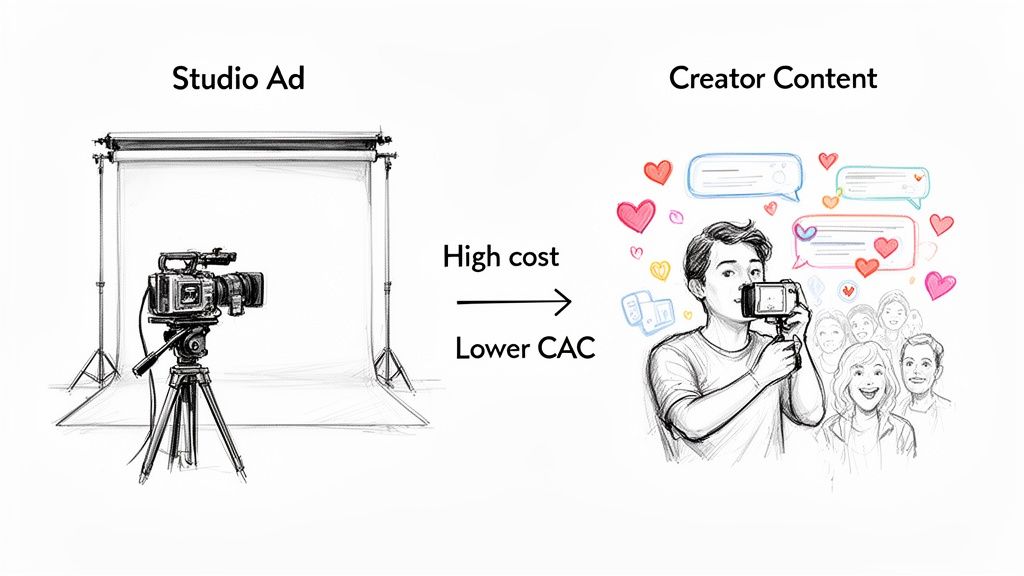
Let's be blunt: the old playbook for creating ads is broken. For years, the go-to strategy for ecommerce brands was the polished, high-production studio shoot. These ads certainly looked professional, but they often felt cold and distant, completely failing to land with people scrolling through personal, intimate feeds on Facebook and Instagram. Today, that model isn't just inefficient—it’s a dead weight on growth.
Modern customers are incredibly sharp. They can spot a corporate ad a mile off and have grown completely weary of its predictable, salesy formula. This "ad fatigue" leads directly to lower click-through rates, soaring costs, and rapidly diminishing returns. Brands find themselves stuck on an expensive treadmill, constantly churning out new creative only to watch it burn out in a matter of weeks.
This is precisely why the top UK ecommerce brands are making a decisive change. They're ditching the sterile brand ads and going all-in on creator-led content.
The Power of Authentic Connection
Creator content cuts through the noise because it solves the biggest hurdle in advertising: trust. When a potential customer sees a real person—someone they relate to—unboxing, using, and genuinely enjoying a product, it doesn't feel like an ad. It feels like a recommendation from a friend. That’s a level of authenticity a studio shoot can never hope to replicate.
And this isn't just a feeling; it's backed by hard data.
Creator Content vs Traditional Brand Ads on Meta
We've seen first-hand how creator-led ads consistently outperform their traditional counterparts on Meta's platforms. The difference isn't subtle—it's a game-changer for campaign performance and budget efficiency.
Metric | Creator Content Ads | Traditional Brand Ads |
|---|---|---|
Click-Through Rate (CTR) | 70% higher on average | Baseline performance |
Cost Per Click (CPC) | 40-60% lower | Significantly higher |
Conversion Rate | Often 2x-3x higher | Lower, requires more spend |
Ad Fatigue | Slower onset; content feels native | Sets in quickly (1-2 weeks) |
Production Cost & Time | Low cost, fast turnaround | High cost, slow and complex |
This data paints a clear picture. For UK ecommerce brands, creator content isn't just an alternative; it’s a strategically superior approach that delivers better results across the board, from initial engagement right through to the final sale.
Key Takeaway: Creator content isn't about making your ads look "real." It's a strategic play to borrow the trust and credibility that creators have already built with their followers. This makes your advertising more believable and effective from the very first impression.
This approach transforms the entire ad experience. Instead of interrupting someone's feed, you're adding to it with content that entertains, educates, and feels like it belongs there. To really nail this, you need a solid grasp of social media marketing for ecommerce brands as a whole.
From Unpredictable Chore to Systematic Growth
Now, I know what you might be thinking. The process sounds like a logistical nightmare. Manually finding creators, negotiating deals, chasing them for the content, and then trying to track results in a messy spreadsheet… it’s chaotic, eats up time, and is nearly impossible to scale effectively.
But here’s the good news: that's the old way of doing things. Modern platforms have transformed this messy, unpredictable chore into a systematic growth engine. By blending smart technology with organised workflows, brands can now:
Source the right creators, fast: Pinpoint verified nano and micro-creators who are a perfect fit for your brand’s niche and location.
Automate the grunt work: Set up campaigns with pre-built outreach scripts, unique tracking links, and crystal-clear deliverables to cut out the endless back-and-forth.
Measure what actually matters: Move beyond vanity metrics and directly attribute sales to specific creators and their content.
This systematic approach is what truly unlocks the ability to scale your ad creative. Instead of relying on a handful of expensive, slow-to-produce brand ads, you can generate a steady, diverse stream of high-performing creator content. This means you can test more, learn faster, and ultimately drive down your customer acquisition costs for good. This guide is your playbook to make it happen.
How to Build Your Creator Sourcing Engine
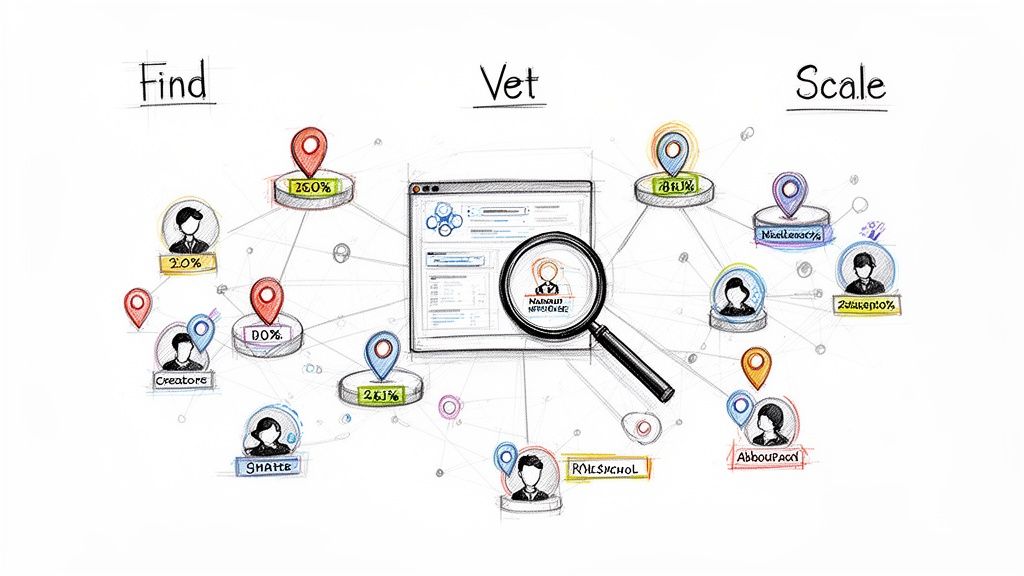
If you want to use creator content effectively in your Meta ads, you need a system. Finding the right creators can't be a random, manual task you do once in a while. You need to build a scalable sourcing engine—a reliable process for finding and vetting partners who produce content that actually converts.
This isn’t about just finding a handful of influencers. It’s about creating a constant flow of ad-ready creative that you can plug directly into your campaigns.
The biggest mistake I see brands make is getting star-struck by follower counts. Sure, a mega-influencer with a million followers looks great on paper, but their audience is often so broad that your message gets lost. This leads to weak engagement and watered-down results.
The real gold is with nano and micro-creators, those with audiences between 1,000 to 50,000 followers. Their communities are smaller, more engaged, and built on genuine trust. That's why their content is so powerful for targeted Meta ads. These creators are truly passionate about their niche, and it shines through in content that feels authentic and hits home with their followers. For e-commerce brands, this is the sweet spot.
Moving Beyond Manual Searches
We’ve all been there: endlessly scrolling through Instagram hashtags and sending cold DMs that get ignored. It's frustrating, time-consuming, and simply doesn't scale. To do this properly, you have to leave the manual grind behind.
Modern creator sourcing platforms have completely changed the game. Think of them as a search engine for creators, letting you zero in on the perfect partners using criteria that actually impact performance.
Niche and Content Style: You can find creators who already love products like yours and whose visual style is a natural fit for your brand.
Audience Demographics: Need to reach women aged 25-34 in Manchester? You can filter a creator’s followers by location, age, and interests to make sure you’re hitting your target customer.
Engagement Metrics: Forget vanity metrics like likes. These tools let you analyse a creator's real engagement rate, which is a much better predictor of their influence.
This data-first approach takes the guesswork out of the equation. It allows you to quickly build a solid shortlist of high-potential creators who are a perfect match for your campaigns. For a deeper look at building these relationships, our full guide on influencer marketing for ecommerce is a great resource.
Vetting Creators for Ad Performance
Once you've got a shortlist, it's time to vet them. This is where you separate the good from the great. I’ll say it again: follower count is the least important metric. You need to look at their profile with the eyes of a performance marketer.
A creator's feed is their portfolio. Look for consistency in their content style, the quality of their captions, and how they interact with their followers in the comments. A creator who actively responds to questions and fosters a community is a much more valuable partner.
When you're reviewing a creator, ask yourself a few critical questions:
Is the engagement real? Dive into the comments. Are they just generic "nice pic!" comments, or are people having actual conversations? High-quality engagement signals a strong, trusting community.
Does their aesthetic align with your brand? You're looking for content that will look and feel right when you turn it into an ad. If their style is worlds away from yours, the partnership will feel jarring and inauthentic.
Have they worked with brands before? Seeing previous partnerships, especially with brands in your space, is a good sign. It shows they know the ropes and can create sponsored content that doesn't scream "ADVERTISEMENT!"
Building this sourcing engine turns your creator programme from a string of one-off projects into a predictable, scalable system. You'll end up with a go-to roster of trusted creators, ensuring you always have a fresh supply of authentic, high-performing content ready to fuel your Meta ad campaigns and drive real growth.
Designing Campaigns That Actually Convert
So, you’ve lined up some fantastic creators. That’s a brilliant start, but finding the talent is only half the battle. The real work begins now: turning that creative potential into campaigns that don't just look good, but actually make the till ring.
This is where strategy takes over. Before you even think about launching an ad, you need a solid foundation. I’m talking about crystal-clear briefs, efficient outreach, and—most importantly—tracking that leaves no room for guesswork. Without these in place, you’re just throwing money at content and hoping for the best. Let’s get it right from day one.
Building a Foundation with Clear Briefs
I’ve seen it a thousand times: a brand gets back a piece of content that's completely unusable, and it almost always comes down to a poor brief. If you ask for a "video with our new moisturiser," you'll get exactly that—a generic video that does nothing for your brand.
You have to be specific, but not so rigid that you kill the creator's authenticity. Think of your brief as guardrails, not a script. It should be a simple, scannable document that covers the absolute must-haves.
Here's what a solid brief needs:
The Big Idea: What's the one thing you need the audience to remember? Is it a unique product benefit, a limited-time offer, or how easy the product is to use? Nail this down first.
Key Talking Points: Give them 2-3 non-negotiable points. This could be anything from "sustainably sourced ingredients" to "free UK delivery." Don't overload them.
The Call to Action (CTA): Tell them exactly what you want viewers to do. Should they "Shop Now," "Learn More," or use a specific discount code like "CREATOR15"? Be explicit.
Mandatory Do's and Don'ts: This is your brand safety net. Include essentials like "must show the product unboxing" or "do not mention competitor brands."
A great brief respects the creator's voice while ensuring the final cut is perfectly aligned with your commercial goals and ready to run on Meta.
Automating Outreach and Tracking Setup
Once your brief is solid, it's time to get it into the hands of creators. Forget about sliding into DMs or wrestling with messy spreadsheets. It's slow, unprofessional, and a nightmare to track. This is where you bring in automation to handle the heavy lifting.
Modern platforms let you build a campaign once and push it out to dozens of creators at the same time. These tools handle the personalised outreach messages and, critically, generate unique tracking assets for every single creator you work with.
My Golden Rule: Never, ever use a generic link or discount code. Every creator gets their own unique UTM link and a unique promo code. It’s the only way to know for sure who’s driving sales and who isn’t.
This level of detail is absolutely essential. When a sale appears in your Shopify dashboard, you need to know precisely which creator's link was clicked or which code was redeemed. This data is what turns a one-off campaign into a scalable strategy, showing you exactly where to reinvest for the best returns. Honing this process is a huge part of Mastering Facebook Ad Management.
Projecting ROI Before You Launch
Here’s where it gets really powerful. With a proper automated system, you can start forecasting your return on investment before you’ve spent a single pound. By plugging in your campaign goals and average order value, the platform can estimate the sales and revenue you’re likely to generate from your chosen creators.
This moves creator marketing out of the 'hope and pray' column and into a predictable, data-driven growth channel.
And you need that predictability, because when this works, it works fast. A staggering 71% of UK consumers have made a purchase within a few days of seeing creator content on Meta's apps. For brands targeting a younger audience, that figure jumps even higher, with 78% of 18-34-year-olds showing similar buying behaviour. You can discover more insights about creator-driven holiday conversions on Digiday.
By pairing clear briefs with smart automation and obsessive tracking, you’re not just running a campaign; you’re building a conversion machine. This organised approach cuts through the chaos and gives you the clear performance data you need to turn great creator content into your most effective Meta ads.
Right, you’ve got a folder full of amazing content from creators. That’s a brilliant starting point, but it's just that—a start. The raw, organic-style videos and images are the ingredients, not the finished meal.
The real magic happens when you take that authentic content and strategically rework it for the paid world of Meta ads. This is where we blend the creator's genuine voice with hard-nosed, direct-response marketing principles to actually drive sales. We’re not just talking about hitting the “Boost Post” button here. This is about re-engineering each asset to make it work as hard as possible for your ad budget.
From One Post to a Full Ad Arsenal
Think of a single 30-second creator video as a goldmine. With a bit of smart editing, you can spin that one piece of content into a whole suite of different ad formats, each designed for a specific purpose. This lets you test what resonates with your audience without having to constantly source new material.
Let’s walk through a real-world example. Say a creator sends you a fantastic video of them unboxing and trying your new skincare serum for the first time. Here’s how you can slice and dice it.
Creative Ad Formats from a Single Creator Post
This table shows how a single piece of creator content can be repurposed into multiple ad formats, giving you more assets to test across various Meta placements and maximising its value.
Original Content | Ad Format 1 (Reel/Story) | Ad Format 2 (Feed Video) | Ad Format 3 (Static Image) |
|---|---|---|---|
A 30-second video showing a creator unboxing a product and sharing their first impressions. | Create a fast-paced, 15-second cut. Open with the creator's "wow" reaction as the hook. Add bold text overlays highlighting the main benefit (e.g., "Instant Glow!"). End with a clear "Shop Now" CTA. | Use the full 30-second clip but re-crop it to a 4:5 ratio for the feed. Add burned-in captions throughout. Place a branded overlay with the product name and a discount code at the bottom. | Pull a high-resolution still frame from the video where the creator is smiling and holding the product. Add a text overlay with a direct quote like, "My skin has never felt so soft!" along with your offer. |
By following this approach, you give Meta's algorithm multiple creative angles to work with, which dramatically increases your chances of finding a winning ad that really scales.
This entire workflow—from briefing the creator to getting the final ads live—is a repeatable process.
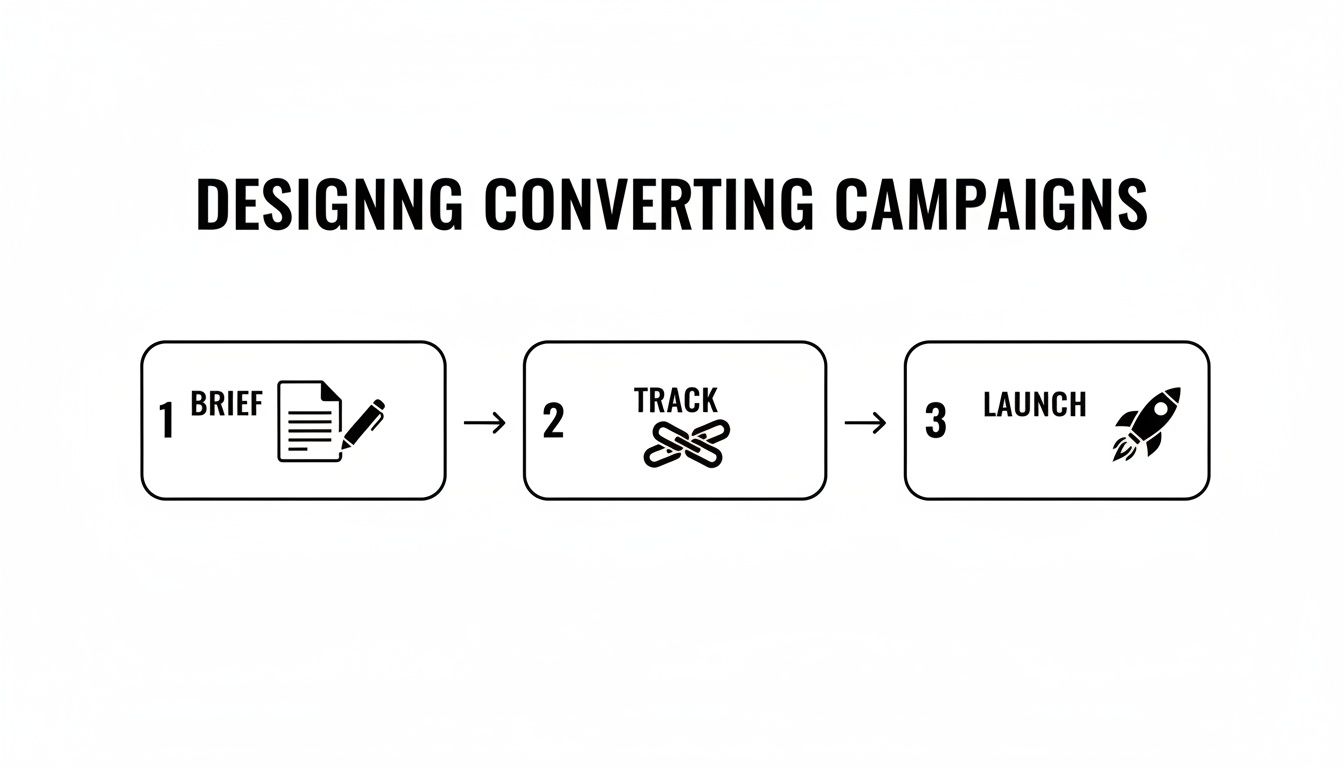
When you have a streamlined system like this, you ensure every piece of content is briefed properly, tracked accurately, and launched efficiently for the best possible performance.
Editing for the Ad Environment
Content that works organically doesn't always work in a paid ad. An ad needs to be far more direct. It has to stop someone mid-scroll, get a message across, and push for an action—all in a matter of seconds.
The most successful creator ads I see don't actually feel like ads. They keep the creator’s authentic vibe but are clearly edited with a performance marketer’s eye—adding hooks, punchy captions, and strong calls-to-action that guide the viewer.
To get your organic content ready for the ad auction, here’s what you need to focus on:
Nail the Hook: The first 1–3 seconds are everything. Don't build up to the good part; start with it. Open with the most visually interesting clip, a surprising result, or the creator asking a direct question to the viewer.
Add Dynamic Captions: Most people watch videos on their phones with the sound off, so burned-in captions are non-negotiable. Use a bold, clear font and make them pop on screen to keep eyes locked on your video.
Drive the Action: Don't assume people know what to do next. You have to tell them. A clear call-to-action like "Tap to Shop," "Swipe Up for 15% Off," or "Use My Code at Checkout" should be impossible to miss.
These aren't just minor tweaks; they can be the difference between an ad that gets ignored and one that drives serious revenue. Knowing how to get great creator content for your ecommerce brand is step one, but knowing how to optimise it for ads is where you’ll really see the ROI.
Putting Your Money Where It Works
Once your creator content is edited and optimised, it’s time to amplify it. Meta provides a couple of incredibly powerful tools that are practically built for this. The two you need to know are Partnership Ads and Advantage+ Shopping Campaigns.
Partnership Ads (what we used to call branded content ads) let you run the ad from the creator’s own Instagram or Facebook handle. This is a game-changer. When someone sees an ad from a creator they follow and trust, it feels more like a genuine recommendation than a corporate promotion. We consistently see lower CPAs and higher engagement with this tactic.
Then you have Advantage+ Shopping Campaigns (ASC). This is where you let Meta's AI do the heavy lifting. You feed your best-performing creator ads into an ASC campaign, and its machine learning goes to work finding the most likely buyers across Facebook and Instagram.
The winning formula for many top brands in 2026 is combining the authenticity of creator ads with the raw power of Meta's AI. A well-organised content library is your best friend here, as it lets you quickly find your proven winners and feed them into your campaigns to scale profitably.
Measuring ROI and Scaling Your Creator Ad Strategy
Let’s be honest. Likes and comments are great for the ego, but they don't keep the lights on. When you're running creator content as Meta ads, the only thing that truly matters is the impact on your bottom line. We have to look past the vanity metrics and get laser-focused on what drives clicks, conversions, and most importantly, revenue.
This is exactly where I see so many brands stumble. They get their hands on brilliant creator content, push it live as an ad, and then completely lose track of what happens next. Sure, they might notice a general lift in sales, but they have no way of knowing which creator or which video actually moved the needle. Trying to scale your efforts without that clarity is just throwing money at a wall and hoping some of it sticks.
The fix is to build a system that ties every single piece of creator content directly to performance data. This is how you stop treating your creator programme as a cost centre and start seeing it as the predictable, high-growth revenue channel it can be.
Creating a Single Source of Truth for Attribution
To get a real grip on your ROI, you absolutely need a central dashboard. Think of it as your mission control, pulling all your performance data into one place so you can see, at a glance, how each creator’s ad is performing.
The non-negotiables here are the unique tracking assets we talked about earlier:
Unique UTM Links: These are your click-trackers. They follow every tap on a creator's ad, showing you precisely how much traffic each person is driving to your site.
Unique Promo Codes: This is your direct line to revenue attribution. When a customer checks out using a creator’s specific code, you can attribute that sale back to them with 100% certainty.
When you bring this data together, the story becomes crystal clear. You can finally see which creators are driving the most traffic, who’s generating the most code redemptions, and ultimately, which partnerships deliver the best Return on Ad Spend (ROAS).
A quick tip from experience: Don't just obsess over who brings in the most sales. You need to analyse the Average Order Value (AOV) attached to each creator's code. A creator who drives slightly fewer sales but at a much higher AOV could easily be the more valuable partner for your business long-term.
Having this data at your fingertips is a true game-changer. We've seen UK ecommerce brands that adopt this data-first approach to creator ads on Meta slash their cost per acquisition (CPA) by a remarkable 19%. It’s a vital tactic for any performance marketer who needs to deliver measurable results. You can read more about Meta's AI-powered creator partnerships on Marketing Dive.
Building Your Data-Driven Feedback Loop
Once you have clean, real-time data flowing into your dashboard, you can build a powerful feedback loop. This isn’t a one-off report you check at the end of the month; it's a continuous cycle of learning and reinvesting that fuels sustainable growth.
It really boils down to three simple, repeated actions.
First, spot your winners. Dive into your dashboard and pinpoint your top-performing creators and content. Who consistently delivers a low CPA and a high ROAS? Which video hooks or ad formats are getting all the clicks?
Next, double down on what works. This is where you get aggressive. Take the budget from your underperforming ads and funnel it directly to your proven winners. If a specific creator’s video is absolutely crushing it, give them a bigger budget or spin up a new campaign around it.
Finally, you can scale with confidence. Armed with hard performance data, you can scale your entire programme. This means finding and recruiting more creators who have a similar style and audience to your top performers. You’re no longer guessing; you're just replicating proven success.
This feedback loop transforms your ad spend from a blind expense into a smart investment. For a more advanced look at this, our guide on how to measure influencer marketing ROI goes into even greater detail.
By consistently analysing performance, reallocating your budget, and scaling up what’s already working, you create a self-improving system. This is how the most successful ecommerce brands use creator content for Meta ads—not as a one-off tactic, but as a core pillar of their growth strategy. It’s a methodical, data-backed approach that delivers reliable results, time and time again.
Common Questions About Creator Content on Meta Ads
Even the most seasoned marketing teams run into a few common hurdles when they first start weaving creator content into their Meta ad strategy. It's completely normal. Let's walk through the questions we hear time and time again from brands just like yours.
Getting these details right from the start is what separates a chaotic, legally-risky approach from a smooth and scalable creator programme.
How Much Should I Pay Creators for Their Content?
This is always the million-dollar question, and honestly, there's no single price tag. For creators just starting out (nano and micro-creators), trading your product for a post or video can be a fantastic way to begin a relationship. But the moment you want to put ad spend behind that content, you need to be prepared to pay.
A model we’ve seen work incredibly well is a hybrid approach. Start with a fair base fee that covers the creator's time and effort for producing the content itself. Then, build in a performance-based kicker. This could be a cash bonus for every 10 sales tracked through their unique promo code, or a small percentage of the revenue they generate.
This structure is a win-win. It aligns your goals perfectly and motivates creators to think like performance marketers, producing content that doesn't just look good but actually converts. The key is to have this conversation and get it in writing before a single photo is taken.
What Kind of Usage Rights Do I Need for Ads?
This is one area you absolutely cannot afford to get wrong. You must have explicit, written permission for ‘paid media’ or ‘advertising’ usage rights. A verbal "sure, go for it" in a DM just won't cut it and could land you in serious legal trouble down the line.
Your creator agreement is your safety net. It needs to clearly state which platforms you can use the content on (e.g., Meta), for how long (e.g., 6-12 months is standard), and for what purpose (e.g., paid social ads, email marketing). This protects everyone involved.
Crucially, make sure the contract also grants you the right to edit and repurpose their work. You'll need this to add your own text overlays, create different versions for Reels and Stories, and generally optimise the asset for your campaigns. Using a platform that handles automated creator agreements is the smartest way to standardise this process and avoid any misunderstandings.
How Do I Test Which Creator Content Performs Best?
The only way to find out what really resonates with your audience is to test. Systematically. Forget randomly boosting posts and hoping for the best. You need a proper testing framework inside Meta Ads Manager, pitting multiple creator assets against each other with the same audience and budget to see which one comes out on top.
To get clean, reliable data, always isolate one variable at a time. Here are a few head-to-head battles we run all the time:
Hook vs. Hook: Take the same video but test two completely different opening three seconds. Does a question or a bold claim stop the scroll more effectively?
Creator vs. Creator: Run content from two different creators to see whose style and delivery your target audience connects with most.
Format vs. Format: Compare a polished video Reel against a raw, behind-the-scenes static image from the same creator. Sometimes, the less "produced" asset wins.
Get into the habit of using a clear naming convention for your campaigns (e.g., ‘CreatorA_Hook1_LookalikeAudience’). This makes it so much easier to glance at your dashboard and see what's working. Keep a close eye on your north-star metric—whether that’s Cost Per Acquisition (CPA) or Return on Ad Spend (ROAS)—and confidently put more budget behind what the data proves is a winner.
Ready to stop guessing and start scaling your creator collaborations? Sup combines smart AI with a dedicated team to help you launch and measure creator campaigns that drive real revenue. Find your next top-performing creators in minutes. See how it works at Sup.co.

Matt Greenwell
Share