How Influencer Marketing Impacts Restaurant SEO and Local Search: How Influencer

Matt Greenwell
Apr 5, 2026
Think of influencer marketing as the ultimate word-of-mouth, but supercharged for the digital age. It’s not just about getting a nice mention on Instagram; it’s about creating genuine social proof and online chatter that Google’s local search algorithm is designed to pick up on. This digital praise from trusted creators directly fuels branded searches, boosts engagement with your Google Business Profile, builds valuable backlinks, and, best of all, encourages a steady stream of authentic customer reviews.
How Influencers Directly Boost Your Restaurant SEO
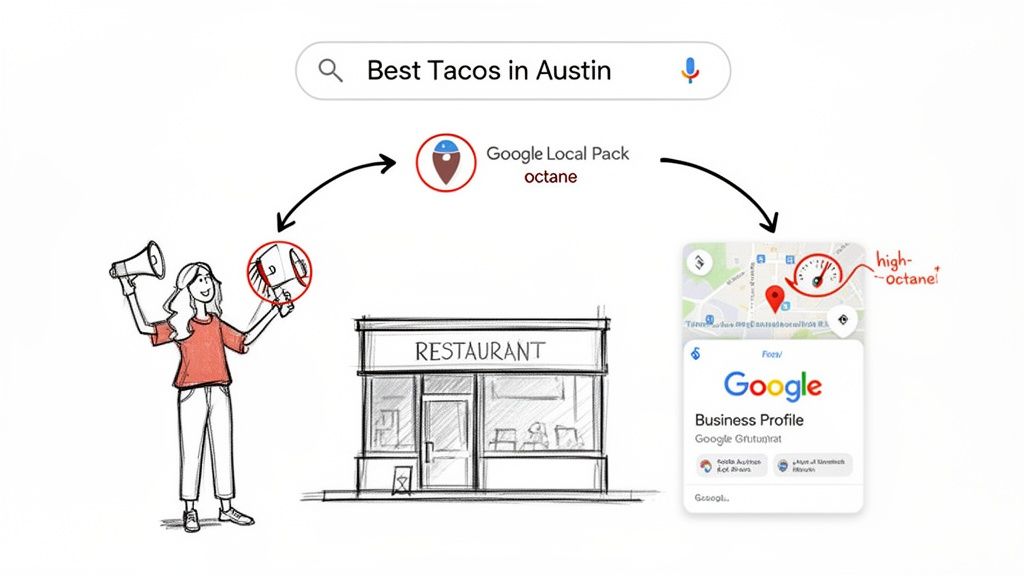
Let's break down how this actually works. Imagine your restaurant's local SEO is an engine. Your website, menu, and Google Business Profile are all crucial parts. But authentic influencer content? That’s the high-octane fuel that makes the whole thing roar, powering you right to the top of the search results and into that all-important Google 'Local Pack'.
When a local food blogger you've partnered with raves about your signature dish, it does more than just make their followers hungry. It kicks off a chain reaction of digital signals that Google absolutely loves. These signals tell the search engine that your restaurant isn't just relevant for "tacos in Liverpool"—it's a popular, credible, and talked-about spot.
The Direct Line From Content to Rankings
This isn't some vague, abstract theory. The connection between a great influencer post and your ranking is a clear cause-and-effect relationship. A creator’s post on Instagram or TikTok isn't just a fleeting social media moment; it's a strategic move that delivers tangible SEO results.
For instance, an influencer shares a video of your weekend brunch special. Their followers don't just 'like' it and move on. A significant number will immediately open Google and perform a branded search, typing in something like "The Corner Bistro Manchester". This sudden spike in searches for your specific name is a massive signal of popularity to Google.
Key Insight: Google’s algorithm sees a sharp rise in branded searches as a powerful vote of confidence. It’s a strong sign of real-world authority, and influencers are one of the most reliable ways to trigger this kind of high-intent search behaviour.
That initial search is just the first domino to fall. The user's journey, sparked by that single post, continues to send positive signals to Google:
They click on your Google Business Profile right there in the search results.
They browse your photos, check opening times, and look over your menu.
They might even tap the "Directions" button—a gold-standard engagement signal for local SEO.
Every one of these actions tells Google that your restaurant is a prominent local destination, directly improving your odds of appearing in the coveted Local 3-Pack.
Mapping Influencer Actions to Direct SEO Outcomes
To make this even clearer, the table below breaks down exactly how specific influencer activities translate into the direct SEO signals that matter most for a restaurant.
Influencer Action | Resulting User Behaviour | Direct SEO Signal |
|---|---|---|
Shares an Instagram Reel of your signature pasta dish | Followers search for '[Your Restaurant Name]' or 'best pasta in [Your City]' | Increases branded search volume and keyword relevance, signalling popularity to Google |
Adds a direct link to your booking page in their bio or story | Users click through to view your hours, menu, or reserve a table | Boosts click-through rate (CTR) and engagement signals on your Google Business Profile |
Writes a detailed review on their personal food blog | The blogger links from their article to your restaurant's website | Creates a high-quality, contextually relevant backlink that increases your site's authority |
Runs a giveaway asking followers to comment who they'd bring | Generates a surge in comments, shares, and profile tags | Creates powerful social signals that correlate with brand visibility and search interest |
As you can see, these aren't just vanity metrics. Each action creates a measurable ripple effect that strengthens your online presence where it counts—in front of hungry customers actively searching for a place to eat.
How Influencers Actually Boost Your Restaurant’s SEO
When an influencer posts a drool-worthy photo of your signature burger, it does more than just make their followers hungry. Behind every like, share, and comment, a good influencer campaign is sending out powerful ripples that search engines like Google pick up on. These are the very signals that help decide who shows up first when someone searches for a place to eat.
So, let's pull back the curtain and see what’s really happening. Think of it like this: every positive action an influencer sparks—a search for your name, a click for directions, a new review—is like a vote of confidence for your restaurant. Google's algorithm is designed to count these votes, and the more you get, the higher you’ll rank.
These aren't just vague ideas; they're concrete, measurable signals. Here are the five most important ways influencers give your restaurant a direct leg-up in search results.
1. The Surge in “Your Brand Name” Searches
The first thing you’ll notice is a spike in people searching directly for your restaurant's name. When a local food blogger with 10,000 followers raves about your "unforgettable Sunday roast," a good chunk of their audience won't just 'like' the post. They'll open up Google and type in "The King's Head pub London" or whatever your name is.
This sudden increase in branded search is a huge green flag for Google. It shows that your restaurant is creating real-world buzz and becoming a known entity. This tells the algorithm you’re not just another listing; you're a destination people are actively seeking out.
Think of it as a credibility loop. The influencer creates the initial buzz, which drives searches for your name. Google sees these searches, marks you as a popular and relevant local business, and is then more likely to show you for broader searches like "Sunday roast near me."
2. Supercharging Your Google Business Profile
Next up is your Google Business Profile (GBP). This is basically your digital shopfront, and influencers are brilliant at getting people to knock on the door. By tagging your location in their posts or stories, they make it incredibly easy for followers to interact directly with your profile.
Suddenly, you’ll see a jump in high-value actions from potential customers:
Clicks for Directions: This is a top-tier signal telling Google someone is planning an actual visit.
Menu Views: Shows genuine interest in what you offer and a strong intent to buy.
Photo Browsing: The more time people spend looking at your photos, the more engaging Google sees your profile as.
Click-to-Call: A direct, qualified lead right from the search results.
Every single one of these clicks strengthens your profile’s authority, massively improving your odds of appearing in the all-important Local Pack when people search for things like "best brunch near me."
3. Earning Powerful Backlinks and Mentions
While Instagram and TikTok are great for visuals, influencers who also run their own food blogs offer a special kind of SEO magic: authoritative backlinks.
When a well-regarded blogger writes a piece about your restaurant and links to your website from their article, they're giving you a powerful digital thumbs-up. This isn't just any link; it's a recommendation from a source that Google already sees as a trusted voice on the topic of food.
This "link equity" flows from their site to yours, signalling to Google that your website is also a credible and valuable resource. Over time, these quality backlinks are one of the most effective ways to improve your site's overall ranking power.
4. Spurring on New Customer Reviews
Reviews are the lifeblood of local SEO. Influencers are fantastic at increasing both the number of reviews you get (volume) and how frequently you get them (velocity).
They do this cleverly, without explicitly asking for a five-star rating (which is often against platform rules). Instead, they prompt their audience organically. A post might end with a simple question like, "If you try their pizza, let me know what you think!"
This gentle nudge is often all it takes to inspire their followers—who are now your new customers—to head to Google or TripAdvisor and share their own experience. A steady flow of fresh, positive reviews is one of the strongest signals you can send to climb the local search rankings. You can learn more about this strategy in our guide on how to use influencer marketing to get more Google reviews.
5. Driving Quality Traffic to Your Website
Finally, the traffic that influencers send to your website is the best kind of traffic: people who are already warmed up and genuinely interested in what you do. This leads to fantastic on-page behaviour signals.
Unlike random visitors, these users are more likely to:
Spend more time on the page
Click through to other pages like your menu or gallery
Have a lower bounce rate (meaning they don't leave immediately)
Google pays close attention to this. When it sees that people are arriving on your site and sticking around, it takes it as proof that your website offers a great user experience. This, in turn, is a key factor that helps boost your organic rankings for the long haul.
Building Your First Local Influencer SEO Campaign
Alright, let's move from theory to action. This is where you start seeing real, tangible growth. Kicking off an influencer campaign that actually moves the needle on local search isn't about crossing your fingers and hoping for the best—it requires a solid plan.
Think of it like you're creating a new signature dish. You wouldn't just chuck random ingredients in a pan. You’d follow a recipe, prep your station, and know exactly the flavour profile you're aiming for. We're going to apply that same level of precision to your first campaign.
1. Set SEO-Driven Goals
First things first: what does success actually look like? We need to think beyond vanity metrics like 'likes' and 'views'. For a campaign with a sharp SEO focus, your goals have to be specific, measurable, and tied directly to how you show up in local search results. You're not just buying a bit of buzz; you're investing in long-term digital assets.
Instead of a vague goal like "get more exposure," let's set some concrete targets.
Boost Google Reviews: Aim to generate 10-15 new, authentic Google reviews within a month of the campaign going live.
Increase GBP Engagement: Target a 20% jump in people clicking for directions or calling you from your Google Business Profile.
Climb the Local Pack: Set a goal to move from position #5 to a top-three spot for a crucial search term, like "best brunch in Bristol."
Drive Branded Search: Look for a 15% lift in searches for your restaurant's name, which you can track in Google Search Console.
These kinds of goals give your campaign a clear purpose. More importantly, they make it easy to see whether you got a real return on your investment.
2. Find High-Impact Local Creators
The right influencer isn't always the one with the biggest follower count. Not even close. For restaurant SEO, your most valuable partners are almost always nano-influencers (1,000-10,000 followers) and micro-influencers (10,000-50,000 followers). Why? Because their audience is packed with people who actually live in your area. They're your potential customers.
A national food blogger with 500,000 followers means very little if your restaurant is in Manchester. A local creator with just 8,000 Manchester-based followers is infinitely more valuable. Their recommendation carries genuine weight because it’s relevant and, crucially, actionable for the people seeing it. For a deeper dive, check out our guide on how to find local food influencers in your city.
3. Craft the Perfect Campaign Brief
Your campaign brief is your recipe for success. This is where you translate those SEO goals you set into crystal-clear instructions for the influencer. Never assume they'll know what to do to help your SEO; you need to guide them.
This diagram shows just how an influencer's content can send all the right signals to Google—spurring searches, earning authority, and building trust.
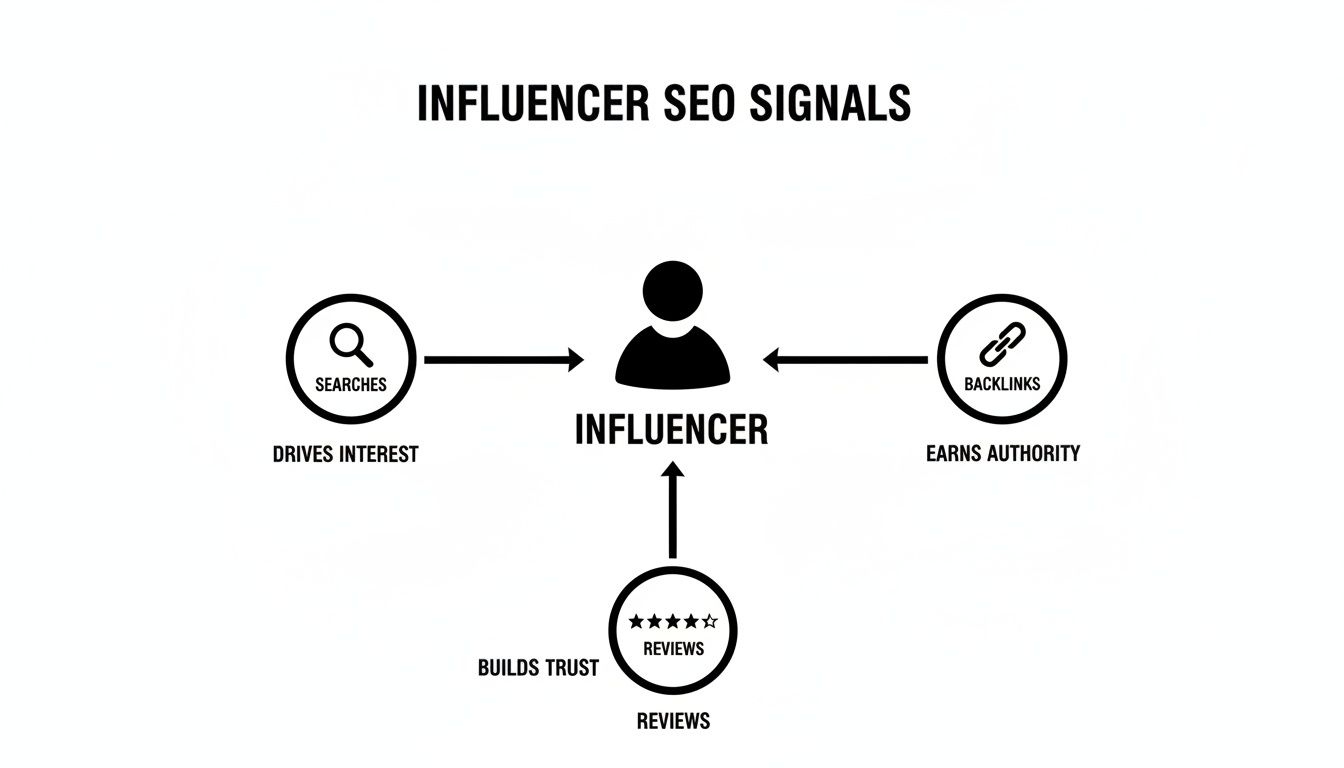
A single creator can trigger multiple positive signals that search engines use to decide where you rank.
Your brief has to be explicit. Ask the creator to:
Tag Your Official Location: They must use the correct location tag for your restaurant on platforms like Instagram. This directly connects their post to your address on the map.
Use Keyword-Rich Phrases: Ask them to naturally work in terms like "best pizza in Soho" or "cosy cafe near me" into their captions, video text, or voiceovers.
Link to Your GBP or Website: Whether it’s in their bio link or a story swipe-up, request a direct link. This could go to your Google Business Profile, your online menu, or your reservations page.
Prompt Reviews Organically: Ask them to end their post with a natural call-to-action. Something simple like, "If you check it out, let me know what you think!" works wonders for encouraging their followers to leave their own reviews later.
When you're trying to understand the impact, it's really insightful to see how social media reviews and mentions translate into real-world calls, bookings, and overall growth.
4. Structure a Fair Collaboration
Finally, make sure the agreement you put in place is clear, professional, and fair for everyone involved. For many nano and micro-influencers, a complimentary meal for two is a perfectly standard and accepted way to collaborate, especially for a single post or a few stories.
Best Practice: Always, always formalise the agreement in writing, even if it's just a gifted experience. A simple email that outlines the deliverables (e.g., one Instagram Reel, three stories), the timeline, and the specific SEO asks (location tag, keywords, etc.) prevents any misunderstandings. It ensures you get the SEO value you're paying for.
For larger campaigns or creators with a more established following, a flat fee might be necessary. Whatever the compensation, clarity is what matters most. Follow these four steps, and you'll launch a campaign that doesn't just produce beautiful content, but also builds a much stronger foundation for your restaurant's future in local search.
How to Actually Measure the Impact of Your Campaigns
All that beautiful content from an influencer is great for creating a buzz, but let's be honest: likes and shares don't pay your staff or your suppliers. The real question is, how do you know if it's actually putting more bums on seats or driving takeaway orders?
This is where good old-fashioned attribution comes in. We need to connect the dots between an influencer’s activity and real-world results. The goal is to move past fuzzy "engagement" metrics and build a clear picture that proves your return on investment.
Use UTM Tags to Follow the Clicks
One of the simplest and most effective tools for this is the UTM parameter. Think of it as a small, digital "nametag" you add to any link you give an influencer. It doesn't change the destination of the link, but it tells your website analytics exactly who sent the traffic.
For instance, when you give a food blogger a link to your online booking page, you can add tags that identify them, the campaign, and the specific post. The link looks a little longer, but it’s packed with data. When someone clicks it, Google Analytics instantly knows that visit came from that creator’s campaign.
This simple step lets you see:
How many website sessions each influencer actually drove.
Which creators sent the most engaged visitors (people who spent time browsing your menu, for example).
How many online bookings or orders came directly from a specific post.
You can create these links for free with Google’s Campaign URL Builder. It’s a straightforward way to turn vague website traffic into a traceable path from a creator's post right to a confirmed booking.
Track Real-World Sales with Unique Discount Codes
For tracking in-person visits and takeaway orders, nothing works better than a unique discount code. By giving each influencer their own code—like "CHLOE10" for one and "MANCFOODIE10" for another—you get a direct line of sight into the sales they generate.
When a customer uses a code, your point-of-sale (POS) system logs it. At the end of the campaign, you just run a report. It’s that simple. You’ll see exactly how many times each code was redeemed, giving you a precise sales figure to tie back to each influencer.
These codes are the clearest way to measure offline conversions. They bridge the gap between someone seeing a post on their phone and actually walking through your door to spend money.
Keep an Eye on Your Google Business Profile
A good influencer campaign almost always creates a ripple effect on your online presence, especially on your Google Business Profile (GBP). Your GBP Insights dashboard is a goldmine of data showing how people’s behaviour changes right after an influencer's post goes live.
In the days following a campaign launch, look for sudden jumps in these key metrics:
Direction Requests: A spike here is a massive buying signal. It means people aren't just looking; they're actively planning a visit.
Website Clicks: This shows you’re successfully moving people from discovering you on Google to exploring your menu or opening hours.
Phone Calls: The most direct lead you can get, often linking an influencer’s post directly to a customer calling to book a table.
By comparing the dates of your influencer posts with your GBP data, you can clearly see the cause-and-effect relationship. This is fundamental to understanding how influencer marketing really impacts your restaurant's local search performance.
Finally, check your branded search volume in Google Search Console. A successful campaign means more people will start searching for your restaurant by name. This lift in brand awareness is a powerful, long-term asset that boosts your authority and search rankings over time.
Scaling Influencer SEO Across Multiple Locations
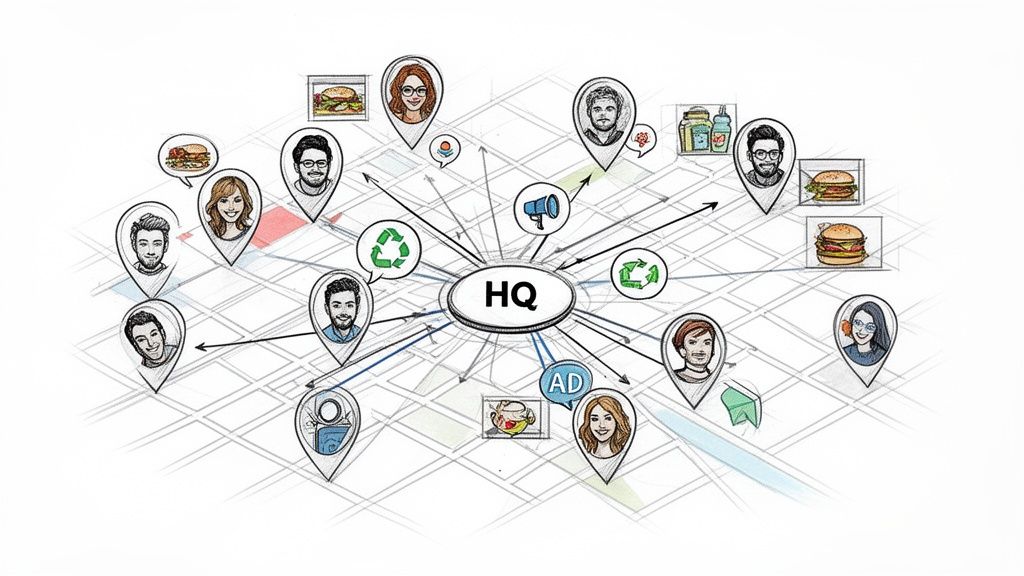
Running an influencer campaign for a single restaurant is straightforward enough. But what happens when you’re a franchise or restaurant group with dozens of locations? The game changes completely. A single, splashy national campaign might seem efficient, but it rarely moves the needle for individual branches. The secret is to think small to win big.
The most powerful approach is to build a network of hyper-local creators for each specific restaurant. You’re essentially creating a “digital street team” for every single location. This ensures recommendations come from a trusted local voice whose followers are genuine potential customers—people living just a few miles away, not distant fans who will never actually visit.
This intense local focus is what makes the strategy work. It generates the exact SEO signals Google loves, like branded searches for “[Your Brand] Bristol” or clicks for directions to your Manchester spot. You’re telling search engines, with pinpoint accuracy, which communities you serve, directly boosting the local search rankings for each individual restaurant.
Centralise the Strategy, Empower Local Execution
Juggling dozens of local campaigns can get chaotic fast without a solid system. The most efficient model involves a central playbook that local managers can then execute on the ground. This gives you brand consistency while leaving room for that crucial local flavour.
Your head office should create a master campaign brief that clearly outlines the SEO goals and the specific actions you need from influencers. This central document acts as a blueprint, and should include:
Core SEO Asks: Non-negotiable instructions for every creator, like tagging the correct location, linking to the specific Google Business Profile, and using key local phrases.
Content Pillars: Clear guidelines on what to feature. Is it the new seasonal menu? The Tuesday night special? Keep everyone on the same page.
Tracking Requirements: Mandate the use of unique UTM codes and promotional codes for each location’s campaign so you can actually measure what’s working.
With this template in hand, your corporate team can guarantee brand standards and proper SEO are being met. At the same time, local managers are empowered to find the right creators and build real relationships in their own neighbourhoods. It’s this blend of central control and local freedom that makes scaling possible. Our full guide on running influencer campaigns for multiple restaurant locations digs much deeper into this model.
Build a Content Engine from Local Campaigns
One of the best perks of a multi-location influencer strategy is the sheer volume of high-quality user-generated content (UGC) it produces. Every local campaign becomes its own mini content factory, pumping out authentic photos and videos that you can use across all your marketing.
By sourcing content from local creators in every market, you build a diverse and authentic library of assets. This content is not only more relatable to customers but also significantly more cost-effective than producing professional photoshoots for every single location.
This steady flow of UGC is an absolute goldmine. With a smart system, you can repurpose it to squeeze out every drop of value and amplify its SEO impact.
Corporate Social Media: Showcase the best content from different locations on your main brand accounts. It’s a great way to shout out the local branch and the creator who made the post.
Local Store Pages: Use those fantastic creator images on the specific location pages of your website and on their Google Business Profiles. This keeps things fresh, authentic, and engaging.
Paid Advertising: Found a video that’s getting tons of engagement? Turn that top-performing influencer content into a hyper-targeted social media ad aimed at audiences right around that specific restaurant.
This approach stops you from treating influencer posts as one-off marketing hits. Instead, it builds a powerful, scalable system that continuously drives foot traffic and strengthens the local SEO for every single restaurant in your group.
Of course. Here is the rewritten section, designed to sound natural, expert-driven, and engaging.
Common Pitfalls in Restaurant Influencer Marketing
We’ve all seen it happen. A restaurant launches an influencer campaign with a lot of fanfare, there’s a brief flurry of posts, and then… nothing. The budget is spent, but the needle hasn’t moved on bookings or search rankings. More often than not, it’s because they’ve stumbled into a few common, yet completely avoidable, traps.
Let's walk through the mistakes I see time and time again, so you can build a campaign that actually grows your business.
The most tempting mistake is getting star-struck by a massive follower count. It’s easy to think a creator with 100,000 followers is the golden ticket, but if their audience is scattered all over the country, you've just paid to promote your local eatery to people who will never visit.
The real gold is in relevance. A local nano-influencer with 5,000 followers who live, work, and dine in your city is a far smarter investment. Their audience genuinely trusts their recommendations on where to eat, meaning their posts don't just get likes—they get people through your door.
Neglecting Clear SEO Goals
This brings us to another classic trap: launching a campaign with a vague goal like "creating buzz". Buzz is nice, but it's fleeting. It doesn't pay the bills, and it certainly doesn't improve your Google ranking in the long run. If you're not thinking about SEO from the very beginning, you're missing the whole point.
Without specific SEO objectives, you might end up with a collection of pretty food photos but no actual assets. You miss out on the valuable backlinks, the keyword-rich captions, and the crucial location tags that tell Google your restaurant is a relevant and popular spot. Your campaign becomes a short-term expense, not a long-term investment in your digital presence.
Relying on Vibes Instead of Data
“I think it went well” isn’t a key performance indicator. Flying blind and judging a campaign on "vibes" or vanity metrics like likes is the fastest way to burn through your marketing budget with nothing to show for it. It's like a chef tasting a dish without knowing the recipe—you can't possibly replicate success.
You have to track everything, right from the start. This means using unique discount codes for each influencer, setting up UTM parameters on your links, and keeping a close eye on your Google Business Profile insights. This is the only way to connect the dots between an influencer’s post and a table booked, proving your campaign is actually delivering a return.
Don't just look at the surface. Data shows that micro-influencers can drive up to 60% more engagement than their macro counterparts. And with millennials being 2x more likely to order a dish after seeing it recommended, tracking that journey is crucial. You can explore more about influencer marketing's impact to dig into these trends.
The One-Off Campaign Mentality
Finally, too many restaurants treat influencer marketing like a firework: a single, spectacular burst that quickly fades. One campaign might give you a temporary lift, but sustainable SEO growth is a marathon, not a sprint. Google rewards consistency.
Instead of one-and-done collaborations, think about building genuine, long-term relationships with a small group of local creators. When you turn them into true brand advocates, you create a steady drumbeat of authentic content, positive reviews, and social proof. That consistent activity is what builds real authority and keeps you top-of-mind—and top of the search results.
Frequently Asked Questions
Getting to grips with how influencer marketing and SEO work together can feel like a lot. It's completely normal to have questions. Here, we've tackled some of the most common ones we hear from restaurant owners, giving you the straightforward answers you need to get started.
How Long Does It Take to See SEO Results?
You'll see some things happen almost immediately, like a jump in website visits and buzz on your social channels. Within a few weeks of a good campaign, you should also notice a definite lift in your Google Business Profile insights—more calls, more clicks for directions.
But the real prize, a meaningful shift in your organic search rankings for competitive phrases like "best pizza in London," takes a bit more patience. We typically see significant movement after three to six months of consistent effort. Think of influencer marketing as a powerful accelerant for your SEO, but remember, SEO itself is a marathon, not a sprint.
Are Many Small Local Influencers Better Than One Big One?
For restaurants, our experience shows the answer is almost always a firm 'yes'. A group of local micro-influencers will do far more for your SEO than a single, big-name macro-influencer with followers scattered across the country.
Why? It all comes down to relevance. Local creators' followers are concentrated right in your service area, which means their recommendations are more likely to turn into actual bums on seats.
This targeted activity sends incredibly strong local SEO signals to Google. Having ten local influencers each bring 50 people through your door is infinitely more valuable for your local ranking than one national influencer sending 500 people who will never visit.
Can I Just Ask Influencers to Post and Hope for the Best?
Hoping for the best is a surefire way to waste your budget. If you want to see a real, tangible impact on your restaurant's SEO, you have to be specific and direct in your campaign brief. Without clear instructions, you're leaving the most valuable ranking signals on the table.
Your brief absolutely must ask influencers to:
Tag Your Exact Location in every post and story. This is non-negotiable.
Link to Your Google Business Profile or your online booking page.
Use Key Phrases naturally in their captions, like "amazing brunch spot in Manchester."
Encourage Reviews by prompting their followers to share their own thoughts on Google if they visit.
How Much Should I Budget for an SEO-Focused Campaign?
This can vary wildly. Many local nano- and micro-influencers are genuinely happy to create content in exchange for a complimentary meal and a great experience. Once you start working with more established creators or planning multi-post campaigns, fees can range from £100 to well over £500.
The trick is to shift your focus from the upfront cost to the return on investment. When you use tracking tools like unique promo codes and UTM links, you can see exactly which campaigns are driving sales and bookings. This data is gold—it empowers you to set a budget that’s not just an expense, but a profitable and sustainable part of your growth.
Ready to turn your influencer collaborations into a measurable growth channel? Sup combines smart AI with a human touch to help you launch, manage, and track creator campaigns that deliver real results. Find local creators, attribute every conversion, and save up to 95% of your time. Get started with Sup today.
Matt Greenwell
Share