How Much Does Influencer Marketing Cost for Restaurants? Practical Guide

Matt Greenwell
Feb 21, 2026
So, how much should you actually budget for influencer marketing? The honest answer is that it varies wildly. Costs can range from a free meal for a local foodie with a small but mighty following to over £10,000 for a campaign with a big-name celebrity chef.
Think of it like planning a party. Your final bill depends entirely on the guest list, the venue, and the menu you choose.
Decoding Influencer Marketing Costs for Your Restaurant
Putting a single price tag on influencer marketing is impossible because it's not an off-the-shelf product. The cost is a spectrum, shaped by your campaign goals, the creators you choose to work with, and the specific content you need them to create. A small independent cafe will have a completely different budget and strategy than a national restaurant chain.
Your investment really comes down to what you want to achieve. Are you looking for a quick burst of local awareness to announce a new menu? Or are you aiming for a sustained campaign to drive table bookings over several months? Each goal requires a different level of effort and, naturally, a different price tag. Getting clear on this from the start helps you set a realistic budget that actually works for your business.
A Quick Look at Typical UK Influencer Rates
To give you a better idea of what to expect, let's break down the general costs. These are ballpark figures, of course—prices can shift based on things like location and deliverables, which we'll get into next. But they provide a solid starting point for your planning.
A quick word of advice: don't get too hung up on follower counts. For a restaurant, an influencer's engagement rate and how well they connect with your local community are often far more valuable.
The table below provides a snapshot of what you might expect to pay per Instagram post. These costs are just for the content itself and don't include things like platform fees or agency retainers.
Typical UK Restaurant Influencer Costs at a Glance
Influencer Tier | Follower Range | Estimated Cost per Post (Instagram) | Common Compensation Model |
|---|---|---|---|
Nano-Influencer | 1k–10k | £0–£150+ | Gifted Meals, Small Fee |
Micro-Influencer | 10k–50k | £150–£500+ | Fee + Gifted Experience |
Mid-Tier Influencer | 50k–500k | £500–£5,000+ | Fixed Fee |
Macro-Influencer | 500k–1M | £5,000–£10,000+ | Fixed Fee |
Mega/Celebrity | 1M+ | £10,000+ | Custom Package Fee |
If you're looking at scaling up your efforts, it's also worth checking out a platform's pricing page to see what management tools cost, as this will be part of your overall budget.
For most independent restaurants, the real magic happens with nano and micro-influencers. Their smaller, hyper-local audiences often drive more genuine footfall than a macro-influencer with a scattered, nationwide following. It's about quality, not just quantity.
Key Takeaway: For most restaurants, the sweet spot for a strong return on investment is found by working with nano and micro-influencers. Their authentic connection with local followers can lead to real people walking through your doors. You can learn more about how to manage these collaborations effectively on our dedicated page for restaurants.
The Key Ingredients That Determine Your Campaign Spend
So, what actually determines how much an influencer campaign is going to set you back? Think of it like putting together a dish from a menu. The final price tag depends entirely on the specific ingredients you choose. Your influencer marketing cost isn't one fixed number; it's a flexible sum built on four core drivers.
Getting a handle on these elements means you can adjust your campaign "recipe" to fit your budget, whatever its size. By mixing and matching, you can build a powerful strategy whether you’re a small local café or a growing restaurant group.
Influencer Tiers and Audience Size
The most straightforward factor is the size of an influencer's audience. As we've seen, creators are generally grouped into tiers—from nano-influencers with a few thousand followers to mega-stars with millions. For a restaurant, though, bigger isn't always better.
A nano-influencer with 5,000 highly engaged followers in your specific town can drive more real footfall than a macro-influencer with 500,000 followers scattered across the country. Local relevance is king here.
Nano-Influencers (1k-10k followers): Will often collaborate for a gifted meal or a small fee. Their real value is in high trust and hyper-local reach.
Micro-Influencers (10k-50k followers): Typically expect a fee on top of the experience. They strike a fantastic balance between reach and genuine engagement.
Macro and Mega-Influencers (500k+ followers): These are brand awareness powerhouses, but their high cost and broad audience make them a better fit for national chains than for most single-location restaurants.
Campaign Deliverables and Content Type
The next ingredient is what you’re actually asking the influencer to do. A single Instagram Story that vanishes in 24 hours is going to cost a lot less than a detailed content package that spans multiple platforms.
You have to consider the effort and production value needed for each piece of content. A high-quality, edited TikTok video takes far more time and skill to create than a quick, off-the-cuff Instagram Story.
A common mistake is not getting content usage rights sorted upfront. If you want to reuse an influencer's gorgeous photo on your own website or in a paid ad, you'll need to negotiate and pay for those rights. This often ends up as a separate line item in your agreement.
This is a smart strategy that marketing teams and agencies managing multiple clients use to get more bang for their buck from every campaign.
The flowchart below shows how influencer size, content type, and campaign goals all mix together to determine the final cost of your campaign.
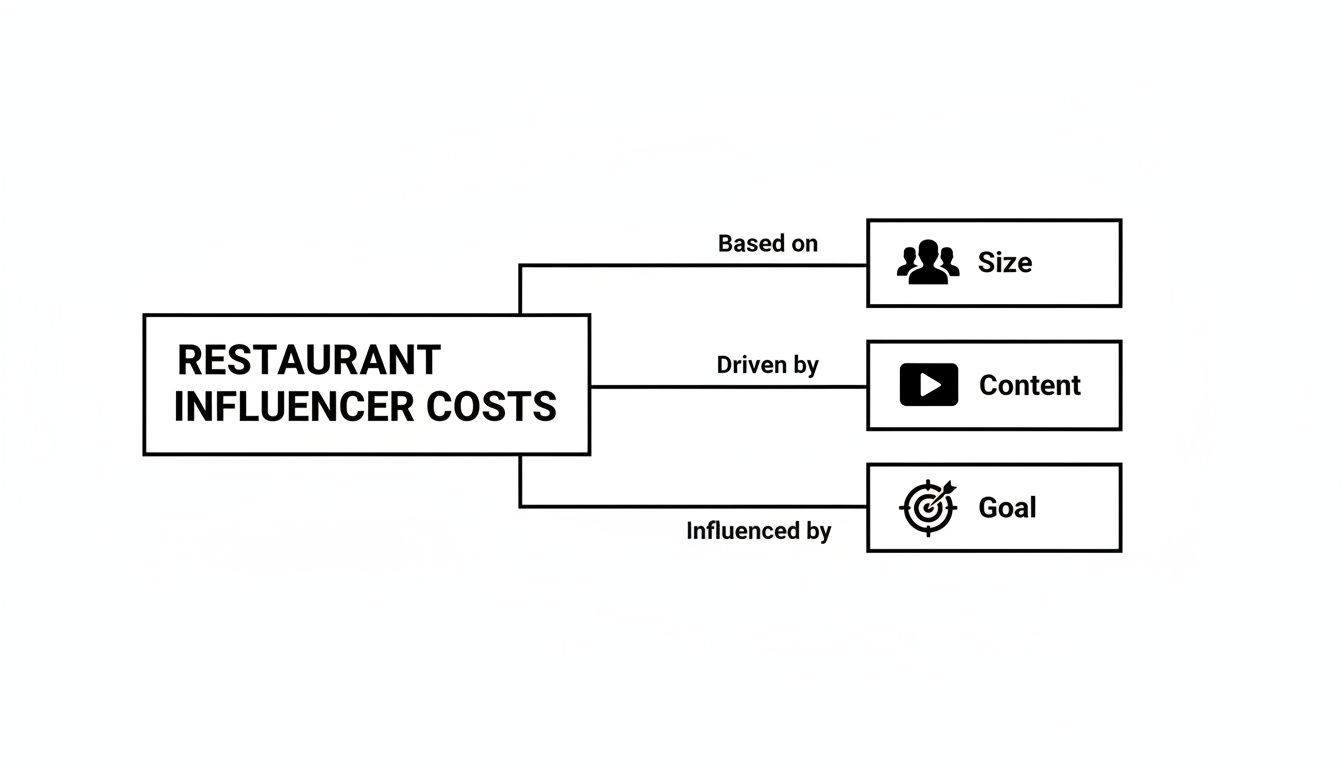
As you can see, each of these factors is a dial you can turn up or down to stay in control of your budget.
Your Campaign Goals
What you want to achieve directly shapes the strategy and, as a result, the cost. A campaign aiming for immediate table bookings will look very different from one designed simply to get your name out there.
Brand Awareness: This goal might involve partnering with several influencers for wide-reaching posts to introduce your restaurant to a new audience.
Direct Bookings or Sales: This needs a more focused approach. Think about using creators who are great at calls-to-action and tracking results with unique promo codes or booking links.
Content Generation: If your main goal is to get a bank of high-quality photos and videos (often called User-Generated Content), you’ll want to find creators known for their excellent photography skills.
The UK's influencer marketing scene is thriving, with 81% of UK brands planning to increase their budgets. For restaurants, this confidence is well-placed, especially as micro-influencers offer a fantastic, cost-effective way in. In fact, a huge 93% of UK marketers now work with creators in the 10k-100k follower range, who often deliver impressive engagement rates.
Location and Exclusivity
Finally, geography and competition play a surprisingly big part. A food blogger in central London, where the market is completely saturated, can command a much higher fee than a similar influencer in a smaller town. It’s basic supply and demand.
On top of that, if you want an influencer to work with you exclusively—meaning they can't promote any other local restaurants for a set period—this will come at a premium. An exclusivity clause protects your investment and ensures their audience only hears about you for a while, but it will definitely increase the cost of the collaboration.
Sample Influencer Budgets for Every Restaurant
It’s one thing to talk about cost drivers in theory, but it’s another to see how it all fits together in a real-world budget. To properly answer the question, "how much does influencer marketing cost for restaurants?", let's move past the abstract and look at three practical budget blueprints.
Think of these as starting points. You can tweak and adapt them to fit your own restaurant, whether you’re a cosy local café, a bustling city-centre bistro, or a chain that’s on the up. Each example will show you what a specific monthly spend can realistically get you.
Budget 1: The Local Independent Café
For a small, neighbourhood café, the mission is simple: get the locals talking and become their go-to spot. The strategy isn’t about chasing massive reach. It's about forging genuine connections with people who live or work just around the corner.
Monthly Budget: £300 – £500
Primary Goal: Build local awareness and get people in the door for specific things, like a new brunch menu or a weekend coffee special.
Target Influencers: 3-5 nano-influencers (1k-10k followers) who are based right in your neighbourhood.
What This Budget Gets You:
This budget is mostly built around gifted experiences. The majority of your spend will cover the cost of the food and drink you provide – complimentary meals, coffees, and pastries for your chosen creators and a friend. You’ll want to set aside a small portion for modest fees (£50-£100) for those with slightly larger audiences or if you’re asking for something specific, like an Instagram Reel.
Example Monthly Plan:
Week 1: Partner with a local parent blogger for a mid-week coffee and cake post.
Week 2: Invite a student influencer to show off your café as a great study spot.
Week 3: Work with someone from a nearby office to promote your lunch special.
Week 4: Host a local foodie for your new weekend brunch menu launch.
With this approach, you can expect a steady flow of authentic User-Generated Content (UGC) to re-share, more online buzz in your area, and a real, noticeable increase in new faces walking through the door.
Budget 2: The Bustling City-Centre Bistro
A mid-size bistro in a competitive city spot needs to do more than just exist; it needs to stand out. The goals here are bigger: driving direct bookings, shining a spotlight on high-margin dishes, and building the kind of reputation that supports a higher price point. That means a more structured approach and a bigger investment.
Monthly Budget: £1,500 – £3,000
Primary Goals: Drive reservations, generate high-quality photos and videos, and build brand prestige.
Target Influencers: A mix of 4-6 micro-influencers (10k-50k followers) and 1-2 mid-tier influencers (50k-150k followers).
What This Budget Gets You:
Once you hit this level of investment, you can move beyond gifted-only collaborations and into proper paid partnerships. This allows you to secure creators who are known for their polished, high-engagement content. You can also start asking for specific deliverables, such as a multi-frame Story sequence, a dedicated grid post, or professional-quality video.
This budget should cover:
Influencer Fees: This will be the biggest chunk, paying for guaranteed exposure and expertly created content.
Gifted Experiences: You'll still need to cover the cost of meals and drinks for the influencers and their guests.
Content Usage Rights: It’s wise to allocate a bit of budget to secure the rights to reuse the best content on your website, social media, or even in digital ads.
Budget 3: The Growing Multi-Location Chain
For a restaurant chain spreading its wings across multiple cities, the challenge is twofold. You need to build a consistent brand image nationally while also driving local foot traffic to each specific venue. The budget here gets pretty substantial, as it needs to fuel a complex, multi-layered strategy that requires serious coordination. For a more detailed look at what's achievable with larger budgets, exploring different platform capabilities is a good idea. For instance, you can find out more about what's included in Sup's pricing plans and how they help with bigger campaigns.
Monthly Budget: £8,000 – £15,000+
Primary Goals: Support new location launches, run nationwide campaigns (like a new menu rollout), and drive local traffic to every single venue.
Target Influencers: A large-scale programme with 20-30+ micro-influencers in different cities, plus 3-4 macro-influencers for big brand announcements.
This kind of investment powers a full-blown marketing machine. You can run synchronised campaigns where dozens of influencers post about a new seasonal menu on the exact same day, creating a huge wave of online conversation. The budget is designed to support dedicated fees for every tier of influencer, the management of a very complex campaign, and extensive content rights for large-scale advertising.
Measuring Your Return on Investment Beyond Likes
It’s a great feeling when an influencer post gets thousands of likes and glowing comments. But what does that really mean for your restaurant’s bottom line? Vanity metrics look impressive, but they don't help you pay your suppliers or staff. True success comes from measuring what actually matters: bums on seats, bookings in the diary, and money in the till.
To figure this out, you need to look past the surface-level engagement and start tracking the real-world impact of your campaigns. Think of it as leaving a trail of digital breadcrumbs that leads a potential customer from an influencer's post right to a table in your restaurant. This is how you stop guessing your return and start knowing it.
Tracking Real-World Actions
The most direct way to measure ROI is by connecting an influencer’s content to a specific customer action. Luckily, this is much easier than it sounds. With a few simple tools, you can draw a clear line between what someone saw on social media and the money they spent with you.
Here are the three most powerful methods for restaurants:
Unique Promo Codes: This is the gold standard for tracking. Give each influencer their own unique discount code (like ‘CHLOE15’ for 15% off) to share with their followers. When a customer uses that code, your point-of-sale system records it, giving you undeniable proof of who drove that sale. It's simple and incredibly effective.
Custom UTM Links: If your goal is to drive online bookings, UTM links are your best friend. These are just normal links to your booking page, but with a bit of tracking code added on. When someone clicks an influencer's unique link to book a table, you can see exactly which creator sent them your way in your website analytics.
The Simple Question: Never underestimate the power of simply asking. Train your front-of-house team to ask diners, "How did you hear about us?" Keep a simple tally sheet by the till. You might be surprised how many people say they saw your place on a specific influencer’s Instagram or TikTok.
Using a mix of these methods gives you a complete picture of your campaign’s performance. It allows you to clearly see which partnerships are delivering tangible results. To truly understand the value, it's essential to not just track vanity metrics but to actively prove the ROI of your social media efforts.
Measuring the Long-Term Value of Content
The ROI of an influencer campaign isn't just about the immediate sales, either. One of the most valuable assets you get—and one that’s often overlooked—is a library of authentic, high-quality User-Generated Content (UGC).
When you secure the rights to reuse an influencer's photos and videos, you're essentially getting a professional photoshoot for a fraction of the cost. This content can be repurposed for your own social media channels, website, email newsletters, and even paid ads for months to come.
Just think about the cost of hiring a food photographer, a stylist, and models for a full-day shoot. A good influencer collaboration that gives you a dozen fantastic images can offer the same value, seriously cutting down your content creation budget in the long run. This long-term value is a crucial, if often forgotten, part of your overall ROI calculation.
Connecting Actions to Revenue
The evidence for this approach is pretty compelling. For UK restaurants, 59% of marketers report a big jump in engagement from their influencer campaigns. Even better, 55% directly credit these partnerships with boosting both their brand’s credibility and their revenue.
In busy cities, social media word-of-mouth is a massive driver, influencing 60% of dining decisions. With Brits spending over 90 minutes on social media every day and 75% of diners admitting they've chosen a restaurant based on photos they saw online, the connection between a great post and a new customer is undeniable.
Ultimately, platforms like Instagram, used by 92% of UK marketers, and TikTok, now used by 80%, are the perfect stages. By carefully tracking promo codes, UTM links, and what your customers are telling you, you can connect the dots between an influencer’s activity and actual revenue. This is how you prove, without a doubt, that your influencer marketing costs are paying off.
Smart Ways to Stretch Your Marketing Budget

Getting real value from your influencer budget isn't about finding the cheapest rates. It's about being clever and strategic, making sure every pound you spend brings people through your door. With a bit of smart planning, you can make a much bigger impact without needing a bigger budget.
Forget just trying to cut costs. These are tried-and-tested tactics that help you invest more wisely. From picking the right partners to getting more mileage out of your content, here’s how to make your budget work harder for you.
Focus on Nano and Micro-Influencers
For most restaurants, the secret to cost-effective influencer marketing is working with nano-influencers (1k–10k followers) and micro-influencers (10k–50k followers). These creators often give you far more for your money, thanks to their super-local audience and fantastic engagement rates.
Think about it: their followers see them as trusted friends, not distant celebrities. A recommendation from them feels like a personal tip-off from someone in the know—which is exactly what you need to persuade someone to book a table. Many are happy to collaborate for a gifted meal or a small fee, making them a brilliant and affordable option for almost any budget.
This isn't just a theory; it’s backed by what’s happening in the market. A massive 93% of UK marketers now partner with micro-influencers. On top of that, 60% specifically work with nano-influencers, who can hit engagement rates as high as 15.2% on TikTok, often leaving bigger names in the dust.
Get the Rights to Their Content
One of the most valuable, yet often overlooked, parts of an influencer campaign is the content itself. When you’re agreeing on a collaboration, make sure you secure the User-Generated Content (UGC) rights. This simply means you get legal permission to use the photos and videos they create on your own marketing channels.
This one small step can save you thousands of pounds on professional food photography and videography. All of a sudden, you have a constantly growing library of authentic, high-quality images and clips for things like:
Your restaurant’s Instagram and TikTok feeds
Your website’s gallery or homepage
Email newsletters promoting new menus or special offers
Digital ads to pull in new customers
This strategy is now a must-do for modern marketing, with 45% of UK campaign goals now focused on generating this kind of content.
By turning every influencer partnership into a content-generating machine, you’re not just paying for a single post. You're investing in a long-term marketing asset that keeps providing value long after the initial campaign is over.
Build Long-Term Ambassador Relationships
One-off posts are great for a quick boost, but building long-term relationships with a handful of key creators can be far more powerful and budget-friendly. When you turn a successful influencer into a genuine brand ambassador, their promotion feels much more authentic.
If a creator features your restaurant again and again over several months, their audience sees a real, ongoing connection, not just a one-time paid ad. That builds incredible trust. Ambassadors are also often open to better rates through a retainer or a package deal, since they get consistent work with a restaurant they genuinely love.
Automate the Admin to Save Time and Money
Let’s be honest: finding creators, sending DMs, negotiating rates, chasing them for content, and tracking results is a huge time-sink. All those hours spent on admin are hours you could be spending running your restaurant. Using a dedicated platform to automate these repetitive tasks is a direct way to save money.
In the UK, rising influencer costs are a genuine worry, with 33% of marketers flagging it as a major challenge. But smart technology is the answer. Platforms can help you find verified local creators, manage your outreach, and automatically track your return on investment through unique codes and links. In fact, 38% of UK marketers now use these platforms to get more from their spend and improve results, and you can discover more insights about these UK marketing trends and the data behind them.
Common Questions About Restaurant Influencer Marketing
As you start thinking about an influencer strategy for your restaurant, a few practical questions will inevitably come up. It's totally normal. Getting your head around these common queries is the best way to launch your first campaign with confidence and sidestep those early, often expensive, mistakes. Let's dig into the questions we hear most from restaurant owners.
Can I Just Pay Influencers with Free Meals?
Yes and no. It really depends on who you're working with. This approach, often called a "gifted" or "in-kind" collaboration, can work wonders with nano-influencers – creators with follower counts typically under 10,000. Many are just starting out, eager to build their portfolio, and are genuinely thrilled to create content for a fantastic meal out for themselves and a plus-one.
But once you start approaching more established micro-influencers and bigger names, or if you have specific needs like a professionally shot video or a series of posts, you'll need to offer a fee. It's about respecting their craft, their time, and the very real business value their audience brings. A good way to think about it is this: gifted meals are great for a casual mention, but paid fees secure professional, guaranteed results.
How Do I Find the Right Food Influencers?
Searching for the perfect foodies for your restaurant can feel like looking for a needle in a haystack. You could spend endless hours manually scrolling through hashtags like #londonfoodie or #manchesterrestaurants, then vetting each profile one by one. Honestly, it’s a huge time sink, and you have no real way of knowing if their followers are genuine, local, or even interested in dining out.
A much smarter approach is to use a dedicated influencer platform. These tools have already done the hard graft, giving you a searchable database of pre-vetted creators. You can filter by location, audience size, engagement rate, and specific food interests, connecting you with authentic local foodies in minutes, not days. It saves you a massive amount of time and connects you with partners who are actually ready and willing to collaborate.
What Is a Good Engagement Rate for a Food Influencer?
An engagement rate is simply the percentage of an influencer's followers who are actively liking, commenting on, and sharing their posts. It's a critical health check for their account, showing you whether their audience is real and paying attention. Forget being dazzled by a huge follower count; engagement is where the real value lies.
As a rule of thumb, a solid benchmark for a food influencer on Instagram is an engagement rate of 3% or higher. On TikTok, you'll want to see 5% or more, as the platform is built for higher levels of interaction.
Think about it: a creator with 10,000 followers and a 5% engagement rate (meaning about 500 interactions per post) is far more valuable than someone with 50,000 followers and a dismal 0.5% rate (just 250 interactions). Always ask to see their media kit or do a quick calculation on their recent posts yourself before agreeing to anything.
Ready to stop guessing and start getting real results from your influencer marketing? Sup combines smart technology with a human team to find local creators, manage your campaigns, and track every booking and sale. See how our platform can save you time and prove your ROI. Book a demo today!
Matt Greenwell
Share