How Much Should You Pay Instagram Influencers? 2026 Guide: Pricing Drives ROI

Matt Greenwell
Mar 8, 2026
Trying to figure out how much you should pay Instagram influencers in 2026 can feel like you’re navigating a maze blindfolded. But let's start with a simple baseline. For a single in-feed post here in the UK, you could be looking at anything from £100 for a nano-influencer right up to £8,000+ for a mega-influencer. Micro-influencers, a popular choice for many brands, typically sit somewhere in the £500 to £1,500 bracket.
Of course, those numbers are just the starting blocks. The real cost is a bit more nuanced.
Your Guide to 2026 Instagram Influencer Rates
The question, "How much should you pay an Instagram influencer?" doesn’t have a one-size-fits-all answer. It’s better to think of influencer rates less like a fixed price tag and more like a tailored quote for a creative service. The final figure is shaped by a whole host of factors that go well beyond follower count.
A creator’s rate card is a useful guide, but the true value of a partnership often lies beneath the surface. For example, a creator with 50,000 highly engaged followers in a niche like sustainable fashion could easily drive more sales for an ethical brand than a general lifestyle influencer with 500,000 followers. That’s why digging into the context behind the price is absolutely crucial.
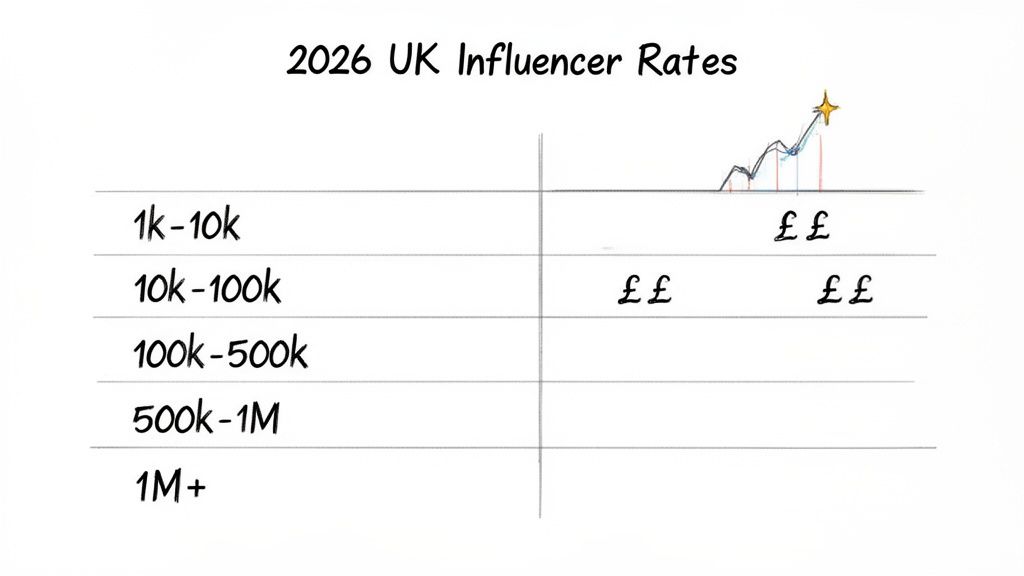
UK Instagram Influencer Rate Benchmarks Per Post for 2026
To give you a solid foundation for your budgeting and negotiations, we've put together some estimated flat-fee benchmarks. These figures are based on a single in-feed post from a UK-based Instagram influencer and act as a practical starting point before you layer on other key variables.
Influencer Tier | Follower Count | Estimated Rate Per Post (GBP) |
|---|---|---|
Nano | 1,000 – 10,000 | £100 – £500 |
Micro | 10,000 – 100,000 | £500 – £1,500 |
Mid-Tier | 100,000 – 500,000 | £1,500 – £5,000 |
Macro | 500,000 – 1,000,000 | £5,000 – £8,000 |
Mega | 1,000,000+ | £8,000+ |
These rates provide a great ballpark figure, but remember, they're just the beginning of the conversation.
Beyond Follower Count: What Really Drives the Cost?
The benchmarks above are only one piece of the puzzle. The final price you agree on will almost certainly be influenced by several other factors that speak to an influencer's true market value and potential return on investment (ROI).
Here are the key things that can push those base rates up or down:
Engagement Rate: A creator with an exceptional engagement rate—lots of genuine comments, shares, and likes—has an active, loyal audience. That’s far more valuable than a huge but passive following.
Niche and Industry: Specialised knowledge is worth paying for. Influencers in high-demand or technical fields like personal finance, B2B tech, or niche hobbies can command higher fees for their expertise.
Deliverables: The scope of work is a massive cost driver. A single, static photo post is one thing. A campaign involving multiple posts, a series of Stories with interactive stickers, and a professionally shot Reel is a completely different ball game.
Content Usage Rights: If you plan to repurpose the creator’s content on your own website, in paid ads, or on other marketing channels, you’ll need to negotiate and pay extra for those rights.
In essence, you aren't just paying for eyeballs; you are investing in a creator's hard-earned trust, their creative talent, and their unique ability to produce content that genuinely connects with their audience.
This guide will walk you through every step, from exploring different pricing models to calculating a fair rate and confidently negotiating contracts. By the end, you'll have the know-how to make smarter, data-led decisions that turn your influencer marketing budget into real, measurable results.
Choosing the Right Influencer Pricing Model
Once you’ve got a handle on the baseline rates, you need to decide how you'll actually pay the influencer. This is just as critical as figuring out how much. The payment structure you choose should be a direct reflection of your campaign goals, whether you're trying to blast your brand name across the internet or drive a surge in sales.
Picking the wrong model is like trying to turn a screw with a hammer – you might make a dent, but you won't get the results you want. Let's look at the main ways these deals are structured so you can pick the right tool for your specific job.
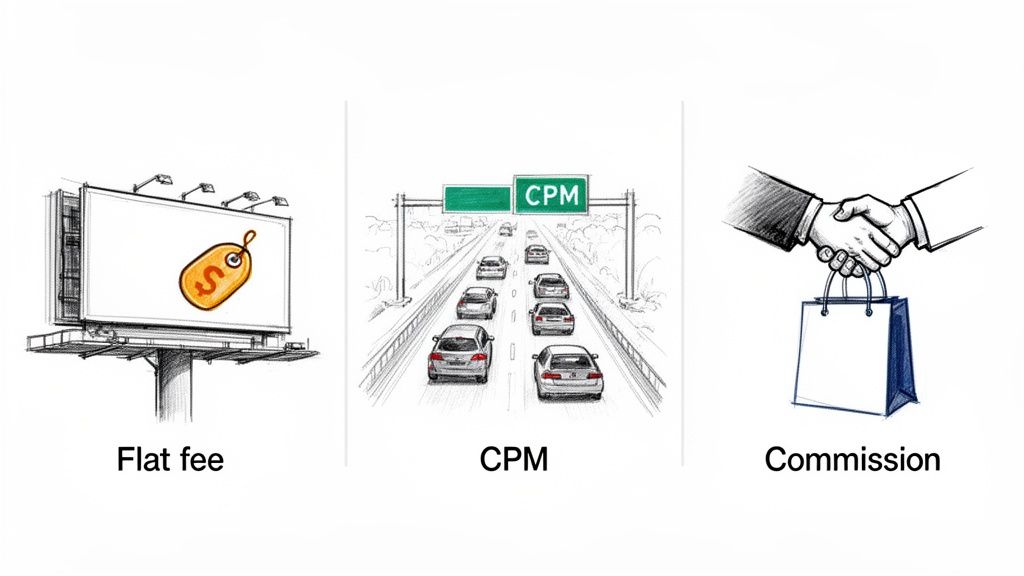
The Flat-Fee Model For Predictable Costs
The flat-fee model is the bread and butter of influencer marketing. It’s exactly what it sounds like: you and the influencer agree on a fixed price for a specific set of deliverables. This could be one Instagram post and three Stories, for example. It’s clean, predictable, and makes budgeting a breeze.
Think of it as buying ad space on a billboard. You pay a set price for a specific spot over a fixed period. It doesn't matter how many people drive past or call your number; you've paid for the space. With a flat fee, you're paying for guaranteed content and a guaranteed introduction to that creator's audience.
When does a flat fee make sense?
Brand Awareness: If your main goal is simply to get your brand in front of fresh, relevant eyes, a flat fee guarantees that exposure.
Content Generation: When you need a steady stream of high-quality, authentic content for your own social media or ads, paying a flat fee ensures you get those creative assets.
Simplicity and Budgeting: This is the perfect model for brands that need to know their costs upfront without fussing over complex tracking.
There's a reason this is the most common approach. In fact, over 70% of influencers prefer it because it gives them a stable income for their creative work, removing the risk that comes with performance-based pay.
The Cost Per Mille (CPM) Model For Guaranteed Reach
With the Cost Per Mille (or CPM) model, you pay for every thousand impressions the content gets. An "impression" is just a fancy word for a view. This model shifts the focus from just getting the content made to making sure it gets seen.
Let's go back to our billboard analogy. A flat fee pays for the billboard itself. A CPM deal means you pay based on the volume of traffic that passes it. If it's a busy bank holiday weekend, you pay more. If it's a quiet Tuesday morning, you pay less. Your cost is directly tied to the content's verified reach.
Key Takeaway: The CPM model is all about eyeballs. You're paying for a guaranteed number of views, which is a powerful way to ensure your budget translates directly into a specific amount of audience exposure.
While it's less common for smaller, one-off collaborations, CPM can be really effective for big campaigns where maximising reach is the number one priority. It does require solid tracking, but the upside is you only ever pay for the audience you actually get.
The Commission (or Affiliate) Model For Performance-Driven Sales
A commission-based model, often called an affiliate model, is all about performance. Here, you pay the influencer a percentage of every sale they directly generate through their content. This is almost always tracked with unique affiliate links or personalised discount codes.
In our analogy, you're no longer paying for the billboard or the traffic. Instead, you're giving the billboard company a cut of the profits every time a driver sees the ad, pulls off the motorway, and buys your product on the spot. For the brand, the risk is incredibly low because you only pay for tangible results.
This approach ties your marketing spend directly to your revenue, which makes calculating your return on investment crystal clear. The catch? It puts all the financial risk on the creator. Because of this, most established influencers will shy away from a commission-only deal unless the product is a perfect fit and the commission rate is very attractive. Often, a hybrid approach—a smaller flat fee plus a commission bonus—is the sweet spot that works for everyone.
Why Nano and Micro-Influencers Drive Better ROI
While it’s tempting to chase mega-influencers with their huge follower counts, the smartest brands in 2026 know a secret: real ROI often comes from smaller creators. When you're figuring out how much to pay Instagram influencers, don't get distracted by vanity metrics. The data consistently points to nano-influencers (1,000–10,000 followers) and micro-influencers (10,000–100,000 followers) as the true power players for delivering a fantastic return.
It really boils down to trust. Think about it – whose recommendation are you more likely to act on? A billboard with a celebrity you've never met, or a tip from a close friend who actually knows their stuff? Nano and micro-influencers function much more like that trusted friend. Their audiences are smaller, sure, but they are incredibly engaged and see the creator as a genuine peer.
The Power of Authentic Connection
The real magic behind smaller creators is their authenticity. They have a much deeper, more personal connection with their followers, often taking the time to reply to comments and DMs directly. This hands-on approach builds a level of trust that massive accounts just can't physically manage.
When a nano-influencer who’s built their entire platform around a vegan lifestyle recommends a new plant-based cheese, their audience pays close attention. It doesn't feel like an ad; it feels like a genuine, personal recommendation. That credibility is what drives people to actually visit a shop, try a product, or book a service.
For brands, this means your message isn't just being broadcast; it's being personally endorsed by a trusted source. Historical data from 2024-2025 UK campaigns showed that nano-influencer collaborations yielded a 22% higher ROI on average precisely because their audiences treat recommendations like a mate's tip-off.
This completely changes the value of your marketing spend. A single £300 post from a carefully chosen nano-creator can genuinely drive more sales than a £5,000 post from a macro-influencer whose audience is too broad and disengaged.
Unpacking the Financial Advantage
The ROI calculation for nano and micro-influencers works so well because it combines lower costs with sky-high engagement. While a macro-influencer might demand thousands for one post, you could partner with a whole squad of smaller creators for the very same budget.
Looking at the UK market in 2026, nano-influencers with 1K-10K followers are typically charging between £100-£500 per Instagram post. This makes them an ideal choice for businesses like local restaurants or e-commerce shops needing to drive sales without a massive upfront investment. As the latest Sprout Social 2026 Guide to UK Influencer Marketing highlights, nano-creators often price themselves accessibly, yet their hyper-targeted engagement punches well above its weight in conversions.
This pricing model lets you spread your bets and scale your campaigns intelligently. Instead of putting all your eggs in one very expensive basket, you can work with multiple creators across different niches and locations. This not only broadens your reach but also gives you a treasure trove of authentic user-generated content (UGC) to repurpose.
Just look at these key benefits:
Higher Engagement Rates: It's common to see nano and micro-influencers achieve engagement rates 5-10 times higher than their mega-influencer counterparts. Their followers are genuinely invested and more likely to like, comment, and share.
Niche Audience Targeting: These creators often serve highly specific communities, from sustainable living in Bristol to gluten-free baking in Manchester. This gives you a direct line to a perfectly aligned audience that’s already interested in what you have to offer.
Cost-Effective Scalability: For the price of one or two macro-influencer posts, you can launch a campaign with 10, 20, or even 100+ smaller creators. This approach amplifies your message and generates far more content and valuable performance data.
Turning Modest Spend into Measurable Results
The accessibility of nano and micro-influencers makes them a powerful engine for growth, especially when you have the right tracking tools. For instance, platforms like Sup can manage the entire workflow, from discovering verified creators to attributing sales directly back to their content using unique promo codes and UTM links.
Picture a London-based nano foodie with 8,000 followers. A £400 Instagram Reel they create could easily hit 50,000 views, as the algorithm often favours engaging content from smaller accounts. If that Reel promotes an offer tracked with a unique discount code and generates a 15% redemption rate, the ROI becomes crystal clear and easy to measure.
For direct-to-consumer brands and multi-location businesses, this approach is a game-changer. By shifting focus to these smaller, high-impact partnerships, you can transform your influencer marketing from a high-stakes gamble into a predictable, high-performance growth strategy. You can find out more by reading our complete guide on why smaller creators can drive bigger ROI.
How to Calculate and Negotiate Influencer Rates
Alright, you know the industry benchmarks and the different ways creators get paid. But knowing the menu is one thing; deciding what to order and agreeing on the bill is another entirely. This is where we move from theory to practice, figuring out what a specific creator is actually worth to your brand and then confidently negotiating a deal that feels right for everyone.
There’s no magic, one-size-fits-all calculator for this. Think of it less like a strict formula and more like putting together a puzzle. Each piece—engagement, deliverables, usage rights—has to fit perfectly to create the full picture of a fair rate.
Building Your Initial Offer
Before you even draft that first email, you need a solid starting number in mind. And this number has to be rooted in data that goes far beyond a simple follower count. The goal is to build an offer that reflects the creator’s real, tangible value.
Here are the non-negotiable factors you need to weigh up:
Engagement Rate: This is everything. A creator with 20,000 followers and a 6% engagement rate is almost always a better investment than someone with 100,000 followers and a lukewarm 1% rate. High engagement means you’re tapping into a community that genuinely trusts and acts on that person's recommendations.
Scope of Work: Get granular. Are you asking for a single, simple in-feed post? Or are we talking about a comprehensive package with one post, five Stories with interactive polls, and a 60-second Reel? Every single deliverable is a piece of work that adds to the bottom line.
Niche Authority: An influencer who’s a recognised authority in a technical field, like a dermatologist or a qualified financial advisor, can rightfully charge a premium. You’re not just paying for eyeballs; you’re paying for years of built-up credibility and trust.
Content Usage Rights: This is a big one. If you want the right to use the creator's content on your website or in your own paid ads, that comes at a cost. A standard agreement might give you rights for 30–90 days, but if you want to use that content forever (perpetual rights), expect the price to jump significantly.
As this chart shows, the smart money is on creators with strong engagement. Investing in them, even if they have a smaller following, is the clearest path to a better return.
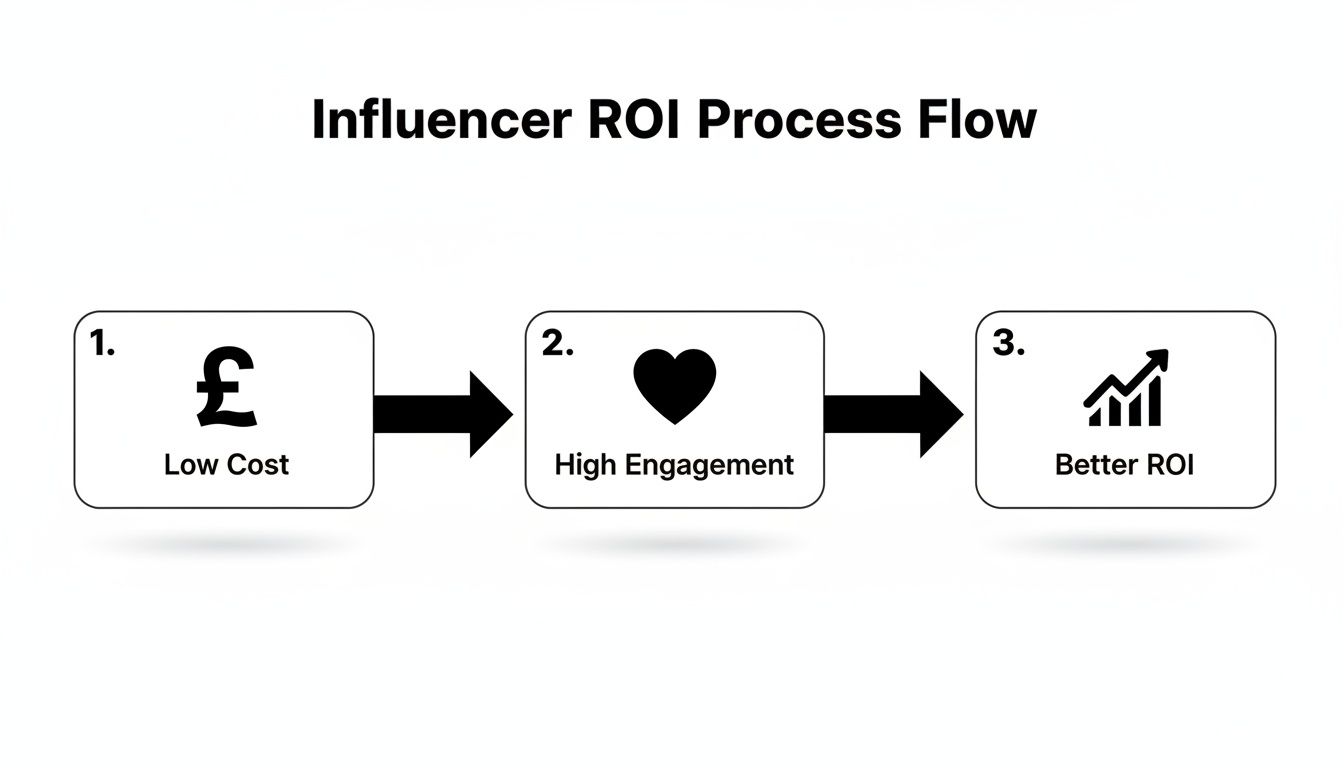
It’s a simple process: by focusing on a highly engaged audience, which you often find with micro- and nano-influencers, you get a much better bang for your buck.
Mastering the Art of Negotiation
Let’s be clear: negotiation isn’t about trying to get away with paying as little as possible. It's a professional conversation to find a sweet spot where the price and the deliverables work for both parties. Influencers are business owners, so approach the chat with respect and a firm grasp of your own budget and goals.
Key Takeaway: The best negotiations are collaborative, not confrontational. Frame the conversation around building a win-win partnership. Always start by telling them why you think they're a perfect fit for your brand before you even mention money.
Here are a few proven tactics to guide the discussion:
Bundle the Deliverables: Most creators will offer a better rate for a bigger block of work. Instead of haggling over a single post, ask for a package deal (e.g., one post, one Reel, and four Stories). They get more guaranteed income, and you lock in a better overall price.
Suggest a Hybrid Model: If their flat fee is just a bit beyond your budget, don't walk away. Suggest a hybrid structure. You could offer a slightly lower flat fee but add a performance-based commission on every sale they drive, tracked with a unique discount code. It shows you’re invested in their success.
Offer Value Beyond Cash: Money is king, but it’s not the only currency. You might be able to offer a higher fee in exchange for longer content usage rights. Or you could offer to feature their profile on your brand’s social channels, giving them valuable exposure to your audience.
In the end, how well you negotiate comes down to how well you understand your own numbers. Getting a handle on your marketing spend is crucial, and a great place to start is our guide on how to calculate customer acquisition cost. When you arm yourself with a data-backed offer and a collaborative mindset, you’ll build partnerships that are not only affordable but primed for outstanding results.
Defining Your Contract Terms and Deliverables
Right, you’ve talked numbers and shaken hands on a rate. Now comes the part that separates the pros from the amateurs: putting it all into a solid contract. Don't think of this as just legal paperwork. It’s the roadmap for your entire collaboration, turning good intentions into a clear, professional plan.
A contract is your best defence against misunderstandings. I've seen promising campaigns fall apart over simple "he said, she said" arguments that could have been avoided. Knowing how to write a contract that protects your business isn't just a good idea; it's fundamental. It's about spelling out every single detail so there's zero confusion.
Laying Out the Core Deliverables
This is the absolute heart of your agreement—the scope of work. And it needs to be crystal clear. Vague requests like "a few promotional posts" are a recipe for disaster. You need to get specific. Really specific.
Spell everything out so there’s no room for guesswork:
Content Formats: Define the exact number and type of content. For example, “One (1) Instagram Reel, running for a minimum of 60 seconds,” or “A sequence of three (3) Instagram Stories posted on the same day.”
Key Messaging and Calls to Action: What’s the one thing they need to say? What do you want their followers to do? Be precise, whether it’s “Include the discount code BRAND20” or “Direct followers to the link in bio.”
Posting Schedule: Don't just say "next week." Lock in the exact dates and, if it’s important for your campaign launch, even the approximate times.
Tagging and Hashtags: Provide a complete list of every @mention and #hashtag that must be in the post caption or creative.
Your contract should work like a checklist. When the campaign goes live, both you and the creator should be able to tick off every single requirement. The more detail you include now, the fewer awkward phone calls you'll have later.
Establishing Approval and Usage Rights
Two of the most common friction points are content approvals and usage rights. Get ahead of them by outlining everything clearly in the contract. This protects your brand and, just as importantly, maintains a great relationship with the creator.
First, map out the content approval workflow. How many chances do you get to review and request changes? Is it one round of revisions or two? What’s the deadline for you to provide feedback? Setting these boundaries keeps the project moving and avoids endless tweaks.
Just as critical are the content usage rights, often called licensing. This section dictates what you can actually do with the content once it's created.
Duration: How long do you have the rights for? Standard terms are often 30, 60, or 90 days. If you want to use it forever (perpetual rights), be prepared to pay a significant premium.
Channels: Where will the content live? Are you just reposting it on your own organic social media? Or do you want to use it on your website, in email marketing, or for paid ads? Rights for paid advertising will always cost you more.
Exclusivity: This is a big one. An exclusivity clause means the influencer can't work with your direct competitors for a specific time. It’s a powerful tool, but it comes at a price and will increase the creator's fee.
Finally, be explicit about the payment schedule. A common and fair approach is 50% upfront when the contract is signed and the remaining 50% when the work is complete. Clear payment terms build trust and show the creator you value their time and effort.
Measuring Real ROI from Your Influencer Campaigns
Once you’ve agreed on rates and the content goes live, the most important question always pops up: did it actually work? Likes and views are nice ego boosts, but they don't pay the bills. The real measure of success is the return on your investment (ROI), and to find that, you need to track the things that actually affect your bottom line.
This means looking past the surface-level vanity metrics and drawing a straight line from an influencer's post to real business outcomes like clicks, sales, and revenue. The good news is, this isn't a guessing game anymore. With the right setup, you can see exactly which creators are driving results and which aren't.
Moving Beyond Vanity Metrics
The key to tracking ROI properly is something called attribution. Think of it like leaving a digital breadcrumb trail that leads from the influencer’s content all the way to a customer's purchase on your site. The best tools for creating this trail are unique discount codes and UTM-tagged links.
Unique Discount Codes: Giving each influencer their own code (like "LAURA15") is one of the simplest and most powerful ways to track sales. Every time a customer uses that code at checkout, you know precisely who sent them your way.
UTM-Tagged Links: These are just your standard website links with a bit of tracking code added to the end. They tell your analytics software exactly where your website traffic came from, so you can see how many people clicked through from a specific influencer’s bio link or Instagram Story.
When you use these two methods together, you get a really clear picture of performance. If you want to get serious about this, understanding analytics is a must. For a much deeper look, check out a creator's guide to UTM variables in Google Analytics.
Calculating Your Return on Investment
With solid tracking in place, working out your return is refreshingly simple. You'll want to focus on two main figures: Return on Ad Spend (ROAS) and Return on Investment (ROI).
ROAS is a quick, straightforward calculation. It measures the total revenue you brought in for every pound you spent on the influencer. It's perfect for a fast look at whether a campaign was profitable on a basic level.
ROAS Formula: (Revenue from Influencer Campaign / Total Cost of Influencer Campaign) x 100
For instance, if you paid an influencer £500 and their campaign generated £2,000 in sales, your ROAS is a very healthy 400%.
ROI gives you a much truer picture of your profitability because it includes the cost of the products you sold (Cost of Goods Sold, or COGS). This tells you how much actual profit you made.
ROI Formula: ([Revenue from Campaign - COGS - Campaign Cost] / Campaign Cost) x 100
Using the same example, if your COGS for that £2,000 in sales was £800, your ROI comes out to 140%.
Modern platforms, including Sup, automate this entire process. Our dashboards provide real-time attribution, letting you visualise clicks, code redemptions, and revenue per creator, all in one clean interface. You can learn more in our complete guide on how to measure influencer marketing ROI. This is how you turn influencer marketing from a hopeful expense into a predictable, scalable growth engine for your business.
Your Top Questions, Answered
When you're trying to set a budget for influencer marketing, a lot of questions naturally pop up. Let's walk through some of the most common queries brands have about paying creators, so you can move forward with a clear, confident strategy.
Should I Pay More for an Instagram Reel Than a Post in 2026?
In a word, yes. By 2026, it's a given that you'll need to budget more for an Instagram Reel. Think about what goes into creating one: the filming, the professional editing, maybe even sound design. It's a much bigger undertaking than a single, static photo.
On top of the extra effort, Reels simply have a higher potential for explosive reach because Instagram’s algorithm is heavily favouring short-form video. A good rule of thumb is to set aside 1.5x to 3x your standard in-feed post rate for a well-produced Reel. The final price will, of course, depend on its complexity.
Is It Better to Pay with Free Product or Cash?
This really comes down to the creator's experience level and what you're trying to achieve. For emerging nano-influencers (those with around 1,000-10,000 followers), a gifted collaboration can sometimes be a good fit, especially if your brand is popular and the product has a high value.
However, once you start working with more established creators, you have to remember that this is their job. For the vast majority, creating content is their profession and main source of income. Offering cash shows that you respect their work and value their time. A hybrid model—combining a cash fee with free product—is often the perfect middle ground.
How Do I Find an Influencer's Engagement Rate?
You can always calculate it yourself with a pretty simple formula. Just grab the numbers from their last 10-15 posts and plug them in.
First, add up all the likes and comments. Then, divide that by the number of posts you reviewed. Finally, divide that result by their total follower count and multiply by 100 to get the percentage.
Formula: ((Total Likes + Comments) / Number of Posts) / Total Followers * 100 = Engagement Rate %
For a micro-influencer in 2026, you're looking for a healthy engagement rate somewhere above 3-5%. Of course, modern platforms can do this work for you, automatically vetting creators and providing verified engagement rates. This not only saves you a ton of time but also ensures the data you're basing your decisions on is accurate.
Ready to stop guessing and start scaling? Sup combines AI-powered sourcing with a human team to find, manage, and measure your influencer campaigns. See how our platform removes the manual work and delivers provable ROI. Learn more and get started at Sup.co.
Matt Greenwell
Share