How to Negotiate Influencer Rates Without Burning Relationships: A Guide

Matt Greenwell
Apr 14, 2026
You find a creator who fits your brand perfectly. The content style is right, the comments look healthy, and the audience overlap is obvious. Then the rate card lands in your inbox and the gap between what they charge and what you planned to spend feels impossible.
That moment is where a lot of influencer relationships go wrong.
Some brands disappear. Others fire back with a number so low it tells the creator, clearly, that the brand doesn’t understand the work. Neither approach helps if you’re trying to build an influencer channel that lasts longer than one post.
The better approach is to treat negotiation as part of partnership design. Not a tug-of-war over price. If you’re trying to operationalise creator partnerships across dozens or hundreds of micro-collabs, you need a system that protects margin, keeps conversations respectful, and makes performance measurable from day one.
That’s how to negotiate influencer rates without burning relationships.
Moving Beyond Sticker Shock to Strategic Partnerships
The first mistake brands make is treating the creator’s opening rate as an insult or a final answer. It’s usually neither. It’s a starting position.
Creators are pricing more than filming time. They’re pricing audience trust, creative labour, admin, revisions, usage risk, and the opportunity cost of saying yes to your campaign instead of another one. If you ignore that, your negotiation tone will be off before you even send the second message.
That’s why the strongest negotiators don’t respond with “we only have £X, can you do it?” They respond by reframing the conversation around fit, scope, and outcomes.
What strong negotiations feel like
A healthy negotiation feels like this:
The brand shows homework. You reference why the creator is a fit, not just their follower count.
The creator feels respected. You don’t imply their rate is unreasonable.
The commercial discussion stays specific. Deliverables, timing, usage, exclusivity, and performance all get named.
Both sides can adjust something. Price is only one lever.
That last point matters most. If the only lever you think you have is “pay less”, you’ll either overpay or offend people.
Practical rule: Don’t negotiate as if you’re buying media inventory. Negotiate as if you’re building a small commercial partnership.
A lot of teams need a reset before they do this well. If your internal view of creator work is still fuzzy, A Guide to Modern Influencer Marketing is useful because it puts influencer partnerships in the broader context of how brands now buy attention, trust, and content.
What burns relationships fast
These are the insidious habits that poison your pipeline:
Brand move | What the creator hears |
|---|---|
“What’s your best price?” | “I want a discount without changing scope.” |
“We have no budget but great exposure.” | “I don’t value your work.” |
“Can you include usage rights too?” | “I want extra value for free.” |
Silence after a rate card | “You were never serious.” |
Negotiation gets easier when you stop aiming for a cheap deal and start aiming for a fair structure.
That shift matters most with micro and nano creators, because those relationships often become your most repeatable growth engine. Burn one large creator and you lose one opportunity. Burn a network of smaller creators and you damage the channel you were trying to scale.
Your Pre-Negotiation Playbook for Data-Driven Offers
Good negotiations are usually won before outreach starts. If your team hasn’t decided what success looks like, what the content is worth to you, and where your walk-away line sits, you’ll improvise in the inbox and pay for it later.
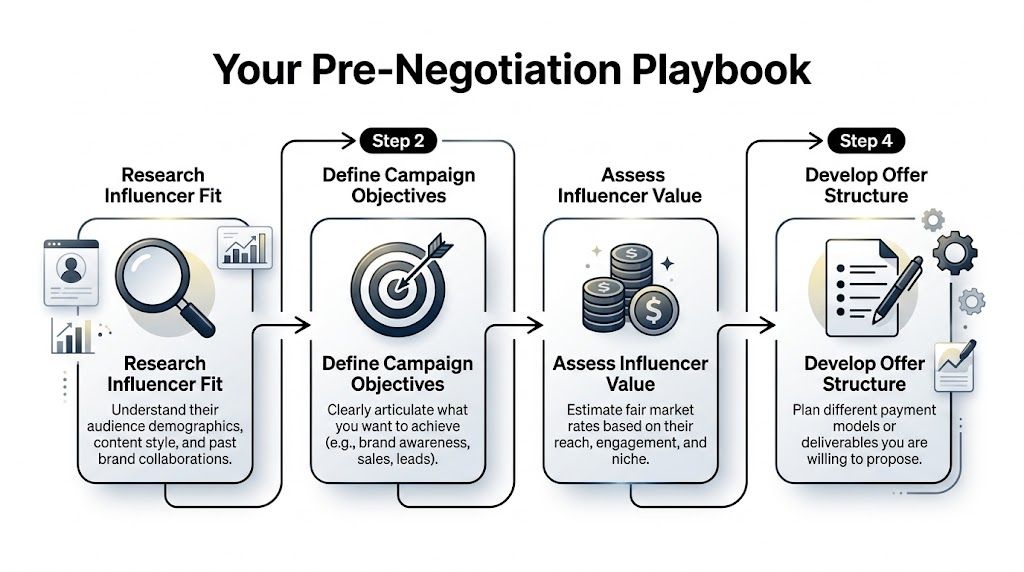
Build a one-page negotiation brief
Before contacting any creator, prepare a short internal brief with four fields:
Campaign objective
Ideal deliverables
Maximum payable rate
Measurement method
That sounds basic, but most negotiation problems come from one of those fields being vague.
If you’re driving awareness, you can tolerate softer attribution. If you’re driving ecommerce sales or restaurant bookings, you need trackable mechanics built in. That changes what you can justify paying.
Start with UK benchmark reality
For UK micro and nano negotiations, benchmark discipline matters. According to MediaNug’s UK rate guidance, nano-influencers account for 29.54% of campaign creator selections in 2026 benchmarks, and UK nano creators on TikTok average 10.3% engagement. The same source says a UK creator with 5,000 to 10,000 followers typically charges £300 to £800 per Reel, and data-backed offers help brands close 40% more deals without devaluing creators.
Those numbers do two things for you. They stop you from overreacting to rate cards, and they stop you from inventing budgets that have no relationship to the market.
If you need another pricing reference point from a nearby creator economy category, this breakdown of how much models get paid per shoot is a useful reminder that visual commercial work is rarely priced on time alone. Usage, format, and deliverables shift the fee.
Decide what you’re actually buying
A lot of brands think they’re buying a post. They’re often buying three separate things:
Reach and engagement from the creator’s audience
Content production you may want to reuse
Commercial rights that extend the content’s value
If you don’t split those internally, your offer will be messy. You’ll ask for too much in one fee, then wonder why the creator pushes back.
Use this quick internal checklist before sending anything:
Audience fit: Is the creator locally relevant, niche-relevant, or both?
Format fit: Do you need a Reel, TikTok, Stories, or a mix?
Reuse fit: Will the content stay organic, or do you want paid usage rights later?
Attribution fit: Can this creator realistically drive code uses, clicks, bookings, or footfall?
For a more current UK pricing lens, keep this internal reference handy once during planning: https://sup.co/blog/how-much-should-you-pay-instagram-influencers-2026-guide
Create three offer versions, not one
Don’t enter negotiation with a single “take it or leave it” number. Build three versions.
Offer type | When to use it | What it includes |
|---|---|---|
Ideal | Strong fit, room in budget | Full deliverables and preferred usage terms |
Target | Most negotiations | Core deliverables with limited extras |
Walk-away | Worth testing, not forcing | Minimum viable package |
This keeps your team from making emotional decisions mid-thread.
If your offer can’t be explained internally in one sentence, it’ll be impossible to defend externally.
The brands that scale this well don’t rely on negotiation instincts. They rely on prepared ranges, clear campaign maths, and a documented structure their whole team can repeat.
Crafting the Opening Move That Sets a Collaborative Tone
Your first message does more than start a conversation. It tells the creator what kind of brand you are to work with.
A rushed outreach message usually creates a rushed negotiation. If it reads like a mail merge, creators assume the process will be impersonal, slow, and price-led. That makes them defensive.
A good opening message is short, specific, and easy to answer.
Ask for their rate first more often than not
In most cases, letting the creator quote first is the stronger move. UK negotiation data from Superfiliate’s field guide says influencer rates are almost always negotiable by 10% to 30%, and a 2025 UK study found 72% of agencies using an “ask first” approach avoided budget overruns. The same source notes that creators usually open with their highest rate, which gives you a baseline for a more informed counter.
That matters because early low offers can damage trust before the main conversation even starts.
When asking first works best
Ask for their rate first when:
You like the creator but don’t know their commercial maturity
You’re testing a niche or region
You’re comparing several similar creators
You suspect your internal budget may be too conservative
Use a message like this:
Hi [Name], really liked your recent [specific post/topic]. The way you covered [specific detail] felt natural and commercially strong, which is rare.
We’re exploring a campaign for [brand/category] aimed at [audience/outcome]. I’d love to know whether you’re open to paid collaborations at the moment, and if so, could you share your current rates or media kit for [desired format]?
If it’s a fit, I’m happy to discuss scope, timing, and how we normally structure partnerships.
That message does three things well. It proves relevance. It doesn’t force a budget too early. It signals professionalism.
When to lead with your budget
Sometimes it’s better to put a number on the table first. Usually that’s when your budget is fixed and the only useful question is whether scope can be shaped to fit it.
Examples:
You’re running a tightly costed product seeding test
You need a high volume of creators in one market
Procurement or finance has capped spend
The campaign needs quick yes-or-no decisions
Lead with a budget only if you can pair it with a clear scope and a respectful tone.
Use this script:
Hi [Name], I’m reaching out because your content around [niche] is a strong fit for a campaign we’re planning.
We have budget allocated for a paid collaboration and are currently scoping around [deliverable]. Our working range for this brief is [budget range], depending on final deliverables and usage terms.
If that’s in the right ballpark for you, I’d love to discuss what a package could look like.
The key phrase is “working range”. It sounds commercial, not rigid.
A useful explainer on tone and negotiation psychology sits below.
What not to send
These lines usually create friction fast:
“We love your page, what are your rates?” Too vague.
“Can you send your best price?” Too transactional.
“We don’t have much budget.” You’ve framed yourself as a problem.
“We can offer gifted only, but great exposure.” Fine for the right gifting scenario, poor as a default opener.
The first message should make the creator feel selected, not scraped.
The opening move doesn’t need to close the deal. It only needs to create the right conditions for a sensible negotiation. If your first message is thoughtful, the rest of the thread usually stays calmer.
The Art of the Counteroffer and Value-Based Bundling
Most bad counteroffers fail for one reason. They ask the creator to lose value without changing the shape of the deal.
A creator says £700. The brand says £400. Nothing else changes. That isn’t negotiation. It’s just a smaller number.
A stronger counteroffer keeps the creator’s rate in view and adjusts the package around it.
Counter the structure, not just the fee
When a rate comes in above budget, work through these questions in order:
Can scope be narrowed?
Can value be bundled?
Can rights be separated?
Can performance incentives bridge the gap?
That order matters. It keeps you from reaching for a discount before you’ve explored smarter packaging.
According to Modash’s influencer negotiation guidance, a UK-focused bundling method can reduce per-deliverable cost by 20% to 30%, and 60% of marketers report no pushback when proposing extra deliverables such as Stories or Reels at the same fee.
A practical counteroffer framework
Use this structure:
Acknowledge the original rate
State your real constraint
Offer a revised shape
Make the trade explicit
Example script:
Thanks for sending this through. Your rate makes sense given the quality of your content and fit for the brief.
We’re slightly above budget at that level, but I’d still like to make something work. If we kept the fee at [their rate or near it], would you be open to structuring it as 1 Reel plus 2 Story frames rather than a single standalone asset?
That would help us justify the spend internally while keeping the partnership fair on your side.
That tone works because it doesn’t tell the creator they’re overpriced. It explains your internal commercial reality and offers a reasoned adjustment.
Four levers that preserve goodwill
Bundle deliverables
This is the simplest and often the cleanest move.
Instead of asking for a discount, ask whether the package can include an extra Story set, raw cut, or second posting format. You keep more value in the deal without forcing the creator into a defensive price debate.
Separate usage rights
A lot of negotiations go wrong because the brand casually folds usage into the base fee.
Don’t do that. Organic posting and paid reuse are different commercial asks.
Try this:
For now, we’re pricing this for organic use on your channels only. If the content performs well, I’d love to discuss paid usage separately rather than forcing that into the initial rate.
That line signals fairness immediately.
Add a performance layer
If you care about measurable outcomes, a hybrid structure can help.
For example:
We can’t quite get to your full rate on a flat-fee basis, but we can meet at [base fee] and add a performance bonus tied to verified code uses or tracked conversions.
This works best when your tracking is organised and both sides trust the reporting.
Trade product carefully
Product can increase perceived value, but only when the creator's desire is sincere.
Good use cases:
Premium hospitality experiences
Higher-ticket DTC products with obvious personal fit
Campaigns where the product meaningfully reduces the creator’s own cost
Bad use cases:
Commodity products
Requests for extensive content production
Any situation where the product is being used to replace fair pay for real work
For a useful breakdown of where gifting makes sense and where it doesn’t, this internal guide is worth bookmarking once: https://sup.co/blog/gifted-vs-paid-influencer-campaigns-when-to-use-each
A simple negotiation table
Situation | Weak response | Better response |
|---|---|---|
Rate is too high | “Can you do less?” | “Can we reshape the package to include X and Y at this fee?” |
Need more brand value | “Add Stories too” | “If we hold fee, could we include Stories so the package works internally?” |
Unsure on reuse | “We need full rights included” | “Let’s keep initial rights narrow and discuss extension if performance justifies it” |
Budget gap remains | “That’s all we can do” | “We can bridge with a smaller base plus tracked upside” |
Key takeaway: A good counteroffer protects dignity on both sides. The creator keeps their positioning. The brand gets a workable commercial structure.
That’s the difference between haggling and negotiation.
Finalising the Deal and Measuring True Campaign ROI
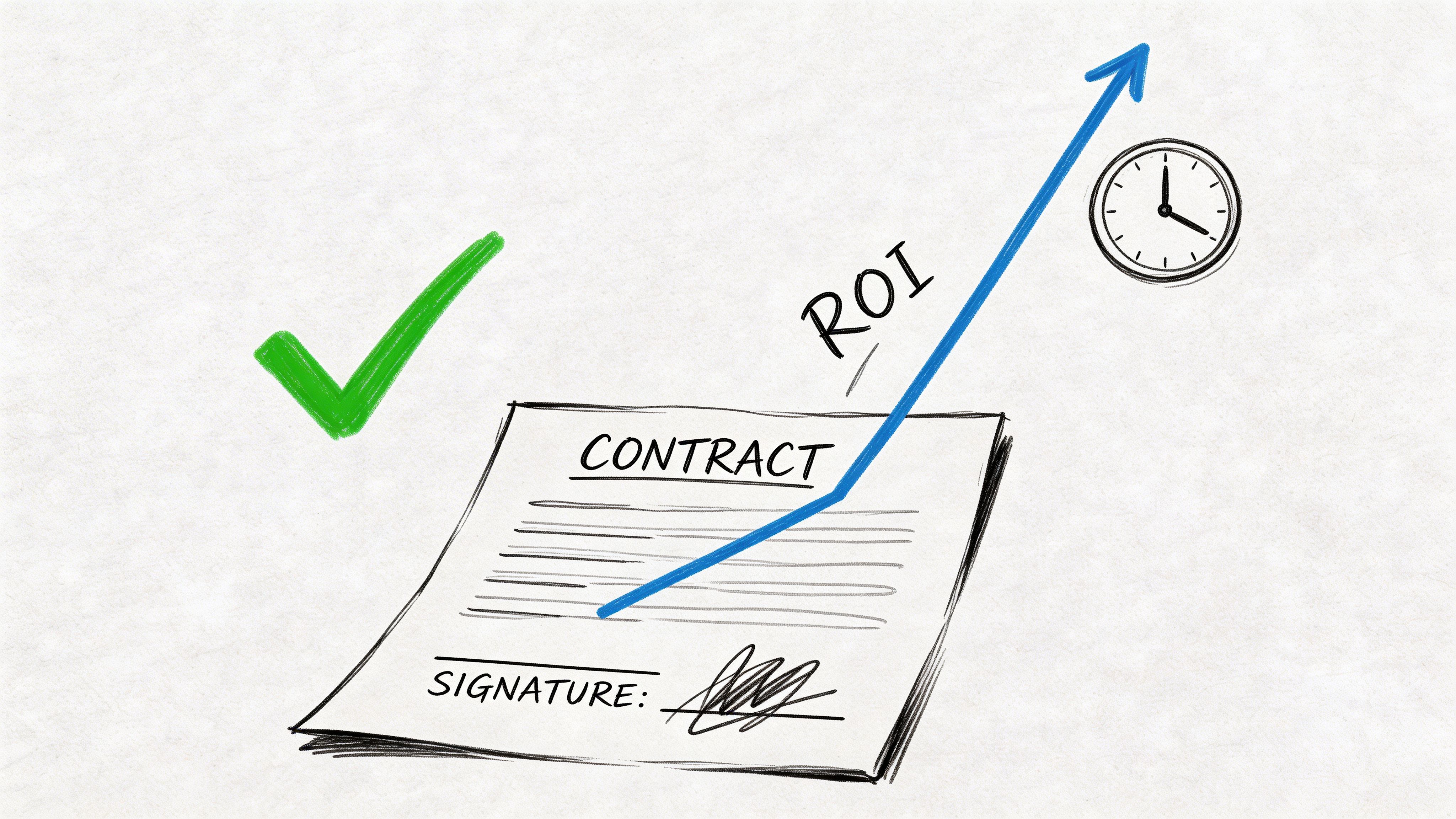
A deal isn’t real when both sides say “sounds good”. It’s real when the scope, timeline, rights, payment terms, and tracking method are documented clearly enough that nobody has to interpret them later.
That’s where a lot of influencer programs break down. The negotiation was fine, but the operational handoff was sloppy.
Put the commercial terms in writing immediately
The fastest way to create friction is to renegotiate details after verbal agreement.
Your statement of work or contract should cover:
Deliverables. Exact format, quantity, and platform.
Deadlines. Posting window, draft review dates, and approval timeline.
Payment terms. Deposit if any, invoice requirements, and payment date.
Usage rights. Organic reposting, paid ads, whitelisting, duration, and channels.
Exclusivity. What category counts as a competitor, and for how long.
Reporting mechanics. Codes, links, screenshots, or platform access expectations.
If you need a solid template reference for the legal side, this is the one internal resource I’d keep on hand: https://sup.co/blog/the-complete-guide-to-influencer-contracts-and-agreements
Treat attribution as part of the negotiation, not admin
If performance matters, bring tracking into the deal before content goes live.
According to Portent’s negotiation guidance, UK influencer ROI rose 28% in 2025 for campaigns using real-time tracking such as promo codes and UTMs. The same source says 65% of agencies struggle with fragmented tracking, which contributes to failed renewals, and notes a 40% adoption spike in AI attribution tools among UK brands.
That has a direct negotiation implication. When both sides know how results will be tracked, the conversation shifts away from “what does one post cost?” and towards “what performance are we trying to generate?”
What to include in your tracking setup
Use one attribution stack per creator:
Tracking element | What it does |
|---|---|
Unique UTM link | Identifies creator-specific traffic |
Unique promo code | Connects sales or bookings to the creator |
Content naming convention | Keeps internal reporting clean |
Payout notes | Links bonuses or milestones to verified actions |
For hospitality brands, this might mean a creator-specific booking link or offer code. For ecommerce, it’s usually a discount code plus UTM-tagged destination page.
A useful clause for performance-led campaigns
If you want cleaner renewals, spell out the review process upfront.
Use language like this:
We’ll review performance against agreed dashboard metrics after the campaign window closes. That includes clicks, code uses, conversions, or bookings where applicable. If the partnership performs well, we’d like first discussion rights on a repeat collaboration.
That clause does two jobs. It shows the creator you’re serious about measurement, and it opens the door to longer-term work without promising it blindly.
Clear attribution protects both sides. The brand can justify spend. The creator can point to results instead of defending a rate in the abstract.
Don’t leave payment vague
Creators remember two things for a long time. Brands that paid cleanly, and brands that didn’t.
Be explicit on when payment is made, what triggers it, and whether content approval affects the invoice. Keep the workflow boring. Boring is good here.
A clean closeout process usually includes:
Same-day written confirmation after verbal agreement
Single source of truth for assets, links, codes, and deadlines
Prompt payment processing once deliverables are complete
Post-campaign results summary so the creator sees the outcome
A lot of renewal problems aren’t performance problems. They’re clarity problems. When the campaign is easy to execute and easy to measure, creators want to work with you again.
Advanced Strategies for Scaling and Long-Term Partnerships
One-off negotiation advice breaks down when you’re trying to run influencer as a channel, not a side project. At that point, the job changes.
You’re no longer asking, “How do I get this creator over the line?” You’re asking, “How do I build a repeatable system that keeps good creators, filters out poor fits, and turns local content into measurable revenue?”
The common assumption is that scaling means standardising harder and pushing rates down. In practice, that usually creates worse creator relationships and weaker output.
Local creators often outperform bigger names for practical reasons
For location-specific campaigns, the economics can favour smaller creators. According to Sprout Social’s negotiation guidance, UK micro-influencers deliver 22% higher engagement rates and 60% more cost-effective conversions for local campaigns. The same source points to a useful tactic that many guides miss: a 15% uplift for a 90-day regional non-compete, and notes that 78% of UK nano-influencers prefer performance bonuses and stable local gigs over flat fees.
That matters for restaurants, fitness chains, clinics, retail stores, and franchise groups. The creator who matters most isn’t always the one with the biggest audience. It’s the one whose audience can act nearby.
Use retainers to reduce constant renegotiation
If a creator has already shown fit, don’t keep buying them one post at a time unless you have to.
A simple retainer can include:
Monthly content volume with a clear posting cadence
Preferred rate in exchange for commitment
Review point after an initial trial window
Optional local exclusivity if the market justifies it
That structure helps both sides. The creator gets predictable work. The brand avoids restarting negotiation from zero every few weeks.
A practical retainer message might read like this:
We’ve liked both the content quality and the way you work. Rather than brief you ad hoc, we’d be interested in a recurring arrangement if that suits you.
We’re thinking in terms of a monthly package with a preferred rate, a clear content calendar, and agreed tracking so we can review performance consistently. If local exclusivity matters, we can discuss that as a separate paid term.
That last line is important. Exclusivity should almost never be treated as a free extra.
What to do when negotiation stalls
Deadlocks usually happen for one of three reasons:
Reason | What it looks like | Best next move |
|---|---|---|
Budget mismatch | You’re far apart on fee | Reduce scope or walk away cleanly |
Rights mismatch | They resist broad usage | Split organic and paid rights |
Risk mismatch | They want certainty, you want performance | Introduce base fee plus bonus |
If you hit a stall, don’t argue harder. Change the shape of the offer.
Try:
I don’t want to force a structure that doesn’t feel fair to either side. If the flat fee and rights package isn’t the right fit, we could simplify this to a smaller initial scope and revisit based on results.
That preserves the relationship, even if the deal doesn’t happen now.
Red flags that show up during negotiation
Not every creator who says yes is worth onboarding.
Watch for:
Unclear communication. Repeatedly vague on deliverables, timing, or invoice details.
Refusal to define scope. Wants an open-ended brief with no clear boundaries.
Pushback on disclosure or compliance. A serious warning sign.
Last-minute rate changes. Especially after scope was already agreed.
Poor responsiveness before signing. Usually gets worse after signing, not better.
A red flag doesn’t mean someone is a bad creator. It means they may be a bad operational fit for your team.
The brands that scale creator partnerships well aren’t the ones that win every negotiation. They’re the ones that know which negotiations are worth continuing.
Build a creator bench, not a creator roulette wheel
The most efficient teams keep a tiered roster:
Core partners for recurring campaigns
Test creators for new audiences or regions
Specialists for seasonal pushes or launches
That model keeps you from overdepending on any single person and reduces panic when a brief lands quickly.
It also changes your negotiation posture. You stop negotiating from scarcity. You start negotiating from process. Creators feel that difference. Conversations become calmer, more respectful, and more sustainable.
That’s the operational side most influencer advice skips. If you want influencer to behave like a growth channel, your negotiations need to produce systems, not just deals.
Frequently Asked Questions About Influencer Negotiation
Should I ever lowball just to see if they’ll take it
No. If your real aim is a long-term creator network, lowballing is expensive even when it “works”.
You may get a yes from someone who needs the cash, but you’ve started the relationship with resentment. That usually shows up later in delayed replies, lower effort, awkward revisions, or refusal to work together again.
A better move is to explain your real range and reshape scope.
Is gifted-only ever appropriate
Yes, but only in a narrow set of situations.
Gifted works when the creator is already a natural fit, the ask is light, and there is no expectation of guaranteed deliverables unless that has been explicitly agreed. It tends to work better for genuine product trials or local hospitality experiences than for campaigns needing structured content output.
If you need deliverables, timing, review rounds, or usage rights, paid is usually the cleaner route.
What if a creator ignores my counteroffer
Treat silence as a signal, not a personal rejection.
Follow up once, briefly. If there’s still no reply, close the loop politely and keep the door open.
Use this:
Thanks again for the conversation. I understand if the current structure isn’t the right fit. If your availability or preferred scope changes in future, I’d be glad to reconnect.
That keeps your reputation intact.
How do I know if a creator is overpriced
Don’t judge only on follower count.
Look at niche fit, content quality, comment quality, likely conversion intent, location relevance, ease of working together, and whether the content has reuse value. A creator can be expensive on paper and still be good value. Another can look cheap and still waste your team’s time.
“Overpriced” usually means the package doesn’t match your objective, not that the person is wrong to charge what they charge.
Should I ask for usage rights in the first deal
Only if you need them.
Many brands ask for broad rights by default, then never use them. That increases negotiation friction for no reason. If reuse is uncertain, keep the first deal narrower and add rights later if the content earns it.
That approach is often easier for both sides to accept.
How quickly should I pay influencers
As quickly as your finance process allows, with the timing stated clearly in writing before work starts.
Fast, predictable payment is one of the easiest ways to become a preferred brand. It also reduces follow-up friction and makes renewals smoother. If your internal process is slow, be transparent about it early.
What if I can’t reach a fair rate
Walk away well.
A clean “not this time” is far better than dragging someone through a negotiation you already know won’t close. Thank them, be direct, and leave the relationship usable for a future brief.
This is a small industry. Professional exits matter.
What’s the simplest mindset to keep during negotiation
Think like an operator, not a bargain hunter.
You’re trying to build a repeatable acquisition and content system with real people at the centre of it. The right rate is the rate that supports the brief, respects the creator, and leaves room for the relationship to continue.
If you want to turn influencer negotiations into a repeatable, trackable workflow instead of a pile of DMs and spreadsheets, Sup helps brands source micro and nano creators, manage outreach, assign promo codes and UTMs, and track views, clicks, conversions, bookings, and revenue in one place. It’s built for teams that need measurable creator ROI without handling every negotiation manually.
Matt Greenwell
Share