How to Run Influencer Campaigns for Multiple Restaurant Locations in 2026

Matt Greenwell
Mar 11, 2026
When you’re running a restaurant brand with multiple locations, your biggest challenge is often a balancing act. You need to maintain a consistent brand identity, but you also need each restaurant to feel like a genuine part of its local neighbourhood. This is where a hyper-local influencer strategy comes in.
Forget chasing big-name celebrities. The key is to focus on partnering with nano and micro-influencers who have a real, established connection to the community around each specific branch. This approach is what turns online buzz into actual footfall.
Why Hyper-Local Influencers Are Your Secret Ingredient
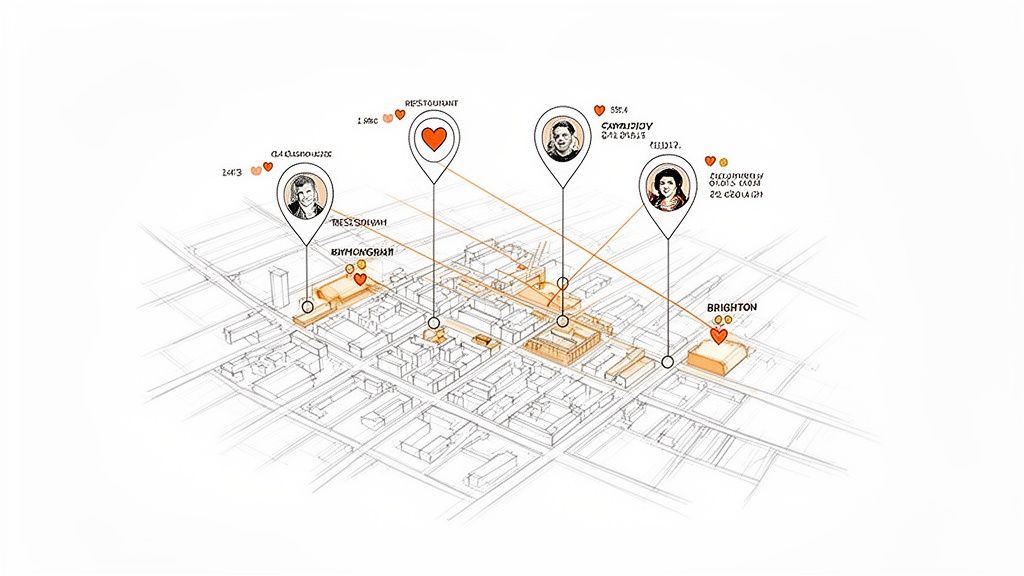
A single, nationwide campaign might get your brand name out there, but it’s not going to convince someone in Manchester to pop into your new spot on their high street. To do that, you need voices that people in Manchester actually listen to.
Hyper-local influencers are the creators who live, work, and dine in the very communities your restaurants serve. Their followers trust their recommendations because they feel authentic and, most importantly, relevant to their own lives.
The Power of Local Authenticity
Think about it from a customer's perspective. A recommendation from a creator who regularly posts about their favourite local parks, independent coffee shops, and weekend markets feels less like a paid advert and more like a genuine tip from a friend. That authenticity is precisely why this strategy is so effective for multi-location restaurants.
A food blogger with 5,000 followers concentrated in Brighton, for instance, has far more sway over their audience’s dining habits than a celebrity with five million followers scattered across the globe. Their content hits home because it’s relatable and, crucially, actionable for their local audience.
This isn’t just a hunch; it’s backed by solid market trends. The UK influencer marketing industry, valued at USD 2.36 billion in 2024, is forecast to grow at an incredible 29.5% CAGR through 2029. For chains, this is a huge opportunity, particularly on Instagram, the platform of choice for 89% of UK brands.
With 69% of consumers buying something after seeing an influencer recommend it—a figure that climbs to nearly 79% for Gen Z and Millennials—the line between local content and customer action is crystal clear. You can find more data by exploring the complete statistics about the UK influencer market and its projected growth.
Turning Online Buzz into Offline Customers
Ultimately, any restaurant marketing campaign has one goal: getting more bums on seats. Hyper-local campaigns are exceptionally good at bridging the gap between a ‘like’ on Instagram and a customer walking through your door.
By focusing on creators who are genuinely part of the local fabric, you're not just buying reach; you're investing in trust. This trust is what convinces someone to leave their house and try your restaurant—not just for a one-off visit, but to become a regular.
This targeted strategy delivers a real, measurable return on investment. For every £1 spent, UK brands are seeing an average return of £5.78, and 55% of marketers can directly attribute revenue growth to their influencer programmes.
To make this strategy work, we need a clear framework. The table below summarises the core pillars of a successful localised campaign.
Quick Guide to Localised Influencer Marketing Success
Pillar | Actionable Focus | Key Outcome |
|---|---|---|
Localised Sourcing | Find creators based on postcodes or specific neighbourhoods, not just cities. | Authentic partnerships with creators who genuinely know the area. |
Operational Ease | Equip each location manager with simple tools to manage visits and offers. | Smooth, positive experiences for both influencers and restaurant staff. |
Impact Tracking | Use unique promo codes or UTM links for each influencer at each location. | Clear data on which partnerships are driving bookings and sales. |
Scalable Process | Create a repeatable playbook for launching campaigns in new cities or branches. | Consistent and efficient growth of your influencer programme across the UK. |
By mastering these four areas, you can shift your focus from vanity metrics like follower counts to what really matters: table bookings, in-store visits, and loyal customers. A well-run campaign with local creators in Birmingham, Bristol, and beyond ensures your brand message is not just heard, but felt and acted upon by the right people, in the right places.
Laying the Groundwork for a Campaign That Scales
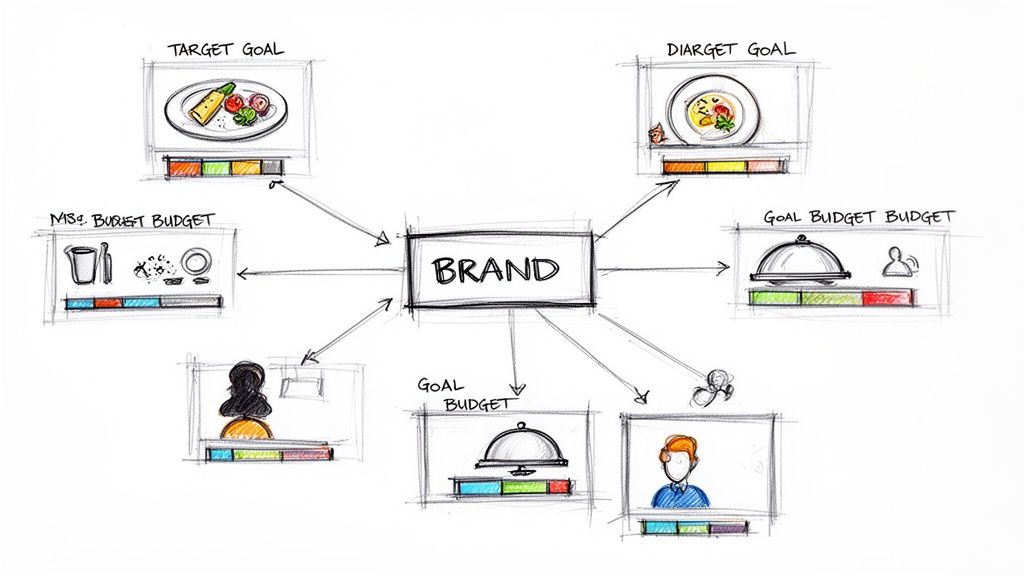
Here's a truth I've learned from running countless campaigns: successful multi-location influencer marketing isn't about getting lucky. It comes from a solid, repeatable plan that can grow right alongside your restaurant group. Before you even think about messaging your first creator, you need to get your strategy on paper.
This blueprint is your single source of truth. It’s what stops you from managing a dozen disconnected, chaotic campaigns. It ensures every partnership, whether in Manchester or Cardiff, is pulling your brand in the same, deliberate direction. Without this plan, you're just throwing money at the wall and hoping something sticks.
Set Goals That Matter for Each Location
First things first, let’s get specific. A vague, group-wide goal like "increase brand awareness" is a recipe for failure. What does that even mean for the individual manager on the ground? You need to dig into the unique challenges and opportunities at each one of your restaurants.
Think about it. What does each branch actually need? Is your Leeds restaurant dead on a Tuesday lunchtime? Is the goal for your Bristol spot to own the weekend brunch scene? These distinct commercial goals will dictate every choice you make from here on out.
A few examples of what strong, location-specific goals look like:
Liverpool Location: Increase bookings for our new Thursday evening set menu by 20% within three months.
Edinburgh Location: Drive footfall during the Fringe Festival by promoting a "pre-theatre" special offer.
Birmingham Location: Create a real buzz around the new cocktail menu to pull in a younger, after-work crowd.
A campaign without a clear, commercial goal is just a fun-but-expensive PR exercise. By setting sharp, measurable targets for each restaurant, you can focus your influencer strategy on solving real business problems and properly measure your return.
Who Are Your Local Tastemakers? Build a Persona
Once you know what you're trying to do, you need to figure out who can help you do it. The ideal customer for your suburban family-friendly spot is completely different from the one at your city-centre cocktail bar. Your ideal influencer will be, too. This is where a "creator persona" comes in.
This isn’t just about follower count. A creator persona is a detailed profile of the perfect local influencer for a specific branch. It covers their content style, the makeup of their audience, and their personal passions.
To build one, start asking questions:
Who is the target customer for this specific location? Are we talking about young professionals, families with kids, or students?
What kind of content do they actually engage with? Is it polished, aesthetic food shots, casual 'day-in-the-life' vlogs, or helpful guides to family days out?
What are they into outside of just food? Think local art, fitness, or sustainable living.
This exercise forces you to find creators who are a genuinely good fit, which always leads to more authentic and powerful content. If you're juggling a lot of locations, this is where you can get some serious time back. Taking a look at different influencer marketing platforms can help you filter and find these people much more efficiently.
Write a Brief That Inspires, Not Restricts
A brilliant campaign brief walks a fine line. It needs to give just enough direction to protect your brand message but also offer enough creative freedom for the influencer to make something that feels real. I've seen it time and again: a rigid, corporate brief leads to robotic, awkward content that flops.
Think of your brief as a guide, not a script. Lay out the absolute non-negotiables—like key messages or a campaign hashtag—but then empower the creator to bring the story to life in their own style.
A solid, scalable brief template should always have:
The Big Idea: What's the campaign about in a single sentence?
Location-Specific Goals: The main thing we're trying to achieve for this restaurant.
Key Talking Points: Just 2-3 essential messages to get across (e.g., "our new vegan menu," "we source from local suppliers").
Content Deliverables: What you need them to create (e.g., 1 Instagram Reel, 3 Stories).
The "Dos and Don'ts": Simple guidelines on brand voice, visual style, and anything to steer clear of.
Lastly, be smart with your budget. Instead of one big pot of money, assign funds based on each location's specific goals and market size. A splashy new opening in London will naturally need more investment than a campaign to boost weekday lunch in an established branch. This flexible approach ensures your money is always working as hard as it possibly can.
Finding and Vetting Local Influencers at Scale
So, you’ve got your campaign blueprint ready to go. Now comes the real challenge: finding and vetting the right creators for each of your restaurant locations.
If you’ve ever tried this manually, you know the drill. Hours spent scrolling through hashtags on Instagram, searching for creators in each city, and hoping for the best. It’s a slow, soul-crushing process that just doesn't work when you're managing more than a couple of branches. If you have ten restaurants, you can’t afford to lose a week just building a prospect list.
The old way of doing things—endless DMs, messy spreadsheets, and crossed fingers—is a recipe for failure at scale. To do this properly, you need a system.
From Manual Chaos to Smart Sourcing
Let’s be honest, the traditional method of finding influencers is broken. You start with a hopeful search for something like #manchesterfoodie, scroll for what feels like an eternity, and painstakingly copy-paste profiles into a spreadsheet. Then the real work begins: manually checking their engagement, guessing at their audience demographics, and sending a cold DM that will probably get buried.
It’s a logistical nightmare for a single restaurant, let alone a growing group trying to coordinate campaigns across Bristol, Leeds, and Edinburgh all at once. The quality and consistency just aren't there.
This is where a dedicated creator discovery platform completely changes the game. These tools are built to find verified, on-brand creators using precise location data, audience insights, and past performance metrics. You stop guessing and start making decisions based on solid data.
Here’s what a modern campaign management dashboard looks like. It brings all your communication, tracking, and content into one central hub.
The advantage over a spreadsheet is immediate. You get a real-time view of all your active campaigns, creator progress, and content approvals in one place.
A Vetting Checklist That Goes Beyond Follower Count
Once you have a list of potential partners, it’s time to vet them properly. And let me be clear: follower count is the least important metric. What really matters is a creator's genuine connection with their community and their ability to inspire action.
For a deeper look into this process, check out our complete guide on how to find local food influencers in your city.
As you qualify creators for each location, run them through this checklist:
Authentic Engagement Rate: You’re looking for 3% or higher. A low engagement rate on a huge account is a major red flag for fake followers. To calculate it, add up the likes and comments on their last 10 posts, divide by 10, then divide by their total followers and multiply by 100.
Audience Location: Do their followers actually live near your restaurant? Ask creators for a screenshot of their audience analytics from their Instagram insights. This is non-negotiable for a local campaign.
Content Quality and Vibe: Does their aesthetic match your brand? Look for high-quality photos and videos, thoughtful captions, and a consistent style. Does it feel like a good fit?
Community Interaction: Do they reply to comments? A creator who actively engages with their audience has built a foundation of trust that is incredibly valuable.
Brand Alignment: Scroll through their past partnerships. Do they align with your brand’s values? Someone promoting fast-food chains one day and fine dining the next might not have the credibility you need.
Remember, you’re not just buying a post; you’re partnering with a local tastemaker. Their personal brand directly reflects on yours, so choose creators whose values and content you would be proud to associate with your restaurant.
This is especially true as the market shifts. UK restaurant chains are seeing huge success by moving away from expensive macro-influencers and focusing on scalable campaigns with dozens of micro-creators.
While Instagram remains a powerhouse with 57% effectiveness, TikTok’s 66% adoption rate among marketers is driving a new wave of viral short-form video. Nano-influencers, with their incredible 15.2% engagement rates on TikTok, are perfect for hyper-local campaigns and can generate up to 69% purchase intent. You can discover more statistics about the power of influencer marketing and how it’s shaping consumer behaviour.
Making Your Multi-Location Campaign Run Like Clockwork
You’ve got your plan and you’ve found your creators. Now for the hard part: execution. This is where your carefully laid plans hit the real world, and honestly, smooth operations are what separate the successful campaigns from the ones that crash and burn.
Running a campaign across several restaurant locations isn’t just about sending a few emails. It’s a logistical puzzle. The trick is to build a system you can repeat and scale, whether you're working with five creators or fifty. Remember, the experience you give your influencers is just as important as the one they have in your restaurants. A chaotic, disorganised process will kill the vibe before they've even tried the food.
Ditch the DMs and Spreadsheets
Let’s be honest. Trying to manage dozens of conversations across multiple cities with Instagram DMs and a messy spreadsheet is a recipe for disaster. Details get lost, follow-ups are missed, and your team wastes more time on admin than on actually building relationships. This is where campaign management platforms become your best friend.
These tools help you move away from manual chaos by automating personalised outreach. You can set up templates for your first message, follow-up nudges, and visit confirmations, which then get customised for each creator and their specific location. This guarantees every influencer gets a professional, consistent experience that makes your brand look good from the get-go.
Imagine you're launching a new summer menu across your ten locations. Instead of painstakingly contacting 50 different creators one by one, you could:
Send out one personalised message blast to all your chosen influencers.
Automatically see who has opened, replied, and agreed to come in.
Set up reminders to follow up so no one falls through the cracks.
This frees up your marketing team to do what they do best—nurturing key relationships and digging into the campaign data, rather than getting buried in their inbox.
Your Local Teams are Your Secret Weapon
An influencer campaign can fall apart the second the creator walks through the door if your on-site team is out of the loop. Picture this: an influencer shows up at your Bristol branch for their booked meal, only to be met by a confused host who has no idea who they are. It’s an absolute nightmare. It’s unprofessional and practically guarantees you’ll either get a bad review or no content at all.
Briefing your local restaurant managers and front-of-house staff is non-negotiable. They are the face of your brand for that visit and are crucial for making sure the influencer has an amazing time.
Your local manager isn’t just a host; they are your on-the-ground campaign ambassador. A warm, informed welcome makes a creator feel valued and sets the stage for genuine, positive content. This simple step is one of the most overlooked yet impactful parts of running influencer campaigns for multiple restaurants.
For every visit, give the location manager a simple one-page brief. It should include:
The influencer’s name and social media handle.
The date and time of their booking.
The specific offer (e.g., a complimentary meal for two, up to £70).
The campaign's main goal (e.g., promoting the new cocktail menu).
This little bit of prep makes all the difference and ensures a smooth, VIP experience from start to finish.
A Central Hub for Content and Approvals
Once the content starts rolling in from all your different locations, you need one central place to manage it. Chasing creators for their posts and stories via email or DMs is a huge time-waster. A good campaign platform gives you a dedicated space where influencers can submit their draft content for you to look over.
For multi-location campaigns, getting top-notch visuals is essential, especially when you're showing off your food. Great culinary photography can make a huge difference in how well your influencer posts perform. Having a central approval workflow helps maintain brand consistency across all locations, letting you give quick feedback and the final thumbs-up.
This kind of system creates a clear, documented trail of all communications and approvals, which protects both you and the creator. Better yet, it helps you build a library of user-generated content that you can repurpose later. This turns the execution phase from just a posting exercise into a way to create valuable marketing assets for the future.
Measuring Real ROI: From Clicks to Customers
Likes and shares are nice, but they don't keep the lights on. When you're running influencer campaigns across multiple restaurant locations, success isn't measured in hearts and comments—it's measured in booked tables, online orders, and actual footfall. This is where we stop chasing vanity metrics and start tracking real-world impact.
The key is to give each influencer a unique, trackable asset for every single location they promote. It sounds simple, but this is the foundation of attribution. It lets you see precisely who is driving results and where. Without it, you're flying blind.
Connecting Content Directly to Covers
The most reliable way to connect an influencer’s post to a customer’s booking is by using tools that leave a clear digital trail. We’re talking about unique promo codes and custom, UTM-tagged links. These aren't just technical extras; they’re the only way to get a true read on your campaign's performance.
Let's say you're working with ten food bloggers to push your new lunch menu across your Manchester and Liverpool spots. A generic "mention us" just won't cut it. Instead, you need to arm each creator with specific assets.
For instance, a Manchester-based influencer could get:
A unique promo code like “FOODIEMCR15” for 15% off.
A custom booking link:
yourrestaurant.co.uk/book-manchester?utm_source=instagram&utm_medium=influencer&utm_campaign=lunch_promo&utm_content=foodiemcr
This level of detail means you can trace every single booking or code redemption back to a specific creator and location. You're no longer wondering if a campaign worked; you're seeing exactly how much revenue it generated.
To help you decide which tracking tools fit your goals, here’s a quick breakdown of the most common methods.
Attribution Methods for Multi-Location Campaigns
Tracking Method | How It Works | Best For Measuring | Implementation Ease |
|---|---|---|---|
Unique Promo Codes | Each influencer gets a distinct code (e.g., “HANNAH20”) for customers to use at checkout or in-store. | In-store redemptions, online orders, and offer popularity. | Easy |
UTM-Tagged Links | Custom URLs that track the source, medium, and campaign for every click. | Online bookings, clicks to your menu, and website traffic sources. | Moderate |
Affiliate Links | Special links that track clicks and attribute sales, often paying the influencer a commission. | Direct online sales and order value. | Moderate to Hard |
"How did you hear?" | Staff ask customers at the point of booking or payment how they found out about the restaurant. | General brand awareness and qualitative feedback. | Easy |
Choosing the right mix of these methods will give you the clearest possible picture of what's actually working.
Centralising Your Data for a Clearer Picture
Managing dozens of unique codes and links across multiple cities sounds like an admin nightmare, but it doesn't have to be. The trick is to pull all this data into one central dashboard. This is where a good campaign management platform really earns its keep, turning scattered data points into intelligence you can act on.
A unified dashboard gives you a live overview of campaign performance, letting you compare results at a glance. You can instantly see which influencers are genuinely connecting with local audiences and which partnerships might need a rethink.
The goal is to build a performance-driven culture for your influencer marketing. When you can clearly see that one creator drove 50 table bookings in Bristol while another only drove five, you know exactly where to reinvest your budget next time.
This data-first approach lets you make smarter decisions, optimise your spend, and prove the value of your work to stakeholders. Once your campaigns are live, it’s vital to effectively track and learn how to measure social media ROI to justify your investment and sharpen future strategies.
Building Your Evergreen Content Library
A great influencer collaboration delivers more than just immediate sales. It also gives you a ton of authentic, high-quality user-generated content (UGC). Every photo, Reel, and Story is a valuable marketing asset that you absolutely should be repurposing.
Don't let this brilliant content just fade away on the social media timeline. Create a central library to house it all. This organised collection becomes a goldmine for your own marketing channels. For a deeper dive, our article on measuring influencer marketing ROI offers more detailed insights.
The campaign process itself, from outreach to the creator's visit, is designed to produce this content.
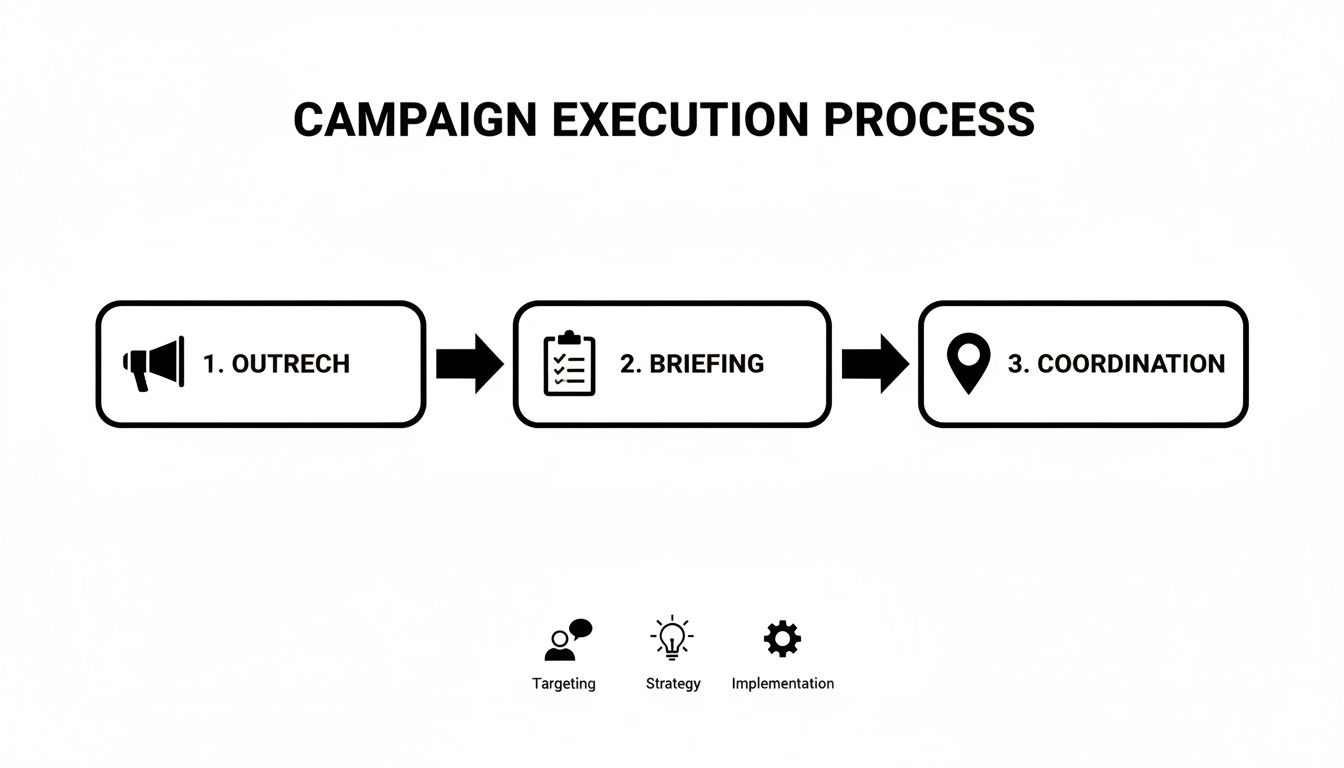
A smooth, structured process makes for a happy creator, and happy creators produce the best content. By having a central place to store all this UGC, you can easily grab compelling visuals for:
Your own social media feeds: Share an influencer's fantastic shot of your signature burger, giving them full credit in the caption.
Email newsletters: Feature a collage of UGC to show off the brilliant atmosphere at your different locations.
Your website: Create a "Community" or "As Seen On" gallery on each location's page.
Digital ads: Repurpose high-performing influencer content for paid social campaigns. It adds a layer of authenticity that stock photos can't match and often boosts conversion rates.
By collecting and reusing UGC, you extend the life and value of every partnership. You're turning a one-off post into an evergreen asset that continually works for your brand. This shifts your campaign from a short-term promotion into a long-term content engine.
Your Top Multi-Location Campaign Questions, Answered
When you're juggling influencer campaigns across several restaurant locations, a few common headaches always seem to pop up. Let's walk through the most frequent challenges I see and tackle them with some practical, real-world advice.
What if My Restaurant Locations Have Different Prices?
This comes up all the time, especially for chains with sites in, say, London and Liverpool. It’s completely normal for your prices to vary. The trick is to handle it with total transparency to avoid any awkward moments for the creator or their followers.
Clarity from day one is everything. When you bring a creator on board for a specific location, your brief needs to be crystal clear about the value of their gifted experience, based on that particular branch’s menu.
For instance, forget vague offers like a “complimentary meal for two.” Instead, be precise:
Manchester Brief: “We’d love to host you for a meal and drinks for two, up to a value of £80.”
London Brief: “We’d love to host you for a meal and drinks for two, up to a value of £120.”
This immediately sets the right expectations and saves everyone from a surprise when the bill comes. It also means you’re keeping a firm grip on your budget for each site, which is absolutely essential for measuring the true ROI of your campaign.
My best advice is to always tie your gifted experience to a specific monetary value, not just a list of menu items. It gives the influencer freedom to order what they genuinely want, while you keep your costs predictable.
How Do I Keep My Brand Consistent with Diverse Local Creators?
Trying to maintain a consistent brand image while working with dozens of different local creators can feel like a tightrope walk. You hired them for their unique voice, so the last thing you want is a feed full of identical, soulless posts. The secret weapon here is a well-thought-out campaign brief.
Think of your brief as a set of guardrails, not a rigid script. Your goal is to give creators a clear vision for the campaign without killing the very creativity you wanted in the first place.
Here’s what a strong brief for a multi-location campaign should include:
Core Brand Pillars: Name 2-3 non-negotiable messages or values. Maybe it’s “We use locally-sourced ingredients” or “We’re a family-run business.” These are your must-haves.
Visual Mood Board: A picture really is worth a thousand words. Share a small collection of images that nail your brand’s aesthetic. It’s far more effective than a long list of dos and don'ts.
The "No-Go" Zone: Clearly, but briefly, list anything you want creators to steer clear of. This could be competitor mentions, sensitive topics, or certain photo filters. Keep it short and sweet.
This approach gives creators the space they need to make content that feels authentic to their audience, all while making sure their work still feels like your brand. It’s all about finding harmony, not forcing uniformity.
How Can I Start If I Have a Very Tight Budget?
You absolutely do not need a huge budget to get started with influencer marketing. In fact, starting small and smart is often the best way forward. With a tight budget, your best bet is to run a gifting-only or “contra” campaign.
This simply means you offer an influencer a complimentary experience—like a meal and drinks—in exchange for an agreed-upon amount of content (e.g., one Instagram Reel and three stories). This approach is perfect for working with nano-influencers (1k-10k followers). These creators are typically passionate local foodies who are genuinely excited to share great spots with their highly engaged community.
Don't underestimate the power of these smaller accounts. Their tight-knit follower base often translates into higher trust and much better engagement rates than you'd see with a huge influencer. For a restaurant, one heartfelt post from a trusted local can do more than a pricey paid ad ever could.
Here’s a simple way to get going on a budget:
Find 5-10 nano-influencers in the city of one of your key restaurant locations.
Send them a personalised message offering a complimentary dining experience for them and a plus-one.
Be upfront about the content you'd love to see in return.
Track your results. You can use a unique promo code or simply have your staff ask new customers how they heard about you.
This is a fantastic, low-risk way to test the waters, build real relationships with local creators, and collect a bank of great user-generated content without spending any cash upfront.
Ready to scale your influencer marketing without the manual guesswork? Sup is the all-in-one platform that helps multi-location restaurants launch, manage, and measure creator campaigns that drive real footfall. Book a demo today and see how we can save you 95% of your time while boosting your ROI.
Matt Greenwell
Share