You’re at the awkward middle stage.
A handful of creators are posting. Some content is working. You can see the upside. But your day is now spent chasing replies, checking whether a Reel went live, updating a spreadsheet no one fully trusts, and trying to remember which creator got which code, product, brief, invoice, and approval note.
That setup can produce early wins. It cannot produce scale.
How to Scale Influencer Marketing From 5 to 500 Creators is not a question about finding more creators. It is a question about building operations that can survive volume. Once you cross out of single-digit partnerships, your bottlenecks stop being strategy and start being workflow, attribution, approvals, payments, and team design.
The brands that scale this well do not “do more influencer marketing”. They build a repeatable engine around it.
The Foundational Shift From Manual Methods to a Systemised Engine
The break happens on a normal Tuesday.
A creator asks whether the brief in email is the latest version. Finance wants the invoice that was approved in Slack. Someone on the team cannot tell whether the post is late or whether the creator never accepted the deal. None of those problems look serious on their own. Together, they tell you the programme is being held together by memory.
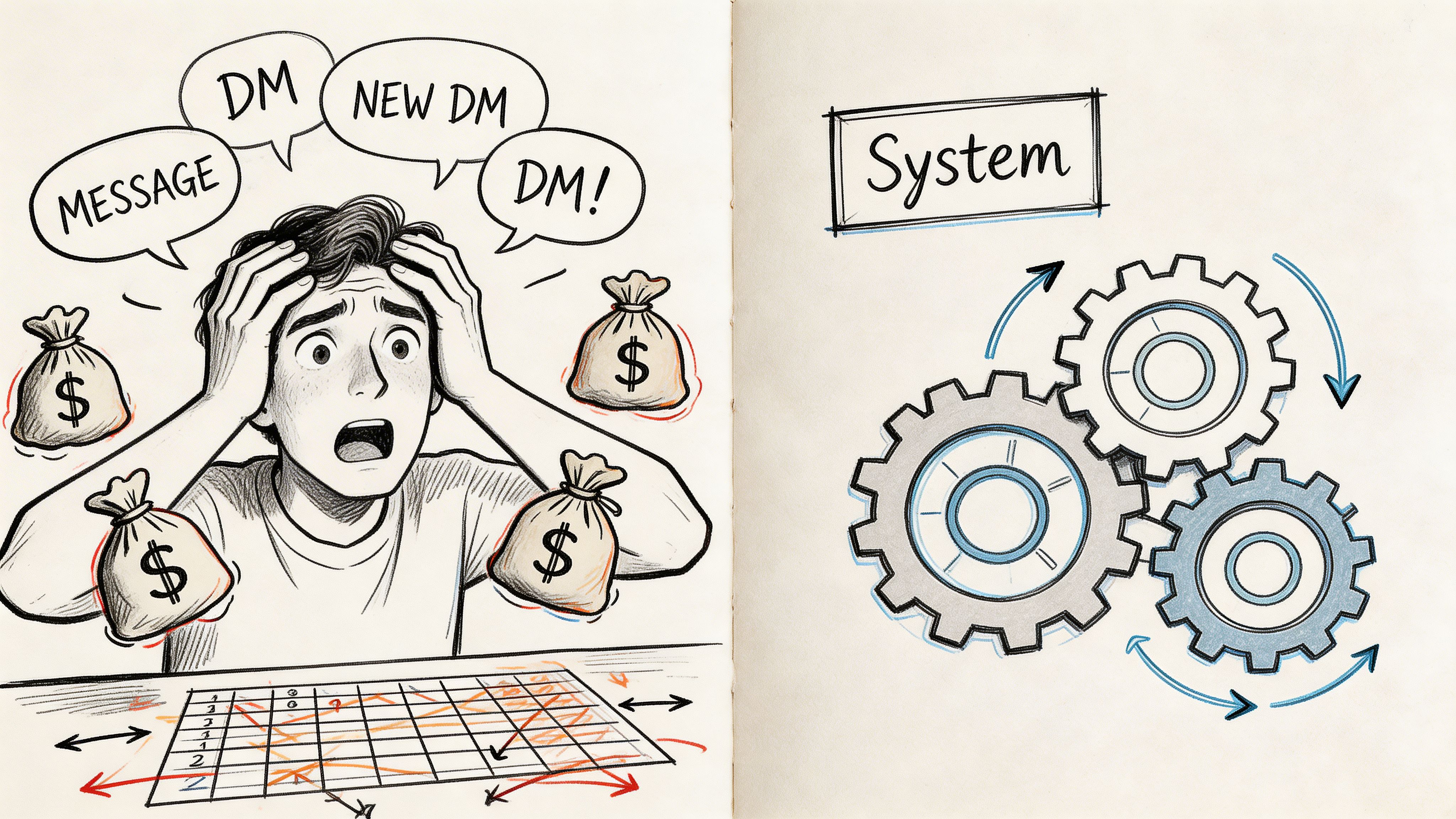
That is the point where influencer marketing stops being a creator problem and becomes an operations problem. Five creators can sit in a spreadsheet because one person still remembers every agreement, every code, and every exception. At fifty, that memory breaks. At five hundred, the programme breaks with it.
The cost is not only admin time. It shows up in missed approvals, duplicated outreach, late payments, lost usage rights, weak attribution, and reporting that arrives after decisions needed to be made. Teams often blame volume. The actual issue is that the operating layer was never built.
What breaks first
Creator sourcing gets a lot of attention, but it is rarely the first failure point. The first failure point is the system of record.
If creator status lives in a sheet, approvals live in email, content lives in Drive, contracts live with legal, and performance lives in a separate dashboard, nobody has a reliable view of the programme. The team starts asking basic questions too:
Where is this creator in the workflow?
Which brief version did they receive?
Has the content been approved for paid usage?
Has finance paid them yet?
Did this post generate sales, or only reach?
Once those answers depend on chasing people, the programme has already outgrown its setup.
A Shift in Mindset
Scaling creator programmes is a systems design job.
At the start, the work is hands-on. You write the outreach, send the product, review the draft, and check the post yourself. As volume rises, your job changes. You are designing the path each creator moves through, the handoffs between teams, the approval logic, the payment rules, and the reporting structure that tells you what is working without a manual audit every Friday.
That shift matters because manual effort does not get slower at scale. It gets less reliable. Every exception creates another side conversation. Every side conversation creates another gap in attribution or accountability.
A systemised setup looks like this:
Manual setup | Systemised setup |
|---|---|
One-off DMs | Sequenced outreach with tracked stages |
New brief built from scratch | Reusable templates by campaign type |
Spreadsheet status updates | Central creator record with clear ownership |
Reminder messages sent manually | Triggered follow-ups based on stage |
Performance checked after the campaign | Live reporting by creator, content, and offer |
Practical rule: if a task repeats every campaign, document it first. If it repeats across team members, turn it into a workflow. If it fails when one person is away, automate or reassign it.
The same operating discipline shows up in adjacent growth functions. Teams that understand how to Scale Content Creation adapt faster here because they already work with approval queues, asset libraries, reusable formats, and production timelines.
Build the operating layer before increasing volume
A lot of brands try to scale the front end first. They sign more creators, widen the niche list, and increase outreach volume. That can create a temporary spike in activity, but it exposes weak infrastructure fast. Briefs become inconsistent. Content approvals bottleneck. Codes get assigned badly. Finance chases missing paperwork. Performance reporting turns into guesswork.
A better approach is to set the operating rules early and keep them boring:
One place for creator records and history
One defined workflow from sourcing to payment
One approval structure for briefs, content, and usage rights
One attribution method used across campaigns
One clear owner for operational quality
Software decisions matter here, but discovery databases are only one part of the equation. The harder question is whether your stack can run the programme day to day. This guide on how to choose between influencer marketing platforms is a good reference point for that decision.
The jump from 5 creators to 500 is not a test of how much hustle the team can sustain. It is a test of whether the programme has a repeatable operating model that produces output, control, and ROI at the same time.
Building Your Creator Sourcing and Vetting Machine
Many teams begin with search. They browse hashtags, scan tagged posts, save profiles, then lose half of them in a spreadsheet.
That works for a pilot. It fails as a pipeline.
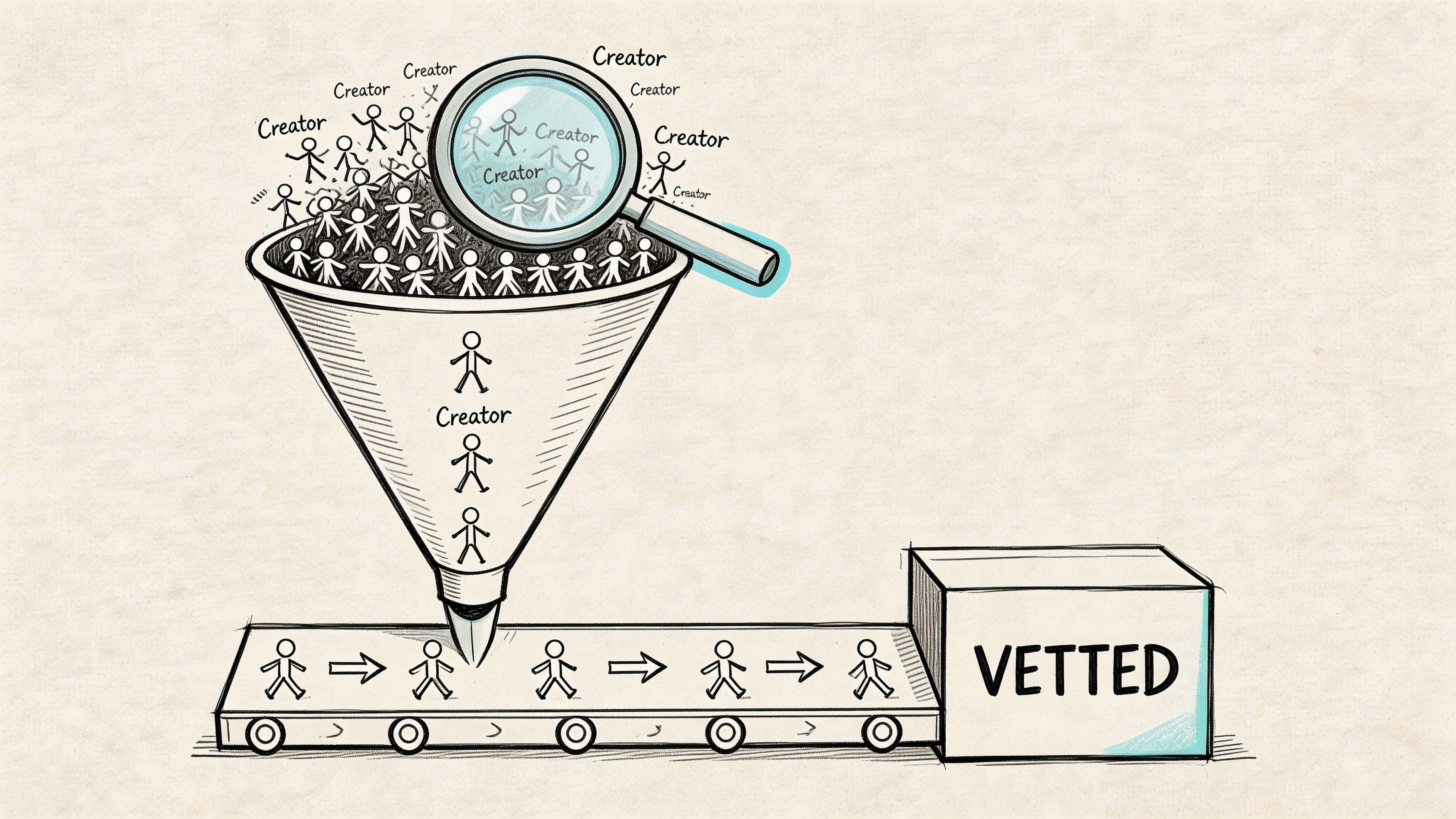
The top of the funnel needs structure long before outreach begins. If you do not build a qualified creator pipeline, your outreach volume rises while your conversion quality falls.
Start with an Ideal Creator Profile
A scalable sourcing machine starts with a clear Ideal Creator Profile.
Not a vague idea like “micro food creators in London”. A defined profile. Tight enough that different team members would shortlist similar people.
I define ICPs across five fields:
Niche fit: What do they post about most often, not what do they list in their bio.
Location fit: Essential for restaurants, events, and multi-location brands.
Audience fit: Who comments, who follows, and whether the audience matches the buyer.
Content fit: Can the creator produce the style you can reuse.
Commercial fit: Have they worked with brands before without turning their feed into an ad board.
This sounds basic, but it saves huge amounts of wasted outreach. A broad ICP creates a bloated list. A sharp ICP creates a list sales teams and brand teams can use.
Separate sourcing from vetting
A mistake I see is trying to source and approve in one pass. That slows everything down.
Treat them as different stages.
Sourcing is collecting possible matches at volume. Vetting is applying rules that decide who moves forward.
That lets one person, or one workflow, feed another. It also prevents the senior team from wasting time searching when they should be reviewing qualified options.
To secure 50 creator partnerships, brands may need to send over 150 personalised outreaches, and scaling to 500 partners could require contacting over 7,500 influencers, which is why manual sourcing and tracking break down fast, as noted in Modash’s guide to scaling influencer marketing.
Build a repeatable vetting scorecard
You need a standard scorecard, even if it is simple.
A good one answers questions like these:
Brand fit: Would this person look natural talking about the product?
Content quality: Is the creator good on camera, clear in voice, and consistent in framing?
Audience authenticity: Do engagement patterns look credible?
Posting reliability: Are they active enough to be dependable?
Reuse potential: Could this content work in paid social, organic social, email, or landing pages?
You do not need a complicated scoring model. You need a shared filter that keeps quality consistent across the team.
Tip: Vet for usefulness, not just reach. The creator who can produce clean, believable content on brief outperforms the creator with the prettier media kit.
For local brands, geography is part of fit
Restaurants, chains, and local service brands over-index on follower count and under-index on proximity.
If the objective is footfall, bookings, or local awareness, location matching matters more than a broad national audience. A creator who is part of the local scene produces stronger comments, more credible recommendations, and better offline action.
That is where discovery tools start earning their keep. Filtering by location, niche, and audience signals is far more useful than endless manual search tabs.
Here’s a useful walkthrough on the practical side of sourcing creators at scale:
What a healthy sourcing pipeline looks like
A scalable creator pipeline is less like a contact list and more like a recruiting funnel.
Try organising it into stages:
Stage | What belongs here |
|---|---|
Raw prospects | Broad matches from discovery and manual finds |
Pre-vetted | Meets ICP basics |
Vetted | Passed scorecard review |
Outreach-ready | Prioritised and enriched with notes |
Active backup | Good fit, not yet contacted or not right for current campaign |
Campaigns slip when teams start from zero every time, so this is important. A healthy pipeline means you are always building the next shortlist while current campaigns run.
Avoid three sourcing traps
The biggest sourcing issues are operational, not strategic.
Over-collecting: Teams save too many creators and review too few properly.
Weak notes: Someone marks a creator as “good fit” with no context. Two weeks later, nobody remembers why.
No backups: The campaign relies on an exact shortlist with no reserve bench.
Good sourcing work feels a bit boring. That is a sign it is working. The shortlist quality improves, the outreach team wastes less effort, and campaign planning becomes predictable rather than frantic.
Automating Outreach Onboarding and Campaign Execution
Once the pipeline is healthy, communication becomes the next bottleneck.
Many promising programmes stall at this point. The team has creators to contact, but every conversation is still happening one by one across DMs and inboxes. Negotiation notes live in a spreadsheet. Briefs are copied from old docs. Approval feedback arrives in fragments. Launch dates drift.
That is not a creator strategy problem. It is a workflow problem.
Turn outreach into a sequence
The best outreach at scale still feels personal. It does not rely on hand-writing every message from scratch.
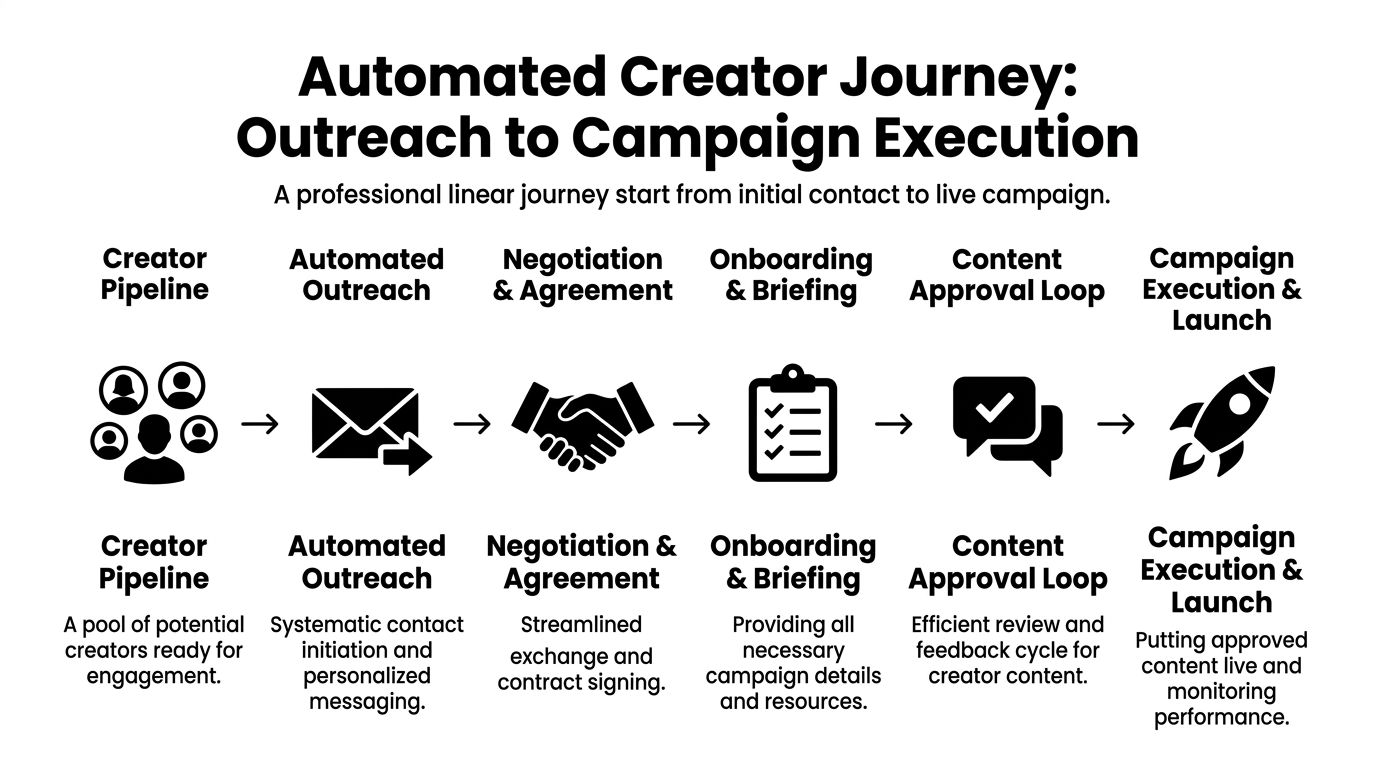
I treat outreach as a sequence with controlled points of personalisation:
Initial message Short, relevant, and customised. Mention the fit, not only the product.
Follow-up Sent only if there is no response. Keep it lightweight. Many teams over-explain here.
Offer and scope Clear deliverables, timing, and value exchange. Avoid ambiguity.
Onboarding trigger Once they agree, move them into a standard process.
The aim is not robotic volume. The aim is consistency. Good creators should get the same level of clarity whether they are first or fiftieth in the queue.
If you need a framework for the first message itself, this guide on how to write the perfect influencer outreach email is useful because it focuses on relevance and clarity rather than hype.
Build campaign briefs that travel well
A brief that works for one creator is not usable at scale. A scalable brief needs to be easy to duplicate, easy to understand, and hard to misinterpret.
The strongest briefs include:
Campaign objective: Awareness, visits, sales, bookings, reviews, content capture, or a mix.
Deliverables: Exact content formats and any timing requirements.
Key messages: What must be included.
Creative boundaries: What should not be said or shown.
Brand assets: Links, references, offers, location details, or product notes.
Compliance notes: Disclosures and approval expectations.
Tracking setup: Codes, links, landing pages, and posting instructions.
This should not read like legal copy. It should read like a useful working document.
Standardise the creator journey
When teams say onboarding is taking too long, they mean they have never designed the creator experience as a single flow.
Think of it as one connected path:
Stage | Operational requirement |
|---|---|
Outreach accepted | Move to onboarding automatically |
Terms agreed | Trigger contract and deliverables |
Campaign live | Provide assets, codes, links, deadlines |
Content submitted | Route into approval workflow |
Content approved | Confirm posting instructions |
Post published | Pull reporting and payment status into one place |
Once that flow exists, you stop “managing creators” and start managing a system.
Tip: If creators ask the same operational question more than once, fix the workflow before you rewrite the message.
Approval workflows are where quality survives scale
Volume creates pressure to loosen approvals. That backfires.
A better approach is to make approvals faster, not weaker. Give creators a defined path for draft review, feedback, revision, and sign-off. Keep feedback centralised. Avoid scattered comments in email, text, and social DMs.
For enterprise-scale programmes, the winning workflow combines discovery tools for location-matched creators, automated outreach with pre-built briefs, and structured approval workflows. That setup also improves the ROI of reusing creator content in ads by up to 35% in UK hospitality, according to EMARKETER’s analysis of smaller creators and efficiency.
That last part matters more than some teams realise. Content approval is not risk control. It is asset quality control. If your UGC is going to be reused in paid social, landing pages, or CRM, the standard has to hold.
Keep human judgement where it matters
Automation should handle movement, reminders, and status updates. Humans should handle fit, negotiation edge cases, creative nuance, and escalation.
That division is what makes scale workable.
A few examples:
Use automation for follow-ups, reminders, status changes, and task routing
Use humans for creator selection, compensation judgment, and brand-sensitive feedback
Use templates for briefs, deliverables, and legal handoff
Use live review for content that carries reputational risk
One practical option in this category is Sup, which combines a dashboard with a human team to source location-matched creators, prebuild campaigns with outreach scripts and tracking codes, manage communications, and collect campaign content into a reusable library. That kind of setup is useful when the problem is no longer “finding influencers” but operating a large creator workflow without hiring a big internal team.
What does not work
Some patterns look scalable but are not:
Sending generic copy-paste outreach at high volume
Writing a fresh brief for every creator
Approving content only in DMs
Launching before links, codes, and deadlines are final
Letting campaign managers invent their own process each time
Good execution at scale feels less improvisational. The system absorbs repetition so the team can focus on judgement.
Systemising Attribution Payments and Legal Workflows
A large creator programme can look busy while producing little clarity.
Content goes live. People like it. A few comments mention the product. Someone in the team says the campaign “felt strong”. None of that is enough once budget, creator count, and internal scrutiny rise.
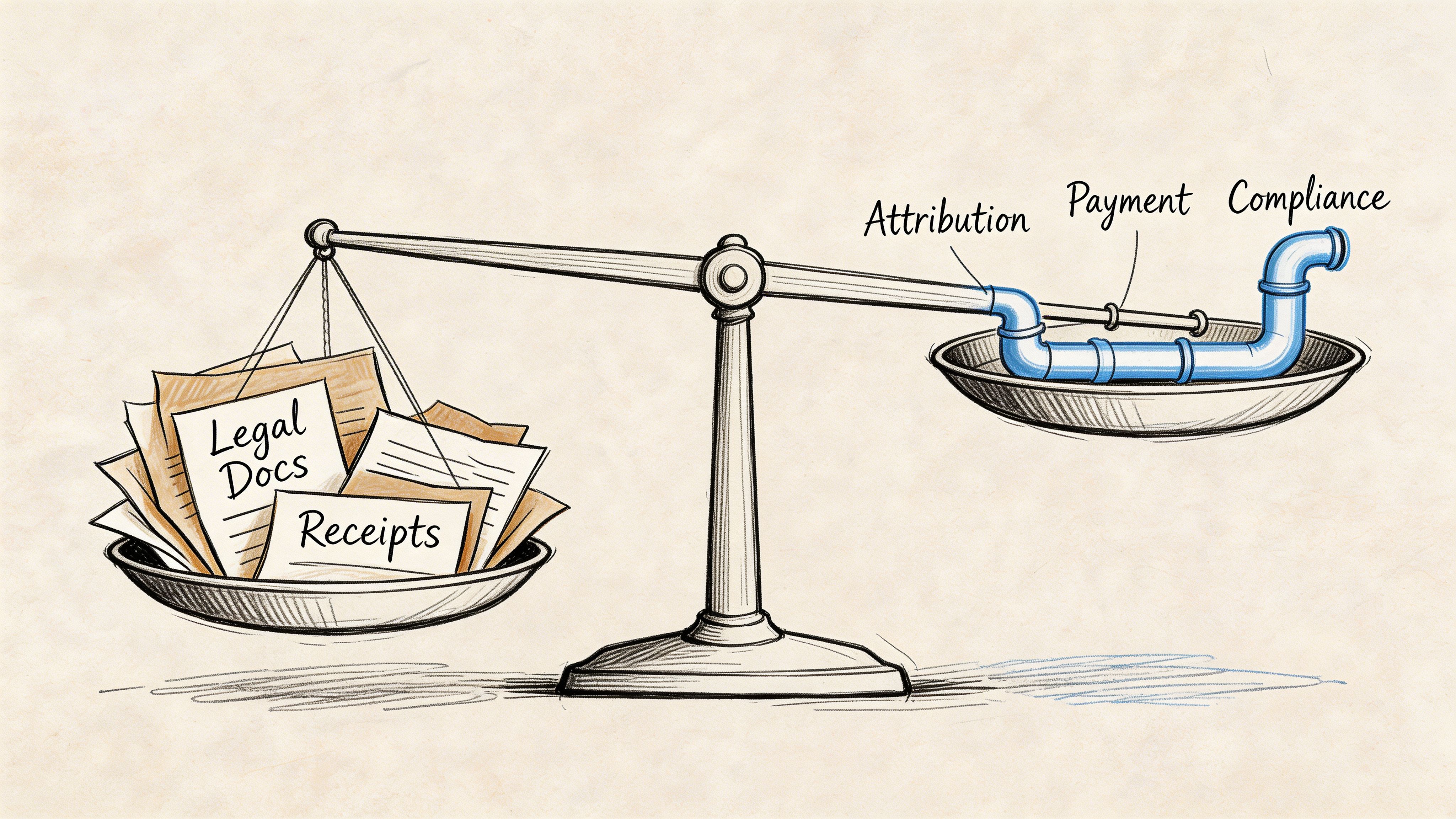
If you want influencer marketing to behave like a serious growth channel, the back-office layer has to be systemised.
Attribution has to exist at creator level
At five creators, teams tolerate fuzzy measurement. At fifty or five hundred, fuzzy measurement creates bad decisions.
You need attribution that ties each creator to activity you can act on. In practice, that means unique promo codes, unique UTM links, or both, assigned at individual creator level rather than campaign level.
That unlocks better decisions:
Which creators drive clicks or redemptions
Which locations respond best to local creators
Which content formats deserve reuse
Which creators should become longer-term partners
Which campaigns produced content but not commercial impact
Without that granularity, optimisation turns into opinion.
Payments are an operations issue and a trust issue
Late or inconsistent payment creates friction fast. So does messy payment admin.
The problem is not only finance workload. It is also creator confidence. If the process feels unclear, the brand looks disorganised. Good creators notice that quickly.
The scalable answer is not “be more organised manually”. It is to build a standard payment path:
Payment problem | Systemised fix |
|---|---|
One-off transfers | Batch or platform-based payouts |
Missing invoice details | Standard collection at onboarding |
Confusion over what was delivered | Link payment status to campaign milestones |
Delayed approvals | Defined finance handoff and owner |
Different terms per creator | Clear compensation rules and templates |
The goal is to remove hidden admin from campaign managers so they can spend time on programme quality rather than payout chasing.
Legal consistency protects speed
Legal work gets treated as overhead until the first issue arrives. Then everyone realises the process was too loose.
At scale, contracts and written terms are what let you move faster with less confusion. You do not want every agreement negotiated from scratch. You want approved templates, clear usage rights, deliverable definitions, disclosure expectations, timing rules, and cancellation language.
Standardisation helps both sides. The creator knows what they are signing. The brand knows the baseline does not shift every time a new partnership begins.
If you need a solid starting point for this layer, the complete guide to influencer contracts and agreements covers the clauses and workflow details that teams often miss.
Practical rule: if attribution, payment, and agreement status are not visible in the same operating environment, someone will have to stitch the truth together by hand.
Why this layer changes how the channel is viewed internally
Leadership teams rarely object to influencer marketing because they dislike creators. They object when the channel looks hard to measure, hard to govern, and hard to reconcile financially.
Back-office discipline fixes that.
Once each creator has trackable links or codes, once payments move through a defined process, and once agreements use standard templates, the programme becomes easier to defend. Performance discussions improve because the data is cleaner. Finance trusts the spend more. Operations stop improvising.
That is the point where influencer marketing moves from “brand activity” into something the wider business can treat as a repeatable operating channel.
Designing Your Team and Measuring True Performance
Many teams underestimate the people side of scale.
They assume the answer is either software or headcount. In practice, it is both. The core work is deciding where technology removes repetition and where people add judgement.
Build roles around bottlenecks, not job titles
At the start, one marketer can do everything badly or a few things well.
As volume grows, specialist ownership matters more than broad hustle. A healthy structure breaks down into functions rather than departments:
Pipeline ownership for sourcing and vetting
Campaign operations for briefs, launches, and approvals
Performance ownership for attribution, reporting, and optimisation
Finance and legal coordination for payment and agreement flow
Content and asset management for UGC reuse
Those functions can sit with a lean internal team, an external partner, or a hybrid model. The important point is that each operational area has a clear owner.
A common reference point is that a team of 4 to 5 people can manage up to 100 partners effectively, but once brands push further, the decision between adding software and adding people becomes a financial question. That is especially true when automation platforms in the UK can cost £500 to £5,000+ monthly, which is why a cost-benefit analysis matters before scaling either path, as noted by impact.com on building successful influencer programmes.
The wrong hiring pattern
The most expensive move is hiring people to preserve a broken manual workflow.
If a team is still tracking status in spreadsheets, chasing approvals in inboxes, and manually assembling reports, more headcount means more people participating in the same inefficient process.
I prefer this decision rule:
If the issue is... | Solve with... |
|---|---|
Repetitive admin | Workflow automation |
Inconsistent quality | Process design and approval standards |
Strategic gaps | Senior ownership |
Creator volume beyond current capacity | Additional operators or a managed partner |
Weak reporting | Better attribution and analytics setup |
That keeps hiring focused on judgement rather than clerical recovery work.
Measure business output, not activity
A lot of creator programmes still get judged on visible but shallow indicators. Reach, likes, comments, views. Those metrics are useful context, but they are not enough for scale decisions.
At scale, performance review should answer harder questions:
Which creators generated attributable sales, bookings, or redemptions?
Which content assets were strong enough to reuse elsewhere?
Which partnerships improved over repeated collaborations?
Which creator segments fit specific locations or customer types?
Which operational stages slowed output or damaged quality?
The dashboard matters less than the decision it supports. If reporting does not tell you where to spend more, where to cut, and what to repeat, it is decorative.
For teams that want a wider market snapshot alongside their own internal numbers, these influencer marketing statistics are a useful context resource. Internal creator-level attribution should still be your main operating lens.
Key takeaway: Measure creators as contributors to revenue, content supply, and operational efficiency. Not just as social posts that happened.
Treat UGC as an asset base
One of the biggest missed opportunities in scaled programmes is failing to operate content like inventory.
Every approved creator asset should be stored, tagged, and retrievable. If your team cannot quickly find content by creator, product, campaign, location, or format, reuse becomes random.
A good UGC library supports several decisions:
Which creator styles convert in paid media
Which hooks work across regions or store types
Which assets suit landing pages or email
Which creators deserve repeat bookings because they produce reusable material
Here, performance and operations meet. The programme is not buying distribution through creators. It is building a bank of content the brand can keep using, subject to the rights agreed.
A practical scaling model
The strongest long-term teams converge on one of three setups:
Lean internal team with strong software Best when the brand wants control and already has operational discipline.
Internal strategist plus specialist support Useful when growth targets are ambitious but headcount is tight.
Hybrid managed model Works when volume, local sourcing, and reporting complexity are already high.
None of these is universally right. The best option depends on whether your present constraint is team capacity, system maturity, or reporting confidence.
That is the ultimate shift in How to Scale Influencer Marketing From 5 to 500 Creators. You stop asking, “How do we run more campaigns?” and start asking, “What operating model lets this channel grow without chaos?”
From 5 Creators to a 500-Creator Growth Engine
The move from five creators to five hundred is not a bigger version of the same job.
It is a redesign.
Manual methods can get the first wins. They can prove there is demand, identify some creator types that fit, and generate useful content. But they also create fragility. The more creators you add without systems, the more confusion you add with them.
The durable version looks different. Sourcing becomes a pipeline, not a search task. Outreach becomes a sequence, not a pile of conversations. Briefs become templates, not one-off docs. Attribution becomes creator-level, not campaign-level guesswork. Payments and contracts become workflows, not afterthoughts. Team structure follows bottlenecks, not arbitrary titles.
That is how influencer marketing becomes operationally mature.
When those pieces are in place, the channel starts behaving more like paid media or lifecycle marketing. You can forecast better. You can compare creator cohorts. You can reuse content intelligently. You can identify what is driving sales, bookings, reviews, and repeatable output. The programme stops depending on heroics.
That is the destination. Not more creators, but a system that can keep adding them without losing clarity, speed, or accountability.
If you want that operating layer without building everything from scratch, Sup helps brands and agencies run creator programmes with sourcing, outreach, attribution, payments visibility, and content collection in one workflow. It is designed for teams that need influencer marketing to function as a repeatable growth engine rather than a manual side project.

Matt Greenwell
Share