How to Track Influencer Marketing Attribution: Promo Codes - A Practical Guide

Matt Greenwell
Mar 7, 2026
When it comes to tracking influencer marketing, there’s one method that stands head and shoulders above the rest: unique promotional codes. By giving each creator their own distinct code, you create a direct, measurable link between their content and your sales.
This simple strategy is how you move beyond fuzzy metrics like likes and views and start talking about real revenue. It’s the clearest, most reliable way to prove your return on investment (ROI) and finally see which partnerships are truly paying off.
Why Promo Codes Are Your Best Bet For Attribution
In a world where every marketing pound has to justify its existence, guesswork just doesn't cut it anymore. That's where promo codes come in, acting as your most trusted tool for influencer marketing attribution. We're not interested in vanity metrics here; we're focused on drawing a straight line from an influencer's post directly to your cash register.
This approach cuts through all the noise. It gives growth marketers, restaurant owners, and ecommerce brands the tangible proof of ROI they need. It’s the difference between crossing your fingers and hoping for results, versus actually measuring them with pinpoint accuracy.
The Power of Direct Measurement
Let’s imagine a direct-to-consumer (DTC) skincare brand. For a long time, they relied on engagement rates to decide if a campaign was successful. They were working with ten micro-influencers but had a nagging feeling they couldn't tell who was actually driving sales.
So, they switched tactics and gave each creator a unique code, like 'JESSICA15' or 'TOM10'. The results were immediate.
Within a week, their dashboard showed that just two of those influencers were responsible for over 60% of all sales coming from promo codes, despite having smaller followings than some of the others. This insight was a game-changer. It allowed them to reallocate their budget, double down on the partnerships delivering genuine value, and completely rethink their approach to influencer collaborations.
Key Takeaway: Promo codes strip away the ambiguity from influencer marketing. They serve as a direct, undeniable link between an influencer’s content and a customer’s purchase, making it incredibly simple to calculate a clear ROI for every creator you work with.
A Look at the UK Market
This isn't just a hypothetical scenario; it's a proven strategy that's shaping the industry right now. Across the UK influencer marketing scene, promo codes have become the gold standard for attribution, especially as brands rightly demand hard numbers.
The UK market is on track to hit £2.9 billion by 2026, delivering an impressive average ROI of £5.78 for every £1 spent. This growth is underpinned by a shift towards accountability, with 25% of UK campaigns now tying payments to performance metrics—like sales tracked with unique codes.
For ecommerce brands and restaurants using platforms like Sup, this often means assigning bespoke codes to nano and micro-influencers on Instagram and TikTok. These creators often punch well above their weight, boasting engagement rates as high as 15.2%. You can dig deeper into the numbers by checking out these influencer marketing statistics from Charle Agency.
Promo Code Attribution At A Glance
Beyond just tracking sales, using promo codes gives you a structured framework to manage and scale your entire influencer programme. The core advantages are pretty clear when you lay them out.
Here’s a quick summary of what makes this method so effective for businesses.
Benefit | Description For Your Business |
|---|---|
Clear ROI Calculation | Directly attribute every sale to a specific influencer, making it easy to calculate ROI per partner and for the overall campaign. |
Performance Benchmarking | Easily compare the effectiveness of different influencers, platforms, and content styles to see what resonates most with your audience. |
Data-Driven Optimisation | Identify your top-performing creators and build stronger, long-term relationships, while discontinuing partnerships that don't yield results. |
Offline Tracking Capability | Perfect for restaurants and brick-and-mortar stores; customers can mention the code at the point of sale, bridging the online-to-offline gap. |
Ultimately, this data-driven approach allows you to make smarter decisions, invest in what works, and build a more profitable and sustainable influencer marketing strategy.
Building a Scalable Promo Code Tracking System
Let's be honest, just handing out random discount codes isn't a strategy. It's a shot in the dark. To get real, actionable data, you need to build a scalable framework. A well-designed system will transform your influencer marketing from scattered efforts into a fine-tuned engine that measures attribution with precision, finally putting an end to the guesswork.
The goal is to move beyond fuzzy vanity metrics and get to what really matters: measurable ROI. Promo codes are the bridge that gets you there.
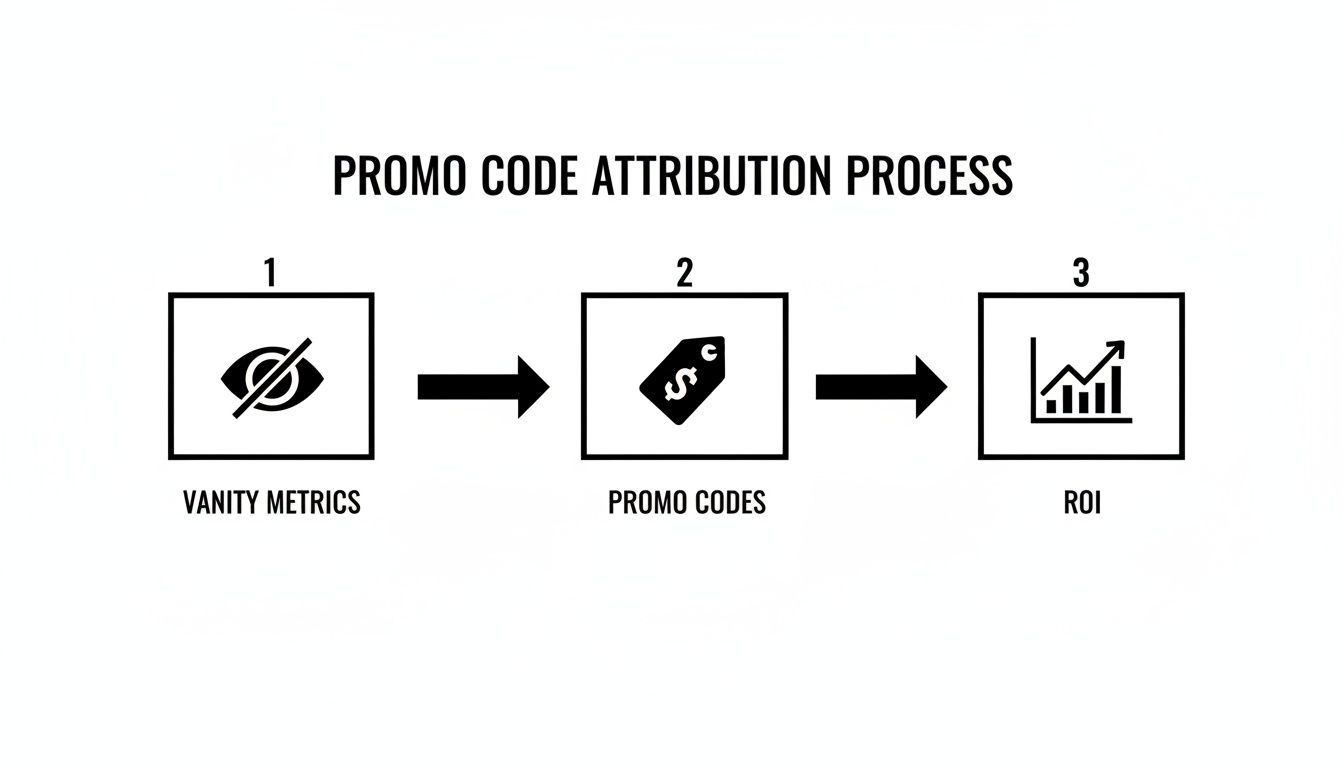
As you can see, promo codes are that crucial link between the initial audience engagement and the tangible business results you can take to the bank.
Creating Unique and Memorable Codes
First things first, let's talk about the codes themselves. A generic code like ‘SAVE15’ is an attribution nightmare, while something cryptic like ‘XYZ789’ is just plain forgettable and feels impersonal. Your aim is to craft unique codes that are easy for everyone—the creator and their followers—to remember and use.
I’ve found a simple formula works wonders: [CreatorName] + [Discount].
Think about it:
LAUREN15 for 15% off
DAVID20 for £20 off an order
PETESBOGO for a buy-one-get-one-free offer
This approach makes the code instantly attributable. It also gives creators a sense of ownership, which I've seen firsthand makes them far more likely to promote it with genuine enthusiasm. For their audience, it feels like a special, exclusive offer, which can really bump up your redemption rates.
Configuring Codes in Your Sales Platform
Once you've settled on a naming convention, it's time to get these codes set up in your e-commerce or Point of Sale (POS) system. It doesn’t matter if you’re on Shopify, WooCommerce, or using a system like Toast or Square for a physical location; the fundamentals are pretty much the same.
You’ll typically head to your platform's discount section to generate the new code. This is where you'll define its value (a percentage or fixed amount), set any rules like minimum purchase requirements, and, crucially, assign an expiration date.
Pro-Tip: Always, and I mean always, set an expiration date. This not only creates a sense of urgency for the customer but also gives you a clean cut-off for analysing a campaign. It stops old codes from popping up months down the line and throwing your data into chaos.
Tracking influencer impact has come a long way in the UK, with promo codes now being the gold standard for accurate attribution. The UK influencer market, valued at a staggering USD 3.1 billion in 2025, is projected to hit USD 28.3 billion by 2034. A huge chunk of this growth is driven by micro-influencers, whose tight-knit communities are perfect for targeted promo code strategies.
Unifying Data with UTMs and Spreadsheets
A promo code tells you who drove a sale, but that’s only half the story. To truly map the entire customer journey, you need to pair each unique promo code with its own unique UTM link. This combination is a powerhouse, allowing you to track both the clicks and the final conversions. You get the full picture.
To keep everything straight, especially as you start working with more creators, a master spreadsheet is non-negotiable. This becomes your single source of truth for the entire campaign. If you want to dig deeper into building these kinds of systems, you can explore insights on scalable systems from industry blogs.
Your tracking spreadsheet should, at a minimum, have columns for:
Influencer Name: The creator you're working with.
Unique Promo Code: The specific code you've assigned them (e.g., LAUREN15).
Unique UTM Link: The trackable URL for their bio, stories, or posts.
Campaign Dates: The official start and end dates.
Deliverables: A quick summary of the content they’ve agreed to create.
Getting organised like this from the start prevents costly mistakes, ensures every creator has what they need, and makes your life so much easier when it’s time to analyse performance. If you're looking for more ways to get the most out of your online store, have a look at our complete guide on influencer marketing for ecommerce.
This kind of structured setup is the blueprint for a promo code system that not only works but also scales with you. It’s the foundation for proving the real, tangible value your partnerships are delivering.
Watching Your Campaign Performance in Real Time
Once your promo codes and UTM links are out in the wild, the real work begins. This is the most crucial part of any campaign: active monitoring. This isn’t a task you can just set up and walk away from. Real-time data is your biggest advantage, giving you the power to make smart adjustments on the fly and put more fuel behind what’s already working.
But before you can track anything, you have to nail the influencer briefing. You need to be crystal clear about where their unique code and link should go—is it in their bio? A swipe-up story? The video description? I’ve found that a simple checklist or one-pager can be a lifesaver here. It helps avoid that all-too-common scenario where a creator posts without their code, making your tracking efforts completely useless from the start.
Your Performance Dashboard: The Campaign's Pulse
With your creators properly briefed, you can start watching the redemptions come in. Most modern e-commerce platforms like Shopify or even restaurant POS systems have dashboards for this. If you’re using a dedicated tool like Sup, all your attribution data is pulled into one central hub, which saves a massive amount of time.
Forget waiting until the campaign is over. You should be checking these dashboards daily. Keep an eye out for immediate patterns. Is one influencer’s code flying off the shelves while another’s is completely flat? Catching this early is incredibly valuable.
I once worked with a fashion brand that saw an influencer’s “20% off” code gain huge traction just hours after she posted. We jumped on it, immediately putting a small ad spend behind her content to amplify it. That quick move turned a good result into a phenomenal one. We would have completely missed that opportunity without keeping a close eye on the real-time numbers.
A recent Sprout Social survey found that a staggering 83% of marketers see more conversions from sponsored influencer content than from their own brand's organic posts. This just goes to show how powerful these partnerships are when you can actually track and optimise them properly.
The Metrics You Should Actually Obsess Over
Sales and revenue are obviously important, but they don't give you the full picture. If you really want to understand what's driving performance, you have to dig a bit deeper. To get instant answers from your attribution data as you monitor campaigns, exploring solutions like AI powered business intelligence can give you a serious edge.
Here are the numbers I always keep a close watch on:
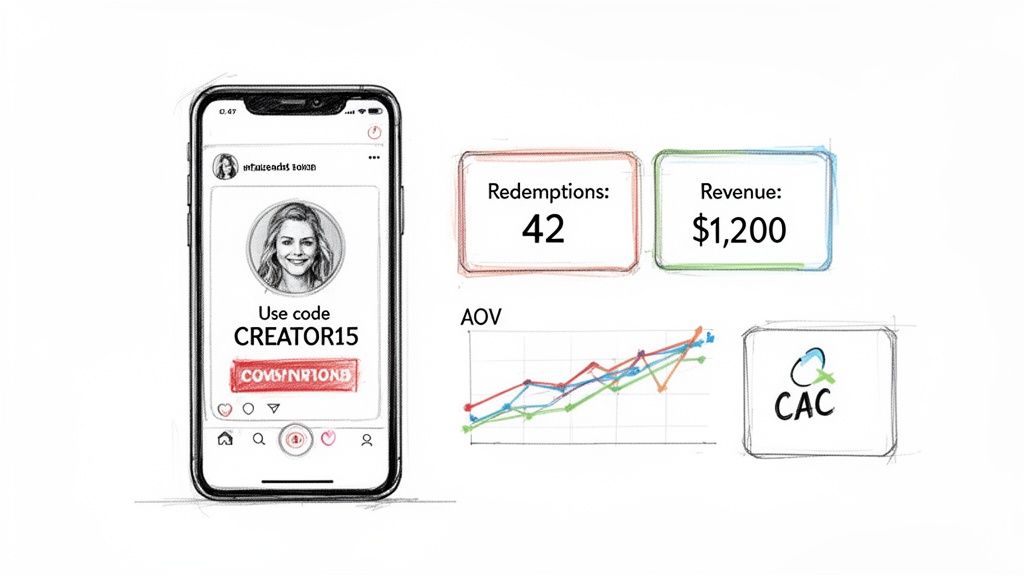
Average Order Value (AOV): Are the customers coming from a specific influencer spending more with each purchase? A creator with a high AOV but fewer sales can easily be just as valuable as someone driving high volume with small, low-value orders.
Customer Acquisition Cost (CAC): This one’s simple. Just divide the total cost of an influencer partnership (their fee, plus any product costs) by the number of new customers they brought in. A low CAC is the holy grail of profitable marketing.
New vs. Returning Customers: Is an influencer bringing in a fresh audience, or are they just reactivating people who already know you? There's value in both, but knowing the split helps you understand if a campaign is driving brand growth or customer loyalty.
By tracking these in real time, you can start to answer some really important questions. If Influencer A has a fantastic conversion rate but a low AOV, maybe their audience is more sensitive to discounts. If Influencer B brings in fewer sales but has a much lower CAC, they might be a more efficient partner for long-term growth.
Making Smart Changes Mid-Campaign
This is where all that real-time monitoring really pays off. The data you’re collecting isn't just for a fancy report you’ll write next month; it's for making agile decisions that can improve your results right now. For a deeper look at this, our guide on how to measure influencer marketing ROI offers some great additional strategies.
Here are a few common adjustments you can make on the fly:
Reallocate Your Support: If one creator is knocking it out of the park, shift your own promotional efforts—like social media shout-outs or ad spend—to give their content an extra boost.
Tweak the Offer: Is a specific discount percentage falling flat? You can always test a different offer with a new group of influencers to see if it resonates better.
Refine Your Content Guidance: Did you notice a particular video style really connected with an influencer’s audience? Share that insight with your other creators as a best-practice example.
When you stay active and responsive, you turn a static campaign plan into a living, breathing system that learns and improves. This hands-on approach is the secret to getting the most out of your budget and proving the undeniable value of your influencer programme.
How To Calculate True Influencer ROI
So, your campaign has wrapped up. You've collected a mountain of data, but what does it all really mean? Turning those raw numbers into actionable insights is where the real work begins. Calculating the true return on your influencer investment is about more than just a quick look at sales figures; it's about building a complete performance picture to guide your future strategy.
Let's start with the most straightforward calculation. This gives you a hard number that answers the most pressing question: was this partnership profitable?
The Basic ROI Formula: (Revenue from Codes - Total Campaign Costs) / Total Campaign Costs
It's a simple but powerful formula. For instance, if you brought in £10,000 in sales from promo codes and your total campaign costs were £2,000 (factoring in fees, products, and so on), you'd have an ROI of 400%. That’s a brilliant result on paper, but the real magic happens when you start digging deeper.
Accounting for Total Campaign Costs
To get an accurate ROI, you have to be brutally honest about every single cost involved. It’s a classic mistake to only focus on the influencer's fee, but the true investment is almost always bigger. For a clear-eyed view of your expenses, you need to add everything up.
When you're tallying up your costs, don't forget to include:
Influencer Fees: The direct payment to the creator for their work.
Product Costs: The cost of any goods you gifted to the influencer.
Shipping and Handling: The expense of getting those products into their hands.
Team Time: The hours your team spent on outreach, management, and reporting.
Tool Subscriptions: A portion of the cost for any software you used to run the campaign.
Getting all of these down gives you the true 'Total Campaign Costs' for your ROI formula. Nailing down these details is also fundamental to understanding your Customer Acquisition Cost (CAC). A low CAC is a powerful indicator of an efficient partnership. You can learn more in our detailed guide on how to calculate customer acquisition cost.
Looking Beyond Direct Revenue
From my experience, a successful influencer campaign delivers value in ways that don't always show up on a sales dashboard. If you ignore these non-monetary wins, you're massively undervaluing your programme. A holistic performance review has to look at these other crucial elements.
One of the biggest assets is high-quality user-generated content (UGC). Think about it – that fantastic video or set of images a creator produced can be repurposed for your own social channels, website, or even paid ads. The value of this content alone can sometimes match or even exceed what you paid the influencer, stretching your marketing budget much further.
Then there's brand awareness. It’s tougher to put a number on, but you can track proxy metrics. Did you see a spike in website traffic from the creator’s region during the campaign? Did your follower count on social media jump? These are all tell-tale signs that the partnership introduced you to a fresh, relevant audience.
Pinpointing Your Most Valuable Partners
Let’s walk through a real-world scenario. Imagine a restaurant chain works with five local food influencers to promote a new menu item. At the end of the month, they pull the data.
Influencer A: Drove 150 code redemptions. Great volume, but the data shows they were mostly for small takeaway orders.
Influencer B: Only brought in 40 redemptions. But their followers booked tables for four, resulting in a significantly higher Average Order Value (AOV).
Influencer C: Had modest sales, but she produced a stunning video reel that the restaurant now uses in its digital ads, saving them thousands in production costs.
If you just looked at the number of redemptions, Influencer A seems like the clear winner. But when you dig in, you realise Influencer B delivered more profitable customers, and Influencer C provided incredible long-term value. This is the kind of insight that helps you spot your true star performers, ensuring every marketing pound is invested wisely for future collaborations.
Advanced Strategies and Common Pitfalls to Avoid
Once you've got your basic promo code tracking sorted, you can start to layer on more sophisticated tactics. This is really where you separate a professional, high-performing influencer programme from an amateur one. It’s not just about tracking what happened; it’s about actively shaping what happens next and protecting your data from common issues.
By weaving in some advanced strategies and knowing which mistakes to sidestep, you can build an influencer marketing engine that’s more profitable, scalable, and resilient.
Introducing Tiered Rewards to Fuel Motivation
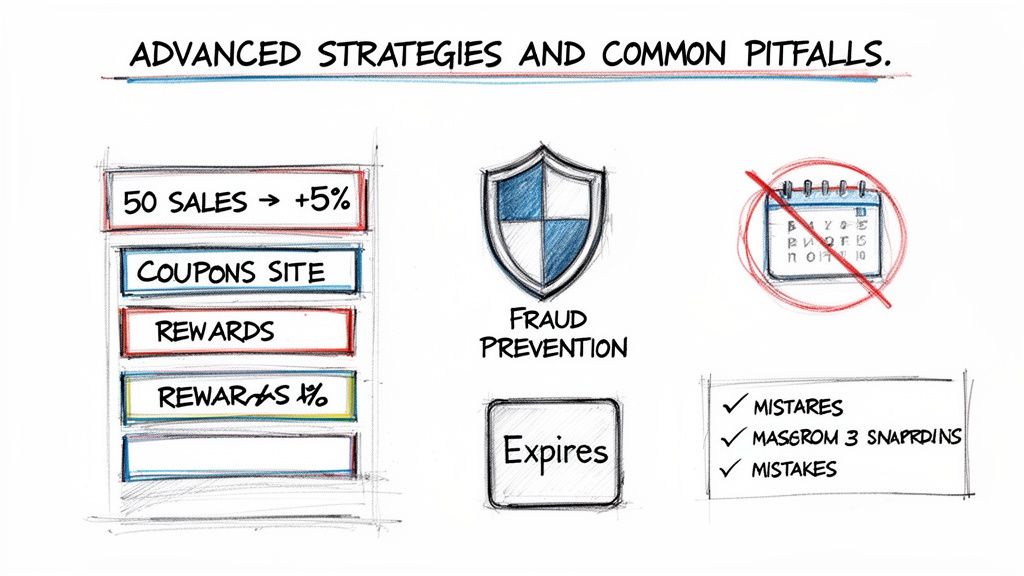
A flat commission is a decent starting point, but what if you could incentivise your best creators to sell even more? That’s exactly what tiered rewards are designed to do. It’s a simple but powerful structure that increases an influencer's commission rate as they hit specific sales milestones.
For example, you could start a creator on a standard 10% commission and then build out tiers to fire up their motivation:
Tier 1 (0–50 sales): The standard 10% commission on each sale.
Tier 2 (51–100 sales): The commission jumps to 15% for every sale from number 51 onwards.
Tier 3 (101+ sales): The commission reaches an impressive 20%.
This approach effectively gamifies the sales process and gives influencers a tangible goal to work towards. I’ve seen this work wonders in long-term partnerships, keeping creators engaged and driven long after the initial buzz of a campaign has faded. It creates a genuine partnership where their success is directly tied to yours.
Preventing Promo Code Leakage and Fraud
One of the biggest headaches you'll run into is promo code leakage. This is when an influencer’s unique code gets scraped and posted on a coupon aggregator site like Honey or RetailMeNot. Suddenly, you’ve got anonymous shoppers using a code meant for a specific creator’s audience, which completely messes up your attribution data and eats away at your profit margins.
You have to be proactive to get ahead of this.
Set Clear Expectations: Your influencer agreement needs a clause that explicitly states codes are for their audience only and must not be submitted to discount websites.
Monitor Coupon Sites: Make it a habit to regularly search for your brand on these sites. If you spot a leaked code, you can deactivate it and have a conversation with the influencer.
Use Single-Use Codes: For high-value offers or exclusive collaborations, some e-commerce platforms let you generate a batch of unique, single-use codes for an influencer to share. This is less practical for wide-reaching campaigns but brilliant for targeted ones.
A Quick Tip from Experience: Make your influencer codes feel personal. A code like 'SOPHIE15' clearly belongs to Sophie's community. A generic bargain-hunter is far more likely to be searching for terms like 'SALE15' or 'SAVE15'. This subtle psychological trick can make a real difference in reducing unwanted redemptions.
Comparing Promo Code Strategies
Not all promo code strategies are created equal. The right approach depends entirely on your campaign goals, the type of influencers you're working with, and how much control you need over attribution.
Here’s a quick breakdown to help you decide which strategy fits your needs.
Strategy Type | Best For | Primary Goal | Potential Pitfall |
|---|---|---|---|
Unique & Perpetual | Evergreen content, long-term partners | Continuous tracking, influencer loyalty | Higher risk of leakage over time |
Unique & Time-Bound | Specific campaigns, product launches | Creating urgency, clear ROI reporting | Requires more management to set up/deactivate |
Tiered Rewards | High-performing, motivated influencers | Maximising sales from top partners | Can be complex to track and pay out |
Single-Use Codes | Highly exclusive offers, VIP gifting | Preventing fraud, precise 1:1 attribution | Difficult to scale for mass audiences |
Choosing the right strategy from the outset is crucial. A time-bound code is perfect for a Black Friday push, but a perpetual one makes more sense for a creator who produces evergreen YouTube reviews of your product.
Combining Promo Codes with Whitelisted Ads
Here’s where things get really powerful. Try pairing an influencer's best-performing organic post with whitelisted ads. Whitelisting (or 'allowing' on some platforms) means you get permission to put ad spend behind an influencer's content, running it as an ad directly from their social media account.
This tactic is incredibly effective. You take a piece of content that's already proven to resonate with an audience and amplify it to thousands of other highly targeted people who are likely to be interested. Because the ad comes from a trusted creator instead of a faceless brand account, it feels far more authentic and almost always results in a lower Customer Acquisition Cost (CAC).
When you run these ads, you can continue to use the influencer's original promo code. This gives you a crystal-clear picture of the total ROI, showing you exactly how many sales came from the organic post versus the paid amplification. It’s a fantastic way to squeeze every bit of value from your top-tier content.
Common Mistakes That Wreck Your Data
Even the most advanced strategies will fall flat if you’re making simple, fundamental mistakes. Being aware of these common pitfalls is the first step toward building a truly bulletproof tracking system.
With a recent survey showing 73% of marketers now prefer working with micro-influencers, you could easily find yourself managing dozens of codes at once. At that scale, small errors can quickly spiral into a massive data headache.
Here are the most frequent blunders I see brands make:
Using Generic Codes: Handing out a code like 'SUMMER20' to every influencer is an attribution nightmare. You have no idea who is actually driving sales. Always, always use unique codes.
Forgetting Expiration Dates: An open-ended code can be used months or even years down the line, making it impossible to analyse a specific campaign’s performance. Always set a clear end date.
Ignoring Customer Lifetime Value (LTV): The first sale is only part of the story. You need to track whether customers brought in by an influencer come back for repeat purchases. A creator who brings in loyal, high-LTV customers is pure gold, even if their initial sales volume isn't the highest.
Failing to Brief Influencers Properly: If a creator shares the wrong code—or forgets to mention it at all—your tracking is dead before it even starts. Give them clear, simple, and idiot-proof instructions in every campaign brief.
Avoiding these slip-ups is just as vital as implementing fancy new tactics. A disciplined programme built on clean, reliable data will always outperform a chaotic one in the long run.
Here are some of the most common questions we get asked when brands start getting serious about tracking their influencer marketing. Let's clear up the confusion so you can manage your programme with confidence.
Aren't Promo Codes Just the Same as Affiliate Links?
It's a fair question, as they both aim to track sales. But at their core, they work in fundamentally different ways and are built for different platforms.
An affiliate link is a unique URL with a creator's ID baked into it. When someone clicks that link, a small tracking file (a cookie) is saved in their browser. If they make a purchase, that sale is automatically credited to the creator. It’s a seamless system for platforms where clicking links is second nature, like blogs or YouTube descriptions.
A promo code, on the other hand, is what we call "clickless" tracking. It’s a simple code, like ‘LAURA15’, that the customer has to physically type in at the checkout. This makes it a perfect solution for channels where links are awkward or even impossible to use. Think about places like:
Instagram Stories before you have the "link sticker" feature
TikTok videos
Podcast ad reads
Offline marketing, like a mention in a restaurant or at an event
Basically, links track the initial click, while codes track the final redemption. For the most complete picture, you can (and should!) use both. Giving a creator a unique UTM link and a matching unique promo code lets you cover all your bases.
What if an Influencer Forgets to Add Their Code?
Trust me, this happens all the time, and it can be a real headache. A creator puts up a beautiful post that gets tons of engagement, but they completely forget their code. Just like that, your attribution data vanishes.
The best defence here is a good offence. Your influencer brief needs to be impossible to misread. Use bold text, highlighters, and checklists to make the promo code and instructions on where to place it stand out. I’ve also found that sending a quick reminder just before they’re due to post works wonders. A simple message like, “Hey, can’t wait to see your post go live! Just a quick one to remember your code DAVID20 in the caption” can save you a lot of trouble.
If the mistake has already been made, ask them to edit the post immediately to include the code. For content that can't be edited, like an Instagram Story, the next best thing is to ask them to publish a quick follow-up story with the code front and centre.
A Pro Tip: If you see a sales spike but no code was used, don't panic. Check your analytics for a surge in traffic from that influencer's unique UTM link. It’s not as clean as a code redemption, but it’s a great way to manually attribute sales when you’re in a tight spot.
Can Promo Codes Track Offline Sales?
Yes, absolutely! This is one of their biggest strengths, especially for any business with a physical footprint like a retail shop or a restaurant. It’s one of the easiest ways to see how online buzz translates into actual offline revenue.
Imagine a local food blogger tells their followers, “Head down to The Pizza Place this weekend and mention ‘SAM20’ at the counter for 20% off your order.” All your staff need is a way to log that code in your Point of Sale (POS) system. At the end of the week, you can run a report on your POS to see exactly how many people redeemed the ‘SAM20’ code, giving you hard data on the footfall and revenue that creator generated.
Ready to turn influencer marketing into a repeatable, ROI-proven growth channel? Sup combines AI with a human team to launch, manage, and attribute creator campaigns for brands just like yours. Remove the manual DMs and spreadsheets, and start scaling your collaborations with measurable results.
Matt Greenwell
Share