When you see a queue outside a buzzy new restaurant, what do you think got them there? It probably wasn't a newspaper ad or a flyer. Chances are, it started on someone's phone.
That's the core of using influencer marketing to fill your tables. It’s about getting local food creators to share their experience at your place with their followers. Give them a great meal and a unique offer to pass on, and you can turn that online chatter into actual customers walking through your door.
Why Influencers Are Your Secret Weapon for Filling Tables
Let's be honest, the old ways of marketing are losing their punch. People today discover new restaurants by scrolling through Instagram and TikTok, trusting recommendations from people they follow, not from ads. This is exactly why getting local creators on board is no longer a "nice-to-have" – it's essential for getting bums on seats.
This isn't about paying a fortune for a celebrity to hold up your menu. The real impact comes from genuine, word-of-mouth style recommendations. When a local food blogger posts a video of them tucking into your signature burger, it doesn’t read like an advert. It feels like a friend giving a hot tip, building instant trust and inspiring their followers to check you out for themselves.
It’s All About Local and Niche Creators
For restaurants, the sweet spot is with nano- and micro-influencers. These are the creators with smaller, but incredibly loyal, followings. They’ve often carved out a specific niche, like "the best Sunday roasts in Manchester" or "must-try vegan spots in Bristol."
Their audience hangs on their every word because the content is authentic and hyper-relevant to where they live. By partnering with them, you get a direct line to people in your area who are actively searching for their next great meal. These aren't just passive scrollers; they're diners-in-waiting.
Think about it: a local foodie sharing their genuine excitement over your new brunch menu on Instagram Stories is infinitely more powerful than a faceless ad. It’s word-of-mouth, but supercharged for the digital age.
Turning Online Buzz into Real-World Business
The link between seeing a post online and visiting a restaurant is stronger than you might think. Here in the UK, it’s a proven strategy for driving footfall. In fact, 90% of diners now look at social media before deciding where to eat.
The numbers really back this up. A recent analysis found that restaurants running targeted influencer campaigns saw an average revenue boost of 9.9%. For venues with a really strong social media game, that figure jumped to 14.1%. This is especially true for UK spots, where local nano-influencers deliver fantastic engagement precisely because their audience is right on the doorstep. You can dive into all the data in this detailed report on influencer marketing for restaurants.
Throughout this guide, we'll walk you through the exact steps to make this happen, turning online visibility into a packed dining room.
Laying the Groundwork for a Killer Campaign
It’s tempting to jump straight into DMs, but the best influencer campaigns start long before you hit ‘send’. A solid plan is what separates a campaign that drives real footfall from one that just gets you a few nice photos.
Simply aiming for ‘more customers’ is a recipe for disappointment. You need to get specific. What problem are you trying to solve? Is your restaurant a ghost town on Tuesday nights? Then your goal could be to increase Tuesday bookings by 20% over the next month. Just rolled out a showstopper of a new dessert? A better goal is to sell 100 units of the new tiramisu through influencer promotions.
See the difference? These sharp, measurable goals turn a vague idea into a proper business strategy. They're your North Star, guiding every decision and making it much easier to see what’s actually working. Every touchpoint matters here, and strong food packaging branding for any takeaway options helps reinforce the quality experience you want influencers to share.
First Things First: Nailing Down Your Goals
The goals you set now will shape everything that follows, from the influencers you choose to the offer you put on the table.
Think about your restaurant’s immediate needs. Most of the time, they fall into one of these buckets:
Beating the Slump: Driving traffic during those notoriously slow periods, like weekday lunches or that awkward 4-6 pm slot.
Launching a New Star: Generating immediate buzz and sales for a new dish, cocktail, or set menu.
Putting Bums on Seats: Filling up a ticketed wine dinner, a new bottomless brunch offering, or a seasonal special event.
Owning Your Neighbourhood: Making sure your restaurant is the first place locals think of when they’re deciding where to eat.
After seeing an influencer's post, a potential customer goes on a journey. It starts on their phone and, hopefully, ends with them walking through your door.
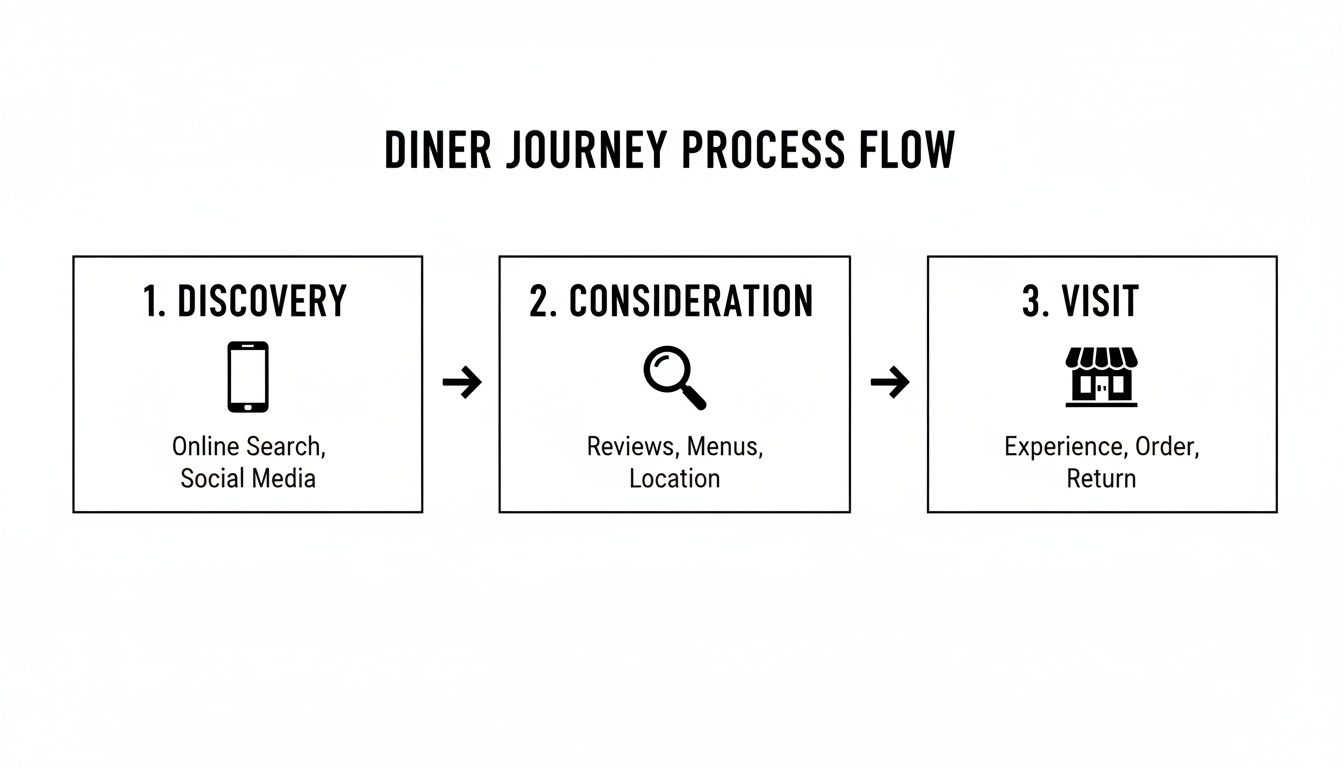
This journey from discovery to visit shows just how vital authentic content is for nudging people from casual interest to actively booking a table.
Creating an Offer They Can't Refuse (and a Budget That Works)
With your goals locked in, it’s time to craft an offer. And I don’t just mean a free meal. The offer is the engine of your campaign, and it needs to be powerful enough to get a creator excited and compelling enough to make their followers take action.
Think beyond just "dinner's on us." Structure a complete experience. A complimentary meal for the influencer and a guest is a great starting point, as it lets them showcase a genuine dining experience with a friend or partner. Then, to get their followers through your door, you need a trackable incentive.
Pro Tip: The best offers create a win-win-win. The influencer gets a genuinely valuable experience and great content. Their audience gets an exclusive deal they can't find anywhere else. And you get new customers and a clear way to measure the results.
For example, give them a unique discount code like 'CHLOE15' for 15% off their bill. Or try a specific offer, like a 'free glass of prosecco with any main course' when a customer shows the influencer’s post. This is your secret weapon for attribution—it’s how you’ll know the campaign is actually working.
Finally, you need to set a realistic budget. This isn't just about cash payments; it's about the total value you’re investing. Your budget should cover:
Gifted Experiences: This is the cost of the food and drink you're providing. For nano-influencers just starting out, this is often the entire arrangement.
Paid Collaborations: A set fee for more established micro-influencers or for campaigns where you need guaranteed deliverables (e.g., one Reel and three Stories).
Platform Fees: If you're using a tool or platform to find influencers and manage the campaign, don't forget to factor in that cost.
My advice? Start small. Focus on gifted collaborations first to test the waters and build genuine relationships. Once you see what resonates, you can start putting a dedicated budget behind paid partnerships to really scale your success.
Finding and Vetting Your Ideal Local Food Influencers
Once you’ve nailed down your goals, it’s time for the real work: finding the right partners to bring your campaign to life. Honestly, this is where most restaurant campaigns either succeed or fail. The perfect influencer can pack your tables for weeks, while the wrong one is just a sunk cost.
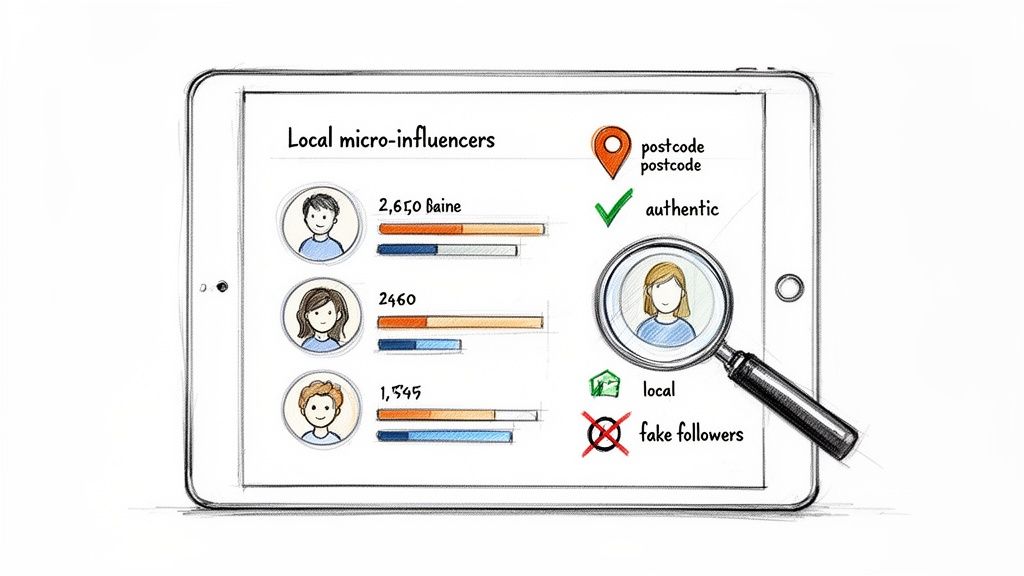
Forget chasing massive follower counts. Your secret weapon is the local nano-influencer (1k-10k followers) and micro-influencer (10k-50k followers). Their audience isn't just a number; it's a community of potential diners who live right around the corner. The challenge is seeing past the vanity metrics. A huge following means nothing if they’re scattered across the country or, worse, a mix of bots and dormant accounts.
How to Pinpoint Your Local Creators
Finding genuine foodies in your city requires a bit of savvy digital detective work. You’re looking for creators with a real, engaged following right in your postcode. A great starting point is to search for the specific hashtags locals actually use on Instagram and TikTok. Go beyond broad terms like #foodie and think local.
For a restaurant in Manchester, for instance, you'd want to dive into tags like:
#manchesterfood#mcrfoodie#eatmcr#restaurantsinmanchester
These hyper-localised hashtags are a goldmine. They’ll lead you straight to the people already reviewing and bigging up venues in your area. You can also use platforms like Sup, which are built to solve this exact problem by letting you filter creators by location, niche (like "vegan food" or "cocktail bars"), and follower size to quickly build a solid list. For a deeper dive, check out our full guide on how to find local food influencers in your city.
And make no mistake, this stuff works. Across the UK, local influencer marketing is driving a serious amount of footfall. Data shows that 49% of consumers make purchases based on influencer posts, with an incredible 81% researching or buying after seeing something on social media. This trend is only getting stronger; by 2026, 60% of UK customers found new places to eat through Instagram and TikTok, directly fuelling more visits. If you want the full picture, this report offers more insights on why influencer marketing is a necessity for restaurant brands.
Separating the Great From the Risky
After you’ve shortlisted a few creators, it’s time to vet them properly. This is where you put on your critic’s hat and scrutinise their profiles to make sure they’re a good fit for your brand and can actually deliver. It’s about more than just pretty pictures—it’s about authenticity, audience quality, and whether their vibe matches yours.
A vegan café partnering with a steakhouse reviewer is an obvious no-go, but other red flags can be much more subtle. You need a consistent way to judge each profile.
To help you out, I've put together a quick-reference table. Use it to look for the green flags that signal a quality partner and watch out for the red flags that suggest you should probably steer clear.
Vetting Influencers: Quality Signals vs Red Flags
Quality Signal | Potential Red Flag |
|---|---|
Comments are genuine conversations from real people, not just emojis. | Comments are generic ("Nice pic!") or full of spam and bots. |
The influencer responds to their followers and fosters community. | An abnormally high follower count but very low engagement (likes/comments). |
Their follower-to-following ratio is balanced or skewed towards followers. | They follow thousands more accounts than follow them back. |
Audience demographics (if available) are heavily concentrated in your city/region. | Follower growth spikes suddenly, suggesting they might buy followers. |
Their content quality is consistently high, with a clear personal style. | Content feels repetitive, low-effort, or is just reposted memes. |
They have a history of successful local collaborations with tangible results. | Their feed is cluttered with mismatched, poorly disclosed #ads. |
Think of this as your defence against a lacklustre campaign. One red flag might just be a blip, but a pattern of them is a clear sign to walk away. This careful vetting process is what separates the campaigns that generate queues out the door from the ones that fizzle out.
An influencer's true value isn't their follower count—it's their ability to build trust and inspire action within a relevant, local community. A creator with 2,000 highly engaged followers in your town is far more valuable than one with 100,000 disinterested followers spread across the globe.
Getting Your Outreach Opened (and Answered)
Alright, you’ve scouted your list of perfect local foodies and done your homework. Now for the bit that makes or breaks the whole thing: the first message. In a world where good creators get dozens of requests a day, a lazy, copy-pasted DM is a guaranteed way to get ignored.
Your mission here isn't just to get a reply. It's to kick off a real conversation that gets them genuinely excited to work with you. That means your outreach needs to feel personal, professional, and valuable from the very first line. You have to prove you’ve actually paid attention.
Seriously, forget about mass DMs. A personalised approach shows you respect their craft. Before you even think about pitching, mention something specific you liked about their content. A quick, "Your review of the new bakery on King Street was fantastic, we loved how you captured the morning light!" shows you’re a real person and not just another brand blasting out generic offers.
How to Personalise Your Pitch
Once you've made that genuine connection, you can introduce your restaurant and the opportunity. Keep it brief and to the point. Tell them exactly why you think they are the right fit for your brand and what you have in mind. Is it for your new weekend brunch menu? A campaign to finally get bums on seats mid-week?
A strong pitch that actually gets a response tends to have a few things in common:
A personal opening: Show you're a fan by referencing a recent post or Story.
A quick intro: Briefly say who you are and what your restaurant is all about.
The "Why You": Explain what it is about their style or audience that makes them a perfect match for you.
The Offer: Clearly outline what’s in it for them (e.g., a complimentary meal for two to try the new menu).
A simple next step: End with an easy, low-commitment question like, "Let me know if this sounds interesting, and I can send over more details."
This whole structure respects their time while making it incredibly easy for them to see the value and say yes. To really perfect your messaging, check out our deep dive on how to write the perfect influencer outreach email.
The Creative Brief: Your Guide to Great Content
Once an influencer says they’re interested, it's time to send over a creative brief. This is your key document for making sure everyone is on the same page. But here’s where a lot of restaurants go wrong: they make the brief far too restrictive. It’s meant to be a guide, not a script.
A great creative brief inspires, it doesn't dictate. The goal is to give influencers the key information they need, then give them the creative freedom to do what they do best: make authentic content their audience will love.
Your brief should clearly state the absolute must-haves without killing their creativity. Think of it as giving a chef the key ingredients but letting them decide how to prepare the dish. It needs to have just enough detail to protect your brand and drive the action you want—getting people through the door.
Building a Brief That’s Inspiring and Actionable
A well-put-together brief prevents so many headaches down the line. It helps the creator deliver content that actually hits your campaign goals. Use clear headings and bullet points to make it scannable.
Here’s what I always include in mine:
Campaign Goal: Be specific. Is it to get the word out about your new vegan menu or to drive bookings for Sunday roasts? Tell them!
Key Messages: What are the 1-3 things you need them to mention? This could be your commitment to local suppliers, your new happy hour specials, or the unique atmosphere of your back garden.
The Call-to-Action (CTA): This is absolutely critical for driving footfall. Be crystal clear about what you want their followers to do. For example, "Use code BRUNCH15 to get 15% off when booking online" or "Show this post at the bar for a complimentary dessert."
Deliverables: Confirm what you've agreed on. For instance, 1 Instagram Reel and 3 Instagram Stories. Be specific about platforms.
Mandatories: Include any essential hashtags (
#YourRestaurantName) and handles (@YourInstagram) they must tag.The Boring (But Important) Bit: Remind them to use disclosure like #ad or #gifted. This keeps both you and them compliant with advertising standards.
By giving them this simple framework, you’re setting them up for success. You empower them to create content that feels natural and serves your business goals—the perfect recipe for a partnership that brings new customers to your tables.
Alright, your plans are set, and your influencers are lined up. This is where the rubber meets the road—the moment you turn all that careful planning into a real, buzz-worthy campaign that gets people walking through your doors.
It's one thing to get likes and comments online; it's another entirely to get bums on seats. Let's talk about how to make that happen.
First things first: the influencer’s visit has to be flawless. A smooth, memorable experience for them will shine through in their content, making their recommendation feel genuinely exciting. I've seen collaborations go sour simply because the front-of-house team was left in the dark. Brief your staff on who is coming, when, and what’s been agreed. A confused host greeting your star influencer is the fastest way to kill the vibe.
From Online Buzz to Offline Business
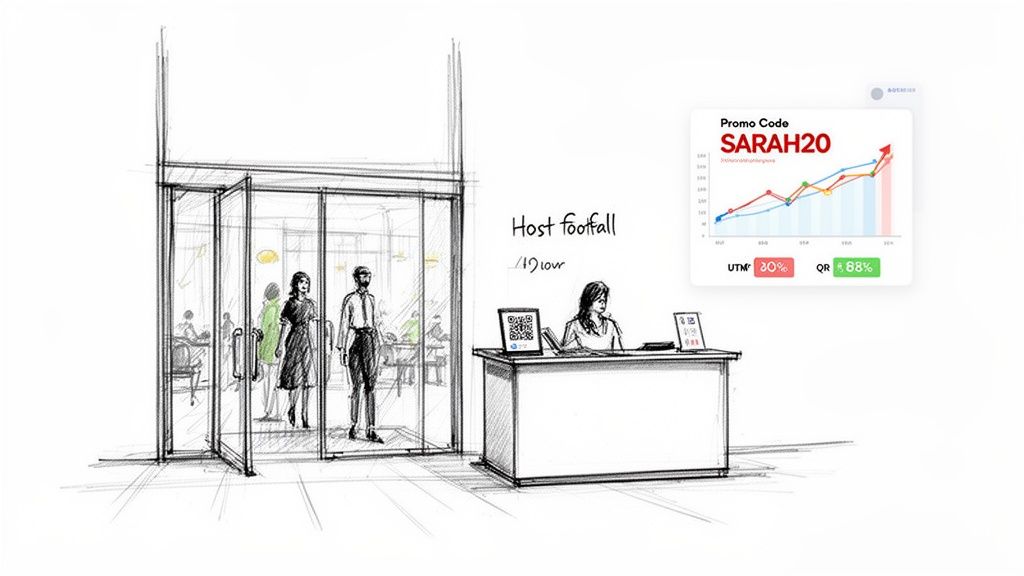
Now for the tricky part: attribution. How do you prove that a specific Instagram post led to a customer sitting at table 12? This is where trackable offers become your secret weapon, closing the gap between online chatter and actual revenue.
Simply giving an influencer a free meal and hoping for the best is a gamble. Instead, you need a system that directly links their content to customers. This moves you from guesswork to knowing exactly which partnerships are delivering and which aren't.
Choosing Your Tracking Method
There are several tried-and-tested ways to track footfall. The best choice really depends on your restaurant's setup, but the golden rule is to give each influencer a unique tracker to isolate their impact.
Unique Promo Codes: This is the industry standard for a reason. Give each influencer a simple, unique code, like ‘CHLOE20’ for 20% off or a free glass of prosecco. When a customer uses that code, you know exactly who sent them.
Trackable Booking Links (UTMs): If you use an online reservation system like Resy or OpenTable, you can create a custom booking link for each influencer. Using a free UTM builder, you can see in your website analytics how many bookings came straight from their link-in-bio or Story swipe-up.
Custom QR Codes: A great visual option for in-person redemptions. An influencer shares a unique QR code in their content, and their followers simply present it at your restaurant to claim their offer. It’s quick, modern, and easy for everyone.
To help you decide, here’s a quick breakdown of how these methods stack up against each other.
Comparing Footfall Attribution Methods
Method | How It Works | Pros | Cons |
|---|---|---|---|
Unique Promo Codes | Each influencer gets a distinct code (e.g., 'SAM15') for followers to redeem. | Simple for customers and staff; easy to track at the point-of-sale. | Requires manual entry; customers might forget the code. |
Trackable Booking Links (UTMs) | A custom URL is created for each influencer's link-in-bio, leading to your reservation page. | Excellent for tracking online-to-offline journey; data is captured automatically. | Only tracks bookings, not walk-ins; relies on an online reservation system. |
Custom QR Codes | Influencers share a unique QR code that customers scan at the restaurant to get an offer. | Visually engaging and tech-savvy; eliminates manual code entry. | Customers need to have their phone ready; requires staff training on scanning. |
Ultimately, the goal of any of these methods is to give you clear, undeniable data on what's working.
Tracking isn't just about patting yourself on the back for a successful campaign; it's about learning. When you see one influencer's code was redeemed 50 times while another's was only used twice, you've just gained critical insight for your next move.
Creating and monitoring all these codes can feel like a chore, especially as you scale up. This is where platforms like Sup can be a game-changer. It automates the creation and tracking of unique codes for every single collaboration, giving you one clean dashboard to see who’s driving revenue and what your true ROI is.
For a masterclass on this topic, our guide dives much deeper into how to track influencer marketing attribution with promo codes.
Calculating Your Return on Investment
Once you have a reliable tracking system, calculating your ROI is surprisingly simple. You can finally answer the question every marketer gets asked: "Was it worth it?"
First, add up your total investment for the campaign. This includes the cost of the gifted meal or experience, any fee paid to the influencer, and other related expenses.
Next, tally the total revenue brought in from their unique code or link. For example, if 30 customers used the ‘CHLOE20’ code and the average bill was £50, that’s £1,500 in direct revenue.
The ROI calculation is straightforward from there:
(Revenue Generated - Campaign Cost) / Campaign Cost x 100 = ROI %
This simple formula is what turns influencer marketing from a "nice-to-have" expense into a measurable growth engine. It gives you the hard data needed to justify your marketing spend and prove that you know how to turn great content into a full restaurant.
Your Top Restaurant Influencer Marketing Questions, Answered
Jumping into the world of influencer marketing can bring up a lot of questions. It's a new frontier for many in the restaurant business, so it's only natural to have some uncertainties. We've been in the trenches with hundreds of restaurants, and we hear the same questions time and time again.
Here are the straightforward, no-nonsense answers you've been looking for.
How Much Should I Actually Budget for an Influencer Campaign?
This is the million-pound question, isn't it? The good news is, your budget can be surprisingly flexible, especially when you're just starting out.
For a local nano-influencer (think someone with 1,000-10,000 followers), a simple gifted experience is often all it takes. Your only real cost is the meal you provide. It’s a brilliant, low-risk way to get your food onto local feeds and see which creators are a good fit.
Once you start working with more established micro-influencers or if you have a very specific goal in mind (like promoting a new menu), you’ll likely need to pay a fee. In the UK, this could be anywhere from £100 to over £500 per post. The price tag depends on their engagement, the quality of their content, and exactly what you're asking them to do. Just remember: a smaller, highly engaged local following is always more valuable than a huge, generic one.
Is It Better to Gift Meals or Pay Influencers?
Honestly, you should be doing both. Gifted and paid campaigns aren't an either/or situation; they just have different jobs within your overall strategy.
Gifted Campaigns: These are your secret weapon for generating loads of authentic content without a big cash outlay. Gifting works best with nano-influencers who genuinely love supporting local businesses. It's the perfect way to build an army of real brand advocates.
Paid Collaborations: Paying a creator puts you in the driver's seat. It's the right move when you need guaranteed results—say, a high-quality Reel for a competition or a set of Stories promoting a bank holiday special. You're paying for control and a specific outcome.
Here's what we've seen work: Kick things off with gifting to test the waters and build genuine relationships. When you find a few creators who consistently deliver great content and drive real interest, that's when you invest in a paid partnership with them for your bigger campaigns.
How Can I Actually Measure the ROI from Footfall?
This is where the magic happens. Vague metrics like 'likes' and 'views' are nice, but they don't prove that people are actually walking through your door. To measure return on investment (ROI), you need a simple but solid tracking system.
The most reliable method is to give each influencer their own unique code or link. This could be a discount code like ‘CHLOE20’ for 20% off, a custom booking link through your reservation software, or a simple QR code they can share in their Stories.
By tracking every time that code is used or that link is clicked, you can directly attribute real-world sales to a specific influencer. This gives you concrete data to calculate your ROI and finally prove what's working.
What if an Influencer Leaves a Bad Review?
It's a common fear, but it's rarely the disaster you might imagine. The whole point of influencer marketing is its authenticity, and sometimes that means you'll get honest feedback that isn't 100% glowing. The best way to prevent this is to make sure the experience you're offering is flawless.
But if it does happen, your response is everything. Never ignore it. Engage with the feedback publicly and professionally. Thank them for their honest opinion. If the criticism has merit, own it and share what you're doing to fix it. That kind of transparency can build far more trust with their audience than a perfect review ever could.
Of course, marketing is just one piece of the puzzle. For answers to other operational questions, you might find these general business FAQs helpful.
Ready to stop guessing and start seeing real results from your influencer marketing? Sup is your all-in-one growth engine, making it easy to find local creators, manage campaigns, and track footfall with automated promo codes. Save time and finally prove your ROI. Get started with Sup today.

Matt Greenwell
Share