To write the perfect influencer outreach email, you have to ditch the generic templates and embrace a personalised, value-first approach. It really comes down to three things: proving you actually follow their work, making a clear offer that benefits them, and finishing with a simple, direct call to action.
This strategy is the difference between sending a cold pitch and starting a genuine partnership.
Why Your Outreach Emails Are Getting Ignored
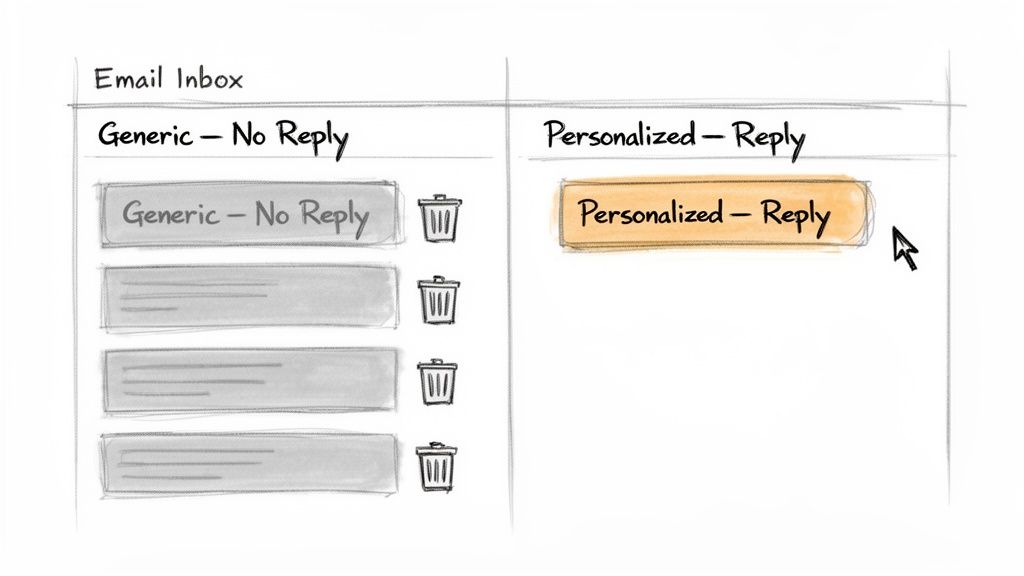
Let's be real for a second. A massive chunk of influencer outreach emails gets deleted within moments of being opened. If you’re sending out messages and only hearing crickets, you’re definitely not alone. The problem usually isn't your product or brand; it's the outreach itself.
So many marketers get stuck in the "spray and pray" trap. They fire off hundreds of identical, impersonal emails, just hoping something sticks. This tactic just floods creators' inboxes with low-effort messages that are easy to spot and even easier to ignore. These emails basically scream, "You're just a number on my list," not, "I genuinely want to build something with you."
The Old Way vs. The New Way
The creator economy has grown up. Today’s influencers are savvy business owners who can sniff out a copy-pasted template from a mile away. An email that just says, "Hey, love your content, wanna collab?" is destined for the bin.
Why? Because it’s missing three critical pieces:
Authentic Personalisation: It fails to mention any specific content, showing you haven't done your homework.
Clear Value: It doesn't bother to explain what the creator actually gets out of the deal.
A Simple Ask: The request is vague, leaving the creator to do all the work of figuring out the next steps.
This outdated thinking is a fast track to getting ignored. It treats outreach as a transaction, not a relationship. In today's market, that’s a losing game. For instance, the UK influencer market is predicted to explode from USD 3.1 billion to an incredible USD 28.3 billion by 2034. This growth means creators are getting more pitches than ever, making it absolutely essential for your outreach to cut through the noise. You can discover more insights about UK influencer market projections on imarcgroup.com.
The biggest mistake I see brands make is sending emails that are all about them. Your outreach should focus entirely on the creator: their content, their audience, and the value you can bring to their world.
From Deleted to Deal Your Outreach Upgrade
To actually get replies and build partnerships, you have to shift your mindset. Stop thinking about volume and start thinking about value. It means putting in the time upfront to understand each creator, writing a message that truly resonates, and making your offer compelling and dead simple to accept.
This table breaks down the common mistakes we all see versus the modern strategies that actually land deals. It's the core difference between an email that gets deleted and one that starts a conversation.
Outdated Tactic (The 'Before') | High-Conversion Strategy (The 'After') |
|---|---|
Sending a generic, one-size-fits-all template. | Crafting a highly personalised message referencing their specific content. |
Using a vague subject line like "Collab Opportunity". | Writing a clear, compelling subject line that includes their name and your brand. |
Focusing only on what you want from them. | Highlighting the mutual value and what's in it for the creator. |
Making a confusing or demanding ask. | Presenting a simple, clear, and direct call to action. |
Coming across as a faceless corporation. | Adopting a human, professional tone that builds rapport. |
By upgrading your approach from the 'before' to the 'after', you're not just improving your email—you're respecting the creator's time and expertise, which is the foundation of any great partnership.
Laying the Groundwork for a Winning Email
Here’s a little secret from the trenches of influencer marketing: the perfect outreach email is written long before you ever open your drafts folder. The real magic happens in the prep work.
Sending a pitch without doing your homework is a guaranteed way to get ignored. It’s what separates a thoughtful, personalised offer that a creator is genuinely excited to open from a generic email blast that gets deleted on sight. This is where you put in the effort to move beyond a simple transaction and start building a real partnership.
Look Beyond the Follower Count
It's so easy to get dazzled by big numbers. But the most common mistake I see brands make is chasing a massive follower count. Sure, a creator with 500,000 followers looks impressive, but what good is that reach if their audience has zero interest in what you sell?
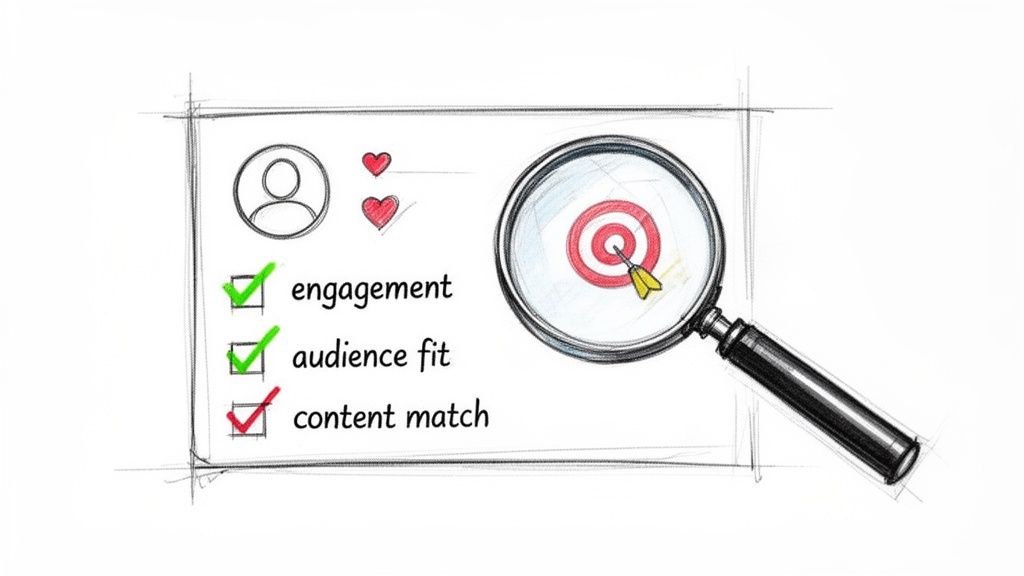
Instead, you need to put on your detective hat. I always vet creators for three things above all else:
Engagement Quality: Don't just glance at the like-to-follower ratio. You have to actually read the comments. Is there real back-and-forth, or is it just a wall of fire emojis and bot comments? Genuine conversation is the sign of a truly connected community.
Audience Alignment: Who are their followers, really? If you're a local restaurant in Manchester, a creator whose audience is primarily based in London or New York isn't going to help you. Ask for a media kit or check their platform’s analytics to confirm their audience demographics are a match.
Content Resonance: Take a moment to just feel their content. Does the style, the tone, the whole vibe fit with your brand? If you sell high-end, minimalist skincare, an influencer known for loud, slapstick comedy probably isn't the one, no matter how many views they get.
A smaller, hyper-engaged audience is almost always more valuable than a massive, passive one. You want creators whose followers genuinely trust them. That trust is what turns a sponsored post into actual sales or footfall.
Get to Know Their World to Personalise Your Pitch
Once you've got a shortlist, it's time to do a bit of research. This isn't about being creepy; it’s about being professional. You need to understand their content and their community before you can hope to become a part of it.
Seriously, spend at least 15-20 minutes on their profile. Watch their recent Reels, read their captions, and click through their Stories. Look for the little things—running jokes, causes they're passionate about, a favourite local coffee shop they always feature. For local businesses, this is non-negotiable, and our guide on how to find local food influencers in your city has more specific tactics for this.
This is the fuel for genuine personalisation. It lets you go from a lazy "I love your content" to something that proves you've paid attention, like, "Your recent series on finding the best flat whites in Shoreditch was fantastic—I especially loved the detail in your third post about the latte art." See the difference? One is a template; the other is a conversation starter.
Define Your Goal and Make an Offer They Can’t Ignore
Before your fingers hit the keyboard, you need absolute clarity on two things: what you want to achieve, and what you’re offering in return. A vague "let's collaborate" pitch is easy for a busy creator to ignore.
Get specific about your objective. Are you trying to:
Boost Awareness? Simply get your brand name in front of fresh eyes.
Drive Sales? Push direct purchases with a unique discount code.
Generate Content? Get high-quality user-generated content (UGC) you can use across your own marketing channels.
Your offer must be a fair exchange for the work involved. A simple product gift might work for a quick Story mention from a nano-influencer. But if you're asking for a dedicated Reel and three feed posts, you need to come with a proper budget. Be ready to propose a flat fee, a commission structure, or a seriously compelling product package that respects the time and effort you're asking for.
Anatomy of an Email That Gets a Reply
Let's get one thing straight: creators can spot a generic, copy-pasted email from a mile away. If you want a reply, you need to write like a human being, not a marketing bot. A great outreach email isn't about corporate-speak or complicated templates; it’s a clear, respectful, and direct conversation.
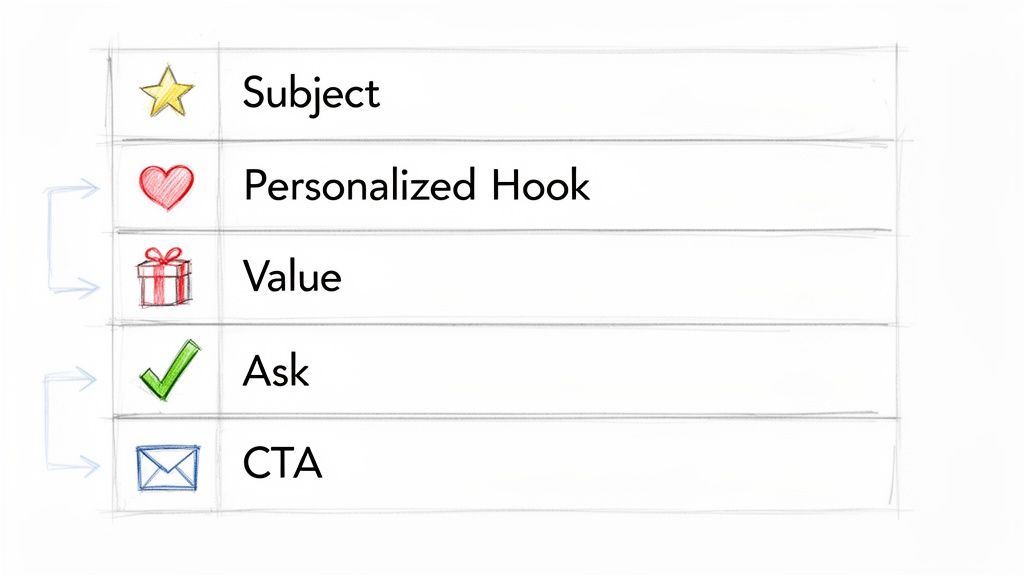
I’ve found it helps to think of your email as having four distinct parts, each with a specific job to do. But before we get to the body, we have to nail the very first thing they'll see.
That’s right, the subject line. It's your digital first impression, and getting it right can boost your open rates by as much as 26%. The trick is to be intriguing without being clickbait. Forget shouting "Urgent Collab!"—it's the fastest way to the spam folder.
The Subject Line Swipe File
A solid subject line is short, includes a touch of personalisation, and hints at the value inside. Here are a few battle-tested examples you can adapt.
For Paid Collaborations
Paid Collab: [Your Brand] x [Influencer's Name]
Partnership Idea for Your [Topic] Content
[Influencer's Name], love your work! Paid post idea?
Paid Ambassador Role with [Your Brand]?
Quick question about a paid partnership
For Product Gifting & Seeding
A gift from [Your Brand] for you
Love your [specific content type]! Can we send you something?
For [Influencer's Name]: A package from [Your Brand]
Product for you from a fellow [Their Interest] fan
Hope you like this, [Influencer's Name]
For Event Invitations
You're Invited: [Your Brand] Event in [City]
VIP Invite for [Influencer's Name]
Joining us? [Event Name] on [Date]
An exclusive invite for you, [Influencer's Name]
Hope to see you at our [Event Type] event
The Four Essential Parts of Your Email Body
Once they’ve opened your email, the clock is ticking. You have seconds to convince them it's worth reading. This is where a clear, logical structure is your best friend. In my experience, mastering the art of writing cold emails that get replies is the single most important skill for successful outreach.
An effective email moves through four key stages:
First, you need a Personalised Hook. This is your opening line, and it has one job: to prove you've done your homework and aren't just blasting a list.
Next, you deliver the Clear Value Proposition. This immediately answers the creator’s unspoken question: "What's in it for me?".
Then comes the Simple Ask. Be crystal clear about what you're hoping they'll do. No vague requests.
Finally, you close with a Professional Call-to-Action (CTA). Tell them exactly what the next step is if they want to move forward.
The difference is night and day. Just look at this "bad" vs. "good" example.
Bad Example:
Hi,
I'm from Brand X. We sell sustainable activewear. We love your page and think you’d be a great fit for a collaboration. We want you to post about our new leggings.
Let me know if you’re interested.
Thanks, Marketing Team
This is the kind of email that gets deleted on sight. It's impersonal, lazy, and all about what the brand wants. It offers zero value and gives the creator no reason to even consider replying.
Now, let's see how a pro would do it.
Good Example:
Subject: Paid Collab: [Your Brand] x Sarah
Hi Sarah,
I’ve been following your marathon training journey on Instagram for a few months—that sub-4-hour goal is so inspiring! Your recent post about finding comfortable running gear really stood out to me.
I'm the founder of [Your Brand], and we make eco-friendly activewear designed for endurance runners. Because your audience trusts your recommendations for performance gear, we’d love to partner with you for a paid post featuring our new compression leggings.
We’re offering £500 for one in-feed post. In return for the post, you’ll receive the leggings plus our best-selling running top.
If you're interested, just reply to this email, and I can send over a simple one-page brief with all the details.
Cheers, [Your Name] Founder, [Your Brand]
See the difference? This email works because it’s built on genuine appreciation and mutual benefit. It leads with a specific, authentic compliment (The Hook), connects the brand to the creator's content (The Value), lays out the compensation and deliverables clearly (The Ask), and ends with an easy next step (The CTA).
That's how you turn a cold email into a warm conversation. It's not just a transaction; it's the start of a real partnership.
Field-Tested Outreach Templates for Any Scenario
Alright, this is the part you’ve probably been waiting for. The theory is great, but what you really need are some solid, adaptable templates to get the ball rolling. Forget the generic, one-size-fits-all emails that creators can spot a mile away. The secret to getting a response is matching your message to the specific situation.
The templates below are built for the real-world scenarios you’ll actually run into. Think of them less as fill-in-the-blanks and more as proven starting points. They’re structured to hit all the right notes—personalisation, value, and clarity—but you absolutely have to inject your own brand’s personality and genuine appreciation for the creator to make them work.
Template 1: Product Gifting for Nano and Micro-Influencers
This one is perfect for e-commerce startups or any brand looking to get their product into the hands of smaller creators (think under 10k followers). The main goal here is to build genuine relationships and hopefully spark some authentic user-generated content, all without a hefty budget. The offer is simple: a free product, no strings attached.
Why this works: It’s a low-pressure offer that shows you respect the creator's autonomy. By not demanding a post, you come across as confident in your product's quality. This genuineness often makes creators want to share their experience organically.
Subject: A little something from [Your Brand] for you, [Influencer's Name]
Hi [Influencer's Name],
My name is [Your Name], and I'm the founder of [Your Brand]. I’ve been following your Instagram for a while now, and I was so impressed with your recent post on [mention a specific post, e.g., your tips for sustainable living]. Your passion for [their niche, e.g., eco-friendly products] really shines through.
We create [brief, one-sentence description of your product, e.g., handcrafted, vegan-friendly candles here in the UK], and I immediately thought of you.
We would absolutely love to send you our [specific product] as a gift. There are no strings attached whatsoever—we’re just big fans and would be thrilled for you to try it.
If you’re open to it, just let me know the best address to send it to.
Cheers,
[Your Name] [Your Title], [Your Brand]
Template 2: Paid Collaboration With an Established Creator
When you’re ready to invest in a paid partnership, your outreach needs to be sharp, professional, and straight to the point. This template is designed for approaching more established creators (think 50k+ followers) or those who have an agent listed in their bio. It respects that their time is valuable and their inbox is a business tool.
Key Elements:
Direct Subject Line: Using "Paid Partnership" immediately signals a serious business enquiry.
Clear Offer: You're upfront about the compensation and exactly what you're looking for.
Professional CTA: It gives them (or their agent) a clear next step without asking for too much commitment.
Subject: Paid Partnership Idea: [Your Brand] x [Influencer's Name]
Hi [Influencer's or Agent's Name],
My name is [Your Name], and I head up partnerships at [Your Brand]. I've been a huge admirer of [Influencer's Name]'s content, especially the way they [mention something specific and authentic, e.g., create such cinematic travel reels that capture the feel of a place].
We are launching our new [Product/Campaign Name] and believe [Influencer's Name]'s authentic storytelling and engaged audience would make for a perfect partnership.
We'd like to propose a paid collaboration for one in-feed Instagram post and a set of three Stories. Our budget for this is [Your Budget, e.g., £1,500], and of course, the full product collection would be included.
If this sounds like a potential fit, I would be happy to send over a more detailed one-page brief.
Looking forward to hearing from you,
[Your Name]
[Your Title], [Your Brand]
[Link to Your Website]
Template 3: Local Collaboration for a Cafe or Shop
If you run a brick-and-mortar business—a cafe, a local boutique, a restaurant—your goal is driving foot traffic and creating local buzz. This template is all about inviting a local micro-influencer for a complimentary experience. The value you're offering isn't cash; it's a great experience they can share with their like-minded local followers.
Subject: An Invite from a local spot, [Your Brand]!
Hi [Influencer's Name],
I’m [Your Name], the owner of [Your Business Name], the [type of business, e.g., independent coffee shop] over in [Your Neighbourhood/Area]. I’m a big fan of your page and how you showcase the best hidden gems in [Your City]—your recent feature on [mention a specific place they visited] was fantastic!
Since you and your followers clearly have a great eye for local spots, I'd be honoured to invite you and a friend to visit us for [your offer, e.g., brunch on the house].
There’s no obligation to post at all; we’d just love to host you and get your honest thoughts.
Let me know if you might be free to stop by sometime in the next few weeks!
Best,
[Your Name]
Owner, [Your Business Name]
[Your Instagram Handle]
Template 4: Exclusive Event Invitation
Hosting a product launch, a new menu tasting, or a brand anniversary? Inviting the right influencers can generate a massive amount of content and social proof in a single evening. The key here is to make the email feel exclusive and exciting, positioning the creator as a true VIP.
Subject: You're Invited: The [Event Name] with [Your Brand]
Hi [Influencer's Name],
I'm [Your Name] from the team at [Your Brand]. On behalf of our entire team, I’m thrilled to extend a personal invitation to you for our exclusive [Event Name]!
We're celebrating [reason for the event, e.g., the launch of our new winter collection] with an intimate gathering of [City]'s top creators and press. The evening will feature [mention 1-2 exciting details, e.g., a live DJ set, bespoke cocktails, and a first look at the collection].
Date: [Date of Event]
Time: [Time of Event]
Location: [Venue Name, Address]
We've been following your work for some time and would be honoured to have you as our guest.
Please RSVP by [RSVP Date] so we can add your name to the guest list. We hope to see you there!
Warmly,
[Your Name] [Your Title], [Your Brand]
Mastering the Follow-Up and Measuring What Matters
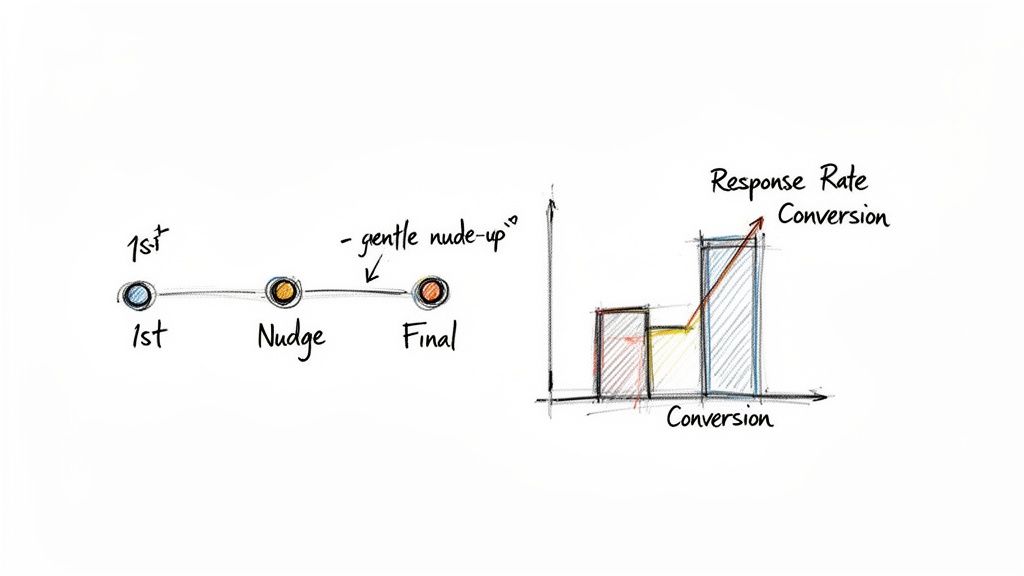
Hitting ‘send’ on that carefully crafted email feels great, but it’s really just the beginning. I see so many brands fire off one message and then sit back, assuming no response means "no thanks".
Let's be real: creators are swamped. Your brilliant pitch could easily be sitting unread, buried under dozens of others.
This is where your follow-up game needs to be strong. It’s not about being pushy; it's about professional persistence. I’ve found that a single, polite follow-up can make a world of difference, often turning radio silence into a signed partnership.
The Art of the Gentle Nudge
The real skill here is walking that fine line between persistence and becoming a pest. You’re not chasing them—you're just giving your genuinely valuable offer another moment in the spotlight. A great follow-up is short, friendly, and references your first email without rehashing the entire pitch.
My tried-and-tested method is a single "gentle nudge" sent 3-5 business days after the initial outreach. This gives them plenty of time to have seen the first email but doesn't let the opportunity go cold. To get this right, it helps to understand different kinds of follow-up email templates for re-engaging creators and boosting your response rate.
Here’s a simple template you can adapt that’s worked wonders for me:
The 'Gentle Nudge' Follow-Up Template
Subject: Re: [Original Subject Line]
Hi [Influencer's Name],
Just wanted to quickly follow up on the email I sent last [Day of the week] about a potential partnership with [Your Brand].
We’re still huge fans of your [mention their content again, e.g., stunning travel photography] and would love to hear your thoughts on a collaboration when you have a moment.
Let me know if you're interested!
Best, [Your Name]
If you still don’t hear anything after this one follow-up, it’s usually best to move on. Honestly, your time is better spent on creators who are showing some interest. Bombarding someone with messages is just a fast track to getting your brand a bad reputation.
Measuring What Actually Matters for Your Business
So, the replies are starting to trickle in. But how can you be sure your outreach is actually working? Open rates are a decent starting point, but they don't paint the full picture. To really get a handle on your campaign's health, you need to track the key performance indicators (KPIs) that tie directly to what your business wants to achieve.
At a minimum, you should be tracking these three core outreach metrics:
Response Rate: The percentage of creators who reply to your emails—good or bad. This tells you whether your subject lines and opening lines are grabbing their attention.
Positive Response Rate: The percentage of creators who show genuine interest in working together. This is a direct reflection of how compelling your offer is.
Partnership Conversion Rate: The percentage of your initial contacts that become active, signed-up partners. This is the ultimate measure of your entire outreach funnel's success.
With 59% of UK marketers planning to partner with more influencers in 2026, the entire industry is shifting towards performance-based campaigns that require this level of airtight tracking. Whether you're an agency managing client budgets or a restaurant looking to drive reviews, this trend makes connecting outreach to results essential. You can read the full research about UK influencer marketing trends on sproutsocial.com.
Tying Outreach to ROI
Tracking those KPIs is a fantastic start, but the real goal is to link your influencer outreach to tangible business results like sales, bookings, or sign-ups. This is where attribution becomes your best friend.
You can definitely start with a simple spreadsheet to log your outreach metrics. But to truly measure the financial impact, you need to get comfortable with trackable links and codes. Platforms like Sup automate this process by giving every creator a unique UTM link and promo code. This gives you a real-time view of who is driving clicks, conversions, and most importantly, revenue.
By measuring that entire journey from first email to final sale, you can finally prove the value of your work. We've got more tips on how to do this—you can learn more about measuring influencer marketing ROI in our complete guide. This data-driven approach is what turns influencer marketing from a shot in the dark into a reliable, repeatable growth channel.
Common Questions About Influencer Outreach
Even when you feel you've got your influencer outreach strategy nailed, a few practical questions always come up. Here are some of the most common queries we see from brands trying to connect with creators, along with our straight-talking answers.
How Long Should an Outreach Email Be?
Short. Really short. Your sweet spot is between 100 and 150 words.
Think about it from the creator's perspective: they're running a business, and their inbox is flooded with pitches. A concise, scannable email that respects their time is far more likely to get a positive response than a long-winded proposal. Your goal is to get straight to the point: what's the opportunity, what do you need from them, and what's the next step?
Should I Contact an Influencer Directly or Through an Agent?
This is a big one, and getting it wrong can make you look unprofessional. The rule is simple: if an agent or manager’s contact details are in the influencer's bio, you must go through the agent first. It's their job to handle business enquiries, and trying to bypass them is a bad look.
For nano or micro-creators who don't list a manager, it's perfectly fine to email them directly. Just be sure to double-check their Instagram bio or website for any specific instructions before you hit send.
When an agent is involved, they are your primary point of contact for all negotiations, contracts, and logistics. Bypassing them undermines their role and can damage your brand's reputation within the creator community.
With influencer marketing delivering an impressive ROI of $5.78 for every $1 spent, there's a lot of pressure to prove a campaign's worth. For businesses like hotels or restaurants, this means your outreach needs to introduce trackable elements right from the start, like unique discount codes or UTM links, to measure real-world results. For more insight, you can discover more about the state of the UK influencer market on imarcgroup.com.
What Is a Fair Offer for a Micro-Influencer?
This really depends on the creator, but let’s talk about the typical starting points. For smaller micro-influencers (usually with under 50k followers), a product-for-post exchange, or 'gifting', can sometimes work. However, the industry is professionalising fast, and most creators now rightly expect to be paid for their time, effort, and the audience they've built.
The best way to approach this is to simply ask for their media kit or rate card. This opens the conversation respectfully and shows you value their work. To get a better sense of current rates, our comprehensive guide can help you figure out how much you should pay Instagram influencers in 2026.
How Soon Should I Follow Up if I Do Not Get a Response?
Give it a little time. We recommend waiting 3-5 business days before sending a polite follow-up. A single, friendly nudge is professional and shows you’re genuinely interested in working together.
After that one follow-up, though, it’s best to let it go. Sending multiple messages can feel pushy and cross the line into spam. If you don’t hear back, it's better to move on and focus your energy on other creators who might be a better fit.

Matt Greenwell
Share