You can usually tell when an influencer programme is being held together by spreadsheets. The symptoms are obvious. A marketer is chasing creators in Instagram DMs, someone in paid social is asking for usage rights after the post has already gone live, finance is waiting on invoices with no matching deliverables, and the only campaign report anyone can produce is a screenshot of likes and comments.
That setup works for a one-off gifting push. It breaks the moment a brand wants predictable revenue, repeatable footfall, or clean client reporting.
The UK market is too mature for improvised workflow now. Influencer marketing reached an estimated £1.5 billion in 2025, and 71% of UK brands now use unique promo codes and UTM tracking, with managed campaigns averaging 4.2:1 ROAS versus 2.8:1 for unmanaged campaigns, according to Influencer Marketing Hub UK data referenced here. If you're still treating influencer work as a side project, you're competing against teams that already treat it like a channel.
Beyond the DMs A Modern Approach to Influencer Marketing
Manual influencer work fails in familiar ways. Outreach lives in one inbox. Negotiation sits in another. Product shipping details are trapped in a Google Sheet. Tracking links get built ad hoc. Nobody agrees on naming conventions. By the time reporting day arrives, the team has activity data but not business data.
That gap matters more than most brands realise. Influencer campaign management isn't just creator selection and content approvals. It's the operating system behind sourcing, outreach, briefing, compliance, publishing, attribution, payments, and reuse of the resulting UGC.
What unmanaged campaigns usually get wrong
The biggest issue isn't effort. It's fragmentation.
A chaotic process usually produces these problems:
Mixed objectives: One stakeholder wants reach, another wants online sales, and the restaurant manager wants bookings.
Weak attribution: Creators post with no creator-specific links, no code logic, and no clean handoff into analytics.
Late legal and compliance checks: ASA disclosure gets reviewed after content is drafted instead of before.
No content asset plan: Strong creator content disappears after posting because nobody secured rights or filed assets properly.
When teams work this way, they often mistake motion for management. A busy campaign can still be a poorly run campaign.
Practical rule: If a creator post can't be tied back to a tracked link, code, booking action, or asset library entry, it wasn't properly operationalised.
What a modern setup looks like
A stronger model is less glamorous and far more effective. Every creator gets a role in a campaign structure. Every deliverable has a deadline, owner, status, and approval path. Every post has a tracking framework attached before it goes live. Every result lands in one reporting view.
That's what separates “we ran influencer activity” from “we built an acquisition channel”.
For ecommerce brands, that means tying creator content to sessions, code use, add-to-carts, and attributed revenue. For hospitality groups, it means connecting local creators to bookings, review generation, and venue-specific footfall signals. For agencies, it means being able to show a client what happened by creator, by location, and by objective without spending half the month reconciling exports.
The shift is simple in theory. Stop managing influencers as conversations. Start managing them as campaigns.
Laying the Groundwork for a Profitable Campaign
Most influencer ROI problems start before outreach. Brands often approve creator fees, then realise too late they still need budget for paid amplification, content rights, tracking, management time, and contingency. That planning error keeps showing up in underperforming campaigns.
According to this UK campaign planning analysis, 62% of UK brands fail to allocate 30-40% beyond creator fees for amplification and management, leading to 45% lower ROI. The same source notes that success rates improve 73% when teams set SMART KPIs such as a 10% uplift in promo code redemptions from geo-targeted London creators.

Set revenue goals before creator goals
The brief should start with the commercial outcome, not the content format.
For an ecommerce brand, a usable goal sounds like this: increase creator-attributed orders for a defined product category and track that via creator-specific codes and UTM-tagged landing pages. For a restaurant group, a better goal is often creator-attributed bookings, offer redemptions, or review volume by location. For an agency, the KPI needs to be something a client can defend internally, usually revenue, qualified actions, or store-level outcomes.
Broad awareness still matters. It just can't be the only thing on the scoreboard.
A good KPI stack usually works in layers:
Primary commercial KPI such as revenue, bookings, or redemptions.
Supporting behaviour KPI such as clicks, landing page visits, or menu views.
Context KPI such as saves, shares, comments, or completion quality.
Build the budget with all costs visible
The practical budgeting framework I keep coming back to is the 50-30-20 rule from the verified data. Put 50% into creator fees, 30% into amplification and content licensing, and 20% into tools, contingencies, and attribution tracking. That forces the team to acknowledge the full cost of making creator content perform, not just the cost of buying the post.
This is also where campaign naming discipline matters. If your links, assets, invoices, and dashboards all label the same campaign differently, reporting turns into manual cleanup. A useful primer on fixing marketing data with structured naming helps prevent that mess before launch.
If you're planning from a blank page, this guide to building an influencer marketing strategy from scratch is a useful reference for aligning campaign structure with goals.
Sample KPIs by business type
Business Type | Primary KPI (Revenue-Driven) | Secondary KPI (Engagement/Awareness) |
|---|---|---|
Ecommerce and DTC | Attributed revenue from promo codes and UTM-linked sessions | Saves, product page visits, content reuse quality |
Restaurants and hospitality | Bookings, offer redemptions, or venue-specific code use | Review volume, local reach, comments indicating intent |
Multi-location chains | Location-level redemptions and store visits tied to creator/location match | Local engagement quality and repeat creator performance |
Agencies managing clients | Client-attributed revenue or qualified conversion events | Content delivery rate, approval speed, reporting completeness |
A profitable campaign is usually planned backward. Start with the number the finance team cares about, then decide which creators and content can realistically move it.
Sourcing and Vetting Authentic Creator Partners
Follower count is still the easiest trap in influencer campaign management. It offers a quick sense of scale, but it tells you almost nothing about local relevance, buying intent, or whether the audience trusts the creator enough to act.
That matters in the UK market because many high-performing campaigns now lean smaller and more specific. According to UK data on managed nano-creator campaigns, 73% of DTC brands and 68% of restaurants used managed campaigns with nano-creators, who achieved 7.2% engagement rates versus 3.1% for macros. The same source says this translated to 22% direct sales growth via promo code redemptions.
What to look for beyond the audience size
A strong creator fit usually shows up in a cluster of signals rather than one metric.
Look for:
Location credibility: For hospitality and multi-site retail, the creator should visibly spend time in the area they claim to influence.
Audience fit: Comments, content themes, and recurring brand mentions should align with your buyer, not just your category.
Behavioural relevance: Someone who regularly drives action is more useful than someone who passively collects views.
Content usability: Ask whether the brand could reuse the creator's footage in paid social, email, or site content without it feeling forced.
The best creators for a campaign often aren't polished in the agency-deck sense. They're trusted, consistent, and close to a specific audience.
How to vet without overcomplicating it
I prefer a simple pass-fail review before any outreach starts.
Check | What good looks like | What raises concern |
|---|---|---|
Engagement quality | Comments that respond to the actual post | Repetitive generic comments |
Audience relevance | Clear niche or local alignment | Broad content with no audience thread |
Posting pattern | Consistent content style and cadence | Sudden spikes or inconsistent brand fit |
Brand safety | Stable tone and obvious disclosure habits | Unclear sponsorship history or risky content mix |
You don't need a forensic audit for every creator. You do need enough discipline to avoid paying for mismatch.
A common mistake is building a roster made entirely of one creator type. Better programmes mix creators by role. A few are used for reach within a niche. A few are used for direct response. A few are selected mainly because their content style can be repurposed elsewhere.
The right creator isn't the person with the biggest audience. It's the person whose audience is most likely to do the thing your campaign needs.
A practical sourcing lens for UK brands
For ecommerce, prioritise creators who naturally demonstrate products in a way that can support code use and repeat content testing. For restaurants, cafés, and venue groups, prioritise creators whose audience overlaps with the catchment area and whose content already reflects real local behaviour. For agencies, source with future reporting in mind. If a creator can't be measured cleanly, they become expensive to manage even before they become expensive to pay.
Good sourcing reduces downstream friction. Bad sourcing creates it.
Mastering Outreach and Crafting Compelling Briefs
Outreach usually fails for one of two reasons. It's generic, or it's controlling. Creators can tell immediately when a brand has copied the same pitch into fifty inboxes. They can also tell when a brief has been written by someone who wants creator-style performance but brand-deck language.
Professional outreach respects both the creator's time and the campaign's commercial purpose.

Outreach that gets replies
The message should prove three things fast. You know why you chose them, you know what action you want, and you've thought about fit.
A weak message says, “Hi, we'd love to collaborate, are you interested?” A useful one gives enough detail to let the creator decide without a long back-and-forth.
We're planning a local campaign for a restaurant group in Manchester and your recent venue content stood out for both tone and audience fit. We're looking for creators who can visit, post one short-form video and one story set, and use a creator-specific offer code so we can track bookings and redemptions. If that fits your style, I can send the brief and timing.
That works because it gives context, scope, and intent. It doesn't bury the ask.
If you want a stronger reference point for writing first contact messages, this article on how to write the perfect influencer outreach email is worth keeping on hand.
What a usable brief includes
A brief should remove ambiguity, not remove personality. The creator needs clarity on deliverables, mandatory messaging, timeline, disclosure requirements, and what counts as approval. They also need room to make content that still sounds like them.
The most effective briefs usually contain:
Campaign objective: The business result attached to the content.
Deliverables: Format, quantity, platform, timing, and whether drafts are required.
Mandatory inclusions: Product, venue, CTA, link or code usage, and ASA-compliant disclosure.
Creative guardrails: What must appear, what must not appear, and where the creator has freedom.
Usage rights: Whether the brand can repost, whitelist, edit, or run paid usage.
Operational details: Shipping, booking, contact person, and payment terms.
Brief for guidance, not script control
Here's the balance I aim for:
Brief principle: Be strict on outcomes and compliance. Be flexible on expression.
That means you can insist on a booking code, a location mention, and a disclosure label. You shouldn't dictate every phrase, camera angle, and reaction beat.
A creator who feels micromanaged will usually produce stiff content. A creator with no structure will usually miss the outcome. The brief has to hold both truths at once.
One practical habit helps a lot here. Separate your brief into two blocks. “Non-negotiables” goes first. “Creative freedom” goes second. That prevents compliance needs and brand requirements from getting buried inside taste-based comments.
Executing Flawless Campaign Logistics
The glamorous part of influencer work is the content. The fragile part is logistics. Most campaign delays don't happen because creators are difficult. They happen because the handoffs are poor. Someone forgot to confirm delivery dates. A draft sits in email while the publishing date approaches. Legal hasn't reviewed content rights. Payment terms were never written down.
A campaign gets easier the moment every asset and deadline moves through one visible workflow.
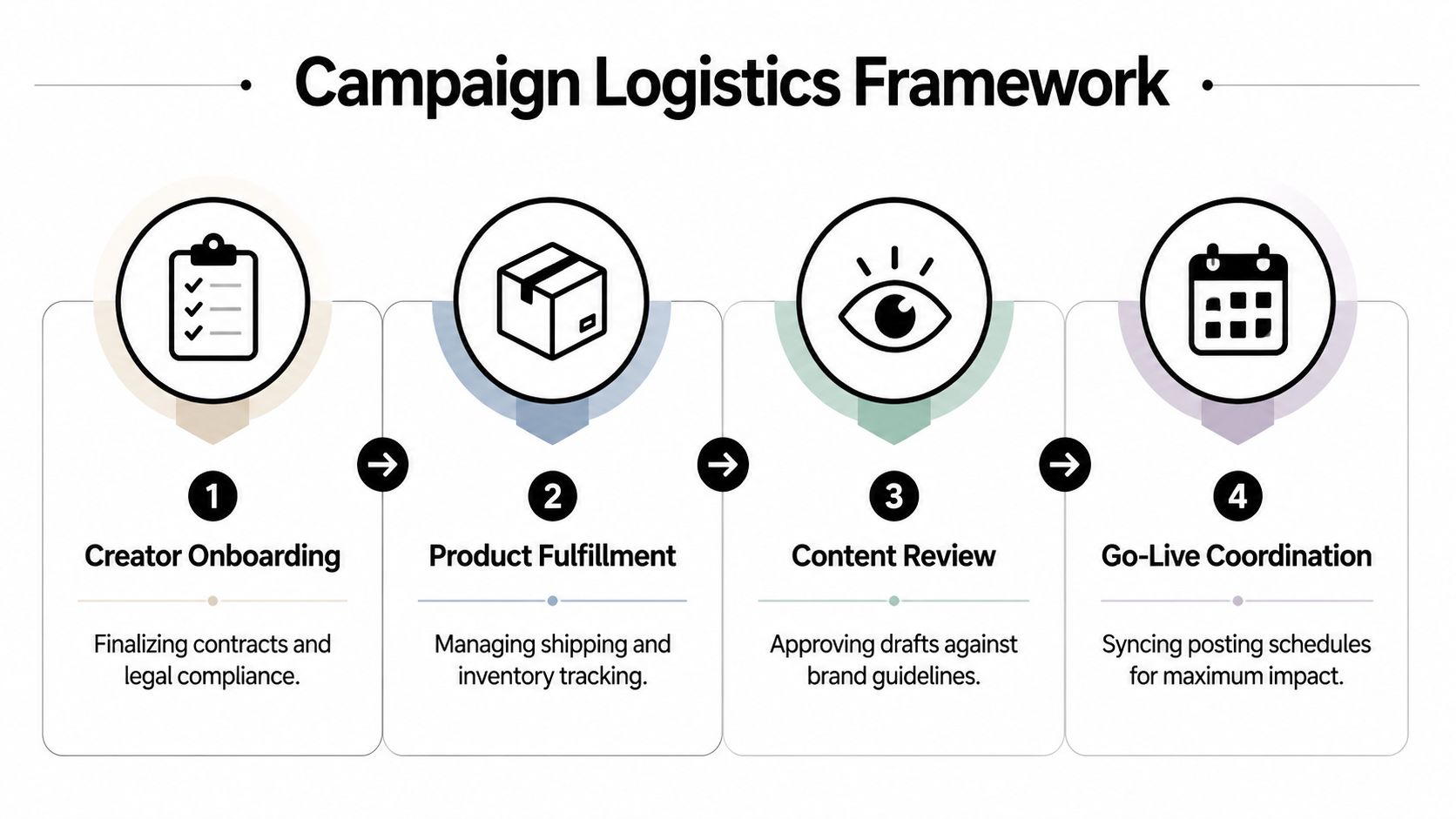
The content journey from agreement to go-live
I treat every creator placement like a production line with clear checkpoints.
Creator onboarding
Confirm deliverables, rates, usage rights, timeline, disclosure expectations, and payment terms in writing.Product fulfilment or booking coordination
If physical product is involved, track shipment status. If hospitality is involved, confirm reservation windows, guest policy, and site contact details.Draft and review
Review for factual accuracy, CTA placement, code or link inclusion, and ASA disclosure. Avoid rewriting the creator's voice unless there's a clear brand or compliance issue.Go-live coordination and payment
Confirm posting time, collect live links, verify that tracking is working, and trigger payment against agreed milestones.
That sequence sounds basic. It isn't always executed basic.
Where campaigns usually break
The most common logistical failures are avoidable:
Rights confusion: The brand assumes it can reuse the content in ads. The creator assumed organic reposting only.
Approval bottlenecks: Too many stakeholders comment directly on the draft, often with conflicting feedback.
Loose scheduling: A campaign week becomes a vague “post when ready”.
Missing compliance checks: Disclosure isn't specified clearly enough upfront.
A concise working document solves much of this. Teams that don't already have one can use an essential creative brief for marketing agencies as a starting point, then adapt it for influencer-specific needs like usage rights, disclosure, and creator-specific tracking instructions.
Good operations feel boring. That's the point. Boring systems let creative work land on time and still be measurable.
Keep approvals narrow and payments predictable
One person should own final approval. Not three. Not six. If multiple teams need input, collect it internally before feedback goes to the creator. Creators shouldn't have to decode internal politics.
Payment should also be tied to a simple structure. That might be on posting, on content approval, or split across milestones. What's important is that the trigger is explicit and documented. Reliable payment keeps creator relationships healthy. Disorganised payment degrades future response rates.
Influencer campaign management often gets sold as relationship work. It is. But relationship quality depends heavily on operational reliability.
Tracking Attribution and Measuring True ROI
Most influencer reporting still overweights what is easiest to capture. Views, reach, likes, shares. Those numbers have context value, but they don't answer the question that matters most. Did the campaign create revenue, bookings, or another tracked commercial result?
That question is where many UK teams are still underbuilt. According to this measurement analysis, measurement gaps affect 68% of UK campaigns, only 50% track conversions, and that causes 40% budget waste. The same source gives the standard ROI formula as (Revenue from codes - Total cost)/Cost, notes an average of 4:1 for verified UK micro-influencers, and says central dashboards can support 20-minute campaign setups and 95% manual time savings.

What to track instead of stopping at engagement
A working attribution model for influencer campaign management usually combines two things:
UTM-tagged links for traffic and on-site behaviour
Unique promo codes for creator-level redemption and revenue tracking
UTMs help you identify who drove the visit, from which platform, under which campaign label. Promo codes help when the conversion path doesn't happen on the first click or when customers move across devices. Used together, they give you a much cleaner picture than either one alone.
For ecommerce, the minimum useful view includes clicks, sessions, add-to-carts, orders, code use, and attributed revenue by creator. For hospitality, replace add-to-cart with booking intent and redemption behaviour. The principle is the same. Track the action that moves the business.
Keep the naming structure strict
If one creator uses “spring-sale”, another uses “SpringSale”, and a third has a manually typed code in the caption that doesn't match the dashboard, your data becomes expensive to trust.
Dedicated platforms offer a solution to these logistical challenges. Some teams build this stack manually with analytics tools, spreadsheets, and internal templates. Others use creator management software that generates creator-specific links, stores communication history, and pipes results into one dashboard. Sup is one example of a platform that combines sourcing, outreach, tracking codes, and live reporting in a central workflow. The useful point isn't the brand name. It's the architecture. One campaign, one naming structure, one source of truth.
If you need a practical walkthrough focused on outcomes rather than vanity metrics, this guide on influencer marketing ROI and what actually works is a solid companion piece.
A simple reporting model stakeholders can trust
I like reporting in three layers:
Layer | What it answers | Example output |
|---|---|---|
Creator performance | Who drove action | Revenue, bookings, redemptions, click quality |
Content performance | Which asset type worked | Reel, Story, TikTok, review-style clip |
Campaign outcome | Was it commercially worth it | ROI calculation using tracked revenue and total cost |
That structure keeps everyone honest. The social team gets asset insight. The growth team gets attribution. Leadership gets commercial clarity.
A short explainer can also help internal stakeholders understand how view-based and conversion-based analysis fit together:
When campaigns include video-heavy content, teams also benefit from reviewing more detailed video analytics features so engagement signals and viewing behaviour can be interpreted alongside clicks and code use rather than in isolation.
If reporting ends at engagement, the team learned what people noticed. If reporting includes attribution, the team learned what people did.
Optimising and Scaling Your Influencer Programme
A campaign shouldn't end with a live post report and a folder full of downloaded assets. The useful part starts after delivery, when you can compare creators, formats, locations, offers, and outcomes with enough distance to make better decisions next time.
The brands that scale well don't treat each collaboration as a fresh experiment. They build a feedback loop.
What to review after every campaign
Post-campaign analysis works best when it's practical rather than theatrical. You don't need a massive retrospective. You need a shortlist of decisions.
Review these questions:
Which creators drove tracked business outcomes? Keep a distinction between creators who drove action and creators who mainly produced reusable content.
Which format moved people further? A casual venue walkthrough may outperform a polished review, or the reverse.
Which offer or CTA got used? Weak code redemption can signal poor fit, poor framing, or weak offer design.
Which locations or audience segments responded well? This matters most for chains, hospitality groups, and regional campaigns.
A strong optimisation habit is to classify creators into three buckets after each campaign: repeat now, test again later, and do not renew. That makes future sourcing faster and less emotional.
Turn creator content into a reusable asset library
The content itself often becomes more valuable over time than the original post fee, provided rights were agreed clearly from the start.
The best UGC can be repurposed across:
Paid social: Creator-style ads often bridge the gap between social proof and performance creative.
Email campaigns: A creator testimonial or product demo can improve launch and retention flows.
Product and landing pages: Especially useful for DTC brands that need visual proof in context.
Organic brand social: Reposts, compilations, and creator roundups keep momentum going.
Disciplined campaign management pays off again in this context. If rights, file storage, creator tags, and performance labels are all organised, content reuse becomes easy. If they aren't, teams leave value sitting in message threads and downloads folders.
Build an always-on programme, not a string of one-offs
One-off campaigns can work. They rarely compound. Programmes scale when the team uses each campaign to improve targeting, briefing, creator selection, offer structure, and reporting.
For ecommerce, that often means keeping a steady group of niche creators active around launches, hero products, and seasonal moments. For hospitality, it means maintaining a cadence of local creator activity that supports ongoing footfall, review generation, and venue visibility. For agencies, it means converting custom campaign execution into a repeatable service model with cleaner margins.
The key trade-off is control versus throughput. A highly manual process can feel bespoke, but it usually limits scale. A platform-driven workflow creates more consistency, but only if the team still leaves room for human judgement in creator fit, creative nuance, and local relevance.
The best influencer programmes don't chase perfect campaigns. They build systems that get sharper with every one.
If you're trying to move from scattered DMs and post-by-post admin into a cleaner, measurable workflow, Sup is built for that operating model. It combines creator sourcing, outreach, tracking codes, attribution, scheduling, and UGC collection in one system, which is especially useful for ecommerce brands, hospitality groups, agencies, and multi-location chains that need influencer campaign management tied to real business outcomes.

Matt Greenwell
Share