Influencer spend keeps rising, but the operational gap is still the same. Teams can usually find creators. The harder part is turning outreach, approvals, posting, and reporting into a repeatable system that shows what the programme is producing.
That is why this shortlist groups influencer marketing companies by fit, not by feature volume. Some are full-service agencies that suit brands that want strategy and execution handled for them. Some are software-heavy platforms built for in-house teams with time, process, and analyst support. Others sit in the middle. Sup is a good example of the done-with-you model, where you get hands-on campaign support without taking on the overhead of a traditional agency or the admin load of a DIY tool.
1. Sup
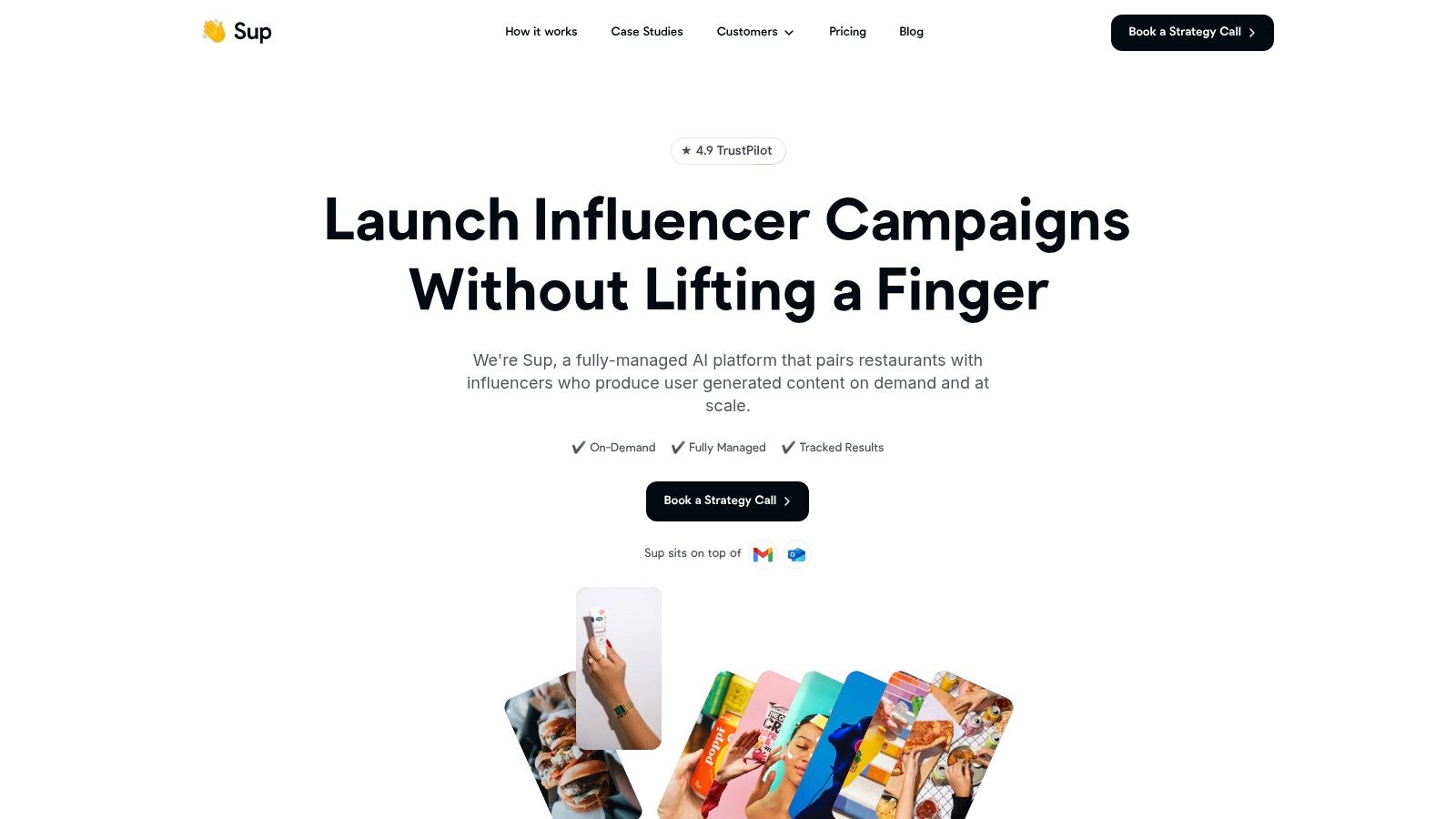
Sup suits teams that want creator campaigns to produce tracked business results without hiring an in-house operations layer to run every brief. The fit is strongest for brands that have already realised the hard part is not creator discovery on its own. It is keeping outreach, approvals, posting, reminders, and reporting moving on schedule across dozens or hundreds of creators.
The model sits between software and agency. Sup uses AI for creator sourcing, then a human team handles campaign setup, outreach, scheduling, follow-ups, and reporting. For ecommerce brands, restaurant groups, hospitality operators, and agencies, that split matters because it cuts admin load without pushing the whole programme into a slower, heavier agency structure.
If you're comparing service-heavy support against self-serve tooling, Sup's guide on when to use an influencer management agency is a useful decision frame.
Why Sup stands out
Sup is focused on micro and nano creator programmes on Instagram and TikTok. That makes sense for brands that care more about repeatable conversions, local relevance, and creator volume than headline names.
The practical advantage is execution discipline. Campaigns are set up with outreach scripts, tracking links, promo code logic, and ROI estimates before creators go live. Then the team runs the communication layer that usually stalls internal teams after the shortlist is approved.
Practical rule: If a team says influencer marketing is too messy to scale, campaign operations are usually the failure point.
Sup also does a good job with location-aware matching. That is especially useful for restaurants, venues, and multi-location brands where a creator's audience needs to be close enough to visit, book, or order. Reach without geographic fit looks good in a report and does very little in-market.
Best for
Restaurants and hospitality groups: Brands that need local creators tied to bookings, reviews, or footfall
DTC and ecommerce teams: Operators who care about sales attribution, not just content volume
Agencies: Teams that need repeatable creator fulfilment without building a dedicated outreach function
Multi-location brands: Businesses that need geography-specific creator sourcing across multiple sites
The attribution piece is where Sup makes the clearest business case. Structured use of UTM links, promo codes, and campaign tracking gives teams a cleaner read on which creators drove visits or sales. That does not guarantee efficient CAC on every campaign, but it is a far better setup than managing creator activity through inbox threads and spreadsheets with no consistent tracking.
Trade-offs
Sup is not the right choice for every brief. Brands looking for celebrity talent, wide channel coverage beyond Instagram and TikTok, or large brand campaigns with heavy production will probably need a larger agency or an enterprise platform. Pricing is not listed publicly either, so the buying process starts with a conversation rather than a self-serve plan comparison.
For the right buyer, that trade-off is reasonable. Sup is a strong match for SMB and mid-market teams that want a done-with-you model, clear attribution, and less operational drag than either a DIY platform or a traditional full-service agency.
2. The Goat Agency

The Goat Agency is a strong pick when the brief is bigger than creator seeding and needs proper campaign architecture behind it. It's UK-headquartered, part of WPP through GroupM Nexus, and built for brands that want influencer work connected to broader media planning, paid amplification, and cross-market accountability.
This is not the company I'd send a local challenger brand to if they need fast scrappy execution. It is the company I'd shortlist when a national or regional brand wants institutional support, category experience, and confidence that governance won't get bolted on later.
If you're weighing platform support against agency support, Sup's take on when to use an influencer management agency gives a useful frame for that decision.
Where Goat fits best
Goat uses its own tooling for creator discovery, pricing, and optimisation, but its primary appeal is less about the dashboard and more about the operating environment around it. You get agency strategy, managed activations, and access to a wider media ecosystem.
That makes Goat a good fit for:
Enterprise consumer brands: Teams that need procurement-friendly partners and formal campaign structures
Brands with paid media plans: Campaigns where influencer content needs coordinated amplification
UK and EMEA rollouts: Businesses that don't want to stitch together separate local partners
If legal review, reporting structure, and paid media integration are all part of the brief, a larger agency can save a lot of internal friction.
The trade-off
The same structure that helps larger brands can frustrate smaller ones. Enterprise agencies tend to be heavier on process, approvals, and timelines. That's not a flaw. It's just the cost of control.
Goat also makes most sense when influencer marketing is one part of a larger media plan. If all you need is a reliable stream of local micro-creators creating trackable content, a done-with-you operator or commerce-led platform is often a tighter fit.
3. THE FIFTH
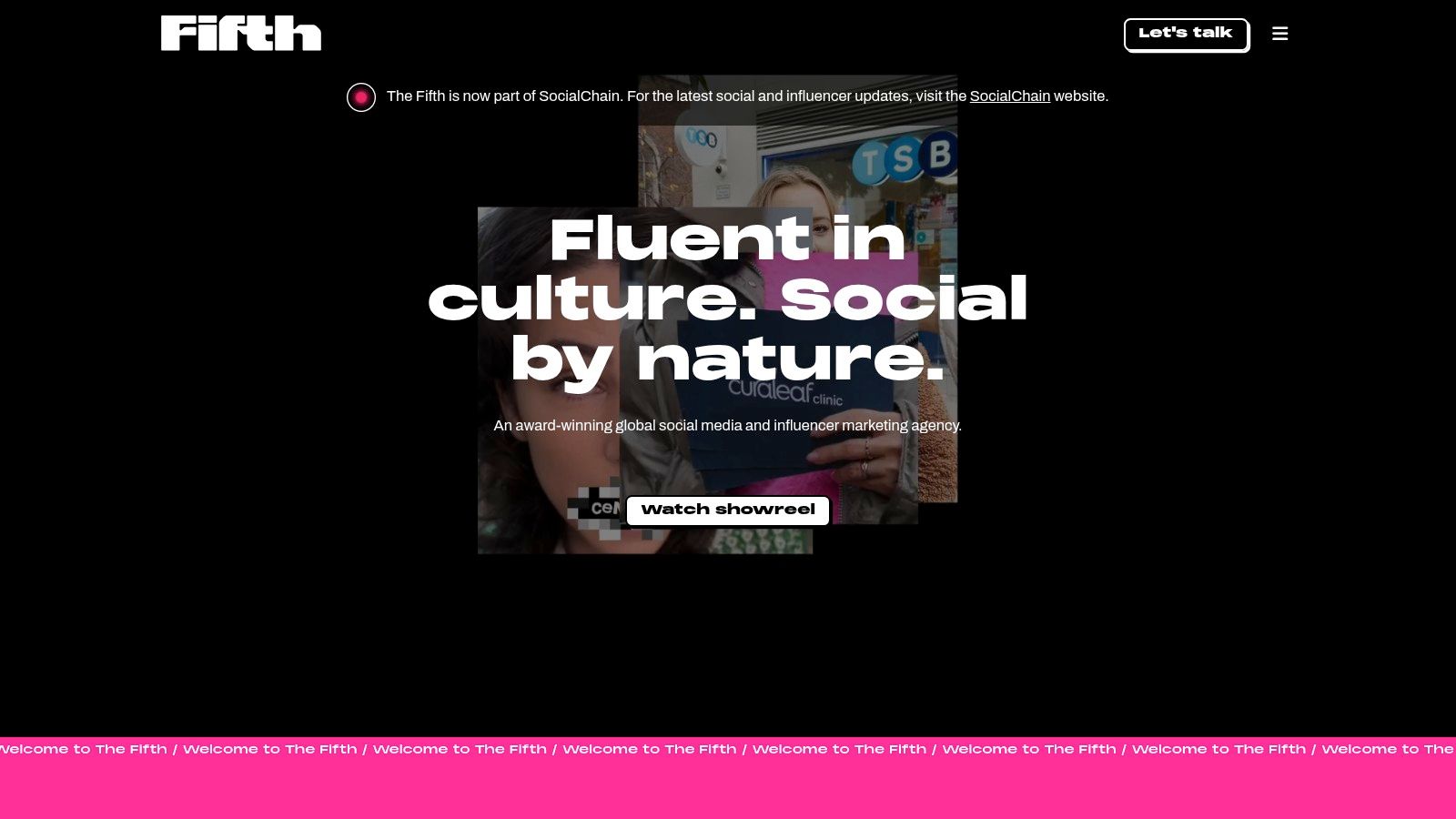
THE FIFTH is a good option for brands that care as much about creative quality and cultural fit as they do about creator logistics. It has roots as a specialist influencer agency and now sits within the wider Brave Bison and SocialChain ecosystem, which gives it more production and distribution muscle than a typical boutique shop.
That combination matters when the campaign can't feel transactional. Some influencer marketing companies are strong at fulfilment but weak on story. THE FIFTH is more useful when you want casting, creative direction, and social-first production working together.
Best use case
I'd look at THE FIFTH for lifestyle, fashion, entertainment, and consumer campaigns where the content itself has to carry the brand. If your internal team already knows what “good” looks like creatively but needs an external partner to shape talent selection and execution, this is the kind of agency that can add value.
Its strengths are usually clearest in briefs such as:
Brand storytelling campaigns: When message and tone matter as much as reach
Inclusive casting briefs: When representation isn't a box-tick and needs deliberate strategy
Integrated social production: When the content needs to work beyond the creator's own post
What to watch
THE FIFTH is still an agency model. That means bespoke planning, more collaboration, and less of the “press go” simplicity you'd expect from a platform. For many brands, that's the point. For others, it's unnecessary overhead.
The other thing to watch is fit with performance-led teams. If your first question is “How quickly can we tie this to revenue per location?”, a commerce-focused platform or a done-with-you operator may get you there faster. If your first question is “Will this feel right for the brand?”, THE FIFTH becomes much more compelling.
4. TAKUMI
TAKUMI has always sat in an interesting position. It isn't a pure SaaS tool, and it isn't a classic old-school agency either. It uses its own platform and wraps that in a managed service, which makes it attractive for brands that want performance-minded execution without taking on the campaign admin themselves.
For UK and European brands focused on Instagram and TikTok, that's a practical setup. You get strategy, creator handling, and reporting in one place, but you're not expected to build a full internal workflow around the software.
Why teams choose it
TAKUMI tends to appeal to brands that already believe in influencer marketing and want a partner to run it properly. That's different from a business that is still experimenting and wants the cheapest entry point.
The platform-plus-service model usually works best for:
Mid-market consumer brands: Teams that want support but don't need a holding-company agency
Performance-leaning campaigns: Brands that still care about outcomes and reporting discipline
TikTok and Instagram execution: Businesses concentrating spend where creator content naturally performs
Managed service works well when the blocker is capacity. It works less well when the blocker is strategic uncertainty.
What doesn't work as well
TAKUMI isn't ideal if your team wants deep self-serve control. Because it's managed, you rely on their process more than you would with a platform-first provider. Pricing also isn't public, which means you need to enter a sales conversation before you can compare total cost against alternatives.
That said, some businesses prefer exactly that. They don't want another tool. They want campaigns launched, creators handled, and reporting delivered. For that use case, TAKUMI stays relevant.
5. Traackr
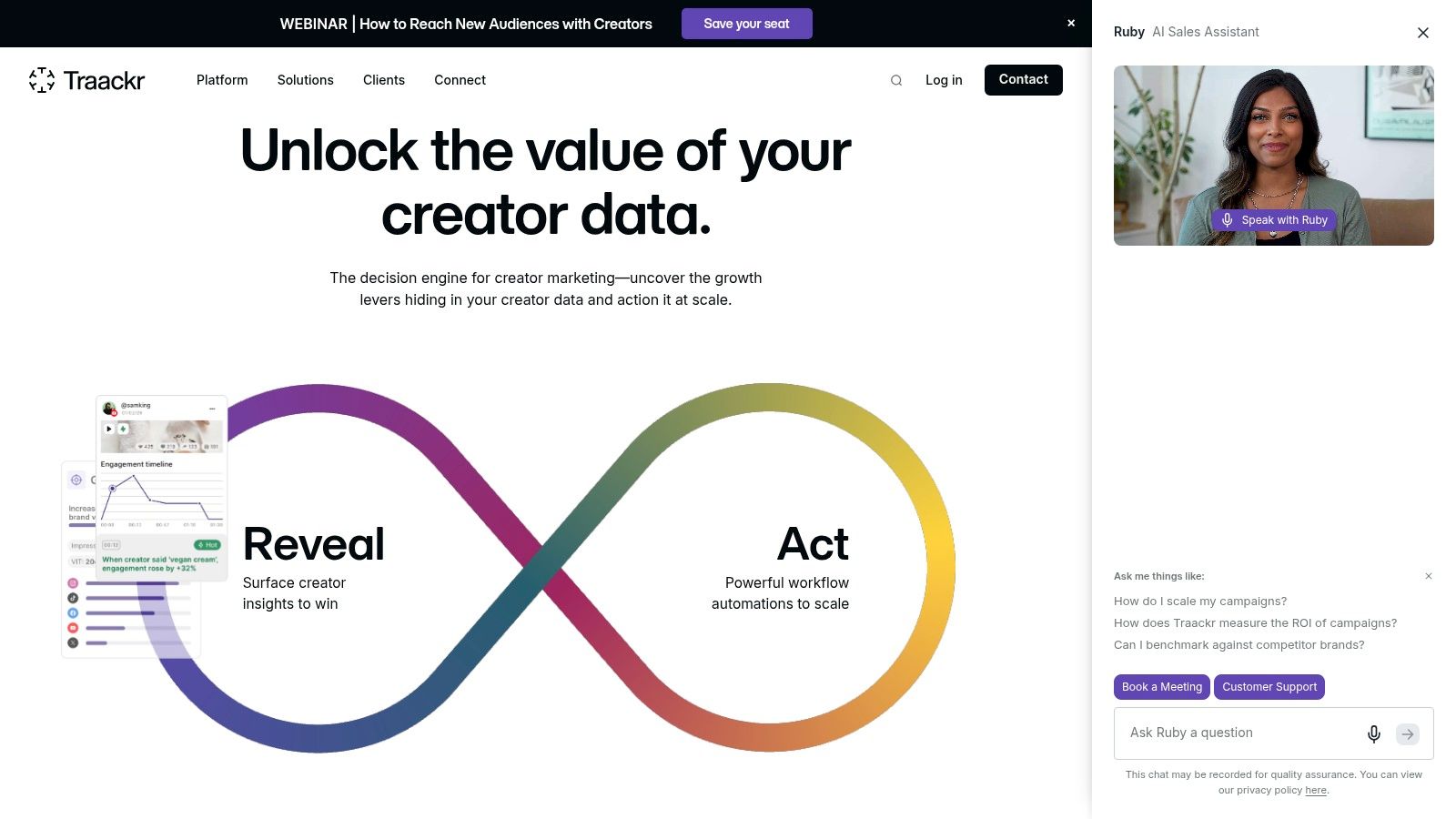
Traackr is built for organisations that need system-level control. If you're running creator programmes across markets, business units, or regulated categories, that matters more than a slick discovery interface.
This is one of the more mature enterprise influencer marketing companies in the market. It brings discovery, workflow, spend management, and analytics into one platform, with a clear emphasis on governance and standardisation.
Who should shortlist Traackr
Traackr is best for teams with complexity. Not “we have a busy quarter” complexity. Actual organisational complexity. Multiple regions. Shared budgets. Approval chains. Compliance requirements. Category-level reporting.
It's a good fit for:
Global brand teams: Centralised oversight across local markets
Regulated or cautious categories: More emphasis on controls and process
Companies standardising influencer operations: One framework across many teams
The bigger advantage is consistency. Enterprise teams often don't fail because they lack creator options. They fail because every region runs a different process, measures different outcomes, and reports in different formats.
Real trade-off
You won't get lightweight speed here. Traackr requires internal adoption, process discipline, and enough programme scale to justify the investment. Smaller brands often overbuy when they choose enterprise software too early.
There is also a mindset shift involved. Platforms like Traackr make most sense when influencer marketing has already moved from campaign experiment to governed channel. If you're still validating the channel, this can feel like too much machinery.
6. CreatorIQ
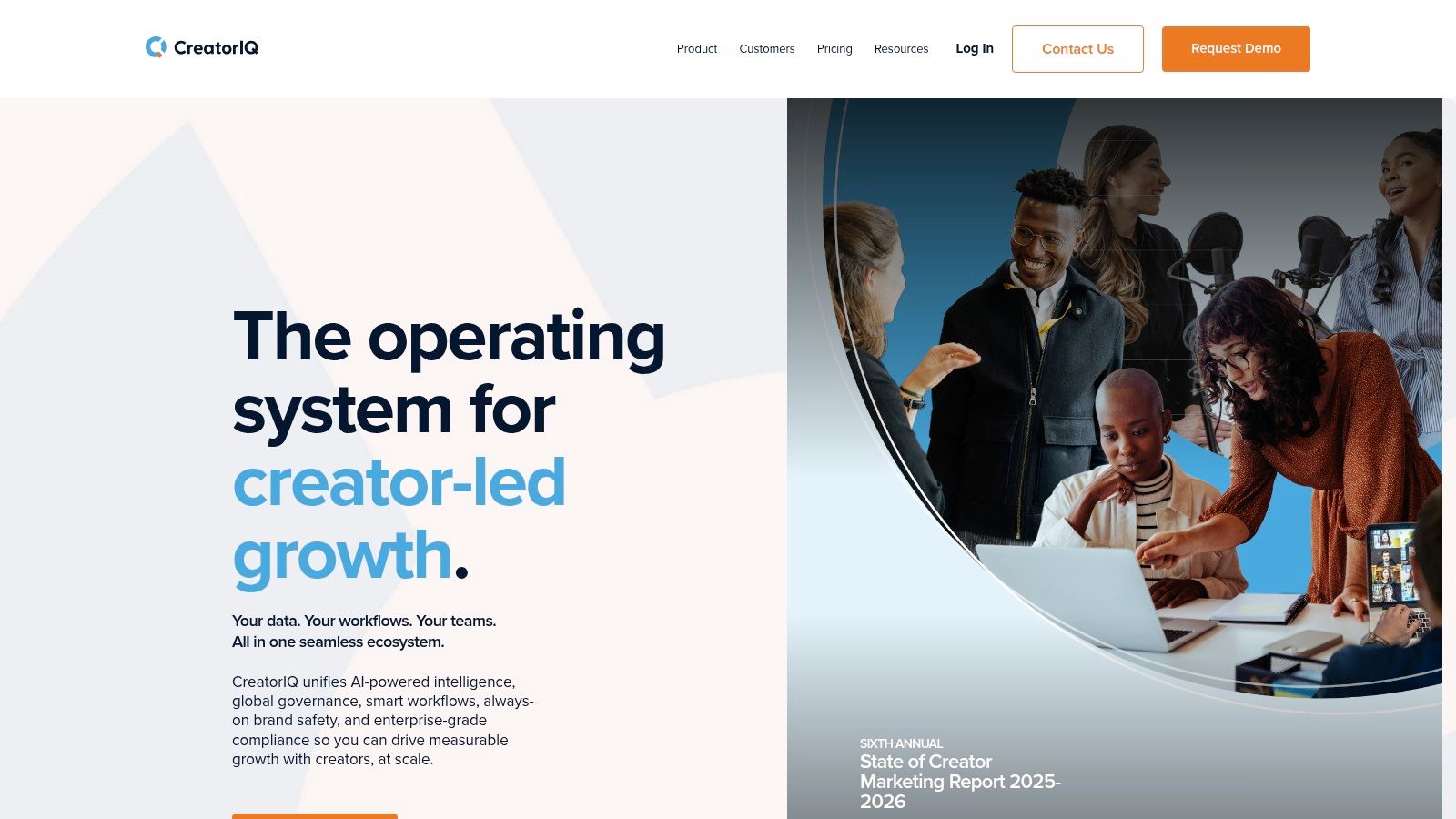
CreatorIQ belongs in the enterprise tier, but it solves a slightly different problem from a managed agency. It acts more like an operating system for creator marketing. Discovery, workflow, rights management, measurement, commerce, and integrations sit in one environment.
For complex teams, that's useful because creator work rarely stays inside one department. Brand wants content. Legal wants approvals. Ecommerce wants sales data. Regional teams want flexibility. CreatorIQ is designed for that level of sprawl.
Where it shines
If your company already has structured marketing operations, CreatorIQ can slot into that ecosystem well. It tends to suit brands and agencies that want integrations, security, process control, and a proper data foundation.
Its sweet spots are usually:
Multi-market enterprises: Teams coordinating creators across countries
Agency groups: Businesses serving multiple clients with formal workflows
Commerce-aware brands: Companies linking creator work to affiliate and sales motions
The catch
CreatorIQ isn't usually the answer for lean teams. The value comes when the organisation commits to using it properly. If the team is small, the workflows are loose, and the campaigns are relatively simple, much of that power goes unused.
UK teams should also think carefully about what problem they're solving. If the issue is operational throughput, a done-with-you service may enable faster progress. If the issue is fragmented systems, approvals, and cross-market visibility, CreatorIQ starts to make much more sense.
7. Upfluence
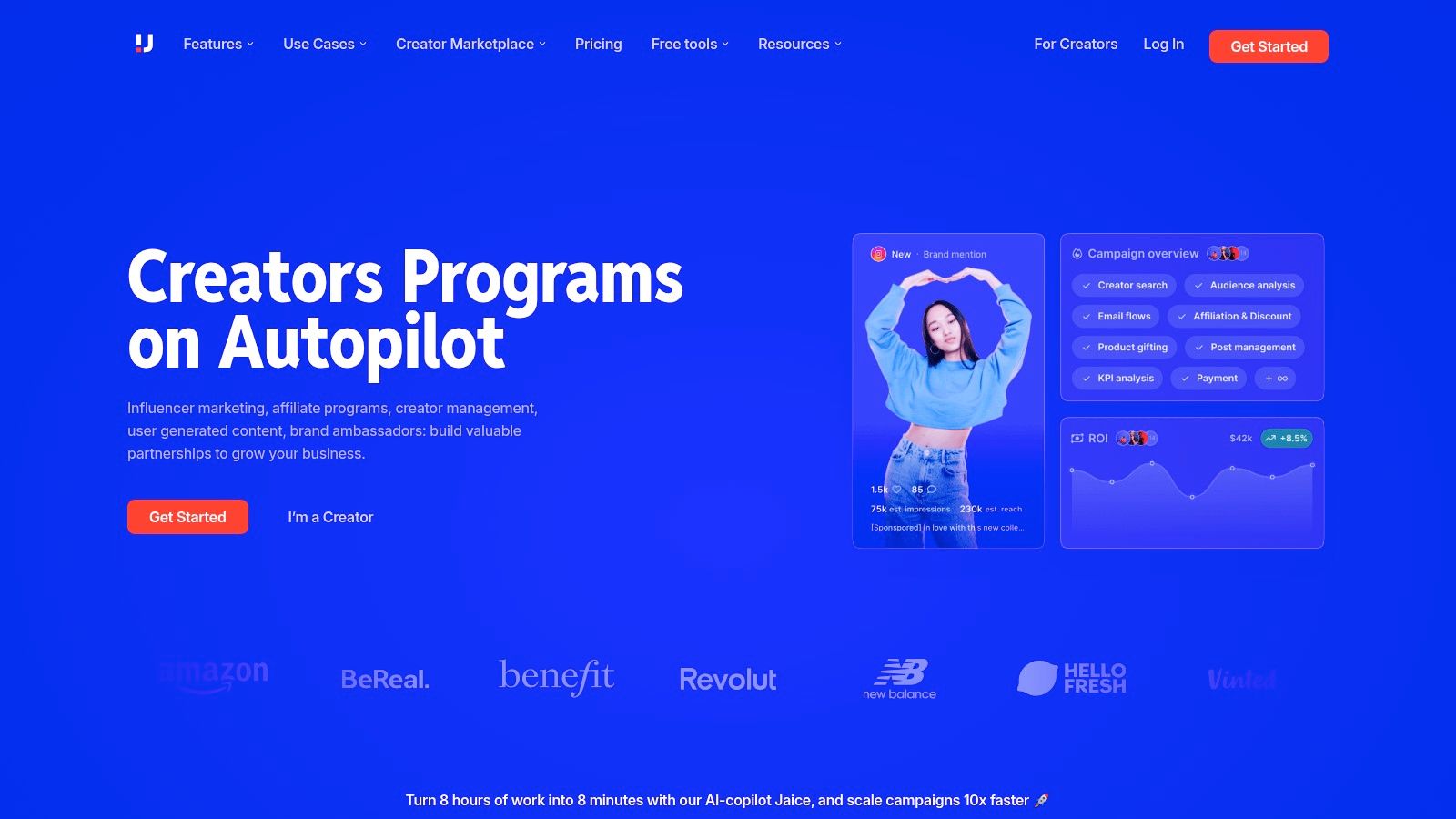
Upfluence is one of the more practical choices for ecommerce-led teams. It leans into creator discovery, outreach, CRM, codes, links, payments, and ecommerce integrations. That makes it useful for brands that don't just want content. They want orders tied back to creators.
For DTC and retail brands, that orientation matters. One of the biggest unresolved gaps in the market is attribution. Influencer Marketing Hub highlights proving value to senior stakeholders as a persistent challenge in its discussion of key influencer marketing challenges. Upfluence is appealing because it tries to solve that operationally, not just rhetorically.
Best for sales-linked creator programmes
If you're running Shopify-heavy operations, care about affiliate mechanics, and want codes and links baked into workflow, Upfluence is a sensible option. It gives mid-market teams enough structure to scale without immediately stepping into full enterprise complexity.
I'd put it high on the list for:
DTC brands: Teams focused on attributable sales
Retailers with affiliate overlap: Where influencer and affiliate programmes are converging
Mid-market ecommerce teams: More capable than entry-level tools, less burdensome than enterprise suites
The closer your KPI is to orders and revenue, the more your platform needs to behave like commerce software, not just creator search.
Limitations
Upfluence still requires internal ownership. Someone has to manage workflow, relationships, and programme decisions. So while it's more commerce-friendly than many alternatives, it doesn't remove operational labour the way a done-with-you service can.
Pricing also isn't fully public, and add-ons can shape the total cost. That's normal in this category, but it's worth evaluating carefully if you're comparing against managed options.
Top 7 Influencer Marketing Agencies Comparison
Solution | 🔄 Implementation complexity | ⚡ Resources & speed | 📊 Expected outcomes | 💡 Ideal use cases | ⭐ Key advantages |
|---|---|---|---|---|---|
Sup | Low, 15–20 min setup, pre-built campaigns and managed review | Minimal internal resources; rapid launches; managed outreach saves time | Clear attribution to clicks/conversions/revenue; UGC library for reuse | E‑commerce/DTC, restaurants, multi-location rollouts, agencies wanting repeatable programs | AI-curated, location-aware micro-creator discovery; full-service management; live dashboard |
The Goat Agency | Medium–High, bespoke planning with enterprise workflows | Significant agency resources; slower cadence but scalable | Scaled regional campaigns with integrated paid media and measurement | Enterprise brands targeting UK/EMEA, FMCG, beauty, entertainment | Proprietary Ibex analytics; GroupM/WPP media integration; UK/EMEA expertise |
THE FIFTH (Brave Bison) | Medium, creative-led production and bespoke execution | High creative and production resources; timeline-dependent delivery | High-quality storytelling and distributed social production | Lifestyle, fashion, entertainment brands seeking inclusive casting and creative production | Award-winning creative capability; Studio 5 production + distribution ecosystem |
TAKUMI | Low–Medium, managed service on in-house platform | Moderate resources; fast go-to-market for TikTok/IG campaigns | Performance-framed lifts with clear post-campaign reporting | Brands wanting done-for-you performance campaigns on TikTok and Instagram | Proprietary tech + managed execution focused on measurable outcomes |
Traackr | High, enterprise onboarding, governance and process adoption | Significant internal teams and governance; slower to adopt but scalable | Standardisation, benchmarking, compliance and multi-market control | Global teams needing governance, regulated categories, centralised programs | Mature analytics, enterprise controls, strong compliance features |
CreatorIQ | High, complex integrations and structured workflows required | High total cost and resource investment; robust API/channel integration | End-to-end program management with commerce/affiliate measurement at scale | Complex, multi-market enterprise teams requiring deep integrations | Creator Graph, extensive integrations, enterprise-grade security and compliance |
Upfluence | Medium, platform onboarding with native ecommerce integrations | Moderate resources; balanced for mid-market scaling; commerce-friendly | Direct attribution to orders/revenue, CRM and payment workflows | DTC brands and retailers focused on ecommerce sales attribution | Native Shopify/Amazon integrations, affiliate tools, practical ecommerce reporting |
Your Next Step From Shortlist to Scalable Results
Brands are putting more budget into influencer marketing, but budget alone does not produce a repeatable channel. Operating fit does. The shortlist only becomes useful once you match each option to the way your team works.
That is the main dividing line in this category.
Traackr and CreatorIQ suit teams with procurement, legal review, regional approvals, and the internal resources to run a structured program across markets. The Goat Agency and THE FIFTH fit brands that want an external team to carry strategy, creative direction, and campaign delivery for larger brand-led work. TAKUMI is a practical choice for brands that want managed campaigns on TikTok and Instagram without building a full in-house operation. Upfluence makes sense when ecommerce attribution, affiliate workflows, and store integrations matter more than brand planning.
Sup sits in a different lane. It is the done-with-you option for teams that need hands-on execution and clear measurement, but do not want the cost and process weight of a traditional agency or an enterprise platform. That model tends to work well for ecommerce brands, hospitality groups, and multi-location businesses that need campaigns live quickly and still want visibility into what drives revenue.
The trade-off is straightforward. Full-service agencies remove more work, but they usually give you less day-to-day control and can be expensive to scale. DIY platforms give you more control, but your team owns sourcing, outreach, coordination, and reporting. Done-with-you support gives you a middle ground. You keep strategic oversight while the operational load stays off your team.
For many brands, that is the fastest route from a pilot campaign to a channel with clear reporting and a process you can repeat.
If you are also thinking about how creator content performs after the campaign, especially in paid social, this piece on scaling agency ROAS with AI UGC is a useful next read.
If you want influencer marketing to behave like a measurable growth channel rather than a side project, take a closer look at Sup. It is a strong fit for brands that need local micro-creators, hands-on campaign management, and attribution from views through to revenue without building the whole function in-house.

Matt Greenwell
Share