Influencer marketing for ecommerce isn't just about getting your name out there anymore; it's a serious sales channel. By 2026, the brands that get this right will treat creators not as one-off advertisers, but as a vital extension of their sales team. This guide will walk you through exactly how to build, scale, and measure an influencer programme that drives real revenue.
Why Influencers Are Your New Ecommerce Sales Team

Let's be honest, the days of relying solely on polished, faceless ads are fading fast. Today’s shoppers are experts at scrolling past slick corporate content. Instead, they’re tuning into voices they actually trust: authentic creators sharing their genuine experiences. This is a massive shift, turning influencer marketing from a "nice-to-have" awareness play into a must-have, ROI-driven sales engine.
Think of it like this. Traditional advertising is like shouting your message from a billboard on a busy motorway. Sure, some people might glance at it, but how many will actually stop and buy? Influencer marketing, on the other hand, feels more like a trusted friend recommending a product over a coffee. It's personal, it's relatable, and it's far more persuasive.
This isn't just a hunch; the numbers tell the story. The UK influencer marketing industry is on track to hit a staggering £2.9 billion by 2026. With social commerce expected to climb to nearly £12 billion, it’s no surprise that UK shoppers now trust influencer posts 54% more than celebrity ads. People are craving that relatable touch. For a deeper dive, you can explore the full influencer advertising report.
The table below really highlights how the game has changed, shifting the focus from broad-stroke advertising to targeted, personal connections.
Influencer Marketing vs Traditional Ecommerce Ads in 2026
Metric | Traditional Ads (e.g., Paid Social) | Influencer Marketing (e.g., Creator Collabs) |
|---|---|---|
Trust Factor | Low; often seen as interruptive and corporate. | High; recommendations come from a trusted, relatable source. |
Content Style | Polished, branded, and professionally produced. | Authentic, user-generated, and conversational. |
Primary Goal | Broad reach and brand awareness. | Building community, driving conversions, and generating social proof. |
Audience Targeting | Based on demographic and interest data. | Based on niche communities and audience affinity with the creator. |
Cost Model | Pay-per-click (PPC) or pay-per-impression (CPM). | Flexible; can be flat fees, commissions, or product seeding. |
ROI Measurement | Primarily focused on clicks and conversions (ROAS). | Holistic; includes sales, engagement, content value (UGC), and brand sentiment. |
Content Lifespan | Short; runs only while the ad budget is active. | Long; content lives on creator's feed and can be repurposed (evergreen). |
As you can see, we’re moving away from simply buying eyeballs towards earning genuine advocacy. This approach delivers value that goes far beyond a simple click.
From Manual Effort to a Scalable Sales Channel
It wasn't long ago that managing influencer relationships was a complete headache. It meant drowning in DMs, wrestling with complicated spreadsheets, and struggling to prove any real impact. That manual grind made it tough to scale, leaving many ecommerce brands feeling like they were gambling rather than investing in a predictable channel.
Thankfully, technology has caught up. Modern platforms have automated the most painful parts of the process, handling everything from creator discovery and outreach to contracts and payments. This efficiency frees you up to build a high-performing "sales team" of creators without getting bogged down in admin.
By automating the tedious tasks, your team can focus on what truly matters: building genuine, long-term relationships with creators who will become powerful advocates for your brand.
This evolution has made influencer marketing accessible for everyone, not just huge brands with bottomless budgets. It’s now a scalable strategy for any ecommerce business ready to compete. Instead of one-off campaigns, you can build an always-on engine that consistently delivers:
Authentic user-generated content (UGC) that you can use across all your marketing channels.
Direct sales tracked precisely with unique promo codes and affiliate links.
Valuable social proof that builds brand credibility and the trust you need to grow.
In 2026, influencers aren’t just promoting products; they are your distributed sales force, personal shoppers, and brand storytellers, all rolled into one. They expertly guide their loyal followers from the moment of discovery right through to checkout, making them a non-negotiable part of any modern ecommerce growth strategy.
Building Your High-Performance Influencer Strategy

A successful influencer programme doesn't just happen. It's the result of a carefully built strategy that puts measurable results first, moving past fuzzy metrics like follower counts and likes. Without a solid plan, you're just throwing money at content and hoping something sticks—a risky game to play in e-commerce.
So, where do you start? First, anchor your strategy in clear, specific goals. What does success actually look like for your brand? Are you chasing direct sales, trying to stock up on authentic user-generated content (UGC), or maybe just boosting your brand's profile in a new market? Each objective needs a completely different playbook.
Think of it like this: launching an influencer campaign without goals is like setting sail without a map. You’ll drift aimlessly and burn through your budget. By defining your key performance indicators (KPIs) upfront, you give yourself a North Star to guide every decision, from which creators you pick to how you measure success.
Aligning Goals with Creator Tiers
Your campaign goals have a direct impact on the kind of creators you should be working with. Different tiers of influencers are good at different things, and getting this mix right is the secret to getting the most out of your investment.
Driving Sales and Conversions: For this, micro-influencers (10k-100k followers) are your best bet. Their smaller, niche audiences hang on their every word, which makes them incredibly powerful at driving actual purchases. A recommendation from them feels more like a tip from a trusted friend.
Generating Authentic UGC: Nano-influencers (1k-10k followers) are absolute goldmines for user-generated content. They’re genuinely passionate about creating and are often thrilled to collaborate in exchange for products. This gives you a steady stream of authentic visuals for your ads and social feeds.
Boosting Brand Visibility: When you need to get a lot of eyes on your brand quickly, macro-influencers (100k-1M followers) offer that broad reach. They cost more and their engagement rates are usually a bit lower, but they can introduce your brand to a huge, relevant audience almost overnight.
This kind of strategic thinking is quickly becoming the norm. A massive 81% of UK brands are planning to increase their influencer marketing budgets in 2026, shifting their focus from one-off campaigns to more sustainable, long-term partnerships. This change is all about performance, with 93% of brands now prioritising micro-influencers for their incredible engagement and ability to convert.
Defining Your Ideal Creator Persona
Once your goals are set, it’s time to figure out who your ideal creator is. This is about more than just finding someone with a big follower count; it’s about finding someone with the right followers. A great starting point is to look at your own ideal customer. Who are they? What do they care about? Where do they spend their time online?
Your ideal creator is basically a mirror of your target customer. You need to look for creators whose:
Audience demographics are a match for your customer base.
Content style and values click with your brand’s personality.
Engagement quality is top-notch, with real conversations happening in their comments section.
A creator with 10,000 highly engaged followers who perfectly match your target audience is infinitely more valuable than a creator with 100,000 disengaged followers who have no interest in your products.
This laser-focus on audience alignment is the bedrock of a performance-driven programme. To make sure your strategy is built to last, adopting the latest influencer marketing best practices is crucial for getting the results you want. By meticulously matching your brand to the right creators, you ensure every pound you spend reaches people who are genuinely interested, turning influencer marketing from a gamble into a predictable sales channel. For more on this, you might find our https://sup.co/ecom helpful.
How to Scale Creator Outreach and Management
Once you’ve nailed down your strategy, you hit the next big wall: actually finding and managing creators without it swallowing all your time. For most growing ecommerce brands, this is exactly where things fall apart.
The old-school approach of sending endless DMs, wrestling with messy spreadsheets, and chasing people for updates is a fast track to burnout. It just doesn't scale.
Think of it like trying to build a house with only a hand saw and a hammer. You might finish it one day, but the process would be gruelling, slow, and full of mistakes. That’s what manual creator management feels like. By 2026, smart brands are ditching those basic tools for a modern, automated system that organises the whole process while keeping that all-important human touch.
The big idea here is to move away from one-by-one outreach and build a proper system. The goal is to let technology handle the admin so you can spend your energy on what really matters: building genuine relationships with your creators.
From Manual DMs to Automated Systems
The biggest bottleneck in influencer marketing has always been the sheer amount of manual grunt work. Finding creators, sending personalised messages, negotiating rates, handling contracts, and tracking content is unbelievably time-consuming. Thankfully, technology has finally caught up.
Modern influencer platforms are your mission control. They use clever tech to take care of the repetitive, low-impact tasks that used to drain your entire day. This frees you and your team up to focus on the things that actually move the needle, like strategy and building real connections.
Here’s a look at how a systemised approach completely changes your workflow:
Creator Discovery: Forget spending hours trawling through hashtags. Platforms can instantly find hundreds of pre-vetted creators who perfectly match your niche and audience profile.
Automated Outreach: You can send personalised email templates in batches. This makes sure your first contact is always professional and consistent, but without losing that personal feel.
Centralised Management: Every conversation, contract, and content deliverable is tracked in one clean dashboard. No more spreadsheet chaos or overflowing inboxes.
The true advantage of scaling isn't just about doing more work; it's about getting better results with less friction. Let automation handle the logistics, so you can focus on the relationships that push your brand forward.
Crafting Outreach That Gets a Response
Even with the best tools in the world, your outreach message is what ultimately opens the door to a partnership. A generic, copy-and-pasted DM is the quickest way to be ignored. Good creators, in particular, are bombarded with requests.
To cut through the noise, your message has to be sharp, compelling, and show that there's value for both of you, right from the first sentence. Your outreach should feel like a genuine invitation to collaborate, not a cold transaction.
Here are the key ingredients for an outreach message that actually works:
Personalise Your Opener: Start by mentioning something specific about their content that you genuinely liked. It immediately shows you’ve done your homework and aren't just blasting a random list.
State Your Offer Clearly: Be upfront about what you’re offering. Is it a gifted product, a flat fee, or a commission-based deal? Honesty builds trust from the get-go.
Highlight the Mutual Value: Explain why this collaboration makes sense for their audience. How does your product align with their personal brand and bring something cool to their followers?
Define a Clear Next Step: End with a simple, low-pressure call to action. Something like, "Let me know if this sounds interesting, and I can send over the details." works perfectly.
This strategic approach is a must for any brand, but it’s absolutely critical for agencies juggling multiple client campaigns. If you're looking to apply these principles across a whole portfolio, you can discover more about streamlining creator programs for agencies and the platforms that make it all possible.
By systematising how you find, reach out to, and manage creators, you can scale your influencer marketing from a bottleneck into a powerful engine for growth.
Crafting the Perfect Brief and Maximising Your Content

Behind every brilliant influencer campaign is an equally brilliant brief. Don't underestimate this document; it’s the single most important tool you have for translating your brand’s goals into a creator’s authentic voice. A vague brief is a recipe for off-brand content and wasted money, but a great one inspires work that genuinely connects.
Think of your brief less as a rigid set of rules and more as a friendly set of guardrails on a scenic drive. The goal isn't to micromanage every turn but to make sure the creator arrives at the right destination—hitting your campaign targets—while giving them the freedom to take a route that feels natural and exciting to them.
The real skill is balancing clear direction with creative freedom. If you’re too restrictive, you’ll stifle the creator's personality, and the content will feel like a stale, forced advertisement. Give them the space to do what they do best.
Building Your Essential Creative Brief
To head off any confusion, your brief needs to be crystal clear. It serves as the official agreement on expectations for both you and the creator. Your job is to arm them with all the necessary information to knock it out of the park, without drowning them in details.
A solid brief should always include:
Campaign Objectives: What’s the number one goal? Is it driving sales with a specific promo code, building a library of user-generated content (UGC), or drumming up excitement for a new product? Get specific.
Key Talking Points: Give them 2-3 core messages to hit. This could be a unique product feature, something about your brand's ethos, or the details of a special offer.
Clear Deliverables: What do you actually need them to produce? Specify the format and number of posts (e.g., one TikTok video, two Instagram Stories) and any firm deadlines.
Mandatory Elements: List any non-negotiables, like essential hashtags, brand tags (@mentions), or specific calls to action (CTAs).
Content "Do's and Don'ts": Provide simple guidelines on the brand's personality. For example, "Do focus on the product's sustainable materials; Don't show our competitors' products."
Of course, a great brief is only half the battle. To collaborate effectively, it also helps to understand the fundamentals of creating engaging social media content that truly connects with your target audience in the first place.
Turning Content into a Long-Term Asset
The true power of influencer marketing in 2026 isn't just the buzz from the initial post. It's the goldmine of user-generated content you get along the way. A single collaboration can yield a treasure trove of authentic visuals you can use for months, but only if you have the permission to do so.
Never assume you can repurpose a creator's content. Secure explicit usage rights in your initial agreement to avoid legal headaches and keep your brand-creator relationship strong.
Be upfront and clearly outline how and where you plan to reuse their content. This transparency is vital for building trust and ensuring a fair partnership from the start.
Once you have those rights, the possibilities are huge. That one authentic video or image can quickly become your highest-performing asset across all sorts of channels:
Paid Social Ads: Content from influencers almost always outshines polished studio photography in ad campaigns. Why? It looks native to the feed and feels far more trustworthy.
Email Marketing: Drop influencer photos and videos into your newsletters. It’s powerful social proof that shows your products being used and loved in the real world.
Product Pages: Add UGC directly to your product detail pages. Seeing real people enjoying your products builds shopper confidence right at the point of purchase and can seriously boost conversion rates.
By strategically reusing UGC, you turn a one-off collaboration into a durable marketing asset. This is how you multiply your return on investment and make every penny spent on influencer marketing work harder for you in the long run.
Measuring ROI From First Click to Final Sale
For any performance-focused ecommerce brand, this is where the real work begins. We’re going to move past the fluffy stuff—likes and comments—and get straight to the hard numbers that prove your influencer collaborations are actually driving sales. It's time to stop treating influencer marketing like a mysterious branding expense and start seeing it for what it is: a measurable performance channel.
Think of it like leaving a digital breadcrumb trail. Your job is to follow a customer from the second they see a creator’s post right through to your checkout page. This isn't just a nice-to-have; in 2026, it's absolutely essential for justifying your budget and knowing where to invest more.
This is how you turn the "art" of influencer marketing into a science. By tracking the customer journey with precision, you can finally see which creators are your true top-performers, what content actually converts, and which partnerships are giving you the best bang for your buck.
The Two Pillars of Ecommerce Attribution
To build out that breadcrumb trail, you need two fundamental tools in your kit. These are non-negotiable for any brand that's serious about measuring sales. When you use them together, they create a nearly foolproof system for tracking performance.
Unique Trackable Links (UTM Codes): This is your number one tracking tool. A UTM code is just a little bit of text added to the end of a URL that tells your analytics platform exactly where a click came from. You need to create a unique UTM link for every single creator, and ideally, for every piece of content they post. This is how you know precisely who is sending you traffic and, ultimately, sales.
Custom Discount Codes: While UTMs are great for tracking clicks, discount codes are your secret weapon for tracking conversions, especially for those shoppers who see a code but don't click the link. Assigning a unique code like "SOPHIE15" to each creator lets you attribute sales directly to them inside your ecommerce platform, even if the customer comes back to buy a few days later.
These two aren't an either/or; they work hand-in-hand. A shopper might click a UTM link from an Instagram Story on their phone, get distracted, and then later that evening, type your website into their laptop and use the creator's discount code at checkout. Using both means you capture the full picture of an influencer's impact.
From Vague Metrics to Concrete KPIs
Once your tracking is locked in, you can finally wave goodbye to vanity metrics and start focusing on the Key Performance Indicators (KPIs) that actually affect your bottom line. These are the numbers that prove your influencer strategy is working.
This shift to tangible results is happening everywhere. In the UK, social commerce—driven almost entirely by creator content—is set to become a massive £11.75 billion market by 2026. Platforms like TikTok Shop have turned social feeds into storefronts, and brands are catching on fast. In fact, one in four UK brands plans to increase their creator partnerships by over 50% in the next year alone. You can dive deeper into this growing trend at eMarketer.
So, what should you be tracking? Below is a breakdown of the metrics that truly matter.
Key Metrics for Ecommerce Influencer Campaigns
This table outlines the essential metrics to monitor. Each one gives you a different piece of the puzzle, helping you understand not just if a campaign is working, but how and why.
Metric | What It Measures | How to Track It | Why It Matters for Ecommerce |
|---|---|---|---|
Conversion Rate | The percentage of people from a creator's link who make a purchase. | Google Analytics (using UTMs), Ecommerce Platform Reports | Shows the quality of the traffic a creator is sending. High traffic but low conversion? Re-evaluate. |
Average Order Value (AOV) | The average amount spent by customers a creator sends your way. | Ecommerce Platform Reports (filtered by discount code/UTM) | Helps you understand if an influencer attracts high-value customers or bargain hunters. |
Cost Per Acquisition (CPA) | The total cost to get one new customer from a campaign. | (Total Campaign Cost) / (Number of New Customers) | This is the bottom-line cost of a sale. Is it sustainable for your business model? |
Return on Ad Spend (ROAS) | The total revenue generated for every pound you spend. | (Total Revenue from Campaign) / (Total Campaign Cost) | The ultimate measure of profitability. A ROAS above 1 means you're making money. |
By tracking these numbers, you get a clear, data-backed view of your campaign's health and can make smarter decisions about where to allocate your budget next.
By focusing on these concrete KPIs, you can confidently answer the ultimate question: "Is our influencer marketing programme profitable?" This data-driven clarity is what separates successful brands from those just hoping for results.
Calculating ROI isn't something you do once and forget about. It's a continuous cycle of analysing and optimising. For more ideas on fine-tuning your marketing efforts, feel free to explore other guides on the Sup blog. When you constantly monitor these metrics, you can quickly double down on what’s working and cut what isn't, turning your influencer programme into a reliable and scalable growth engine for your brand.
Your 2026 Ecommerce Influencer Playbook
We’ve covered a lot of ground, exploring exactly how influencer marketing will drive ecommerce growth in 2026. This isn't just theory anymore. What you have now is a repeatable process for turning creator collaborations into your most powerful sales channel. With the right strategy, any ecommerce brand can build a scalable programme that delivers real, tangible results.
Think of this section as your final, practical checklist. It’s a playbook to take you from initial planning right through to launching your first high-impact campaign. This is your blueprint for leaving the manual guesswork behind and stepping into a systemised, ROI-focused future.
Let’s tie it all together.
Your High-Impact Campaign Checklist
This is about far more than just sending out free products; it’s about engineering a predictable sales engine. Each step builds on the last, creating a cycle of continuous improvement and growth for your brand.
1. Build Your Strategy: Start with clear, measurable goals. Is it all about sales? Or are you focused on generating content or building brand awareness? Your objectives will dictate everything that follows, from the creators you choose to the KPIs you obsess over.
2. Source the Right Creators: It’s time to look past vanity metrics like follower counts and zero in on audience alignment. Find those micro and nano-influencers whose followers are a perfect match for your ideal customer. Authenticity and genuine engagement will always beat sheer numbers.
3. Perfect Your Outreach: Forget generic templates. Craft personalised, value-driven messages that actually stand out in a crowded inbox. Show creators you’ve done your homework and clearly explain why a partnership is a brilliant move for both your brand and their audience.
The diagram below breaks down the simple but crucial flow for measuring the direct return on these partnerships.
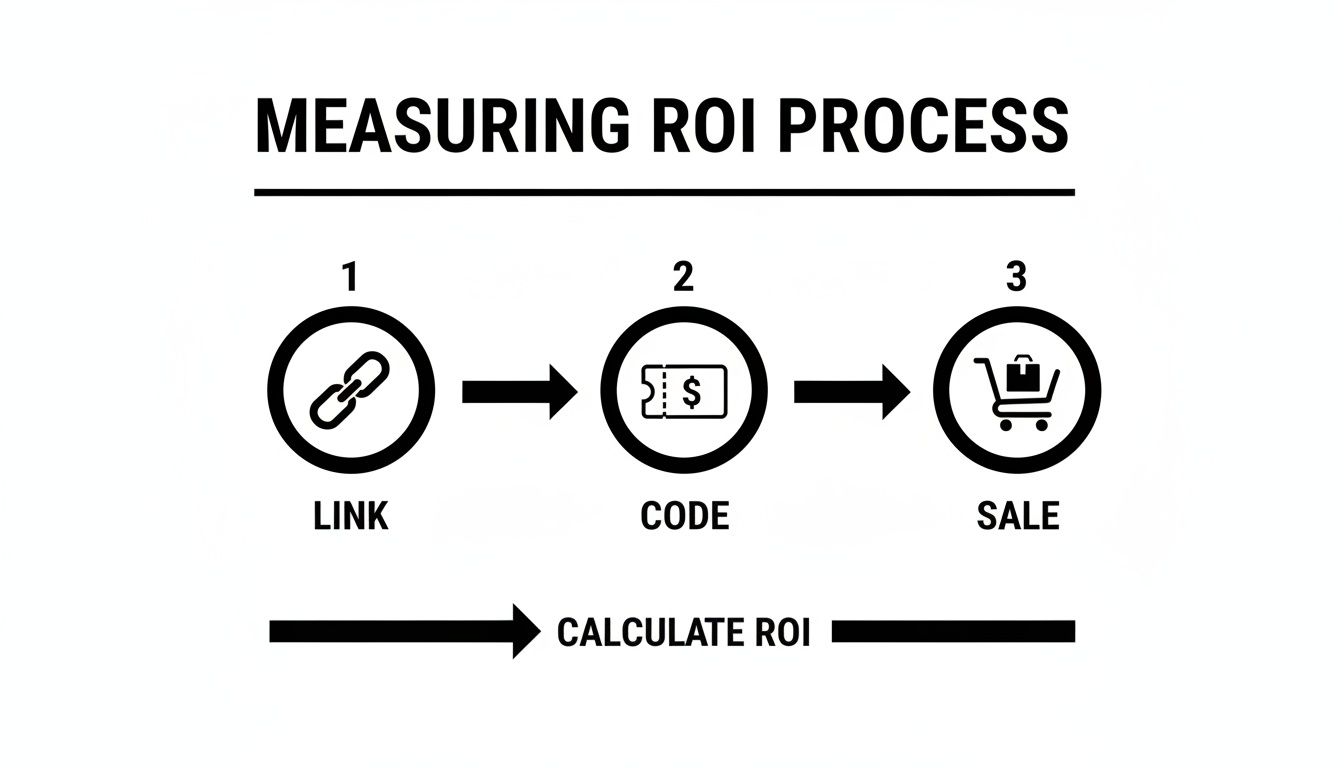
It’s a straightforward visualisation of how to connect the dots, tracking a customer from a creator's post directly to a sale using those all-important unique links and codes.
From Briefing to Beyond
Once you've got your creators on board, the focus shifts to execution and getting the absolute most from your investment. This is where a one-off campaign transforms into a long-term asset.
4. Craft a Winning Brief: Give creators a clear brief with your key messages and deliverables, but—and this is critical—leave room for creative freedom. The best, most authentic content happens when you let creators speak in their own voice.
5. Measure Everything: Use unique trackable links and custom promo codes for every single creator. This is non-negotiable. It’s the only way you’ll be able to properly attribute sales and calculate your exact return on investment.
By following this playbook, you can transform influencer marketing from a scattered, time-sucking chore into an organised, repeatable system. This is how you stay ahead of the curve in 2026 and build a growth engine that’s built to last.
The creator economy isn't a fringe tactic anymore; it has become a central pillar of modern commerce. With this guide, you’re now equipped to harness its full potential and make it your most effective channel for driving revenue and building a brand that customers genuinely love.
Ready to turn your influencer marketing from a manual chore into a scalable growth engine? Sup combines smart technology with a human team to launch, manage, and measure your creator campaigns from start to finish. Get started with Sup today and see how hundreds of ecommerce brands are driving more sales with less effort.

Matt Greenwell
Share