When you're running a fine dining establishment, your marketing isn't just about getting the word out. It’s about crafting an atmosphere of exclusivity and desire. This is where partnering with the right content creators comes in—it’s a strategy that turns passive social media scrollers into genuinely intrigued diners, driving bookings in a way that traditional advertising simply can't anymore.
Why Influencers Are the New Digital Maitre D'
Let's be honest: in the world of high-end dining, reputation is everything. Today's diners aren't just looking for a meal; they're hunting for an experience, a story, and a recommendation they truly trust. Influencers have become the perfect conduit for this, acting as your digital maitre d' by welcoming guests and setting the scene long before a reservation is even considered.
A printed ad might list the ingredients in your signature dish, but a creator’s video shows the curl of the steam, the precision of the plating, and the genuine delight on their face. Their content becomes a curated preview of the evening you’re offering, building a sense of aspiration that feels just within reach.
The Power of a Genuine Recommendation
The real magic of using influencers in fine dining lies in authenticity. When a creator who is genuinely passionate about food shares their experience at your restaurant, it doesn't land as an advertisement. It feels like a tip from a friend who knows all the best spots.
This is particularly true for nano and micro-influencers. Their smaller, hyper-engaged communities are often packed with local food lovers who hang on their every word. They provide a level of social proof that a faceless five-star review on a website just can't compete with.
For a fine dining brand, an influencer partnership is not about chasing likes. It is a calculated strategy to influence the decisions of high-value diners, creating a sense of urgency and desirability that fills tables on a slow Tuesday as effectively as a bustling Saturday.
Driving Real, Measurable Results
The move toward creator collaborations isn't just a trend; it's backed by some seriously compelling numbers. In the UK, a 2026 study from the Influencer Marketing Trade Association found that fine dining restaurants working with food influencers saw an average 35% increase in bookings during their campaigns. For comparison, those sticking to traditional advertising saw just a 12% lift.
What’s more, 78% of British millennials and Gen Z diners now say an influencer’s post carries more weight in their choice of a high-end restaurant than reviews on TripAdvisor or Google. For a deeper dive into the latest creator economy data, you can review these key influencer marketing statistics for 2026.
The table below starkly illustrates the difference in impact between a modern, influencer-led approach and more dated advertising methods.
Influencer Impact vs Traditional Marketing for Fine Dining
Metric | Influencer Marketing (Avg.) | Traditional Advertising (Avg.) |
|---|---|---|
Booking Increase | 35% during campaign | 12% during campaign |
Audience Engagement | 4.5% engagement rate | 0.5% click-through rate |
Trust Factor | High (Peer recommendation) | Low (Corporate message) |
Content Lifespan | Evergreen (Stays on feeds) | Limited (Runs for set period) |
As you can see, the numbers speak for themselves. Influencer marketing isn't just about generating buzz; it's about connecting with the right audience in a way that builds trust and directly drives revenue, solidifying your restaurant's place at the top of their must-visit list.
Laying the Groundwork for Your Fine Dining Influencer Strategy
A truly successful influencer campaign doesn’t start with a DM. It begins much, much earlier. For a fine dining restaurant, this initial strategic phase is the difference between a scattered, expensive gamble and a calculated investment that brings in the right creators—and more importantly, the right clientele.
Before you even think about who to invite, you need to get crystal clear on what you actually want to achieve. Vague goals like “more brand awareness” just won’t cut it. You need to ask yourself: what tangible result are we aiming for?
Getting this right will guide every single decision you make, from the influencers you partner with to the story they tell.
Define What Success Looks Like
Think hard about your restaurant's specific pain points and opportunities. A sharp, well-defined goal is what turns a hopeful experiment into a powerful business driver.
What do you need to move the needle on right now?
Tackling the quiet nights? Your goal could be to increase bookings by 20% on those notoriously slow Tuesdays and Wednesdays.
Launching a new tasting menu? Aim to generate enough buzz to sell out the first two weeks of service before the menu even goes live.
Building a waitlist for a special event? For a guest chef collaboration, you might want to drive 100+ sign-ups to a pre-launch waitlist.
Promoting a specific offering? Maybe you want to boost orders for your high-margin, pre-theatre menu by reaching people in the immediate vicinity.
Each of these objectives gives your campaign a clear purpose and, crucially, a benchmark for measuring real success.
Match Your Brand’s Soul to a Creator’s Style
With your goals set, the next piece of the puzzle is finding influencers whose entire vibe complements your brand's unique character. An influencer is, at their core, a storyteller. Their narrative has to feel like it belongs in your dining room.
Are you a bastion of classic, old-world elegance, or are you pushing the boundaries with avant-garde gastronomy? The answer dictates who you should work with.
For a traditional institution celebrated for its timeless French cuisine, you’d look for a creator whose feed is a gallery of minimalist, sophisticated photos and thoughtful captions. On the other hand, a restaurant exploring molecular gastronomy would be a perfect match for an influencer known for their bold, artistic, and experimental content that mirrors the innovation happening in the kitchen.
A mismatch here can be jarring for an audience. It instantly breaks the spell and makes the partnership feel forced. You're looking for someone whose personal brand feels like a natural extension of your own, making their endorsement feel completely genuine.
This alignment is also fundamental to your user-generated content strategy. When the fit is right, the photos and videos they create aren't just beautiful; they're perfectly on-brand assets you can use across your own marketing channels for months to come.
Set Clear, Measurable KPIs
Now it's time to translate your goals into tangible Key Performance Indicators (KPIs). These are the hard numbers you’ll use to see if your campaign is actually delivering. To understand your true return on investment, you have to look beyond simple likes and comments.
Your KPIs should be a direct reflection of the objectives you defined earlier.
Essential KPIs for Fine Dining Restaurants:
KPI Category | Specific Metric to Track | Why It Matters |
|---|---|---|
Booking & Revenue | Target Cost-Per-Booking (CPB) | This shows you the direct cost to put a paying customer in a seat through your campaign. |
Unique Promo Code Redemptions | Directly ties in-person visits and spending back to a specific influencer. | |
Clicks on Reservation Links (UTM) | Tracks how many people are moving from social media to your booking engine. | |
Content & Reach | Desired Earned Media Value (EMV) | Gives you an estimate of what the exposure generated by the influencer would have cost in traditional advertising. |
Number of High-Quality UGC Pieces | Quantifies the valuable marketing assets you’ve gained for your own future use. |
By setting these KPIs from the get-go, you shift influencer marketing from a perceived expense into a trackable growth channel. It gives you a solid framework for judging performance and justifying future investment, making sure every collaboration contributes directly to your restaurant's bottom line.
How to Find and Vet the Right Food Creators
Finding the right creators for a fine dining restaurant is more like casting for a lead role than just filling a seat. It's easy to get distracted by big follower counts, but that’s often just a vanity metric. The real goal is to find people whose personal brand and audience genuinely reflect the experience you offer.
The secret? Forget the big names for a moment. The real power players in today’s restaurant marketing are nano-influencers (1,000–10,000 followers) and micro-influencers (10,000–50,000 followers). These creators have built incredibly loyal, niche communities who hang on their every word. Their recommendations feel less like an ad and more like a tip from a trusted friend.
This isn’t just a hunch; the numbers back it up. A 2026 UK trends report showed that 73% of upscale restaurants now actively seek out micro and nano creators. Why? They're seeing an impressive 2.55% average conversion rate and an average return of £7.65 for every £1 spent, blowing traditional paid search out of the water. With 60% of UK consumers turning to Instagram to discover new dining spots, the right influencer is your new reservation engine. You can dive deeper into this research on the rising necessity of influencer marketing for restaurant brands.
Searching Beyond the Obvious
So, where are these hidden gems? It takes a bit of digital detective work, but finding the right fit is well worth the effort. You need to think locally and get specific.
Where to Look for Potential Partners:
Hyper-Local Hashtags: Don’t just search for
#londonfoodie. Get granular with tags like#mayfairrestaurants,#shoreditcheats, or even hashtags for nearby landmarks.Your Own 'Tagged' Photos: Your best future partners might already be dining with you. Make it a habit to review who's tagging your restaurant. You might find a creator with a fantastic eye who's already a genuine fan.
Competitors' 'Tagged' Photos: Take a peek at which creators are posting about other high-end restaurants in your neighbourhood. This gives you a ready-made list of people who are already active and trusted in the fine dining scene.
Niche Searches: Look for creators who have a specific passion that aligns with yours. Think
#michelinguideuk,#tastingmenu, or#londoncocktailbars.
This manual search is your first step to building a solid longlist of collaborators who are not only in the right place but also genuinely passionate about the world you operate in.
Vetting for Authenticity and Alignment
Once you have a list of names, the real work begins. This is where you separate the true brand advocates from those just looking for a free meal. You need to analyse their profile with a critical eye, ensuring their digital presence matches the premium quality of your establishment.
Key Takeaway: An influencer's feed is their portfolio. For a fine dining brand, you're looking for a creator whose visual storytelling, tone of voice, and audience engagement all feel like they belong in your world. A mismatch here will feel inauthentic to everyone involved.
To do this right, you need a methodical approach. I recommend creating a simple checklist to evaluate every potential partner consistently.
The Fine Dining Vetting Checklist:
Audience Demographics and Location:
Do their followers actually live in or visit your city? A creator with a massive following in another country won't help you fill tables.
Don't be afraid to ask for a screenshot of their audience demographics from their Instagram Insights. A legitimate creator will happily provide this.
Engagement Quality Over Quantity:
Read the comments. Are they genuine conversations or just a string of "Looks great!" and fire emojis? Real engagement sparks discussion.
Do a quick calculation of their engagement rate: (Likes + Comments) / Followers x 100. For micro-influencers, a healthy rate between 3-6% is a great sign of an active community.
Content and Aesthetic Alignment:
Is their photography sophisticated? Grainy, poorly lit photos will instantly devalue your brand. Look for quality and a consistent style.
Does their writing have substance? You want thoughtful captions that tell a story, not just a list of what was on the plate.
Spotting the Red Flags:
Sudden follower spikes: This is a classic sign of bought followers.
Generic or bot-like comments: Comments from accounts with no profile picture or strange usernames are a huge red flag.
A feed full of '#ad' posts: If every other post is sponsored, their recommendations have likely lost all credibility and impact.
By being rigorous in your vetting, you move beyond just looking at numbers and start building partnerships rooted in genuine alignment. This is how you ensure that when a creator shares their experience at your restaurant, it lands as a trusted recommendation that brings real, high-value customers through your doors.
Getting Your Outreach and Campaign Brief Right
The first message you send to a creator says everything about your restaurant's standards. In the world of fine dining, a generic, copy-and-paste DM is the digital equivalent of serving a microwaved meal. It signals a lack of care and respect for their work, and frankly, it’s the quickest way to be ignored.
Your outreach needs to be as thoughtfully composed as your tasting menu. Personalisation isn't just a nice-to-have; it's essential. Before you even think about hitting ‘send’, do your homework. Dive into their feed. Did you love a specific post? Mention it. Did they recently feature a restaurant with a similar ethos to yours? Tell them that. Point out an element of their storytelling that caught your eye. This small effort shows you see them as a genuine partner, not just another name on a list.
This personalised touch immediately sets your restaurant apart from the endless stream of lazy offers flooding their inbox every day.
Making That First Connection
Your initial message should be short, sharp, and respectful. The aim here is to start a conversation, not to unload every single detail at once.
Introduce yourself and your restaurant, but quickly get to the why. Why them? Explain what it is about their specific content that made you reach out. Then, lay out the proposed collaboration in simple terms.
Always answer the creator's unasked question: "What's in it for me?" Be completely transparent about what you're offering, whether it's a complimentary dining experience for two, a creative fee, or a mix of both. This honesty builds trust right from the start. For a deeper dive, our guide on how to write the perfect influencer outreach email has you covered.
A Simple Outreach Script That Works: "Hi [Creator Name], my name is [Your Name], and I'm the [Your Title] at [Your Restaurant Name]. I've been following your work for a while and absolutely loved your recent feature on [Similar Restaurant]. The way you focus on [mention specific quality, e.g., 'beautiful plating' or 'capturing the atmosphere'] is exactly what we admire. We’d be honoured to invite you and a guest to experience our new seasonal tasting menu in exchange for a post and a few stories. Would you be open to hearing more?"
This approach is direct, personal, and clearly states the value on offer, making it incredibly easy for them to respond with a 'yes'.
The Campaign Brief: Your Blueprint for Success
Once a creator agrees to work with you, the campaign brief becomes your most critical tool. It’s the playbook for the entire partnership, making sure everyone is on the same page about deliverables, timings, and the creative vision.
But for a fine dining restaurant, this document is a delicate balancing act. You need to provide clear direction without killing the creative spark that makes influencer content so powerful in the first place.
Think of it less as a rigid set of instructions and more as a flexible framework. You’re giving them the key ingredients and the desired flavour profile, but you’re trusting the creator—the chef, in this analogy—to bring the dish to life in their own signature style. To make sure these collaborations fit seamlessly with your broader marketing, it helps to have a consistent plan for your managed social content.
The best briefs give a creator everything they need to succeed, empowering them to create authentic content that their audience will love.
Essential Elements of a Fine Dining Influencer Brief
A well-structured brief is your best defence against misunderstandings and off-brand content. It's the single source of truth for the project. Think of this table as a checklist to ensure you've covered all the crucial details before sending it over.
Component | What to Include | Why It's Important |
|---|---|---|
Campaign Goal | A one-sentence summary (e.g., "Drive bookings for our new seasonal tasting menu"). | Aligns the creator with your core business objective. |
Key Messages | 2-3 unique points about the experience (e.g., "Sourced from local farms," "Head Chef's signature dish"). | Gives the creator specific story angles to explore. |
Deliverables | The exact content required (e.g., 1 Instagram Reel, 3-5 Instagram Stories with link stickers). | Sets clear, unambiguous expectations for content output. |
Mandatory Tags | Your restaurant's handle, the head chef's handle, and any campaign hashtags (e.g., #YourRestaurantMenu). | Ensures all key players are credited and content is easily trackable. |
Disclosure Rules | Clear instructions to use #ad, #gifted, or the platform's "Paid Partnership" tag. | Guarantees legal compliance with advertising standards and builds audience trust. |
Content Usage | Specify how you can repurpose their content (e.g., on your website, in paid social ads for 90 days). | Clarifies rights from the start, avoiding future disputes. |
By including these elements, you provide a clear and professional guide that respects the creator’s time and talent, paving the way for a smooth and successful collaboration.
Going Beyond Likes: How to Measure What Really Matters
It's easy to get caught up in the flurry of likes, comments, and views. They feel good, right? But those so-called 'vanity metrics' don't keep the lights on or pay your talented kitchen brigade. For a fine dining restaurant, the real measure of success is putting bums on seats and seeing a return on your investment.
To do that, you have to connect the dots between an influencer’s beautiful Instagram Story and a happy customer enjoying your tasting menu. It’s about moving past the guesswork and getting serious about tracking. Thankfully, it's not as complicated as it sounds.
The entire journey, from that first friendly outreach message to tracking the final results, is a connected process. It's all about being personal, being clear, and working together.
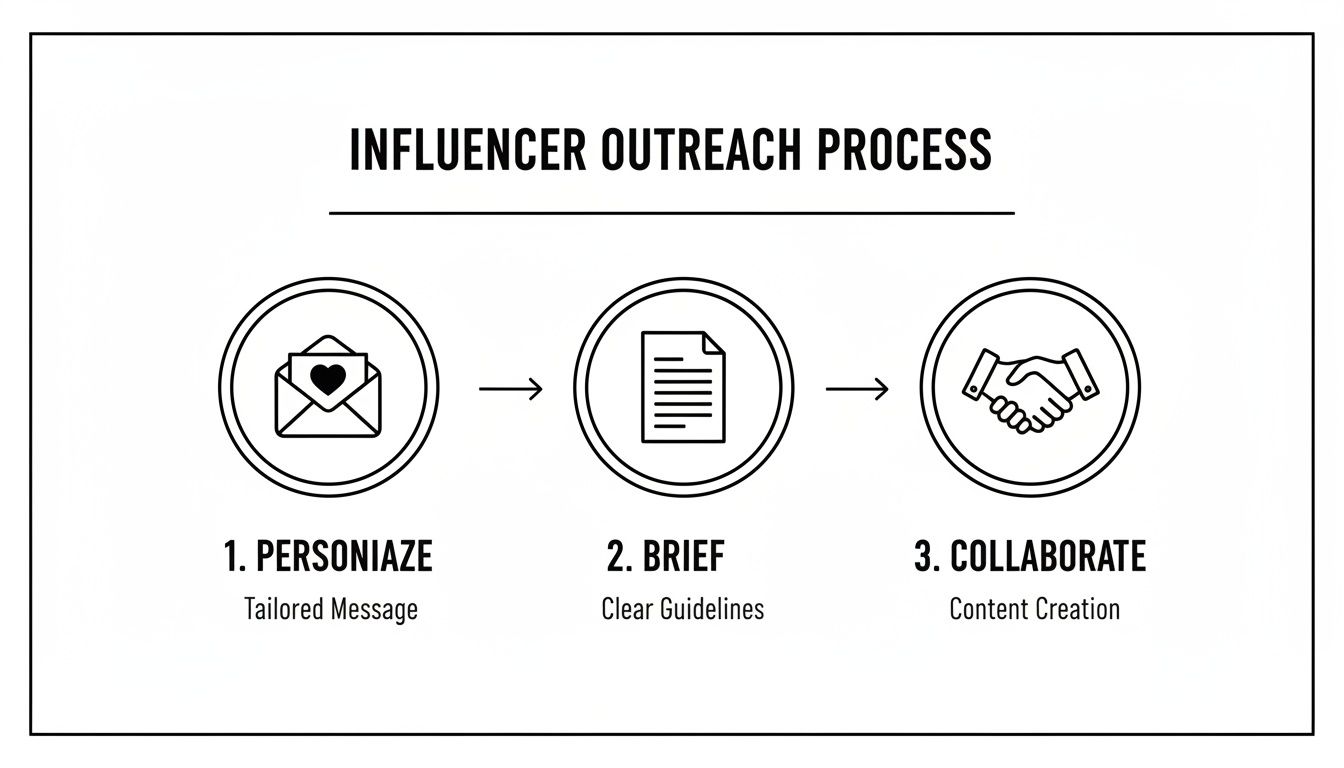
As you can see, solid measurement isn't an afterthought. It's woven into the very fabric of a well-organised campaign from the start.
Pinpointing Bookings and Revenue
How can you be sure an influencer actually drove a booking? Simple: you give them a unique tracking tool. This is the only way to separate the traffic they send from your other marketing efforts. Without it, you're just guessing.
Here are the two best ways to do this:
Custom UTM Reservation Links: Arm each creator with their own special booking link. A UTM code is just a bit of text tacked onto the end of a URL that tells your analytics where someone came from. For instance, a link might look like
yourrestaurant.co.uk/reservations?utm_source=instagram&utm_medium=influencer&utm_campaign=tastingmenu&utm_content=chloe_eats. When you log into Google Analytics, you can see exactly how many people clicked—and booked—from Chloe's specific 'link in bio'.Unique Promo Codes: Not every booking is made online. For phone calls or even walk-ins, a simple, unique code is your best friend. Give each influencer a code like "CHLOE15". It's easy for guests to remember and mention. You can tie it to a small gesture, like a complimentary glass of prosecco, which encourages people to use it and makes it dead simple for your front-of-house team to track.
By pulling the data from your reservation system and cross-referencing it with the codes used in your POS, you suddenly have a powerful picture of who's delivering. You'll know which creator filled your quiet Tuesday nights or whose followers had the highest average spend.
The Hidden Value of User-Generated Content
A campaign's worth goes far beyond the immediate bookings. One of the most precious assets you’ll get is a bank of high-quality user-generated content (UGC). These are authentic photos and videos from a trusted source, and they are pure marketing gold.
Just think what it costs to hire a food photographer and stylist for a professional shoot. An influencer collaboration gives you this content as a natural part of the experience, often for a tiny fraction of the price.
A single fantastic video or a collection of stunning photos can be repurposed for months on your own social media, in newsletters, and on your website. This extends the value of your initial investment long after the campaign has ended.
One way to put a number on this is to estimate its Earned Media Value (EMV). This is a rough calculation of what that content and exposure would have cost if you’d paid for it as a traditional advertisement.
If you want to get deeper into the numbers, we break it all down in our guide to the metrics that actually matter in measuring influencer marketing.
Calculating Your True Return on Investment
To get a complete picture of your ROI, you need to look at both the direct revenue and the long-term value of the content you've gained.
A straightforward way to think about it is:
Total Campaign Value = (Total Revenue from Tracked Bookings) + (Estimated Value of UGC)
Return on Investment (ROI) = ( (Total Campaign Value - Total Campaign Cost) / Total Campaign Cost ) x 100
This approach gives you a much more honest assessment of your campaign's success. It recognises that a great partnership delivers both immediate business and valuable marketing assets for the future, showing the true impact on your restaurant.
Frequently Asked Questions
When your restaurant's reputation is built on excellence, dipping your toes into influencer marketing can feel like a big step. It’s natural to have questions. After all, you’re placing a piece of your brand in someone else’s hands.
Let's walk through the questions I hear most often from fine dining restaurateurs. The goal here is to give you the confidence to build partnerships that truly reflect the quality of your establishment.
Should I Pay Influencers or Just Offer a Complimentary Meal?
This is the big one, and there’s no single right answer. The compensation should always match the value the creator brings to the table. Trying to apply one rule to everyone just doesn't work.
For nano-influencers (1k-10k followers): For creators with a smaller but highly engaged local following, a complimentary multi-course experience for two is often a perfectly fair exchange. This is what we call a "gifted" collaboration, and it can be a great starting point.
For micro-influencers (10k-50k followers) and up: Once you start working with creators with larger audiences, you should expect to pay a fee. They operate their platform as a professional business; you're not just getting a post, you're commissioning a marketing service. Their rates cover their time, creative work, and the access they provide to a loyal audience.
Honestly, a hybrid approach—offering both the dining experience and a fee—tends to get the best results with established creators. It shows you value their craft professionally and sets the right tone for a respectful partnership from day one.
How Much Control Should I Have Over Their Content?
I see this all the time: a desire to control every single detail of the content. While understandable, micromanaging a creator is one of the quickest ways to undermine a campaign. You’re partnering with them for their unique perspective and authentic connection with their audience, not to have them read a script.
The best approach is to provide a clear, concise brief. Think of it as providing the key ingredients, not the full recipe. Your brief should absolutely include:
The core messages or story you want to highlight.
Any mandatory tags (@yourrestaurant) and specific hashtags.
Crystal-clear instructions on advertising disclosures.
From there, trust them. Let them have creative freedom over the shots, the angles, and the caption's tone. The result will feel far more genuine and compelling than a polished advertisement ever could.
What Is a Realistic ROI to Expect from My First Campaign?
For your first influencer campaign, shift your focus from immediate, massive returns to gathering data. Think of it as a reconnaissance mission. Your primary goal is to establish your own benchmarks and learn what resonates with your audience.
Success isn't just about the bookings you get in week one.
A study of 50 London fine dining restaurants found their foodie partnerships generated an average of 135,200 views per Reel and a 28% year-on-year spike in engagement. In Manchester, Mana restaurant reported a 40% revenue lift directly from TikTok collaborations, showing just how powerful these campaigns can be once you find your rhythm. You can read more about how brands are making influencer marketing a core strategy in the full report.
For your initial campaign, focus on tracking these metrics:
Website clicks using unique UTM links for each creator.
Reservation notes or calls that mention the influencer by name.
The quality and volume of content created, which you can then repurpose.
A great first run might just break even on direct revenue, but it will deliver priceless brand awareness and a library of beautiful, authentic content that you can use for months. That’s a win.
How Do I Ensure Influencers Follow Advertising Rules?
This is completely non-negotiable. Both your restaurant's reputation and the creator's credibility are at stake, so transparency is everything. As the brand, the responsibility falls on you to ensure every collaboration is compliant with UK advertising standards.
Your campaign brief must explicitly state that the partnership needs to be disclosed. The Advertising Standards Authority (ASA) is very clear: gifted meals and paid posts must be labelled as advertising.
This means insisting on clear identifiers like #ad or #gifted at the very beginning of a post's caption. For Instagram, using the built-in "Paid Partnership with" label is best practice. Make this a contractual requirement. It’s a simple step that protects your business, the creator, and the trust you have with your customers.
Ready to make influencer marketing a reliable, measurable growth channel for your restaurant? With Sup, you can find the right creators, manage campaigns, and see real results in minutes, not days. We take care of the outreach, tracking, and logistics so you can focus on creating unforgettable dining experiences. Learn how Sup can scale your collaborations today.

Matt Greenwell
Share