For food delivery brands and dark kitchens, influencer marketing isn't just a tactic—it's a direct line to customers. By partnering with local creators, you can generate real trust and drive orders, using authentic, visual content on platforms like Instagram to stand out from the digital noise. It's become a crucial part of the modern growth playbook, especially for brands without a physical storefront.
Why Influencer Marketing is Your New Secret Weapon
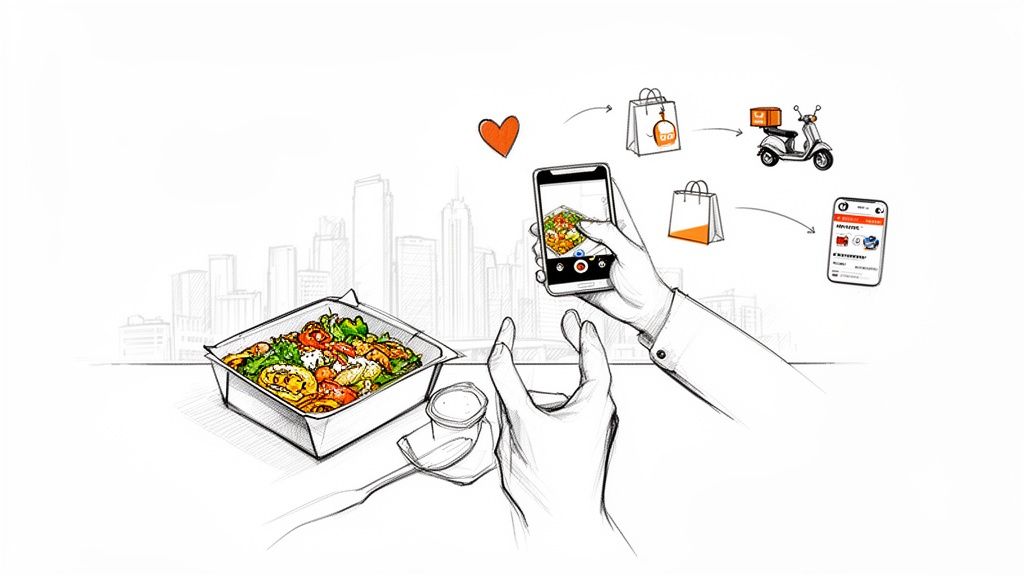
Let's be honest, the old marketing playbook feels a bit stale for food delivery and ghost kitchens. In a world flooded with aggregator app notifications and generic ads, actually grabbing a potential customer's attention—and their order—is a real battle. This is where influencer marketing completely changes the dynamic.
Think about it from a customer's perspective. They're scrolling through Instagram and see a polished ad for a new burger joint. They’ll probably just swipe past it. But then, a few posts later, they see a local food blogger they trust raving about an incredible burger that just arrived at their door, complete with a close-up of the juicy patty and perfectly melted cheese. That single, authentic post builds more trust and desire than any corporate ad ever could.
This is a fundamental shift that taps directly into how we all decide what to eat. We trust recommendations from real people far more than we trust brands. For a dark kitchen without a high-street presence and the natural word-of-mouth it brings, this kind of social proof is absolutely essential.
Cutting Through the Clutter
Getting noticed on crowded aggregator platforms often means paying for top spots. Influencer marketing gives you a more organic way to get in front of the right people. A well-run campaign with local creators can deliver on several fronts:
Builds Instant Trust: A post from a trusted local voice feels like a genuine tip from a friend.
Drives Direct Orders: Creators can share unique discount codes and direct ordering links, making it easy to track sales from their content.
Makes Your Food Look Irresistible: Nothing sells food better than high-quality, real-life photos and videos that create serious cravings.
The market’s explosive growth only makes this more urgent. The UK's foodservice delivery market is projected to hit £14.3 billion by 2025, and delivery turnover for branded restaurants has already doubled since 2019. This boom, driven heavily by delivery-only kitchens, shows just how much customer habits have changed. You can dig deeper into these foodservice delivery market trends to see how the industry is being reshaped.
This isn't just about brand awareness. It’s a performance-driven strategy to win orders, generate authentic reviews, and build a loyal local following in one of the most competitive markets out there.
Find Local Food Influencers Who Actually Drive Orders
Let’s be honest, chasing big-name celebrities with millions of followers is a waste of time and money for most food delivery brands. The real magic happens at the local level. Your most powerful allies are the nano-influencers (1k-10k followers) and micro-influencers (10k-100k followers) who live and breathe your city's food scene.
These are the people whose followers genuinely trust their recommendations for a Friday night takeaway. A creator with 5,000 engaged local fans is going to do far more for your dark kitchen's order volume than a national celebrity whose audience is scattered all over the map. This isn't about vanity metrics; it's about turning authentic content into real sales.
The opportunity here is massive. The UK's online food delivery market was valued at an eye-watering £24.6 billion in 2024 and is on track to more than double by 2035. As mobile apps dominate how people order, your brand needs to be right where they are—scrolling through their feeds and getting inspiration from creators they know and trust.
Uncovering Local Foodie Gems
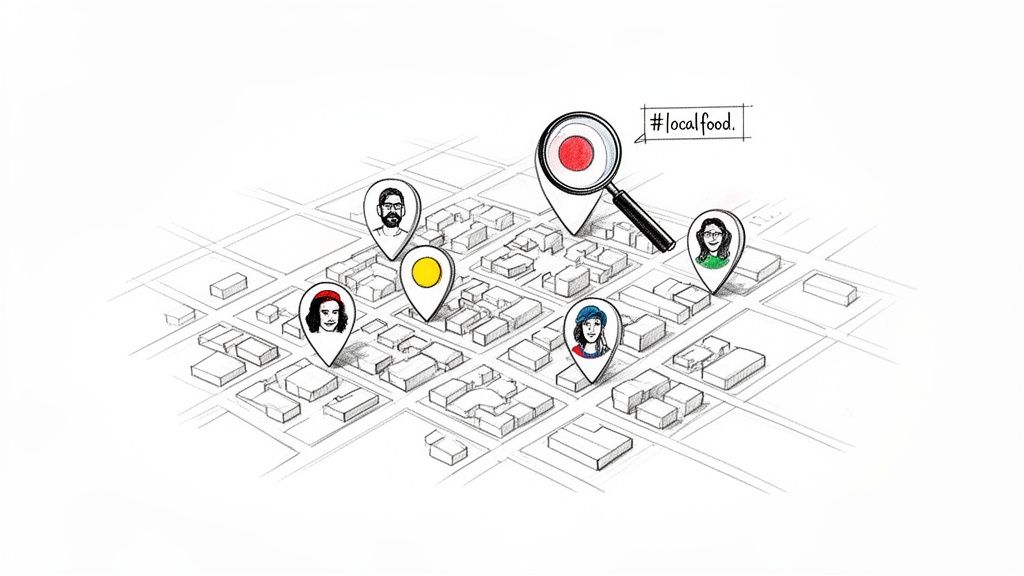
Finding the right creators is part art, part science. You need to put on your detective hat and think like a hungry local searching for their next meal on Instagram or TikTok.
Your best starting point is drilling down into specific hashtags. Forget the generic ones like #food. You need to get granular and postcode-specific. Think about terms like:
By Neighbourhood:
#shoreditcheats,#leedsfoodie,#bristolfoodBy Cuisine:
#manchestervegan,#birminghamhalal,#glasgowburgersBy Occasion:
#londoncheapeats,#edinburghdatenight,#liverpooldelivery
Another brilliant tactic is to do a bit of competitor research. Take a look at which local influencers are already shouting about similar restaurants or dark kitchens in your delivery radius. This gives you a ready-made list of potential partners who are already proven to be effective at promoting food in your area. If you want to dive deeper into this, our guide on how to find local food influencers in your city has you covered.
Vetting Creators For Authenticity and Impact
So, you’ve got a list of potential creators. Now comes the most important part: vetting. This is where you separate the true food enthusiasts from those just hunting for a freebie. You have to look beyond the follower count and dig into the metrics that signal a genuine, engaged community.
A creator's passion for food should be obvious. Look for people who are already posting about local restaurants and takeaways because they genuinely love exploring their city's food scene, not just because they were paid.
To really get this right, you need a solid framework. A comprehensive guide on Food Influencer Marketing That Drives Real Orders can provide that deeper strategic understanding. The end goal is to build a roster of partners who genuinely reflect your brand and can deliver a measurable return on your investment.
A simple checklist can help you make objective decisions and avoid costly mistakes. Before reaching out, run each creator through these simple checks.
Creator Vetting Checklist for Food and Delivery Brands
Vetting Criterion | What to Look For (Green Flag) | What to Avoid (Red Flag) |
|---|---|---|
Engagement Rate | Consistent comments and shares from what look like real, local accounts. The creator actively replies to their community. | A huge follower count but suspiciously few or generic comments. A dead giveaway for a disengaged audience. |
Audience Quality | You see followers in your delivery radius commenting with genuine interest in the food and where to get it. | A high percentage of followers from outside your city or country. An obvious sign of bot or bought followers. |
Content Authenticity | A natural blend of sponsored and organic food posts. You can feel their personality and passion shine through. | Every single post is an #ad. The content feels staged, overly polished, and lacks any real character. |
Niche Alignment | Their content style and audience demographic perfectly match your target customer (e.g., budget-friendly, family-focused, vegan). | They promote a random jumble of products with no clear focus. Their audience doesn't align with who you're trying to reach. |
This deliberate vetting process ensures your marketing budget is invested in partnerships that do more than just make noise. It's about building a community of genuine advocates who will champion your dark kitchen and drive sustainable growth, one authentic post at a time.
Craft Offers and Briefs That Inspire Great Content
The success of your entire influencer campaign really boils down to two things: the deal you offer and the creative direction you give. It’s a delicate balance. A weak offer won't attract the best local creators, but a brief that's too rigid will strip away all the authenticity you’re paying for.
Where I see most dark kitchens and delivery brands stumble is in thinking a free meal is enough of a payment. While that might work for some up-and-coming nano-influencers, you need to structure your offers to reflect the real value a creator is bringing to the table. This isn't just about handing over free food; it's about building a genuine partnership.
Designing Compelling Compensation Models
Your offer needs to be a good match for the creator's influence and what you're trying to achieve with the campaign. A one-size-fits-all approach just doesn't cut it. You need a flexible strategy that you can adapt for different partners.
Here are a few compensation models I've found work incredibly well in the food space:
Product-Only (Gifting): This is your go-to for nano-influencers or newer creators who have small but super-engaged local followings. The key is to be generous. Give them enough credit to order a proper feast, so they can experience your service just like a real customer would.
Flat Fee + Product: When you step up to micro-influencers with a proven track record, a modest flat fee on top of the meal credit becomes the standard. This is a sign of respect, compensating them for their time, their creative effort, and the access they provide to their audience.
Performance-Based Bonuses: Now we're talking. This is how you turn a brand awareness play into a serious performance channel. Try offering a cash bonus for every 10 or 20 redemptions of their unique discount code. This gives creators a real incentive to produce content that doesn't just get likes, but actually gets people ordering.
Remember, the goal is a fair value exchange. The creator gives you authentic content and a direct line to a trusted audience; you provide fair compensation and a delicious product they'll be genuinely excited to share.
Writing an Inspirational Creative Brief
Once you've agreed on a deal, the creative brief is your most important document. A great brief gives clear direction without being a restrictive script. It should feel like you're inspiring the creator, not dictating their every move. The best content always comes from giving creators the freedom to weave your brand into their own unique style.
A muddled or overly demanding brief is a recipe for disaster. It leads to generic, flat content that their followers will immediately scroll past. Your job is to give them the key ingredients and then let them get cooking. Think of it as a simple, one-page guide that's easy to digest.
Anatomy of a Perfect Influencer Brief for Dark Kitchens
Campaign Goal (The "Why"): Be totally transparent about what you want to happen. Are you trying to drive orders for a new menu item? Boost your presence in a specific postcode? Or just get some great, authentic photos you can use on your own social channels? Tell them.
Key Talking Points (The "What"): Don't overload them. Stick to 2-3 essential messages you absolutely need them to hit. For example:
"Our packaging is 100% sustainable and compostable."
"We offer a full vegan menu with 15+ options."
"Our delivery is guaranteed in under 30 minutes."
Creative Freedom (The "How"): This part is crucial for building trust. Add a line that shows you've actually looked at their work: "We love your unboxing videos and trust you to bring our food to life for your audience in your own voice. Have fun with it!" This single sentence can make all the difference.
Deliverables and Deadlines (The "When & Where"): Be specific, but also realistic. Lay it out clearly.
One Instagram Reel showing the unboxing and first bites.
Three Instagram Stories featuring the link sticker with your custom UTM link.
All content needs to be posted within one week of receiving the food.
Mandatories (The Fine Print): Keep this section short and to the point. This is for the non-negotiables, like your brand's handle (
@YourBrandUK), the specific campaign hashtag (#YourBrandNightIn), and the requiredADdisclosure.
By putting real thought into your offer and your brief, you're not just buying a post. You're setting the stage for a powerful collaboration with a creative professional who can tell your story in a way that truly connects—and more importantly, makes people hungry.
Launch and Manage Campaigns Without Drowning in Spreadsheets
Let’s be honest: managing influencer campaigns can quickly turn into a logistical nightmare. If you're juggling Instagram DMs, searching through email threads, and updating clunky spreadsheets, you’re on the fast track to burnout. For any dark kitchen operator, time spent on admin is time you’re not spending on the food or the business itself.
The old way of doing things just doesn't scale. A few collaborations might be manageable manually, but if you want to grow, you need a repeatable system. A modern, organised approach is what lets you handle dozens of partnerships at once, turning a chaotic process into a predictable engine for growth.
This is a simple map of the core management process, from that first point of contact right through to getting the content scheduled.
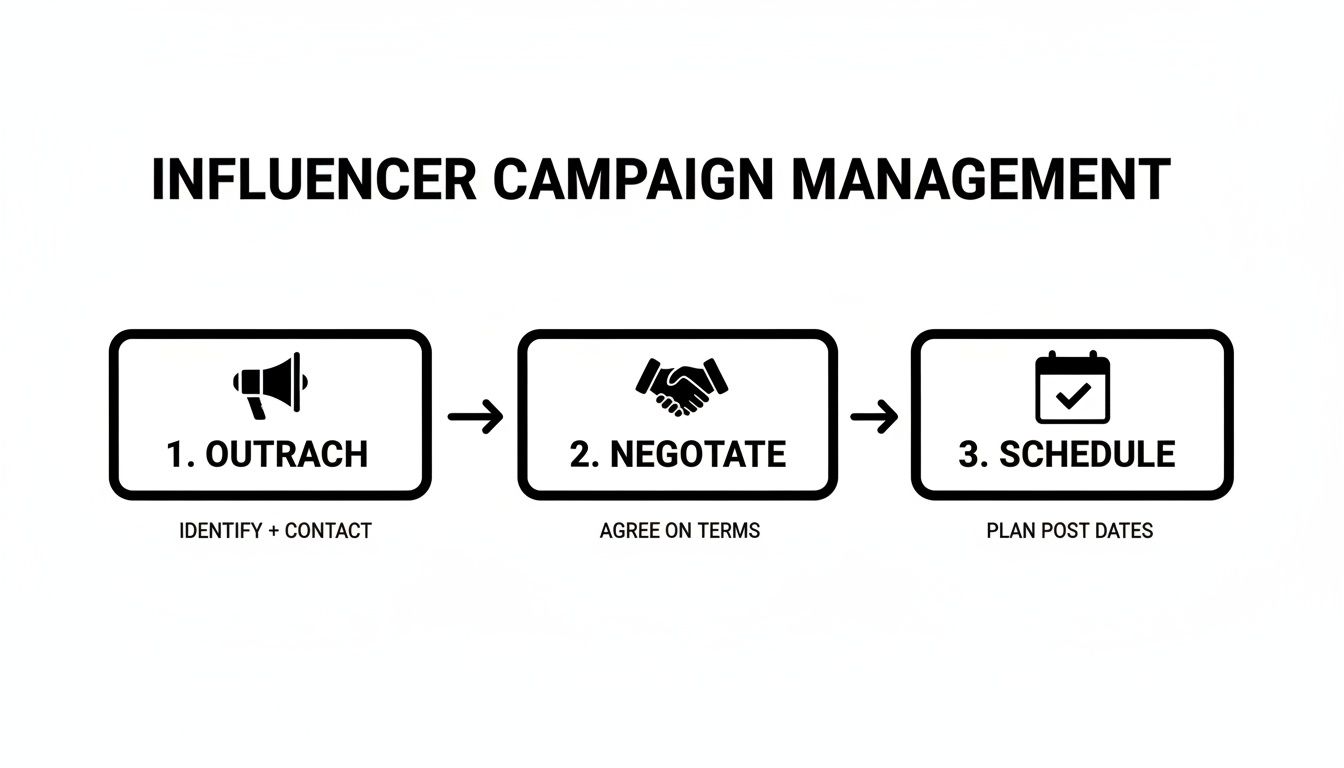
Having distinct phases for each part of the collaboration is critical. It stops things from getting confused and ensures no creator falls through the cracks. This is what unlocks real efficiency.
Centralising Your Campaign Management
The first step away from spreadsheet chaos is to get everything in one place. You need a single source of truth for all your campaign activities. Whether you decide to use a dedicated influencer marketing platform or a project management tool like Trello or Asana, the goal is the same: get it all out of your inbox and into an organised system.
This central hub should let you track every creator through a clear pipeline. A typical workflow looks something like this:
Outreach Sent: Creators you've contacted with an initial proposal.
Negotiating: Those who have replied and are discussing terms.
Deal Agreed: The agreement is finalised, and the brief is on its way.
Content in Progress: The creator has their food and is working on the content.
Content Live: The posts have been published and are out in the wild.
This pipeline view gives you an instant, at-a-glance understanding of where everything stands. You can immediately spot bottlenecks—for example, if too many creators are stuck in the "Negotiating" stage—and take action. That's a level of control that’s simply impossible when your information is scattered everywhere.
Automating to Accelerate Growth
Once you have a centralised system, you can start automating the repetitive tasks that eat up your day. Automated follow-ups are a game-changer. If a creator hasn’t replied to your initial email after three days, a polite, automated nudge can be sent without you lifting a finger.
The same principle applies after the collaboration. When a creator’s content goes live, your system can automatically remind you to check deliverables, track initial performance, and schedule a follow-up to thank them. Automating these small touchpoints not only saves a huge amount of time but also creates a professional and positive experience for your partners, making them want to work with you again.
The goal is simple: free yourself from admin so you can focus on strategy. Time saved on manual follow-ups is time you can spend finding better creators, refining your offers, and analysing what actually drives orders.
The UK's online food delivery market, the very platform dark kitchens are built on, settled at a £3.8 billion valuation in 2023. While growth has steadied, this followed a period of massive expansion—a 14.3% compound annual growth rate from 2020 to 2023. This market maturity is a huge opportunity for savvy dark kitchens to capture market share with efficient, targeted influencer marketing. You can dig into more insights on the UK’s online food delivery market on ibisworld.com.
A Realistic Campaign Timeline
Setting realistic expectations is crucial. From the first email to the content going live, a single collaboration usually follows a predictable timeline.
Week 1: Initial outreach and follow-ups.
Week 2: Negotiating the terms and finalising the agreement.
Week 3: Sending the creative brief and arranging the food delivery.
Week 4: Creator produces and posts the content.
This four-week cycle is a pretty solid baseline to work from. By using a structured management system, you can easily run multiple collaborations on overlapping timelines without losing your mind. You can transform influencer marketing for your food delivery brand from a headache into a scalable and highly effective sales channel.
Measure What Matters and Actually Prove Your ROI
Let's be honest. The days of patting ourselves on the back for a few thousand likes are over. For a dark kitchen or food delivery brand, influencer marketing has to do more than just generate buzz; it has to put orders on the board. The real question is: did this campaign actually make us money?
Moving from hopeful guesswork to hard data isn't nearly as complicated as it sounds. It all comes down to creating a clear, trackable line from an influencer's post straight to your checkout. This requires two fundamental tools that, in my experience, should be non-negotiable for every single collaboration.
Arm Creators with Unique Promo Codes
The most straightforward way to tie a sale directly to an influencer is with a unique discount code. Think of it less as a simple discount and more as your most powerful tracking tool.
When you issue a code like "MARIA15" to a local foodie, you can instantly see every single time that code is used. This gives you a clear, undeniable tally of the orders she drove. It’s simple, clean data that shows a creator's direct impact on sales.
Of course, the offer needs to be good enough to get people to use it. A solid 10-15% discount or a "free delivery" offer is usually the sweet spot. The goal is to make it a no-brainer for their followers to tap "order" and for your system to track it.
Build Trackable Links with UTMs
Promo codes tell you who converted, but they don't capture the full story. What about everyone who clicked the link, browsed your menu, but maybe didn't order right away? That’s where UTM parameters come in.
Don't let the name intimidate you. UTMs are just small bits of code added to a URL that tell your analytics exactly where your traffic is coming from. You can create them in seconds using Google's free Campaign URL Builder.
For example, a link you give to your influencer Maria might look like this: yourbrand.co.uk/order?utm_source=instagram&utm_medium=social&utm_campaign=winter_promo&utm_content=maria_foodie
This one link gives you a ton of information:
Source: The click came from Instagram.
Medium: It was a social media post.
Campaign: It was part of your "Winter Promo."
Content: It came specifically from Maria's content.
By giving every influencer their own custom UTM link, you can log into your analytics and see precisely who is driving the most traffic. This is gold for understanding which partners are best at grabbing your audience's attention, even if it doesn't lead to an immediate sale.
By pairing unique promo codes with custom UTM links, you get a complete picture of an influencer's performance. You can see both the direct sales and the traffic they generate, allowing you to calculate a genuine return on investment.
The Metrics That Truly Matter
With your tracking in place, it’s time to focus on what counts. Forget getting lost in vanity metrics and build a simple dashboard that answers the big financial questions. For a more comprehensive look, you can explore more strategies by measuring ROI for influencer marketing in our detailed guide.
Here’s a breakdown of the essential metrics you should be watching for every campaign.
Key Metrics for Food Delivery Influencer Campaigns
This table zeroes in on the key performance indicators that connect creator content directly to business results.
Metric | What It Measures | How to Track It |
|---|---|---|
Code Redemptions | The exact number of orders directly driven by an influencer. | Your POS or online ordering system's reporting. |
Revenue Generated | The total sales value from those redeemed codes. | Multiply redemptions by your Average Order Value (AOV). |
Cost Per Acquisition (CPA) | How much it cost to acquire each new customer from the campaign. | Total campaign cost (fees + food) / Number of redemptions. |
Click-Through Rate (CTR) | The percentage of people who clicked the influencer's link. | Your website analytics (e.g., Google Analytics) using UTMs. |
Conversion Rate | The percentage of link clicks that resulted in a completed order. | Code redemptions / Total clicks on the UTM link. |
By focusing relentlessly on these numbers, you eliminate the guesswork. You’ll have definitive proof of what’s working, so you can reinvest in the partnerships that deliver real value and move on from the ones that don't. This is how you transform influencer marketing from a marketing expense into a predictable, scalable sales channel for your brand.
Don't Let Great Content Die: How to Repurpose and Scale Your Success
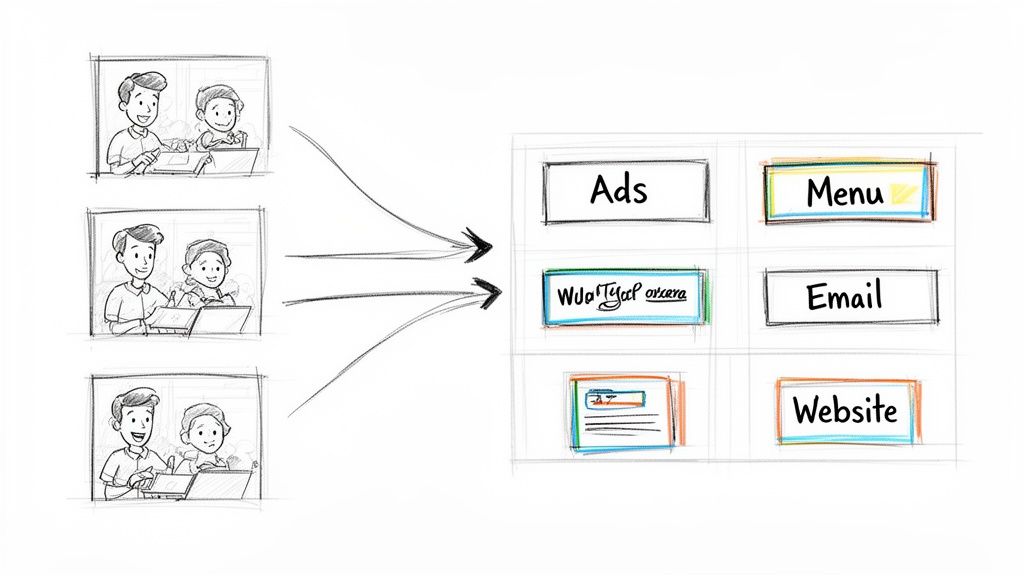
Here’s a mistake I see all the time: a brand runs a fantastic influencer campaign, the posts go live, and then... nothing. The content just sits on the creator's feed, its job considered done. In reality, the moment a creator posts is just the beginning.
The real genius of influencer marketing, especially for a food brand, lies in what you do next. That authentic content isn't a one-and-done deal; it's a goldmine of marketing assets you can use again and again. You’re not just paying for a post; you’re investing in a library of visuals that look and feel real, because they are.
Build Your Evergreen Content Library
First things first: you need the right to use the content. This is non-negotiable. Make sure your collaboration agreement has a clear clause giving you permission to repurpose the creator's photos and videos for your own marketing channels (always with credit, of course).
Once you have that sorted, create a central, organised folder for all the approved content. Tag it, sort it, make it easy to search. This library is your new secret weapon. Forget about shelling out thousands for a professional food photographer every few months. You now have a constantly refreshing source of mouth-watering, real-world images from genuine fans. To take this even further, building out a proper user generated content strategy will turn one-off posts into a repeatable system.
Think about it: a single, well-run campaign with a handful of creators can easily give you enough quality creative to fuel your paid ads, email marketing, and website visuals for a whole month. Your campaign transforms from a short-term boost into a long-term content engine.
Put Your Creator Content to Work Everywhere
With your library stocked, it’s time to deploy these assets. What makes influencer-generated content so powerful is that it doesn’t scream "AD!". It feels genuine, which is exactly why it cuts through the noise and converts so well.
Here are a few of the most effective ways I've seen brands reuse creator content:
Supercharge Your Paid Social Ads: Take those top-performing videos and photos and turn them into targeted ads on Instagram, Facebook, and TikTok. A real person unboxing and raving about your food is infinitely more persuasive than a sterile, polished studio shot.
Freshen Up Your Website and Menus: Use the best creator photos on your website’s homepage or directly on your online ordering menu. When a new customer sees real people loving your dishes, it builds instant trust and social proof.
Make Your Emails Pop: Drop some eye-catching influencer content into your next email newsletter. Announcing a new special? Showcasing a menu favourite? A picture of a local creator enjoying that exact dish will do wonders for your click-through rate.
Power Digital and Print Materials: High-resolution photos are incredibly versatile. You can use them on digital menu boards in a ghost kitchen waiting area or even on flyers for a local letterbox drop.
When you start thinking this way, you squeeze so much more value out of every single pound you invest in influencer marketing. For a deeper dive into sourcing this kind of content, you can learn how to get UGC for your restaurant without paying thousands from our detailed guide. It’s a strategy that ensures every partnership keeps delivering results long after the original post fades from view.
Common Questions Answered
As you get started with influencer marketing, a few questions always pop up. Let's tackle some of the big ones I hear most often from food delivery brands and dark kitchens.
How Much Should I Actually Budget to Get Started?
If you're just dipping your toes into influencer marketing, you don't need a massive budget to see results. A good, realistic starting point is somewhere in the £500 to £1,500 per month range.
With that kind of money, you can comfortably work with 5-10 local nano-influencers (those with 1k-10k followers) by offering a mix of gifted meals and small payments. It’s the perfect amount to test the waters, see which creators resonate with your audience, and figure out who actually drives orders before you commit to a bigger spend.
The secret here isn't bagging one huge, expensive influencer. It’s about building a small army of authentic, local creators whose followers genuinely trust their food recommendations. This approach almost always delivers a much better return on your investment.
We Deliver to Multiple Areas—How Does That Work?
Got multiple delivery zones? This is a common hurdle. The trick is to stop thinking of it as one big campaign and start treating each delivery area as its own mini-project.
You have to get granular. A creator living in South London isn't going to help you sell meals in East London, so organise your outreach based on specific postcodes.
Find them locally: Use location-specific hashtags like
#manchesterfoodieor#bristoldeliveryto find creators who actually live where you deliver.Track them locally: Give each creator a unique discount code tied to their specific area. This is the only way to know for sure which zones are pulling their weight and where your marketing pounds are best spent.
This hyper-local approach ensures your efforts are always relevant to the people you're trying to reach.
Ready to turn influencer marketing into a repeatable, ROI-proven growth channel? Sup combines AI with a human team to launch, manage, and measure your creator campaigns, saving you up to 95% of the time. Learn more and get started at the Sup website.

Matt Greenwell
Share