Forget glossy brochures and polished ad campaigns. The way people choose where to stay has completely changed, and influencer marketing is at the very centre of that shift. It’s a strategy built on authentic storytelling from creators, which in turn builds the trust you need to drive direct bookings.
Why does it work so well? Because today's travellers, especially millennials and Gen Z, don’t just stumble upon your hotel. They actively hunt for user-generated content and genuine travel experiences on social media before they even think about booking. They trust a recommendation from a creator they follow far more than they'll ever trust a traditional advertisement.
Why Influencer Marketing Is Your New Best Friend for Bookings
The currency that really matters in the hospitality world today isn't a five-star review in a travel guide—it's authenticity. Potential guests are no longer just passive viewers of your marketing. They're scrolling through TikTok, saving Instagram Reels, and digging into travel blogs to piece together their perfect trip.
This isn’t just a minor trend; it’s a fundamental change in how people make decisions. They want to see a real person enjoying your hotel—waking up to that stunning balcony view, sipping a cocktail at the rooftop bar, or using your place as a launchpad to explore the local neighbourhood. An unfiltered, first-person perspective from a creator simply connects on a level that a perfectly staged corporate photoshoot never can.
It’s About Action, Not Just Awareness
The real magic of influencer marketing for hotels isn't just about getting your name out there. It’s about sparking that "I need to go there" feeling. When a creator shares their stay, they're not just posting a pretty picture; they're crafting a story that their followers can easily imagine themselves in.
This kind of storytelling creates powerful social proof. I once worked with a boutique hotel that saw a 30% spike in direct booking enquiries from a single, well-targeted campaign with a micro-influencer. It was proof that this kind of authentic content leads directly to real, tangible business.
The goal is to show up where travel inspiration begins—right in the social media feed, not just in the booking engine. When a guest discovers you through a creator they trust, you've already won half the battle before they even start comparing prices.
Hotel Marketing Then vs Now
The difference between old-school hotel marketing and today's creator-led strategies couldn't be clearer. Traditional methods were all about broadcasting a one-way message, whereas influencer marketing is about starting conversations and building a community. It’s a more targeted, credible, and often more cost-effective way to reach your ideal guest.
Just look at how the two approaches stack up.
Attribute | Traditional Marketing (e.g., Magazine Ads, Billboards) | Influencer Marketing |
|---|---|---|
Trust Factor | Low; often viewed as biased advertising. | High; seen as a genuine peer recommendation. |
Audience Targeting | Broad and demographic-based (e.g., age, income). | Hyper-specific and psychographic (e.g., interests, values). |
Content Style | Highly polished, professional, and often impersonal. | Authentic, relatable, and story-driven. |
Measurement | Difficult to track direct ROI (e.g., billboard views). | Highly measurable through promo codes, UTM links, and engagement. |
Ultimately, while traditional marketing still has its place, it can't replicate the genuine connection and trust that comes from a creator sharing their personal experience at your property. That’s the unique power you’re tapping into.
Building a Goal-Oriented Influencer Campaign Strategy
Any good influencer marketing campaign is built on a solid foundation, long before you even think about contacting a creator. It all starts with a clear, strategic blueprint. Forget vague goals like ‘getting more exposure’; you need to get specific about what success actually looks like for your hotel.
Are you trying to fill rooms during the quiet shoulder season? Maybe the goal is to get more people into your restaurant, or simply to build a library of high-quality, authentic content for your own social media. Each of these objectives requires a completely different game plan.
This is where influencers slot into the modern traveller's path to purchase. They help move potential guests from that initial discovery phase, through building trust, and finally to making a booking.
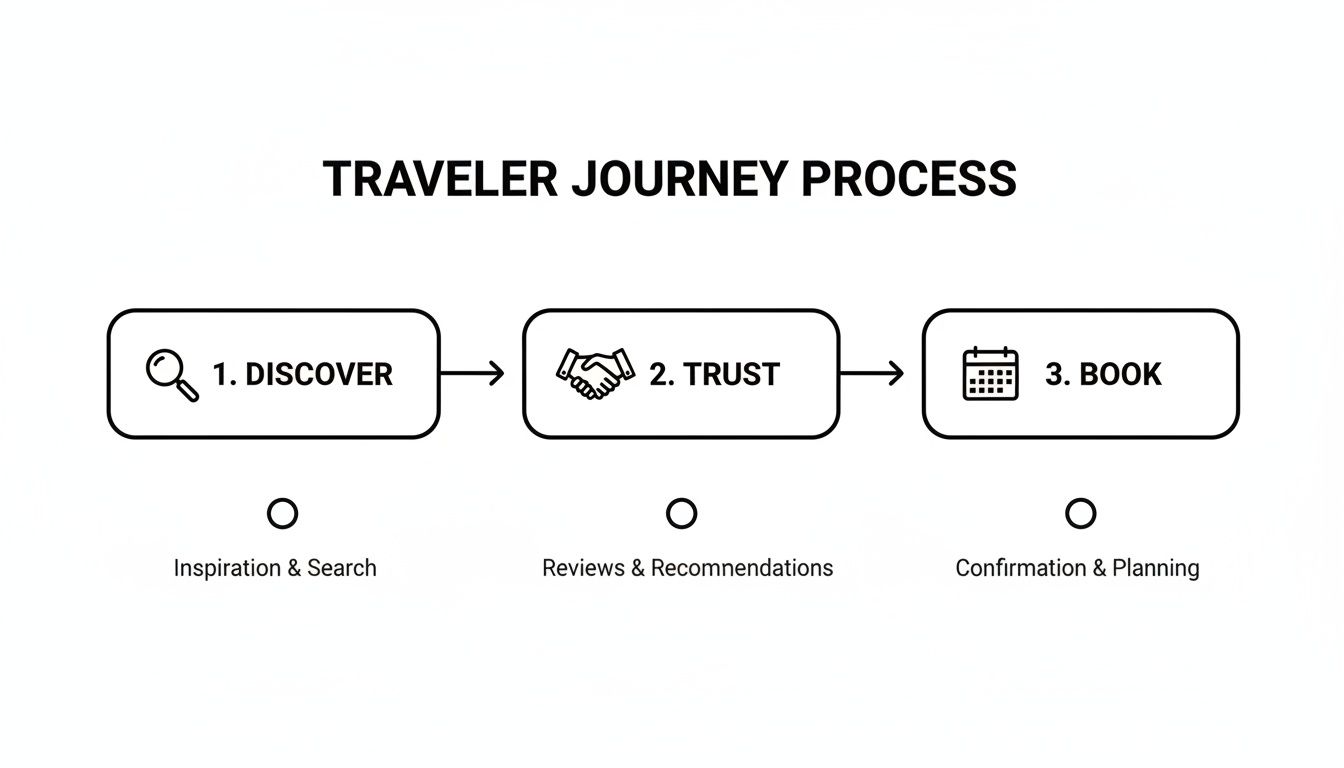
As you can see, trust is the critical bridge between someone knowing your hotel exists and them actually committing to a stay. Without that social proof from a real person, potential guests can get stuck endlessly comparing options.
Aligning Goals with Business Needs
Your campaign goals have to be tied to tangible business outcomes. A campaign to promote a new luxury spa package is going to look very different from one trying to attract families for the summer holidays. The type of creator, the content style, the messaging—it all changes.
For the spa package, you'd want to partner with wellness and lifestyle influencers known for their serene, high-end content. For the family getaway, you'd get much better results working with parent bloggers who create fun, relatable, and sometimes chaotic content that resonates with other parents.
Before you do anything else, ask yourself this one question: "What specific problem are we trying to solve, or what opportunity are we trying to seize?" Your answer is the North Star for your entire strategy.
The trick is to start with your desired result and work backwards.
To drive shoulder-season bookings: You could partner with local or regional travel creators. Task them with showcasing unique weekend getaway ideas and promoting a limited-time offer to their audience.
To increase restaurant footfall: Your best bet is collaborating with local food bloggers and TikTok creators. Get them to produce mouth-watering content about the dining experience itself. Many of the same ideas for scaling restaurant campaigns can be put to work here.
To gather authentic visual assets: Focus on finding creators with a real talent for photography or video. Crucially, you’ll need to make sure your agreement includes the rights to use their content on your website and in your ads.
This focused approach means every pound you spend is actively working towards a measurable goal for your hotel.
Budgeting for Your Campaign Realistically
Once you know what you want to achieve, it’s time to talk money. An influencer budget can be anything from a simple contra deal (a complimentary stay in exchange for content) to a fully-paid collaboration with a hefty fee. There’s no magic number; it all comes down to your goals and the creator’s value.
A complimentary stay is often a fantastic starting point, especially with micro-influencers (5k-50k followers). They're often happy to create content in exchange for a great experience. However, when you start working with larger creators or have more demanding content needs—like multiple videos and broad usage rights for your own ads—you should expect to pay a fee on top of the stay.
Forecasting Potential Returns
You don't need to wait until a campaign is finished to get a sense of its value. Before you even launch, you can forecast the potential ROI by setting clear Key Performance Indicators (KPIs) linked directly to your goals.
For a campaign geared towards direct bookings, the calculation is surprisingly simple.
Here’s a quick example:
Let's say the value of an average two-night stay at your hotel is £500.
You agree to a complimentary stay for the creator, plus a £1,000 fee. Your total investment is £1,500.
To break even on that investment, the campaign only needs to generate three direct bookings.
Framing it this way helps everyone see the collaboration as a strategic investment, not just a marketing expense. By giving each creator a unique discount code or a trackable booking link, you can directly attribute those bookings and see if you hit your forecast. Suddenly, influencer marketing becomes a much more predictable and powerful growth channel.
Finding and Vetting Creators Who Match Your Brand
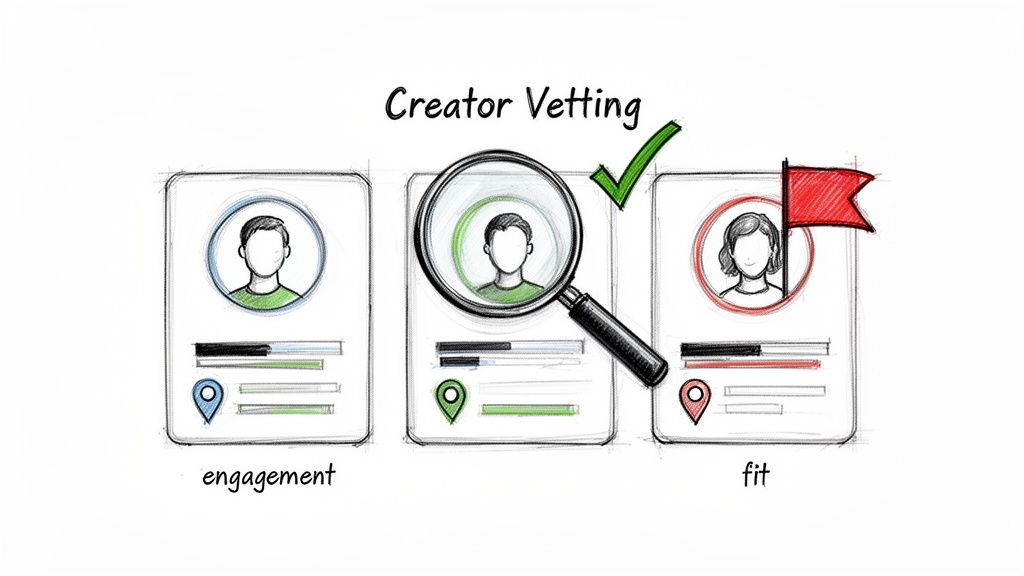
Sourcing the right creator for your hotel isn’t just about scrolling through Instagram. The biggest mistake I see hotels make is getting dazzled by a huge follower count. A creator with a million followers isn't automatically a better fit than one with ten thousand; the real magic happens when you find someone whose audience, style, and values genuinely reflect your ideal guest.
It’s about looking past the surface-level numbers. A high follower count can be a vanity metric. What you should be digging for are the things that actually drive bookings: authentic engagement, the right audience demographics, and a real knack for storytelling. A generic travel influencer might get you some eyeballs, but a creator who specialises in, say, boutique city breaks will bring the right eyeballs for a hotel just like yours.
Defining Your Ideal Creator Profile
Before you even start looking, you need a clear picture of who you're searching for. The perfect creator for a high-end city hotel is worlds apart from the one you’d want for a family-friendly beach resort. Get your team together and outline the characteristics that are non-negotiable for your brand.
For instance, a chic, urban hotel might prioritise creators with a sophisticated, minimalist aesthetic whose followers are into design, food, and culture. On the flip side, a rustic countryside retreat should be looking for creators who champion outdoor adventures, wellness, and cosy getaways, attracting an audience that’s desperate to escape the city grind.
Think about these core attributes:
Aesthetic Alignment: Does their content’s look and feel match your hotel’s brand identity?
Audience Demographics: Are their followers in your target countries and cities? Are they the right age? Do they have the right interests?
Content Niche: Is their specialty relevant? Look for themes like luxury travel, family holidays, foodie adventures, or sustainable tourism.
Looking Beyond Follower Counts
I can't stress this enough: high follower numbers can be incredibly deceptive. A creator with 500k followers but a dismal 0.5% engagement rate offers far less value than a micro-influencer with 15k followers and a healthy 5% engagement rate. That second creator has a genuinely dedicated and responsive community.
You can do the maths yourself. Add up the likes and comments on their last 10-15 posts, divide by the number of posts, then divide by their total followers, and finally multiply by 100. For Instagram, a good engagement rate is usually between 2% and 6%, though this varies by niche. If it's much lower, that’s a potential red flag. We break this down further in our complete guide on micro-influencer marketing for small businesses, which explains why smaller, dedicated audiences often deliver much better results.
Don’t be seduced by a big number. A smaller, highly engaged audience that perfectly matches your target guest profile will always deliver a better return on investment than a huge, disengaged, and irrelevant one.
Spotting the Red Flags
Vetting is also about protecting your brand. You need to filter out creators who are a poor fit or, even worse, could cause reputational damage. As you’re reviewing profiles, keep an eye out for warning signs that tell you to walk away.
Here are a few common red flags I always watch for:
Suspicious Follower Growth: Sudden, massive jumps in followers often mean they’ve been bought. There are free tools online that let you check for unnatural growth patterns.
Generic or Low-Quality Comments: If you see a sea of single-emoji comments or phrases like "Nice!" and "Great pic," it could be a sign of bot activity or just a really unengaged audience.
A Feed Full of #Ads: A creator whose feed is just one sponsored post after another can seem inauthentic. Their audience likely has ad fatigue, which means your message will just get lost in the noise.
Misaligned Past Partnerships: If a creator is pitching themselves as a luxury travel expert but was promoting a fast-fashion brand last week, their brand identity might be too inconsistent to align with your hotel.
Think of this vetting process as your first line of defence. Taking the time to properly research and select creators who are a true brand fit is the foundation of a successful hotel influencer campaign. It’s what leads to authentic content that resonates, builds trust, and ultimately, puts heads in beds.
Your Guide to a Collaboration Brief That Actually Inspires
So, you’ve found a creator who seems like the perfect fit for your hotel. What’s next? It’s time to get down to the details with a collaboration brief. This is where so many partnerships go wrong, but it’s also your biggest opportunity to get it right from the start.
A great brief isn’t a list of commands. It's a conversation starter. It should get a creator genuinely excited to stay with you while also making sure you get the content you need. Think of it as giving them a compass and a destination, not a turn-by-turn satnav. You’re sharing the soul of your hotel, setting the stage for content that feels true to both them and you.
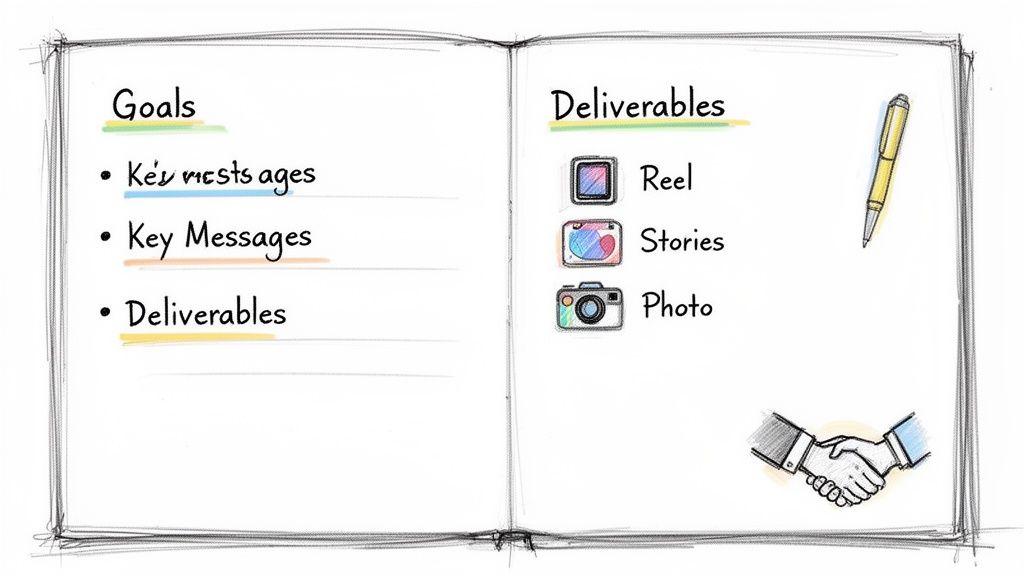
Ultimately, this document is your reference point for the entire project. It’s what you’ll both come back to, preventing those "I thought you meant..." moments and ensuring the final content hits the mark.
The Essential Ingredients of a Great Brief
A vague brief leads to vague content. To avoid confusion, your document needs to clearly outline everything from the big-picture goals to the nitty-gritty deliverables.
Here’s what I always include in mine:
Campaign Mission: What’s the main goal? Be specific. Are you trying to drive bookings for a 2026 summer package, create a buzz around your new spa, or simply get a bank of beautiful user-generated content (UGC)?
Key Talking Points: What absolutely has to be mentioned? List 3-5 things that make your hotel special. This could be your rooftop bar with its panoramic views, your Michelin-recognised restaurant, or your deep commitment to sustainability.
The Deliverables: Spell out exactly what you expect. For instance: "One Instagram Reel (60-90 seconds), three Instagram Stories with a direct booking link, and a gallery of five high-resolution photos we can use on our own channels."
Creative Guardrails (Do's & Don'ts): Offer gentle guidance, not rigid rules. A good example is, "Do try to capture the gorgeous morning light in the suite," but, "Please don't use filters that change the colour of the decor."
The Call-to-Action (CTA): What do you want their audience to do? This might be using a specific promo code for a discount, clicking a trackable link in their bio, or entering a competition.
A brief should be a compass, not a script. Give creators the destination (your campaign goals) and point out the key landmarks (your talking points), but let them find their own way. That freedom is what sparks authentic, truly engaging content.
Getting the Offer and Compensation Right
This is the part that makes many hotel managers nervous, but it doesn’t have to be complicated. The key is to be clear, fair, and upfront about the offer in your very first message or in the brief itself. Compensation in the hotel world can look a few different ways, so you need to figure out what fits your budget and the creator's value.
Here are the most common arrangements I’ve seen work well:
The Contra Deal (Stay-for-Content): This is a straight swap. You provide a complimentary stay, maybe some meals or a spa treatment, and in return, they provide a pre-agreed amount of content. This is a great starting point for working with nano and micro-influencers who are eager to build their portfolios.
The Hybrid Model (Stay + Fee): For creators with bigger, more engaged audiences or when you’re asking for more involved content (like professionally shot video or rights to use their content in ads), a hybrid model is the industry standard. This includes the complimentary stay plus a fee that covers their time, skill, and reach.
Paid Collaboration (Fee-Only): Sometimes you might just need content, not a full stay. For a local creator reviewing your restaurant or a new cocktail menu, for instance, a fee-only project makes the most sense.
Honesty is the best policy when negotiating. Be transparent about the value of the stay you’re offering (room rate, F&B credit, etc.) and be ready to discuss a fee based on the work involved.
Whatever you decide, always, always formalise it in a simple contract. It should cover the deliverables, timeline, payment, and exactly how and where you can use their content. This simple step protects both you and the creator, ensuring everything runs smoothly from check-in to check-out.
How to Measure and Prove Your Campaign ROI
So, the campaign's running, the content looks fantastic, and the likes are pouring in. That’s great, but it’s not the full story. The question every hotelier or marketing manager eventually has to answer is: did it actually work? To truly understand the value of your influencer campaigns, you have to look past the vanity metrics and connect the dots directly to your bottom line.
Our goal here isn't just to see 'engagement'; it's to track real, tangible actions like website clicks, direct bookings, and even restaurant reservations. When you set up proper tracking from the very beginning, influencer marketing stops being a perceived cost and becomes a predictable, measurable growth engine for your hotel.
Tracking Bookings with Unique Promo Codes
The most straightforward way to attribute revenue has always been the humble promo code. It’s simple, direct, and incredibly effective.
When you partner with a creator, give them their own unique discount code. For instance, if you're working with a travel creator named Sophie, you could generate the code SOPHIE15. Her followers get 15% off their stay, and every time that code is used, your booking system automatically credits her with the sale. There's no ambiguity.
Pro Tip: Don't just limit codes to room bookings. If a key objective is boosting your F&B revenue, create a separate code for the influencer to share. Something that gives their followers a complimentary dessert or 10% off their bill at your on-site restaurant can work wonders.
This gives you undeniable proof of how much money the campaign made. You can tally up the exact revenue generated from each creator's code, subtract your costs, and calculate a precise ROI. To really get into the nitty-gritty of the numbers, this practical guide to Social Media ROI is an excellent resource for tracking financial impact.
Measuring Clicks and Conversions with UTM Parameters
Promo codes are perfect for tracking direct bookings, but what about the digital journey? How do you track the people who clicked a link but maybe didn't book right away? This is where UTM parameters come in—they're your secret weapon for understanding online behaviour.
A UTM (Urchin Tracking Module) is just a snippet of text added to the end of a URL. It might sound technical, but it’s surprisingly simple. This code tells your analytics platform, like Google Analytics, exactly where that website visitor came from.
You can create these tracked links for free using Google’s Campaign URL Builder.
Let's build one for Sophie's campaign:
Website URL:
https://yourhotel.com/special-offerCampaign Source:
instagram(the platform where the link is)Campaign Medium:
influencer(the type of marketing)Campaign Name:
sophie_collaboration(to identify the specific creator)
The tool will then generate a link that looks something like this: https://yourhotel.com/special-offer?utm_source=instagram&utm_medium=influencer&utm_name=sophie_collaboration
When Sophie shares this link in her bio or a Story, every single click is recorded. You can then hop into Google Analytics and see precisely how many people she sent to your site and, more importantly, what they did once they got there—including how many completed a booking. You get a clear picture of the entire customer journey. This level of detail is a cornerstone of a solid strategy, which we explore further in our guide on how to measure influencer marketing ROI.
Key Metrics for Hotel Influencer Campaigns
To paint a complete picture of your campaign's success, you need to look at a combination of metrics. Some tell you about brand awareness, while others point directly to revenue. Here’s a breakdown of what you should be tracking.
Metric Category | Specific Metric | What It Measures | How to Track It |
|---|---|---|---|
Direct Revenue | Promo Code Usage | The number of direct bookings or sales attributed to an influencer. | Your hotel's booking system or POS. |
Website Traffic & Behaviour | Clicks from UTM Links | The volume of traffic driven to your website from a specific link. | Google Analytics (Acquisition > Campaigns). |
Website Traffic & Behaviour | On-site Conversions | The number of visitors from a UTM link who completed a goal (e.g., booking). | Google Analytics (Goals or eCommerce tracking). |
Audience Engagement | Likes, Comments, Shares, Saves | The level of audience interaction with the influencer's content. | Instagram Insights, TikTok Analytics, or your influencer platform. |
Brand Awareness | Reach & Impressions | The total number of unique people who saw the content and total views. | Instagram Insights, TikTok Analytics, or your influencer platform. |
Content Value | Earned Media Value (EMV) | An estimated monetary value of the exposure gained from the content. | Calculated using industry benchmarks or influencer marketing platforms. |
By tracking these key metrics, you move beyond guesswork and start making data-driven decisions for your future campaigns.
By combining unique promo codes with UTM-tagged links, you create a powerful, dual-layered tracking system. This approach lets you measure every important action, attribute revenue with confidence, and ultimately prove the real value of your influencer marketing efforts to anyone who asks. You're no longer guessing—you're measuring.
Common Questions About Hotel Influencer Marketing
Getting started with creator partnerships always brings up a few key questions. I've seen hospitality managers run into the same hurdles time and again, from sorting out budgets to making sure the content actually reflects their brand.
Let's clear the air and tackle some of the most frequent queries I hear from hotels.
How Much Should I Pay an Influencer for a Hotel Stay?
There's no single rate card for this, unfortunately. The right compensation is always a mix of a few things: the creator's audience size, their typical engagement, what you’re actually asking them to create (the deliverables), and how you want to use that content later on (the usage rights).
For many collaborations, especially with nano-influencers (1k-10k followers) and some micro-influencers (10k-50k followers), a complimentary stay is a perfectly fair exchange for an agreed-upon set of posts. This is often called a "contra" or "in-kind" deal, and it’s a great starting point.
That said, the moment you start working with creators who have larger, more dedicated followings, or when your content needs are more demanding—like asking for high-resolution videos you can use in paid ads—a fee on top of the stay becomes the norm. My best advice? Figure out your budget and the real-world value of the stay first. This gives you a firm baseline for negotiating a package that feels fair to everyone.
What’s Better: A Macro-Influencer or Several Micro-Influencers?
This really depends on what you're trying to achieve. Think about your main goal.
If you're a brand-new hotel and your goal is massive, top-of-funnel awareness, a single macro-influencer (100k+ followers) can be a powerful move. They offer huge reach, getting your name in front of hundreds of thousands of people almost instantly. It's about making a big splash.
On the other hand, if your goal is to drive actual bookings, a small army of micro-influencers almost always delivers a better return. These creators have smaller, more niche communities that genuinely trust their recommendations. Their engagement rates are often significantly higher. For a hotel looking to attract guests from a specific city or those interested in wellness retreats, a handful of carefully selected local micro-influencers will be far more effective—and more cost-efficient—than one big-name post.
The rule of thumb I always follow is this: use macro-influencers for reach, and micro-influencers for resonance. If you want to drive direct, measurable action, a targeted micro-influencer strategy is the smarter investment.
How Do I Ensure the Content Aligns with My Hotel’s Brand?
Getting the right content comes down to two things: doing your homework before you ever reach out, and providing a crystal-clear creative brief after you’ve partnered up.
Before you even think about sending a message, you need to become a bit of a detective. Go deep into a creator’s feed. Look past the polished photos and analyse their aesthetic, the voice in their captions, and the values they seem to live by. Do their previous brand deals feel genuine? Does their style match the experience you offer your guests?
Once you've found someone who feels like a great fit, the creative brief is your most important document. This is where you set the guardrails. Be firm on your key messages and brand voice, but—and this is crucial—leave them enough creative freedom to make the content their own. Finding that balance is what makes a collaboration feel authentic to their audience while still hitting all the right notes for your hotel.
Can I Reuse an Influencer’s Content on My Own Channels?
You can only reuse a creator's content if you have their explicit permission in writing. This is a non-negotiable, and it needs to be clearly defined in your collaboration agreement. Never assume you have the right to use their photos and videos.
Your contract has to spell out exactly where, how, and for how long you can use their work. Don't be vague.
Organic Social Media: "Rights to repurpose content on the hotel's owned Instagram and TikTok channels for a period of one year."
Paid Advertising: "Rights to use specified photos in digital ad campaigns on Meta platforms for six months."
Website Usage: "Permission to feature the video on the hotel's main website homepage for the duration of the campaign."
Thinking you can just grab their content without a formal agreement is a fast track to legal headaches and can seriously damage your reputation in the creator community. Always get it in writing. It protects both you and the influencer. Plus, to see what’s truly working, you have to effectively measure marketing ROI from every piece of content you use.
Ready to turn influencer marketing from a time-consuming task into a repeatable growth channel? Sup combines AI and a human team to help you find verified creators, launch campaigns in minutes, and track ROI from a single dashboard.
Discover how Sup can scale your creator collaborations today.

Matt Greenwell
Share