If you run marketing for a restaurant franchise, you’ve probably lived this already. One location gets a brilliant local creator partnership, the posts look great, the comments fill up with people tagging friends, and the manager swears they can feel the lift in-store. Then another site copies the same approach and gets almost nothing.
That’s usually the moment teams realise they don’t have an influencer strategy. They have a collection of one-off collaborations, scattered DMs, inconsistent briefs, no clean rights to the content, and no shared view of what worked.
Influencer Marketing for Restaurant Franchises works when it’s treated like an operating system, not a social media tactic. The hard part isn’t finding people who can post a Reel. The hard part is building a repeatable model that local managers can use without breaking brand standards, finance processes, or legal safeguards.
Why Generic Influencer Advice Fails for Franchises
Single-site restaurant advice breaks down fast in a franchise environment. A local independent can make decisions in one room. The owner picks a creator, agrees a comped meal or fee, approves the content, and posts a repost later that week. It’s messy, but manageable.
A franchise network doesn’t get that luxury. You’re balancing head office priorities, franchisee expectations, local trading realities, brand consistency, approvals, payments, and attribution across multiple postcodes at once.
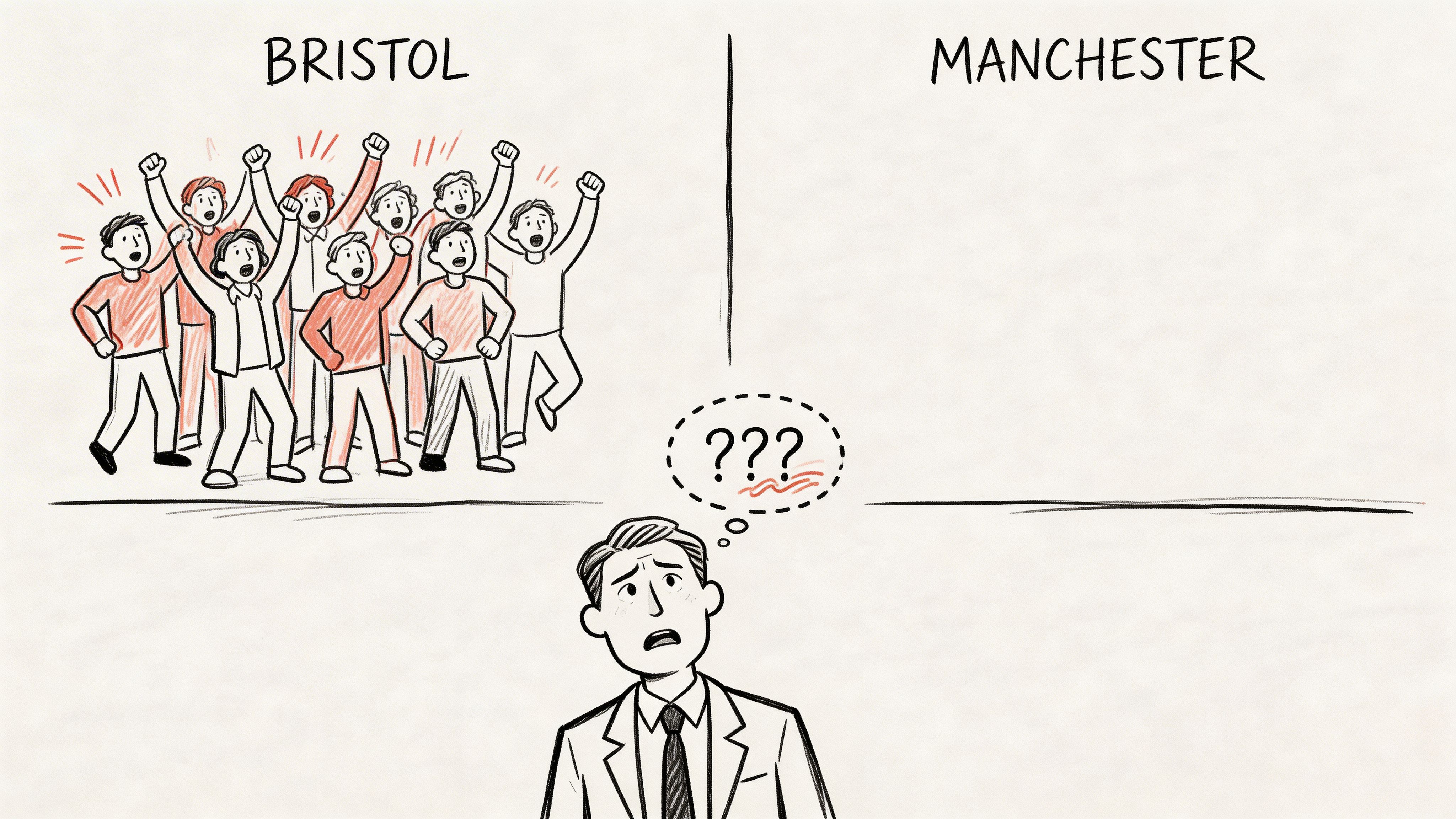
The biggest misconception is that you can scale by doing more creator deals. You can’t. Volume without process just creates wider inconsistency.
According to 5WPR’s discussion of restaurant influencers and footfall, existing content usually focuses on individual restaurant influencer strategies and rarely addresses the operational complexity of coordinating campaigns across multiple franchise locations simultaneously. That gap matters because the core franchise question isn’t “should we use influencers?” It’s how local managers can activate fresh creators without diluting brand messaging or creating administrative drag.
The franchise problem isn’t creativity
Most failed franchise campaigns don’t fail because the content was ugly. They fail because the operating model was weak.
Common examples look like this:
Local mismatch: Head office approves a creator with broad lifestyle content, but their audience isn’t concentrated near the location.
Approval sprawl: A manager, regional lead, social team, and legal reviewer all want changes, so the post goes live too late.
No attribution path: The creator posts, engagement looks healthy, but nobody can connect it to bookings, orders, or in-store redemption.
Payment confusion: One site offers product only, another pays cash, another never sends terms at all.
Franchises need a central engine with local levers
The right model is centralised where it must be and localised where it should be.
Head office should control the parts that create risk or inconsistency. Brand guardrails, contract terms, reporting logic, tracking structure, and approved campaign types belong at the centre. Local teams should control creator selection from an approved process, scheduling around store priorities, and market-specific nuances like menu focus or community events.
Practical rule: If a step affects brand risk, legal rights, or reporting consistency, centralise it. If a step affects local relevance, give the location controlled freedom.
That’s the shift many teams miss. Franchise influencer marketing isn’t just local social with extra admin. It’s a distributed growth channel that needs the same discipline you’d apply to paid media, CRM, or field marketing.
Developing Your Centralised Influencer Strategy
A franchisee in Leeds wants to push weekday lunch. Another in Bristol needs content for a new opening. A third wants to trial family bundles during half term. If each location briefs creators its own way, the programme turns into three different channels with three different standards, and head office cannot compare results.
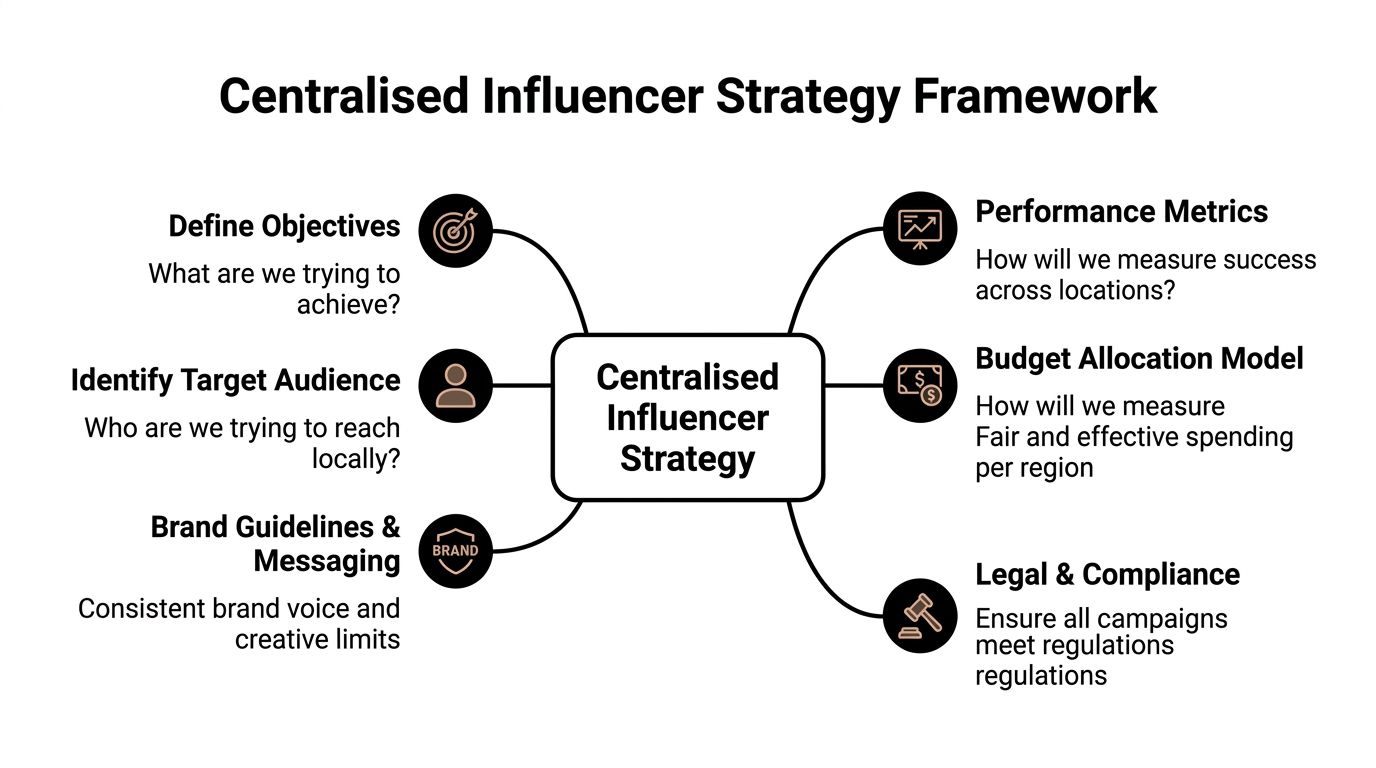
Set the operating model first. Define what every location can request, what the centre approves, how campaigns are tracked, and which rules apply everywhere.
Build one programme with fixed campaign formats
The strongest franchise setups use a central programme with a short list of approved campaign formats. I usually start with four to six. New store launch, menu push, off-peak traffic, family occasion, delivery focus, and local review generation cover most needs without creating admin bloat.
That matters because campaign standardisation does two jobs at once. It keeps the brand consistent, and it gives franchisees a practical menu instead of a blank page.
Each format should come with preset rules:
Area | What must be defined centrally |
|---|---|
Campaign purpose | The business outcome the campaign is meant to drive |
Location fit | Which stores should use that format, and when |
Brand controls | Visual rules, offer rules, and message boundaries |
Tracking method | How links, codes, and in-store redemptions are logged |
Approval route | Who signs off, in which order, and within what timeframe |
Payment logic | How fees, gifting, reimbursements, and tax records are handled |
This is the difference between a programme and a collection of one-off posts.
Set the KPI before outreach
If the location cannot name the conversion event, it is not ready to brief a creator.
I push every franchisee to choose one primary outcome before any outreach starts. That might be a booking, a tracked order, an app download, a code redemption, or a measurable lift in review volume tied to a specific store initiative. Awareness can support that goal, but it cannot replace it.
A usable KPI structure looks like this:
Primary KPI: The conversion event the store cares about
Secondary indicators: Reach, clicks, saves, comments, and content quality
Operational indicators: Time to approve, posting accuracy, rights delivery, and reporting completeness
Operational metrics matter more than many teams expect. If content arrives late, usage rights are missing, or codes are built inconsistently, the campaign can look healthy on social and still fail at store level.
Write guardrails that people will use
Franchise teams do not need a long strategy deck. They need a working document with clear rules and examples.
The core creator brief should stay the same across the network. Keep it short enough for a busy franchisee to use and specific enough for legal and brand teams to trust. In practice, that means one approved brief template with fixed sections for disclosure, prohibited claims, promotion mechanics, visual standards, review timelines, and escalation triggers.
I have seen the opposite approach many times. Head office writes a polished PDF, local teams ignore half of it, and creators fill the gaps with their own assumptions. That is how you end up with unapproved discounts, missing ad disclosures, and posts that feature the wrong menu items.
A short brief with mandatory fields works better than a polished document nobody follows.
Give franchisees an SOP, not extra admin
Adoption usually rises when local teams can follow a simple request flow in under ten minutes. It drops when the programme feels like a central marketing exercise disguised as support.
The central team should provide the assets that remove decision fatigue:
Campaign request form
Standard creator brief template
Shortlist review template
Approval checklist
Store-level reporting view
Usage rights log
Payment and invoice process
For teams that are still defining local discovery criteria, this guide on how to find local food influencers in your city is a useful reference point for setting sourcing standards before outreach begins.
The tool stack can vary. Some teams use GA4, shared drive structures, rights-tracking sheets, and creator vetting tools. Some add Sup as a managed workflow layer for creator sourcing, communications, promo code setup, and central reporting. The exact software matters less than one operating rule. Keep one system of record for briefs, approvals, payments, and results.
If that information lives across inboxes, WhatsApp threads, and local spreadsheets, scale breaks fast.
Building Your Hyper-Local Creator Sourcing Engine
Friday lunch is flat at a Manchester store, even though a creator post went live the night before. The content looks good. The comments are positive. The problem shows up in the audit. Half the audience lives outside the catchment area, the offer was never likely to drive an in-store visit, and the local franchisee now thinks influencer marketing does not work.
That failure usually starts in sourcing.
What a strong local sourcing workflow looks like
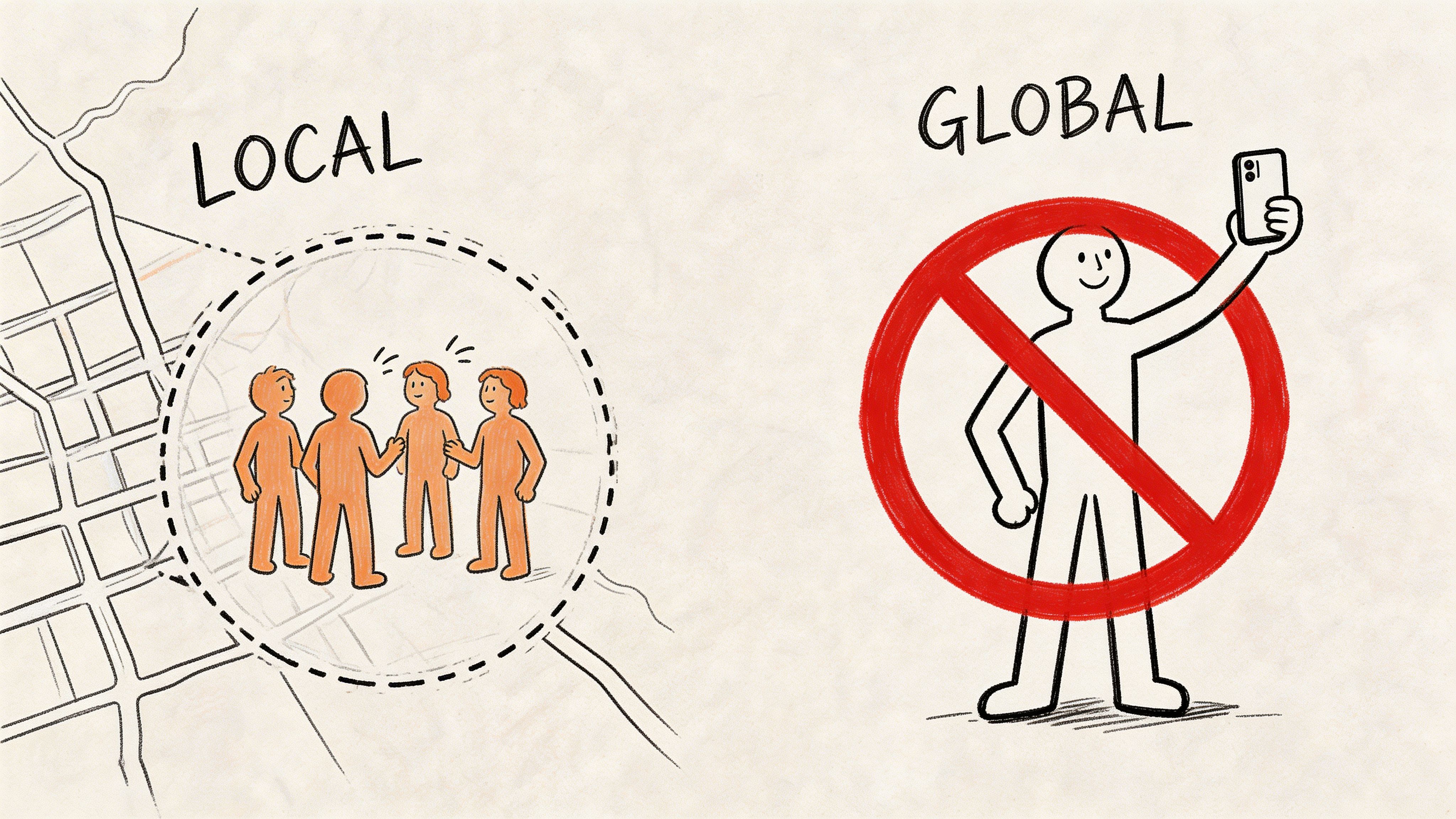
Franchise sourcing needs to work at two levels at once. Head office sets the qualification rules, naming conventions, and approval thresholds. Local markets supply the context, including neighbourhood habits, commuter patterns, school-run traffic, student demand, and the venues creators already cover.
Follower count is a weak starting point on its own. Geography, posting behaviour, and local credibility matter more. I would rather see a smaller creator with consistent coverage of the exact trade area than a larger account with broad regional reach and little evidence they influence where the store trades.
A workable sourcing workflow usually looks like this:
Define the store catchment Set a practical radius around the location, then adjust for real trading patterns. City-centre lunch, suburban family dining, and travel-hub stores all need different sourcing logic.
Search by local signals Review town and neighbourhood hashtags, nearby venue tags, local event posts, campus content, parent networks, and community Facebook or Instagram activity.
Build a first-pass list Include creators across dining, value-focused food content, family activities, student life, local lifestyle, and community event coverage if those audiences match the store.
Verify local audience fit Request audience location screenshots or pull data from your vetting tool. If the creator cannot show meaningful concentration near the target store, they do not move forward.
Score against a shared rubric Use the same scoring fields across every franchise location so shortlists stay comparable and central review stays fast.
For teams building that manual process for the first time, this guide on finding local food influencers in your city is a useful reference for search patterns and discovery sources.
Vet creators like an operator
Good content is only one line on the scorecard. Franchise teams need a repeatable review standard that filters out creators who look promising in-feed but create friction in execution.
A practical vetting checklist should cover:
Audience locality: Is there clear concentration in the store's trade area?
Content history: Do they visit and talk about real local places, or mostly repost trends?
Engagement quality: Do comments show local intent, questions, and recognisable place references?
Brand fit: Would this creator be safe for every franchisee to see attached to the brand?
Execution reliability: Have they handled previous paid or hosted work properly, including deadlines, tagging, and disclosure?
Offer fit: Can they sell the occasion the store needs, such as breakfast, lunch, family dinner, or new opening traffic?
In practice, the strongest sourcing engines filter before outreach. That saves legal review time, store manager time, and payment clean-up later.
Build a bench by location, then maintain it centrally
Sourcing from scratch for every campaign is expensive; staff time represents the primary cost. Central teams end up repeating searches. Franchisees submit duplicate names. No one remembers which creator asked for cash only, which one delivered late, or which one produced content the brand could reuse.
The fix is a living creator bench for every store or cluster.
For each location, keep three lists:
List | Purpose |
|---|---|
Ready now | Vetted creators who fit active briefs and can be contacted immediately |
Watchlist | Creators with local relevance who need more review, better audience proof, or another few weeks of observation |
Past partners | Previously activated creators with notes on performance, reliability, disclosure compliance, and content rights status |
The database matters less than the fields inside it. Store code, city, catchment area, cuisine fit, audience geography, content style, response speed, fee range, disclosure history, and rights status are the fields that make the system useful.
A creator bench becomes more valuable after each campaign if the team logs judgement, not just contact details. That is how a franchise programme gets faster without getting sloppy.
Executing Scalable Campaigns From a Central Playbook
A franchise campaign usually breaks at the same point. Head office approves the idea, one store sends a vague DM, another promises a different offer, a third forgets the code setup, and by the end of the week no one can compare results across locations.
That is not a creative problem. It is an operating system problem.
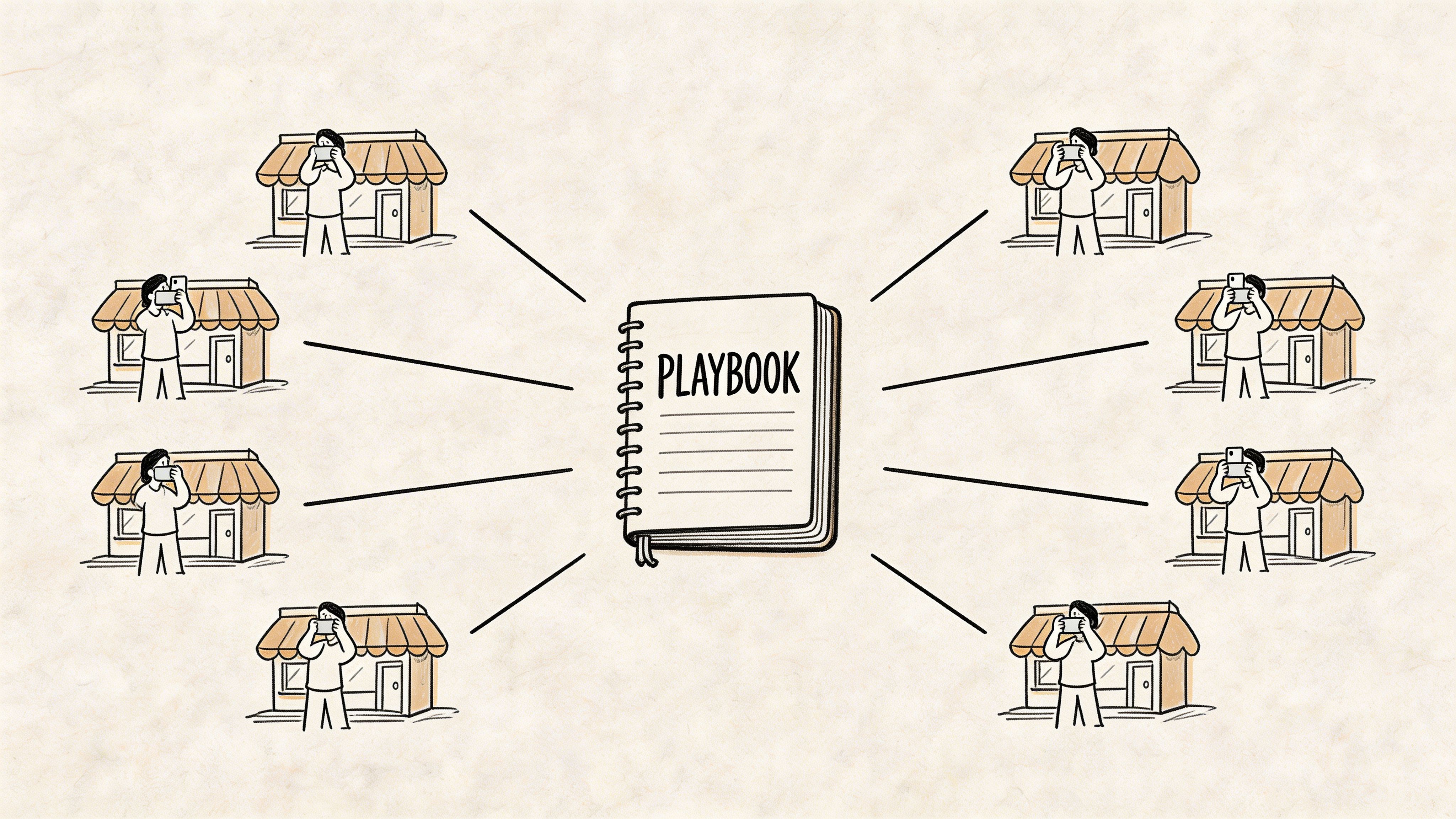
The fix is a central playbook that controls the parts that should stay consistent, while leaving limited room for local adaptation. Store hours, featured menu items, and opening dates can change by branch. Offer structure, briefing format, approval paths, disclosure rules, and tracking conventions should not.
Build the campaign package before anyone contacts a creator
Outreach should start only after the team has a pre-approved package in the shared drive or campaign tool. If creators get different instructions from different stores, execution slows down, legal review gets messy, and reporting loses consistency.
A usable package includes five parts:
Offer structure: what the creator receives, what the audience receives, and which costs the brand will not cover
Deliverables: format, posting window, required tags, talking points, and any banned claims
Tracking setup: creator-level UTM links, branch-specific promo codes, booking or ordering links, and redemption dates
Approval rules: who reviews drafts, what can go live without review, and how long approvals take
Usage terms summary: a short rights note that matches the full contract language
I keep this package modular. The campaign objective stays fixed, but each location gets a version with its own address, booking link, menu priority, blackout dates, and code prefix. That saves time without letting stores improvise the wrong things.
Use one launch sequence every time
Scalable campaigns need a repeatable order of operations. The sequence matters because every shortcut creates cleanup work later.
A practical rollout looks like this:
1. Open the location brief
The local or regional owner selects the campaign type and confirms the commercial goal. New store launch, weekday lunch traffic, family bundle push, delivery support, and review generation need different creator instructions and different proof of success.
2. Pull from the approved bench
Use the creators already vetted for that branch or cluster. Fresh sourcing has its place, but it should be the exception during execution, not the default every time a store wants content next week.
3. Send structured outreach
Good outreach is short, specific, and easy to answer. The first message should confirm the branch, the offer, the expected deliverables, and the next step. Long brand introductions slow replies and create more questions than they answer.
A working outreach message usually covers:
Why this creator fits: one local reference or a relevant content example
Which branch is involved: exact location, not just the brand name
What the creator gets: fee, hosted meal, guest allowance, or product package
What the brand needs: Reel, Stories, posting window, and booking details
What happens next: reply, booking form, or link to the brief
The full brief should come after the creator shows interest, along with the contract and disclosure requirements. Teams that want a cleaner process can base their paperwork on a standard guide to influencer contracts and agreements and then tailor it to franchise approvals, usage rights, and local legal review.
4. Assign tracking before content is scheduled
Tracking has to be live before the creator books, films, or posts. If the code gets created after a post performs well, that campaign becomes anecdotal instead of measurable.
Set up:
Unique UTM links: named by creator, branch, campaign, and date
Location-specific codes: tied to one store, not the full network
Landing pages or booking URLs: used only if the customer journey needs them. Central teams protect data quality here. A shared naming convention sounds boring until ten stores run creator activity in the same month and finance asks which branch funded which result.
Run approvals with one owner per stage
Approval chains drift when three people review the same draft from different angles. One person asks for a new hook. Another changes the offer language. A store manager then adds a menu item that is out of stock by launch day.
A cleaner model gives each stage one decision-maker.
Stage | Owner | Decision |
|---|---|---|
Brief release | Central marketing | Final campaign rules and approved assets |
Creator confirmation | Local or regional lead | Fit for branch, timing, and in-store experience |
Draft review | Brand or social lead | Message accuracy, disclosure, and brand safety |
Go-live check | Campaign coordinator | Links, codes, tags, and post timing |
Performance review | Central reporting owner | Continue, adjust, or stop |
That structure does two things. It speeds up production, and it leaves an audit trail when a franchisee asks why a post was delayed or why a creator was not rebooked.
Treat execution like production, not social admin
Once campaigns run across multiple locations each week, the work starts to resemble light media operations. Deadlines, file naming, rights status, disclosures, invoices, and branch-level reporting all need the same discipline. A central tracker should show campaign status at a glance: contacted, negotiating, contracted, booked, draft received, approved, posted, paid, and reported.
This is also the point where legal and liability details stop being background admin. If a creator posts without proper disclosure, uses unapproved claims, or assumes the brand can reuse the content anywhere, the problem spreads beyond one store. The framework in Influencer Marketing Contracts: Disclosure & Liability is a useful reference for tightening those obligations before campaigns scale.
The goal is not rigid control for its own sake. The goal is repeatable execution that lets head office compare branch performance, keeps franchisees inside brand rules, and gives strong local creators a better experience every time they work with the brand.
The Legal and Content Rights Playbook for Franchises
Many franchise teams treat contracts like cleanup work. They sort them out after the creator agrees, after the content looks promising, or after someone asks if the video can be used in ads.
That order creates risk. Legal structure has to exist before the first deliverable is posted.
The core issue is straightforward. As noted in Mustard’s write-up on restaurant influencer marketing challenges, many restaurants skip contracts entirely, which leads to inconsistent posting and unclear rights to content. In traditional arrangements, the influencer usually owns the content unless the agreement says otherwise. If your franchise wants to repurpose a strong Reel for paid media, your website, in-store screens, or another location’s feed, you need that permission spelled out.
Casual agreements don’t scale in a franchise network
A single-location restaurant can sometimes muddle through on informal arrangements. A franchise network can’t.
You need legal consistency because multiple teams may touch the same creator asset:
local managers
regional marketers
paid social teams
agencies
franchise development teams
customer service or community teams
Without a proper agreement, everyone assumes they can use the content. Then someone discovers the rights only covered one organic post on the creator’s own account.
That’s not a minor admin issue. It affects ad usage, content longevity, platform reposting, and dispute handling.
The contract clauses that matter most
You don’t need a bloated document. You need a clear one.
Every franchise influencer agreement should address:
Deliverables: Exact content format, platform, timing, and tagging requirements
Usage rights: Where the franchise can reuse the content, for how long, and in what formats
Ownership and licence terms: Whether rights are assigned or licensed, and whether reuse is exclusive or non-exclusive
Disclosure obligations: The creator’s responsibility to identify sponsored content properly
Approval and revision terms: Who can request edits and how many rounds apply
Exclusivity: Category or local competitor restrictions where needed
Payment terms: Fee, reimbursement, gifting, timing, and invoice requirements
Removal and breach terms: What happens if content breaches rules or must be taken down
If you want a practical legal reference point, Influencer Marketing Contracts: Disclosure & Liability gives a useful overview of the clauses that protect both brand and creator when compliance and liability are in play.
Build a rights library, not a folder dump
The content itself needs an operating system too.
A central content library should track more than files. It should store the permission status tied to each asset so no one republishes something they don’t have rights to use.
A useful library structure includes:
Field | Why it matters |
|---|---|
Creator name | Identifies the original contracting party |
Location | Shows which branch commissioned the work |
Asset type | Reel, Story frame, still image, testimonial clip |
Rights status | Organic only, paid usage allowed, network reuse allowed |
Expiry date | Prevents reuse beyond agreed term |
Approval record | Confirms what version was cleared |
Contract reference | Links the asset to the signed agreement |
For teams building these documents from scratch, this internal resource on the complete guide to influencer contracts and agreements is a sensible starting point for operationalising the process.
Strong content rights discipline doesn’t slow a programme down. It lets you reuse winning assets confidently instead of asking for permission after the campaign is over.
Measuring True ROI and Scaling Your Programme
A franchisee calls after a creator visit and says the campaign “went well.” The reel pulled strong views, comments looked positive, and staff noticed a busier lunch than usual. Head office still cannot answer the only question that matters. Which location made money, from which creator, under which offer, and at what cost?
That gap is where franchise influencer programmes stall.
Franchise reporting fails when head office accepts social screenshots as proof of performance. Views and engagement help explain why a post travelled. They do not tell an operations director whether Store 14 should repeat the campaign next month, whether Manchester outperformed Leeds because of the creator or the offer, or whether one branch manager created redemption friction at the till.
The fix is simple in principle and demanding in practice. Track each creator as a distinct acquisition source, then force every location to report through the same structure.
Each collaboration needs four identifiers from day one:
A unique promo code tied to the creator and branch
A unique UTM link for bookings, menu visits, or online orders
A location ID that matches your franchise reporting structure
A campaign ID that groups the activation by offer, period, and objective
Without those fields, scale creates noise.
With them, influencer activity starts to behave like any other local media channel. A branch can compare one creator against another, one offer against another, and one market against the network average. That changes the internal conversation fast. Franchisees stop arguing about whether they “liked” the content and start asking better questions about redemption rate, average order value, and repeatability.
A usable dashboard does not need to be complicated. It needs to be consistent.
Metric | Why it matters |
|---|---|
Spend by creator | Shows the true cost of each activation |
UTM clicks | Indicates traffic and purchase intent |
Code redemptions | Connects content to in-store or online action |
Orders or bookings | Ties the campaign to a commercial event |
Attributed revenue | Lets finance review return by location |
Content delivered | Confirms the creator met the brief |
For teams tightening their measurement model, How To Measure Influencer Marketing ROI is a useful external reference. This internal guide on influencer marketing ROI and how to measure what works is helpful when you need to turn creator performance into reporting that franchisees and finance teams will both accept.
What good scaling looks like
Scaling a franchise programme means reducing variation where it hurts and allowing variation where it helps. Head office should standardise tracking, offer logic, reporting rules, creator briefing, and review cadence. Local markets should still have room to choose timing, audience fit, and store-level activation details.
The rollout model that holds up best is wave-based.
Start with a pilot group of locations that reflect real operating conditions. Include one stronger market, one average market, and one location with known execution issues. If the programme only works in your easiest stores, it is not ready for the network. I learned this the hard way. Our first pilot looked excellent until we expanded into branches with weaker manager follow-through and inconsistent code redemption at POS. The problem was not creator quality. The operating discipline at store level was uneven.
After the pilot, freeze the variables that drove results consistently. In practice, those are usually creator type, lead time, offer structure, visit windows, and tracking setup. Caption tweaks matter far less than operators assume.
Then expand in controlled waves:
Add locations with trained managers and stable reporting first
Keep creator packages standard so results stay comparable
Review branch performance monthly, not only at campaign end
Pause underperforming formats quickly and document why they missed
One rule is worth keeping in writing. Do not scale a format that cannot be audited. If the dashboard cannot show which creator drove which redemptions for which branch, the programme is still in test mode.
Measure business outcomes that operators trust
The strongest franchise teams review influencer campaigns the same way they review local paid media. They look at return by branch, offer performance, operational friction, and whether the content can be reused across the network under the rights already cleared.
That last point matters more at scale than it does in a single-site restaurant. A creator asset that performs well in one market can reduce production costs across the system if usage rights, expiry dates, and approval records are in place. A creator post that drives footfall but breaks reporting discipline is less valuable than a slightly weaker performer that can be measured, repeated, and reused.
As noted earlier, industry guidance often points to promo code and UTM combinations because they create a practical attribution baseline for restaurant campaigns. For franchises, that baseline is only the start. The primary gain comes from turning every campaign into a repeatable operating model that finance, field ops, and franchisees can all work from.
Answering Key Franchise Influencer Questions
The sticking points are operational. Once teams accept that influencer marketing can work, they start asking about ownership, local control, admin burden, and who pays for what.
Here’s a practical FAQ to keep decisions moving.
Question | Answer |
|---|---|
Who should own the influencer programme? | Head office should own policy, templates, contracts, tracking rules, and reporting. Local teams should own market context, timing, and on-the-ground coordination within those rules. |
Should franchisees choose creators themselves? | They can, but only from a structured sourcing and vetting process. Uncontrolled local selection usually creates brand inconsistency and uneven quality. |
What’s the right creator size for local footfall? | Hyper-local micro and nano creators are usually the better fit for branch-level activation because locality matters more than broad reach. |
How many deliverables should a standard brief include? | Keep the baseline package simple and repeatable. Too many deliverables slow approvals and reduce creator enthusiasm. |
Should we pay cash, offer gifting, or both? | Use one network policy. Mixed models across locations create resentment and messy precedent. Some creators suit paid campaigns, others fit hosted visits. The important part is consistency. |
How do we get franchisee buy-in? | Show branch-level reporting, not social screenshots. Operators care about covers, orders, redemptions, and reviews. |
What tool matters most? | The tool matters less than the system. You need one place to manage creator records, briefs, approvals, rights, payments, and attribution. |
How often should we refresh creators? | Regularly. Local audiences fatigue quickly when the same faces post the same offer. Keep an active bench in every market. |
What causes the most friction? | Delayed approvals, unclear compensation, weak local fit, and missing rights language. Those four issues create most avoidable failures. |
Can one strong campaign be reused across the network? | The process can. The creative can sometimes be repurposed if the agreement allows it. The audience targeting and offer still need local adaptation. |
A final operational note. The best franchise programmes don’t ask local teams to become influencer marketers. They give them a system that removes the guesswork. That’s the difference between a campaign channel people trust and one they stop using.
If you’re building a multi-location creator programme and want a more operational setup than ad hoc DMs and spreadsheets, Sup is built for that done-with-you model. It helps restaurant groups and franchise teams source local creators, launch campaigns with tracking in place, manage communications, and keep attribution and content rights organised in one workflow.

Matt Greenwell
Share