You’re trading in a place where decisions happen fast. Someone walks past, looks at three stalls, checks Instagram, sees a mate’s Story, and joins one queue.
That shift matters more for street food than for most businesses. You don’t always have a fixed address, a booking system, or a week to warm people up. You have a few trading hours, a changing pitch, and a short window to turn attention into orders.
That is why Influencer Marketing for Street Food and Market Traders works when it is done properly. Not polished. Not expensive. Properly.
For a market trader, the best creator campaign is rarely about broad reach. It is about getting the right local person to post the right food, at the right time, with a clear reason to visit today. If you can also track who came because of that post, you stop treating marketing like luck.
Why Your Street Food Stall Needs Influencers Now
A slow lunch service can turn on a single local post.
One creator films your loaded fries, tags the market, adds a quick verdict, and suddenly people nearby know two things. First, what you sell. Second, that it is worth walking over for now, not next month.
That is the core change. Word of mouth still drives street food sales. It just travels through TikTok and Instagram first.
Local creators now shape local food decisions
The strongest signal here is not hype from global celebrity accounts. It is that mainstream hospitality has already moved budget in this direction.
In 2024, 80% of UK hospitality brands maintained or increased influencer budgets by an average 11%, and 73% preferred micro and mid-tier creators because of their engagement-to-cost ratio, according to Later’s 2025 research reported by PR Newswire. That matters because street food traders live or die on local relevance, not vanity reach.
A person with a loyal audience in Bristol, Manchester, Camden or Edinburgh can do more for a trader than a huge account whose followers are scattered everywhere.
Why this matters more for traders than fixed venues
A restaurant can lean on location pages, bookings, Google reviews, and repeat weekday trade.
A pop-up trader often cannot.
You might be in one market this week and another one next week. You may depend on event traffic, weather, and whatever other traders are doing around you. Influencers help close that gap because they can point people to a specific stall, specific dish, specific day.
Here is the practical difference between a useful campaign and a useless one:
Approach | What happens |
|---|---|
Broad “brand awareness” post | Lots of views, weak local action |
Local creator with a same-day callout | Better chance of real footfall |
Post with no offer or tracking | You feel busy but cannot prove why |
Post with a simple code or phrase | You can tie attention to sales |
Tip: If your food is visual, made fresh, and tied to a market atmosphere, you already have the raw material creators need. The missing piece is structure.
Influencer marketing is no longer a side tactic for traders. It is part of how customers now decide where to eat when they are already out and scrolling.
Finding Your Local Food Heroes
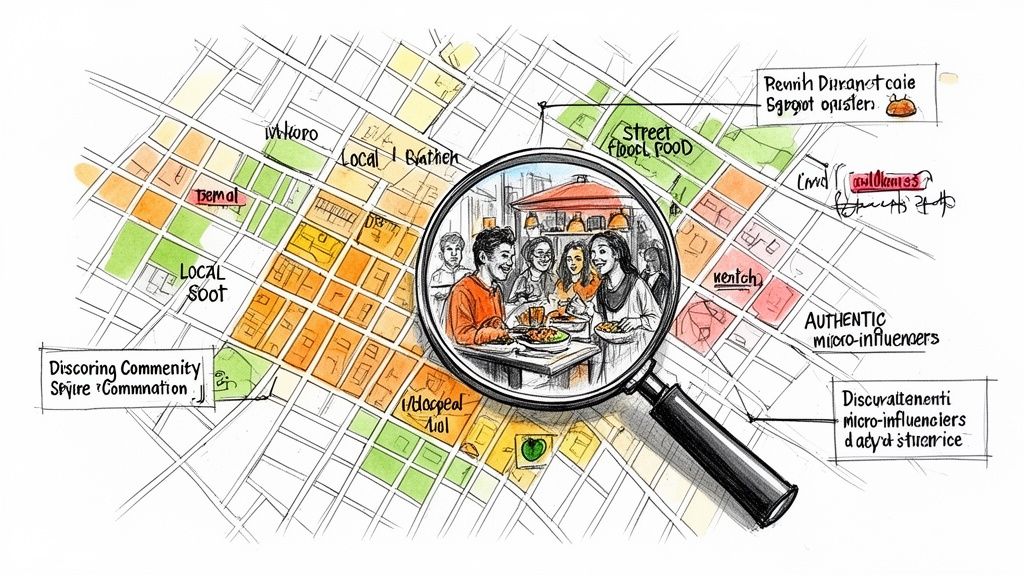
The right creator is usually closer than you think.
Not a celebrity chef. Not a polished lifestyle account with little local pull. You want the person who eats around your city, gets real comments from nearby followers, and can send people to your stall this weekend.
Start with local evidence, not follower count
Since the post-pandemic recovery, UK food content from micro-influencers under 10K followers has grown fast. HypeAuditor’s 2025 report notes a 35% surge in UK food-related content creation among micro-influencers on Instagram and TikTok, which is exactly why small local creators are now easier to find than they were a few years ago, as covered in HypeAuditor’s 2025 State of Influencer Marketing report.
That growth is useful for traders because it expands the pool of creators who are both affordable and local.
If you want a cleaner process, this guide on how to find local food influencers in your city is a solid starting point.
What to check on a creator profile
Do not judge the account by follower count first. Read the profile like a trader trying to predict tomorrow’s queue.
Look for these signals:
Local posting pattern
Check whether they repeatedly post about your city, your market, or nearby food spots. One random market Reel from six months ago is not enough.Comments that sound human
You want comments like “adding this to my weekend list”, “is this at Borough Market?”, or “need this after work”. Generic comments are a warning sign.Food fit
A creator who reviews burgers, tacos, bao, desserts, coffee carts, and market food will usually outperform an account focused on fashion with the occasional brunch shot.Posting style
Some creators are great at cinematic visuals but weak at getting people to act. Others make rougher content that moves people. For traders, the second type often wins.
A simple vetting method
Use this quick pass before you message anyone:
Check their last nine posts
You are looking for consistency. Does the feed show real food coverage, local movement, and audience interaction?
If the account feels generic, it probably is.
Open their tagged content
This tells you whether brands and venues work with them, and whether they show up, post on time, and create content others reuse.
Read the audience clues
Comments often reveal whether the audience is local enough to matter. If nobody asks where the stall is, when it is open, or whether it is worth visiting, the account may not drive action.
Key takeaway: For street food, a smaller creator with local trust is often worth more than a larger creator with broad but irrelevant reach.
Red flags traders should not ignore
There are some profiles that look busy but feel hollow once you dig in.
Follower spikes with weak comments
Big audience, tiny interaction, and flat comment quality usually means poor fit or inflated numbers.No face, no voice, no opinion
If every post looks like a reposted menu shot, they may not have enough personal trust to drive visits.Everything is an ad
If every other post is sponsored, followers stop treating recommendations like recommendations.No local anchor
If you cannot tell where they are based or who they speak to, they are a risky pick for a market campaign.
The best local food heroes are not just content creators. They are people their audience already uses as a shortcut for “Where should we eat?”
Crafting the Perfect Collaboration Offer
Most bad outreach fails before money even enters the conversation.
Traders often send a cold message that says little more than “Fancy a collab?” That puts all the work on the creator. They have to guess what you want, what you’re offering, and whether you’re serious.
Give them clarity instead.
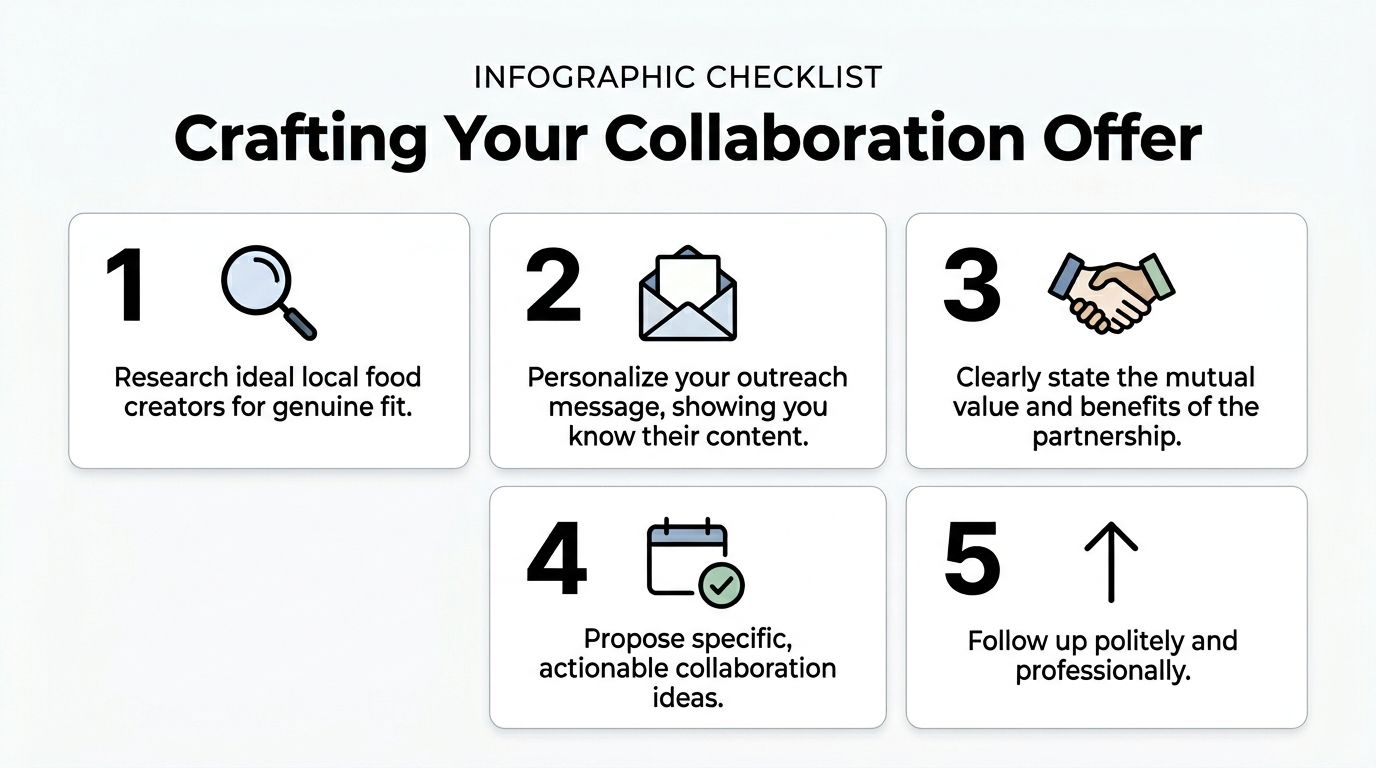
Lead with fit, then make a concrete ask
There is a strong reason to keep this tight and local. In niche markets, micro and nano influencer campaigns can achieve up to 11x ROI compared to traditional digital ads, and nano-influencers have recorded 2.19% engagement rates for niche food audiences, according to this niche influencer marketing methodology.
That does not mean every gifted meal turns into profit. It means the economics can work if you choose carefully and brief well.
A DM that gets replies
Keep the first message short enough to read in seconds.
Try this:
Hi [Name], I run [Stall Name]. We trade at [Market/Event] and saw your posts on [specific local place or type of food]. Your content feels like a strong fit for our crowd. We’d love to invite you down to try [signature dish] and discuss a simple local collaboration for [day/date]. If it suits, I can send the details here.
Why this works:
it shows you know their content
it makes a specific invitation
it does not force them into a decision on the spot
If they reply, move quickly to the details.
Decide whether it is gifted or paid
Not every creator should be offered the same deal.
A practical approach:
Creator type | Good starting offer |
|---|---|
Nano creator with strong local audience | Gifted meal plus clear deliverables |
Micro creator with reliable food coverage | Gifted meal or paid fee, depending on output |
Creator with proven local pull and polished video | Paid collaboration is often fairer |
Gifted collaborations can work well when the creator already likes your type of food and your ask is reasonable. Paid collaborations make more sense when you need defined deliverables, a time-sensitive event push, or content usage rights.
What your brief needs
Here, traders either save themselves or create chaos.
Your brief should be simple enough to read on a phone, but clear enough that nothing important gets missed.
Include:
Trading details
Exact date, market name, pitch location, trading hours.What to feature
Pick one or two dishes, not the whole menu. Your signature item should be obvious.What makes the food worth filming
Flame, crunch, pour, stretch, build, garnish, steam, customer reaction.What to say clearly
If there is a launch, special, or limited item, spell it out in plain language.How people should find you
Tag your account, mention the market, mention the day.Tracking device
A promo code, named special, or spoken phrase for redemption.Usage permission
State whether you want to repost their content on your own channels.
Brief tightly, not heavily
You do not want to choke the content.
Say what must be included. Leave the creator room to make it sound like them. The best food content feels personal, not scripted by a committee.
Tip: The clearest brief is often one page or one message thread. If it reads like a contract before the creator has even agreed, expect silence.
A strong collaboration offer feels organised, respectful, and easy to act on. That alone puts you ahead of most outreach landing in a creator’s inbox.
Activating Your Campaign On-Site
Campaign day should feel smooth, not chaotic.
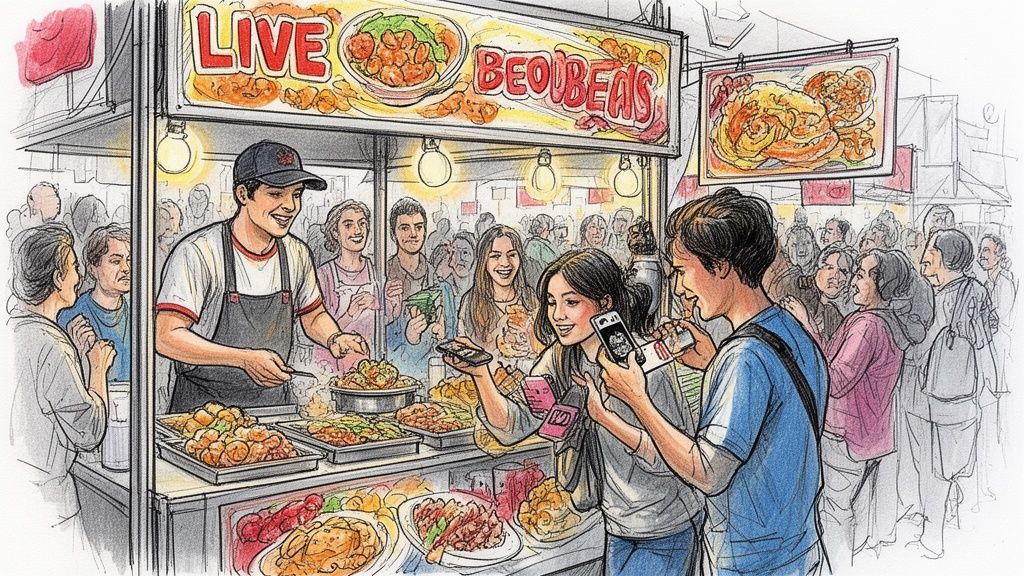
The creator arrives. Your team knows who they are. The food looks right. The code is ready. The person on till knows what to ask. That is the difference between “we did a collab” and “we turned a post into sales”.
Before the creator turns up
Think through the visit like a service drill.
Your stall is busy, there is noise, and people are moving. The creator needs enough space and support to capture the food without blocking the queue or getting rushed.
A practical launch checklist:
Set the offer first
Choose a memorable code or phrase. If your audience buys in person, a short verbal code often works better than something fiddly.Prepare the till team
Everyone taking orders should know the code, the offer, and how to note redemptions.Make the dish camera-ready
The creator should get the version you most want associated with your stall. Consistency matters.Choose your filming window
If possible, avoid the most frantic ten minutes of service.
If you also use a website, online menu, or ordering page, build a trackable link before the visit. This walkthrough on how to run a restaurant influencer campaign step by step is useful for mapping the setup.
What the creator should capture
Food alone is not enough. For street food, the setting sells too.
Good content usually includes a mix of these:
The approach
Show where the stall sits in the market and how people find it.The making
Chopping, grilling, torching, pouring, wrapping, plating.The handover
The moment the food lands in the customer’s hand is powerful because it feels immediate.The reaction
The first bite, the texture shot, the quick verdict.
A realistic on-site flow
Here is what a good visit often looks like in practice.
The creator arrives a little before the main rush. Someone from your team greets them by name and points out the signature dish. You explain what makes it special in one sentence, not a five-minute speech.
The food goes out looking exactly as it should. While they film, you mention the one thing they need for the audience: where you’re trading today and the code they can use. If there is a queue building, that helps the content. If there is not, the market atmosphere still matters.
Then the post goes live.
This is the moment many traders waste. They thank the creator and move on. Instead, your team should be ready for the next hour or two. Ask customers where they heard about you. Keep a note of every code redemption. Watch which dish starts moving.
Key takeaway: On-site activation is not hospitality for the creator alone. It is operations, tracking, and customer handling wrapped around a short content window.
Keep the ask simple for customers
Do not make redemption complicated.
A market customer will not jump through hoops. They will say a word at the till, show a Story, or mention a name. That is enough.
The simpler the action, the easier it is to measure impact without slowing service.
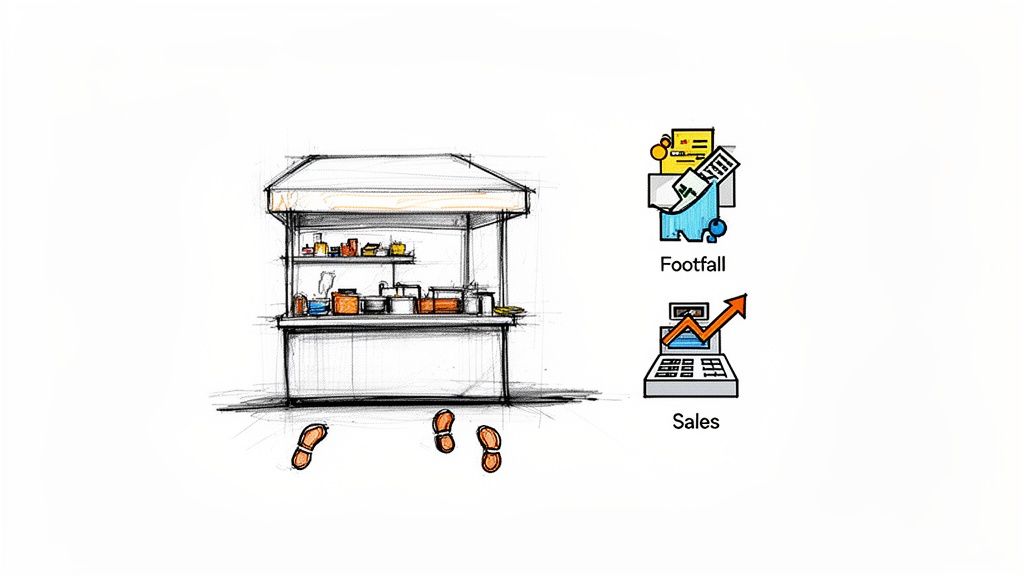
Measuring What Matters Most Footfall and Sales
Views are nice. Orders are better.
For street food traders, measurement gets awkward because the business is mobile, cash-heavy, and often busiest when nobody has time to log anything. That is exactly why you need a rough but repeatable system, not a perfect one.
Why traders struggle to attribute results
A major gap in this space is attribution for mobile vendors.
A UK street food report highlighted 15,000+ traders, with 70% using social media but only 20% measuring ROI due to location flux, which shows how hard it is to tie activity to sales when pitches change and trade happens across multiple markets, as noted in this analysis of how social media fuels street food vendors.
That is the core problem. Not whether influencer marketing can work, but whether you can prove it worked at your stall on that day.
Use stacked tracking, not one method
For transient businesses, one signal is rarely enough.
Use a combination.
Promo codes
A simple code is still the cleanest option if your team can remember it.
Examples:
creator-name codes
market-day codes
dish-specific codes
The code tells you who came because of that campaign, even if they never clicked a link.
Verbal surveys at the till
Train staff to ask one short question when handing over the order:
“Did you see us on Instagram or TikTok today?”
If yes, ask a second:
“Whose post was it?”
This sounds basic because it is. It also works. For pop-ups and markets, verbal logging often fills the attribution gap that digital tracking misses.
UTM links when relevant
If you have a menu page, catering enquiry form, pre-order page, or event landing page, use a creator-specific UTM link. This helps connect content to clicks before someone turns up in person.
A practical breakdown of the wider measurement logic sits here: how to measure influencer marketing the metrics that.
What to record after each campaign
Keep this in a simple sheet, notes app, or till log.
Metric | Why it matters |
|---|---|
Code redemptions | Strongest direct campaign signal |
Verbal mentions | Captures offline influence that no link will show |
Top-selling promoted dish | Tells you whether the content matched the purchase |
Time of post vs busy period | Helps you learn whether same-day posting works best |
Repeat creator performance | Shows who is worth working with again |
Don’t confuse activity with results
A common mistake is treating a busy comment section as proof.
It might be proof of interest. It is not proof of sales.
Look for this chain instead:
creator posts
customers mention the post or use the code
promoted item sells
footfall rises during the campaign window
you can compare that result with another trading day
Once you have done this a few times, patterns appear. Some creators drive immediate lunchtime trade. Others are better for building awareness before a weekend market. Some formats sell best, often a direct recommendation over a cinematic montage.
If you cannot measure perfectly, measure consistently. That is enough to make better decisions next time.
Turning Great Content into Lasting Assets
One of the biggest wastes in trader marketing is letting strong creator content vanish after a Story expires.
If someone has already filmed your food well, captured the market energy, and given you social proof, that content should keep working long after the original post.
Get permission clearly
Do not assume that a tag means usage rights.
Ask in writing whether you can repost the content on your own Instagram, TikTok, website, printed material, and paid local ads if needed. Keep it simple and polite. If the collaboration is paid, spell out usage in the agreement before the visit.
That avoids the awkward message three weeks later when you want to reuse a Reel for your next market announcement.
Build a usable content library
Organisation matters more than fancy software here.
Create folders by:
creator name
date
market or event
dish featured
format such as Reel, Story, photo, testimonial
Add one note beside each asset saying what happened after it posted. Did people mention it at the till? Did a dish sell faster? Did the creator’s audience ask where you would be next?
That context turns content into business intelligence, not just a folder of nice clips.
Repurpose with intent
UK-specific benchmark data shows 40% of campaigns fail due to untracked efforts, and that effective UGC repurposing is part of successful optimisation. The same benchmark notes that micro-campaigns can lift reviews by 40% and footfall by 25%, with stronger effect when content is reused, according to this benchmark on street food campaign pitfalls and optimisation.
For traders, reuse can look like:
reposting creator videos before your next market date
adding creator quotes to pinned Instagram posts
dropping the best food shot into your menu board or flyer design
using a short testimonial on your catering page
building a “featured by local food creators” Story highlight
Tip: Reuse the content that already proved it could start conversations or drive visits. Do not treat every asset as equal.
The long-term win is simple. Each collaboration should leave you with three things: sales data, a creator relationship, and a bank of content you can use again. That is how low-budget influencer work stops being one-off promotion and becomes part of how you grow.
If you want help running creator campaigns without juggling DMs, spreadsheets, tracking codes, and follow-ups yourself, Sup is built for exactly that. It helps hospitality brands and food businesses source local micro and nano creators, launch campaigns quickly, track code redemptions and clicks, and keep all UGC in one place so every collaboration is easier to measure and reuse.

Matt Greenwell
Share