Finding it tough to fill your tables, even with the plant-based market booming? I’ve seen it time and again with fantastic vegan restaurants. The good news is, the solution isn't about spending more on ads; it’s about shifting your focus. Influencer marketing, especially for plant-based spots, has become an absolute game-changer for connecting with diners through voices they actually trust.
The Secret Ingredient for Restaurant Growth
Let's be honest, traditional advertising is losing its flavour. In the restaurant world, and especially within the passionate plant-based community, people are looking for genuine recommendations, not glossy ads. They don't trust billboards anymore; they trust local foodies who share their values and get excited about great food. This is precisely why influencer marketing should be your most powerful tool.
This isn't just a trend; it's a fundamental shift in how people decide where to eat. Your potential customers want to see the real deal—the texture of your signature vegan burger, the vibe of your dining room on a Friday night. A heartfelt post from a local creator builds instant trust and curiosity in a way a magazine spread never could.
This simple diagram shows the journey from old, tired advertising to a modern, profitable strategy built on creator partnerships.
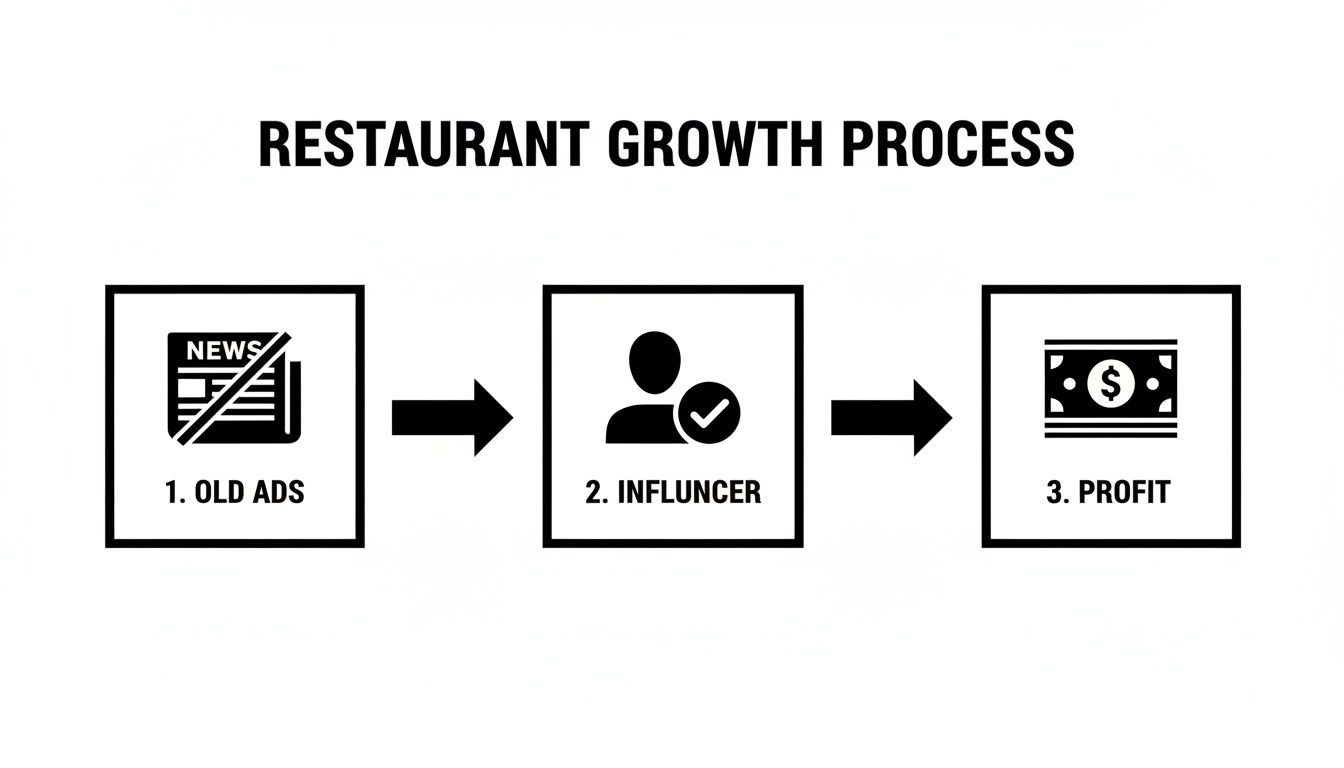
As you can see, it's about moving away from expensive, low-trust media and embracing authentic voices. That path leads directly to more bums on seats and a healthier bottom line.
Why This Matters for UK Vegan Restaurants
The UK's plant-based scene is absolutely exploding, with a projected market growth of 12.5% after 2025. This surge is being driven by creators who connect with the growing wave of vegan and flexitarian diners.
Take The Vurger Co., for example. They’ve absolutely nailed their local collaborations, seeing a 40% increase in footfall by working with micro-influencers on Instagram and TikTok. These authentic stories hit home with Millennials and Gen Z, who make up 62% of the UK's vegan restaurant customers. I even know one London spot that saw a 25% jump in bookings that they traced directly back to content from a single nano-creator. It just proves that hyper-local endorsements really do convert.
The core idea is simple: turn social proof into your primary marketing asset. By building a community of genuine advocates, you create a sustainable pipeline of new customers who are eager to experience what you offer.
Before we get into the nitty-gritty of building a programme that drives measurable footfall and revenue, let's get a high-level view. The table below outlines the core pillars of a successful strategy, giving you a clear roadmap from the start.
Your Quick-Start Influencer Strategy
Pillar | Your Goal | First Action Step |
|---|---|---|
Creator Sourcing | Find authentic, local creators who align with your brand values. | Search local hashtags like |
Campaign Goals & KPIs | Define what success looks like in measurable terms. | Set a clear goal, e.g., "Increase weekday lunch bookings by 15%." |
Tracking & ROI | Prove the campaign is working and driving actual business. | Create a unique promo code for each influencer to track redemptions. |
Content & Scale | Get high-quality, reusable content that drives footfall. | Develop a simple creative brief outlining key dishes and vibes. |
This framework will help keep your efforts focused and effective.
To truly succeed, your influencer efforts should be part of a bigger picture. Building a strong foundation with your overall social media marketing for restaurants is vital. Now, let’s dive into turning these digital connections into real-world results that show a clear return on your investment.
Set Goals That Actually Fill Your Tables
Before you even think about sliding into an influencer’s DMs, we need to talk about what success actually looks like. Running a campaign without a clear goal is a bit like heading into service without a prep list—you'll be busy, but you won't get the results you need. For vegan restaurants, great influencer marketing has to go beyond just getting a few likes.
Those vanity metrics are nice for the ego, but they don't pay your suppliers or staff. What we're after are tangible results that impact your bottom line. It’s about shifting your mindset from vague "brand awareness" to a sharp focus on "filling those empty tables on a Tuesday night".
Awareness Goals Versus Conversion Goals
First things first, you need to decide if you're playing the long game or going for a quick win. Your campaign goal will fall into one of two camps: awareness or conversion. Both are important, but they serve very different purposes and need to be measured in completely different ways.
Brand Awareness Goals are about creating a buzz and putting your restaurant on the local foodie map. This is your go-to strategy for:
Launching a new menu: You want every local food lover to be talking about your new autumn squash risotto or summer berry crumble.
Opening in a new location: Building that crucial sense of excitement in a neighbourhood before you even open your doors.
Promoting a special event: Perfect for a one-off Veganuary tasting menu or a pop-up collaboration with a local plant-based chef.
Conversion Goals, on the other hand, are all about driving a specific, immediate action. This is where you see a direct, measurable return on your investment. Think of campaigns designed to:
Increase weekday footfall: Your weekends are buzzing, but you want to boost lunch traffic from Monday to Thursday.
Drive online delivery orders: You've just partnered with a delivery service and need to get those orders rolling in.
Grow your email list: Building a direct line to your most loyal customers is priceless for future promotions.
By defining your primary objective upfront—whether it's raising awareness or driving conversions—you can shape the entire campaign to hit that one target. It’s the difference between crossing your fingers and engineering a result.
Attaching KPIs to Your Goals
Once you have your goal, you need to give it teeth. That's where Key Performance Indicators (KPIs) come in. KPIs are the specific, measurable numbers that prove your campaign is actually working. They're the proof in your plant-based pudding.
Let's see this in action. Say your goal is to boost bookings for your new Saturday bottomless brunch. Just asking an influencer to "post about our brunch" is far too vague and leaves success up to chance.
Instead, a well-defined campaign would be measured by concrete results:
Tracked Booking Link Clicks: Give each creator a unique UTM link to your booking page. This lets you see exactly who is driving clicks and, more importantly, confirmed bookings.
Promo Code Redemptions: Create a simple, unique code for each person, like "KATIESVEGANBRUNCH" for 10% off. The number of times that code gets used is a direct measurement of their impact.
Follower Growth from Target Cities: Keep an eye on your Instagram analytics. A sudden spike in new followers from your city (say, Manchester) right after a local creator posts is a fantastic sign of growing local interest.
Here’s a simple way to structure your thinking:
Campaign Goal | Primary KPI | Secondary KPI |
|---|---|---|
Increase Weekday Lunch Bookings by 15% | Number of redemptions for a "WEEKDAY15" promo code | Clicks on a "Weekday Lunch Menu" booking link |
Launch a New Vegan Pizza Menu | Reach and impressions on posts using | Follower growth from your restaurant's city |
Drive 50+ Delivery Orders via New Partner | Number of orders using an influencer's unique code | Website traffic to your delivery partner's page |
This kind of structured approach turns your influencer programme from a hopeful experiment into a predictable, measurable growth channel. You'll know precisely which partnerships are bringing people through the door, so you can double down on what works and build lasting relationships with the creators who genuinely move the needle.
Find Local Foodies Who Your Customers Trust
Let’s be honest, the success of your influencer campaign comes down to one thing: the people you partner with. This isn't about throwing money at the creator with the biggest follower count. It's about finding real, local people whose audience genuinely listens when they talk about food.
Think about it. For your Bristol-based vegan spot, a local foodie with 8,000 engaged followers raving about your seitan wings is worth far more than a disconnected celebrity with a million followers. Why? Because their recommendation feels less like an ad and more like a mate excitedly telling you about their new favourite restaurant.
Those are the partnerships that actually get people through your door. They’re built on real passion and local credibility.
Where to Find Your Ideal Creators
Finding the right talent is part detective work, part intuition. You're on the hunt for nano-influencers (with 1,000-10,000 followers) and micro-influencers (with 10,000-100,000 followers). These creators are known for their tight-knit, super-engaged communities.
Put yourself in a customer's shoes. If you were looking for great vegan food in your city, where would you start? Probably with a quick search on Instagram or TikTok.
Location-Based Hashtags: Your first port of call. Start searching for tags like
#VeganLondon,#ManchesterFoodie,#GlasgowVegan, or#BrightonEats. Sift through the 'Top' and 'Recent' posts to see who’s already creating great content in your area.Niche-Specific Hashtags: Now, get more specific. If your restaurant has a unique angle, use it. Look for creators using tags that align with your specialities, like
#ZeroWasteVegan,#GlutenFreePlantBased, or#VeganSundayRoast. This is how you find people whose brand is already a natural fit for yours.Geotagged Locations: This is a goldmine. Check the location tag for your own restaurant and even your competitors. Who is already posting from these places? You might discover some passionate customers who would make incredible brand advocates.
Don't get dazzled by big numbers. The most powerful voices often have smaller, more dedicated followings. Their recommendations carry serious weight. For a deeper dive into this, our guide on how to find local food influencers in your city has even more tactics you can use.
The Vetting Process: A Checklist for Finding True Advocates
Once you have a list of potential partners, the real work starts. It’s time to vet each person to make sure they’re the right fit for your restaurant's ethos and will actually deliver results. Spending a few minutes on this now will save you from a mismatched, ineffective partnership down the line.
A great influencer is more than a mouthpiece; they are a genuine extension of your brand. Their content should reflect the same quality, passion, and authenticity that you put into every dish you serve.
Here’s a practical checklist to run through before you reach out:
Analyse Engagement Quality: Forget vanity metrics like 'likes'. Are people leaving thoughtful comments? Are they asking questions, having conversations, or tagging friends saying, "we have to try this!"? A high comment-to-like ratio is a fantastic sign of a truly engaged audience.
Review Past Content: Take a proper scroll through their feed. Have they worked with other local restaurants before? Is their photography appetising and high-quality? Most importantly, is their tone a match for your brand's vibe? If you're a relaxed, casual eatery, a creator with a very formal, fine-dining aesthetic might not click.
Check for Audience Authenticity: Look for red flags. A sudden, massive spike in followers or posts with thousands of likes but only a handful of generic, emoji-only comments can signal fake followers or bought engagement. These collaborations will bring you zero value.
Confirm Their Niche Alignment: Does this person genuinely live and breathe plant-based food, or are they a general 'lifestyle' creator who posted one vegan meal last year? You need to partner with someone whose passion is authentic. Their endorsement will be far more believable and impactful.
By taking the time to follow these steps, you’ll build a team of true advocates, not just hired guns. These are the creators who become genuine fans, returning time and again to create a steady stream of authentic content that keeps your tables full.
Getting Your Pitch and Creative Brief Right
So, you’ve put in the time and found a fantastic list of local food creators. This next part is where so many restaurants stumble: the outreach.
Let's be honest, a lazy "wanna collab?" DM is the digital equivalent of shouting into a void. These creators are bombarded with dozens of those messages every single day. Yours needs to feel different from the very first word. It has to show you're not just looking for a quick promo, but that you see a genuine fit and are ready to build a real partnership.
Making That First Message Count
Personalisation is your secret weapon here. Your goal is to make the creator feel like you've hand-picked them because you genuinely admire what they do, not just because they have a certain number of followers.
Start by getting specific. Mention a recent post of theirs that caught your eye. Something like, "Hi [Creator's Name], I'm the owner of [Your Restaurant Name]. I absolutely loved your recent reel on the best vegan Sunday roasts in Manchester—the way you captured the cosy vibe was fantastic!" This one small detail proves you're not just copy-pasting a template.
Then, get straight to the point. Briefly introduce your restaurant and explain why you think they're the perfect person to showcase it. Keep it short and focus on the mutual benefit. Are you offering a complimentary dining experience for them and a guest? A preview of a new menu? A set fee? Being upfront builds trust. This thoughtful approach is a cornerstone of how to get food influencers to promote your restaurant and get a positive response.
The All-Important Creative Brief
Once a creator says yes, don't just leave things to chance. This is where a clear creative brief comes in, and skipping this step is a mistake I see all the time. You can’t expect a creator to be a mind reader.
The brief is your campaign's instruction manual. It provides the essential directions they need while still giving them the space to be creative and authentic. Get this right, and you'll get content that not only looks brilliant but actually drives bookings.
A great creative brief is a balance of guardrails and green lights. It gives just enough direction to ensure brand alignment and campaign tracking, but offers enough creative freedom for the influencer’s unique voice to shine through.
Think of it as a simple, one-page guide. It doesn’t need to be formal, just clear.
Here’s what you absolutely must include:
Key Messages: What are the one or two crucial things you want your audience to remember? Perhaps it’s your commitment to locally sourced ingredients, your new zero-waste cocktail menu, or that your pasta is handmade daily.
Content 'Dos and Don'ts': Guide them without stifling their creativity. For example, 'Do' try to capture the vibrant colours of our Rainbow Bowl. 'Don't' use harsh flash photography, as it washes out the food's natural textures.
Call-to-Action (CTA): What do you want people to do? Make this crystal clear. Is it to "Book a table via the link in our bio," "Use code [INFLUENCER15] for 15% off," or "Visit us for our new brunch menu this weekend"?
Tracking Requirements: This is non-negotiable if you want to measure ROI. You need to state clearly that they must include their unique UTM booking link in their bio and mention their specific promo code in the caption and Stories.
Just look at the huge impact of coordinated campaigns during the 2026 Veganuary challenge in the UK. A staggering 1.2 million people took part, and 45% of them visited a vegan restaurant for the very first time, mostly because of what they saw on social media. Influencer content was the number one discovery tool, and UK plant-based venues that ran these campaigns saw an average 30% lift in bookings. That's the power of getting this right.
Finally, Measuring What Actually Matters: Your ROI
Right, let’s get down to business. This is the part where we stop guessing and start knowing. It’s where your influencer collaborations shift from being a line item on your marketing budget to a real, measurable source of revenue.
For years, I've seen restaurants pour money into partnerships, cross their fingers, and hope for the best. We're going to put an end to that. It’s time to look past the flashy 'vanity metrics'—the likes and follows—and focus on what truly impacts your bottom line: bums on seats and orders coming through.
Trackable Promo Codes: Your Direct Line to Sales
The easiest and most effective way to see who’s actually sending customers through your door is with unique promo codes. Think of them less as a discount tool and more as a direct attribution key.
The concept is simple. You give each influencer their own code. So, if you're working with a local creator in Bristol named Alex, you might create the code ALEX10.
Here’s how to get it right:
Keep it simple: The code needs to be memorable for customers and dead easy for your team to pop into your till.
Make the offer tempting: A 10% discount, a free glass of wine, or a complimentary portion of your signature loaded fries is usually all it takes to get people to use it.
Track your redemptions: At the end of the month, just run a quick report on your POS system. You’ll see exactly how many times ALEX10 was used, giving you a hard number of customers that creator brought in.
When you see that Alex’s code was used 50 times while another creator’s was used twice, you know exactly where to double down on your investment for the next campaign. It’s clean, undeniable proof of what’s working.
The goal is to create a clear feedback loop. Data like this empowers you to confidently reinvest in the partnerships that are actually delivering a tangible return and cut the ones that aren't.
From Clicks to Bookings: Using UTMs to Track Online Actions
But what about all the activity that happens online before a customer even decides to visit? This is where UTM links come into play. A UTM is simply your standard website link with a few tracking tags added to the end. It’s a game-changer for tracking online bookings and delivery orders.
These little tags are powerful. They tell your website analytics exactly who sent that visitor your way.
Imagine you give Alex a unique UTM link to your online booking page for her Instagram bio. Someone sees her post, gets hungry, and clicks that link to book a table for Friday night. Boom. Your analytics immediately credit that booking to Alex's campaign.
This lets you accurately attribute:
Website Traffic: See exactly how many people are clicking through from a specific creator’s content.
Online Reservations: Know which influencers are actually filling up your reservation book.
Delivery Orders: If you’re on platforms like Deliveroo or Uber Eats, you can use UTMs to track who is driving clicks to your menu and prompting orders.
To give you a clearer picture of what to track, here are the metrics that truly count for a restaurant campaign.
KPIs That Matter for Restaurant Campaigns
A breakdown of the essential metrics for measuring the real-world impact and ROI of your influencer marketing efforts.
Metric | What It Truly Measures | How to Track It |
|---|---|---|
Promo Code Redemptions | The exact number of in-person sales generated by a specific influencer. | Your Point-of-Sale (POS) system. |
UTM-Tracked Bookings | The number of online reservations directly attributed to an influencer's content. | Google Analytics or your booking platform's analytics. |
Influencer-Driven Footfall | The increase in walk-in customers during or immediately after a campaign. | Ask customers, "How did you hear about us?" or use footfall tracking software. |
Average Spend per Cover | Whether influencer-referred customers spend more or less than your average customer. | POS system reports, segmented by promo code users. |
Content Engagement Rate | The audience's interest in the content itself (a leading indicator of brand awareness). | Creator's social media analytics (likes, comments, shares, saves). |
Online Reviews Generated | The volume of new reviews mentioning the influencer or their promo. | Monitoring Google Reviews, TripAdvisor, etc. |
By tracking these KPIs, you move beyond guesswork and start making data-driven decisions that grow your restaurant.
Of course, tracking sales is just one piece of the puzzle. Another valuable layer of ROI comes from encouraging customer feedback, specifically by focusing on getting reviews for restaurants. If you're ready to go even deeper on this, our complete guide on how to measure influencer marketing ROI is the perfect next step.
Turn One Campaign into Ongoing Growth
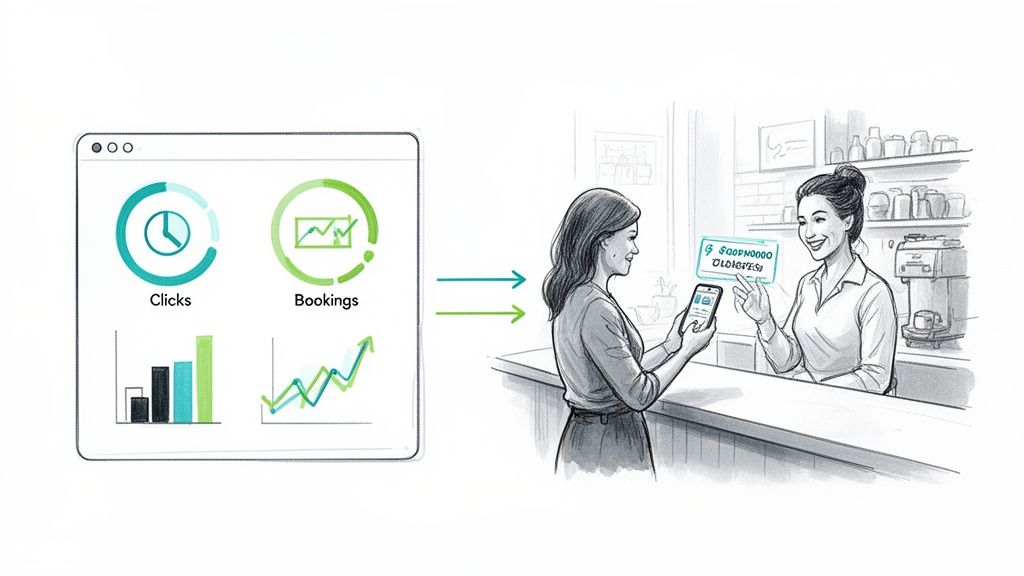
A successful influencer campaign is a great start. But the real goal is to build a system that keeps bringing people through your doors long after the initial posts go live. The aim isn't just a few one-off collaborations; it's about turning this effort into a reliable way to boost footfall and revenue.
This is where you move from short-term wins to long-term strategy. By nurturing the right relationships and getting the most out of every piece of content, a single well-run campaign can keep paying for itself for months, even years.
From Collaborator to Brand Ambassador
Once a campaign wraps up, your work isn't finished. You’re sitting on a goldmine of data. You know exactly which creators drove the most promo code redemptions or booking link clicks. These are your star players.
Don't just send a thank-you email and move on. This is your moment to build a real partnership. Get in touch with your top performers personally, show them the brilliant results their content generated, and invite them to become a long-term brand ambassador. You're shifting the relationship from a simple transaction to a genuine collaboration.
Nurturing your top-performing creators transforms them from short-term advertisers into long-term advocates who genuinely champion your restaurant to their loyal community, creating sustained and authentic promotion.
Think about offering them perks that make them feel like a true insider. Maybe it’s a quarterly invite to taste-test new menu items or a standing discount for when they visit on their own time. These small gestures keep your restaurant top-of-mind and encourage organic mentions that feel incredibly authentic to their audience—because they are.
Scale Your Success Across Multiple Locations
For restaurants with more than one branch, this strategy is a game-changer. You can take what worked in one city and replicate it everywhere you open. Your first campaign becomes the blueprint for recruiting hyper-local influencers in every new market.
Create a Local Playbook: Document the outreach messages, creative briefs, and offers that delivered results. Adapt this framework for each new location.
Build Local Teams: In each city, find a small group of 2-3 trusted nano-influencers to be your go-to advocates for launches, events, and promotions.
Generate Location-Specific Buzz: A creator in Manchester can build excitement for your new Northern Quarter spot in a way a London-based influencer never could. It’s all about local credibility.
Repurpose Content for Maximum Impact
One of the biggest missed opportunities in influencer marketing for vegan and plant-based restaurants is content repurposing. Before you start any collaboration, make sure your agreement gives you the rights to use their content on your own channels. This simple step turns a handful of posts into a whole library of marketing assets.
Authentic, high-quality photos and videos from creators can be woven into all your marketing, saving you a huge amount of time and money on content creation. This user-generated content (UGC) often outperforms polished brand assets because it feels more genuine and trustworthy to potential customers.
Here’s how you can put their content to work:
Your Social Media Feeds: Keep your Instagram and TikTok looking fresh with real-life shots of your food and restaurant atmosphere.
Email Newsletters: Drop influencer photos into your emails to show off new dishes or announce special offers.
On Your Website: Add a "Spotted on Social" gallery to your homepage to provide instant social proof.
Paid Digital Ads: Use their most engaging videos and images in your Facebook and Instagram ad campaigns. You’ll often see higher conversion rates.
By building real relationships, scaling your efforts locally, and squeezing every drop of value from your content, you create a powerful growth loop that keeps your tables full and your brand thriving.
Your Questions, Answered
Jumping into influencer marketing always comes with a few questions. I get it. You want to make sure your time and money are well spent. Here are some straightforward answers to the things I hear most often from vegan restaurant owners.
How Much Should I Pay a Food Influencer?
This is the big one, isn't it? The good news is, you don't always have to lead with a cash payment. Especially when you're working with local nano and micro-influencers (think under 25k followers), a complimentary meal for two is often the perfect starting point. The real key is to give them an experience they’ll be genuinely excited to talk about.
Of course, if you’re approaching creators with bigger, more engaged communities or asking for something more involved—like a professionally shot video reel—a fee usually comes into play. When you get a quote, look at their engagement rate and the quality of their past work, not just their follower count.
A good rule of thumb is to always offer a gifted experience first. If a creator then asks for a fee, don't be put off. It often means they're professional and know their worth, which is exactly what you want. It's then a simple business decision: does their audience and proven impact fit your budget and goals?
What If an Influencer Gives a Bad Review?
Honestly, this is very rare when you do your homework. The vetting process is your safety net. You're looking for creators who are already passionate about plant-based food and have a track record of posting positive, authentic content. You want to build a team of genuine fans, not hire a food critic.
But if the unexpected happens? The best response is to handle it with grace. Reply publicly and politely, treat it as constructive feedback, and thank them for their honesty. By running a programme with several creators, you ensure that one less-than-glowing post won’t sink your campaign. Your brand's story is told by the chorus, not a single voice.
How Quickly Will I See Results from a Campaign?
You’ll likely see some immediate buzz. A spike in Instagram followers, a jump in website visits, and a flood of comments right after a popular creator posts are all common. It’s exciting, but it’s not the whole story.
The real measure of success unfolds over the next few weeks. I always recommend tracking things like promo code redemptions and booking link clicks over a 30-day window. This gives you a far more accurate picture of the campaign’s true return. The real power of influencer marketing for vegan and plant-based restaurants is the steady, sustained momentum you build. Multiple creators posting over time builds trust and drives consistent, real-world footfall.
Ready to stop guessing and start growing? Sup combines smart technology with a human touch to run measurable influencer campaigns for restaurants like yours. Find local foodies and drive real footfall with Sup.

Matt Greenwell
Share