
In the world of wellness and supplements, influencer marketing isn't just another box to tick—it's become a fundamental part of building a trusted brand and driving real sales. The secret isn't about big celebrity names anymore; it's about tapping into the genuine connections of nano and micro-influencers to break through the noise and show your products in a way that feels real and credible.
The New Era of Trust in Wellness Marketing

Let's be honest: marketing supplements and wellness products is a tough game. Today's customers are switched-on, well-researched, and rightly sceptical of the glossy, corporate advertising they see everywhere. They’re looking for something they can actually trust—recommendations from people just like them.
This is precisely where influencer marketing comes into its own, especially for brands in our space. It's shifted away from flashy endorsements and towards partnerships with authentic creators who have nurtured genuine communities around shared values and interests.
For any wellness brand, your most precious asset is consumer trust. In an industry built on personal health, authenticity isn't a nice-to-have; it's the entire foundation.
Why Micro and Nano Creators Are Your Secret Weapon
The real magic happens with nano-influencers (1k-10k followers) and micro-influencers (10k-50k followers). These creators have built incredibly engaged, niche audiences who hang on their every word. A recommendation from them feels less like a paid ad and more like a great tip from a knowledgeable friend.
The numbers back this up. Recent insights show a staggering 23% of Brits have purchased a supplement at least once simply because they saw an influencer recommend it or watched it go viral. This is huge, especially when you consider that 61% of the population already uses supplements daily. It paints a clear picture of the direct line between creator content and what people buy. You can dig deeper into these figures in the UK Supplements Consumption Report on w-wellness.co.uk.
Focusing on these smaller, more authentic voices gives you a clear edge. It allows you to:
Build genuine credibility: Your message is delivered by a trusted source, not a faceless brand.
Reach highly specific audiences: You can connect with distinct communities, from dedicated yogis to new mums navigating parenthood.
Generate authentic content: You gain a library of user-generated content (UGC) that feels real, relatable, and far more persuasive than a polished ad.
Laying the Groundwork for a Practical Playbook
Getting this right requires a proper strategy. It's about so much more than just sending out freebies and hoping for the best. A solid influencer marketing programme for a wellness or supplement brand must stand on three crucial pillars, which we'll break down step-by-step in this guide.
First up is compliance. Understanding the regulations from bodies like the ASA isn't optional—it's essential for protecting your brand and keeping your customers' trust. Second is smart creator selection, meaning you need to find partners whose audience and values are a perfect match for your own.
And finally, it’s all about accurate ROI tracking. You have to move beyond vanity metrics and measure real business impact through trackable promo codes and attributed sales. This playbook will give you the actionable advice you need to master all three.
Navigating Compliance and Building a Foundation of Trust
Let's talk about the elephant in the room for any wellness brand dipping a toe into influencer marketing: compliance. It’s the one area that can feel genuinely nerve-wracking. But getting it right isn't just about avoiding a stern letter from regulators; it's about protecting the very trust you've worked so hard to earn.
In the wellness and supplement space, credibility is everything. Think of your compliance strategy as the framework that supports that credibility. The good news? It’s far less intimidating than it sounds. The Advertising Standards Authority (ASA) and its CAP Code are built on simple principles: honesty and transparency. Your job is to empower creators to share their genuine experiences without veering into misleading or unproven medical territory.
The Golden Rules: Claims and Disclosures
The single most important line to draw is between a "structure/function" claim and a medical claim. An influencer can never, ever say that your product treats, prevents, or cures a disease. That's a hard and fast rule with no grey areas.
Here’s how to think about it in practice:
This is a non-compliant medical claim: "This turmeric supplement cured my arthritis pain!" This is a direct, unsubstantiated medical statement that will land you in serious trouble.
This is a compliant structure/function claim: "I've been taking this turmeric supplement after my long runs to help support my body's natural recovery process." See the difference? The focus is on supporting a normal bodily function, not treating a diagnosed condition.
This distinction needs to be spelled out in black and white in your creative briefs. Give creators simple "swap this for that" examples. It helps them stick to the rules without feeling like their creativity is being stifled.
Just as critical is the disclosure. The ASA is clear that any paid or gifted collaboration must be obviously signposted. That means the hashtag #ad needs to be right at the start of the caption, where no one can miss it. Burying it in a sea of other hashtags at the end simply doesn't cut it anymore.
A compliant influencer post nails two things perfectly: it clearly identifies itself as an ad and it makes claims that support general wellness, not claims that treat specific medical conditions. Mastering this balance is the key to building long-term brand credibility.
Building Trust That Goes Beyond the Hashtag
Real transparency is more than just following the rules. Today’s wellness consumer is savvy; they research ingredients, question sourcing, and demand proof of quality. Demonstrating your commitment to product integrity is one of the most powerful ways to earn their trust.
A fantastic way to solidify this is through external validation. Consider investing in rigorous third-party supplement testing. When you can show that your products have been independently verified for purity and potency, you add a powerful layer of credibility. An influencer who can say the supplement they're promoting is third-party tested instantly elevates their recommendation from personal opinion to an endorsement backed by science.
Practical Tips for Keeping Your Campaigns Compliant
Your creative brief is your best defence. Arming your creators with clear, simple information from the outset is the key to protecting your brand and ensuring a campaign runs smoothly.
Here’s a checklist for what to include to ensure compliance without killing creativity:
A "Do Not Say" List: Clearly list forbidden words and phrases. Think: "cure," "treat," "prevent," "diagnose," or the names of any specific diseases.
Approved Claim Examples: Give them a library of pre-approved, on-brand phrases. For instance, "supports a healthy immune system" is great; "stops you from getting sick" is a no-go.
Mandatory Disclosure Instructions: Be explicit. Specify exactly where and how to place #ad. Don't leave it up to interpretation.
A Little Education: Briefly explain why these rules exist. When creators understand that this is all about building trust and protecting the brand's reputation (and their own!), they become much better partners.
By taking a proactive, educational approach, you turn compliance from a hurdle into a shared goal. This collaborative mindset not only protects you from regulatory headaches but also makes your influencer partnerships more authentic and trustworthy—the perfect foundation for sustainable growth.
Alright, with the essential compliance rules sorted, let's get to the exciting part: finding the creators who will actually connect your brand with the right people.
Finding and Vetting Your Ideal Wellness Creators
When you’re in the wellness and supplement game, it’s easy to think that bigger is better when it comes to influencers. But trust me, that’s rarely the case. The real magic happens with nano-influencers (1k–10k followers) and micro-influencers (10k–50k followers).
Think of these creators as your brand's secret weapon. They’ve built small but incredibly engaged communities founded on genuine conversation and trust. A recommendation from them doesn't feel like an ad; it feels like solid advice from a knowledgeable friend. That’s precisely the tone that cuts through the noise in the health space.
Why Creator Tiers Matter in Wellness
Choosing the right creator tier isn't just about budget; it's a strategic decision that shapes how your audience perceives your brand. While macro-influencers offer massive reach, nano and micro-creators provide the authenticity and targeted engagement that wellness consumers crave. They are seen as peers, making their recommendations feel more personal and believable. This table breaks down what you can expect from each tier.
Creator Tier Comparison for Wellness Brands
Creator Tier | Follower Range | Typical Engagement Rate | Best For | Cost Level |
|---|---|---|---|---|
Nano | 1k–10k | 5%–10% | Building deep community trust, generating authentic UGC, and testing product-market fit. | £ |
Micro | 10k–50k | 3%–6% | Driving targeted conversions with a niche audience and achieving a balance of reach and authenticity. | ££ |
Mid-Tier | 50k–500k | 2%–4% | Expanding brand awareness to a broader but still relevant audience and launching new products. | £££ |
Macro | 500k–1M | 1%–3% | Maximising reach for large-scale campaigns and generating mass brand awareness. | ££££ |
Ultimately, a blend of tiers often works best. You can use nano- and micro-creators to build a foundation of trust and generate high-quality content, while occasionally partnering with mid-tier creators to amplify your message during key campaigns.
The Power of Niche Authenticity
Forget about casting a wide net. Your goal should be to tap into hyper-specific communities. If you've developed a postpartum supplement, you should be looking for new mothers who are openly sharing their journey. Selling a high-performance electrolyte mix? Your ideal partners are the marathon runners, CrossFit athletes, and cyclists who truly live and breathe performance.
This focused approach delivers so much more value than a generic shout-out from a lifestyle celebrity. It puts your product right in front of an audience that isn't just interested but is actively looking for the very solutions you offer.
The data backs this up. The UK vitamins and supplements market is booming among younger consumers, with a staggering 83% of under-35s using them. Yet, reports also highlight that this same group struggles with daily consistency. This is where creators shine—they can show how to turn a one-off purchase into a daily habit by authentically weaving your products into their routines. You can learn more about this in Mintel’s latest market report on UK vitamins and supplements.
Your Creator Vetting Checklist
Finding creators is one thing, but vetting them properly is where you safeguard your investment and brand reputation. Don't rush this part; it's a common and costly mistake. Before you even think about sending that first message, run every potential partner through this essential checklist.
Check for Audience Authenticity: Fake followers are everywhere. Use an audit tool to spot sudden follower spikes, unusually low engagement for their audience size, or a high number of bot-like accounts. With reports suggesting one in four influencers has bought followers, you can't afford to skip this.
Review Past Brand Partnerships: Take a close look at their previous sponsored posts. Do their partnerships feel aligned with your brand’s values? If they're promoting a junk food brand one day and your organic, clean-ingredient supplement the next, that’s a huge red flag. It screams inauthenticity.
Assess Content Quality and Tone: Go beyond the numbers. Does their content’s look and feel match your brand's aesthetic? More importantly, is their tone genuine and educational? For more on this, check out our guide on how to find the perfect creator for beauty brands, as many of the same principles apply here.
Look for Genuine Value Alignment: This is absolutely critical for wellness brands. Read their captions, watch their Stories, and get a feel for who they really are. Do their personal values and daily choices genuinely reflect your brand’s mission? If you stand for natural, whole-food ingredients, a creator who regularly promotes ultra-processed products simply isn't a good fit.
This simple flow diagram is something you should share with every creator. It lays out the core compliance steps clearly and concisely.
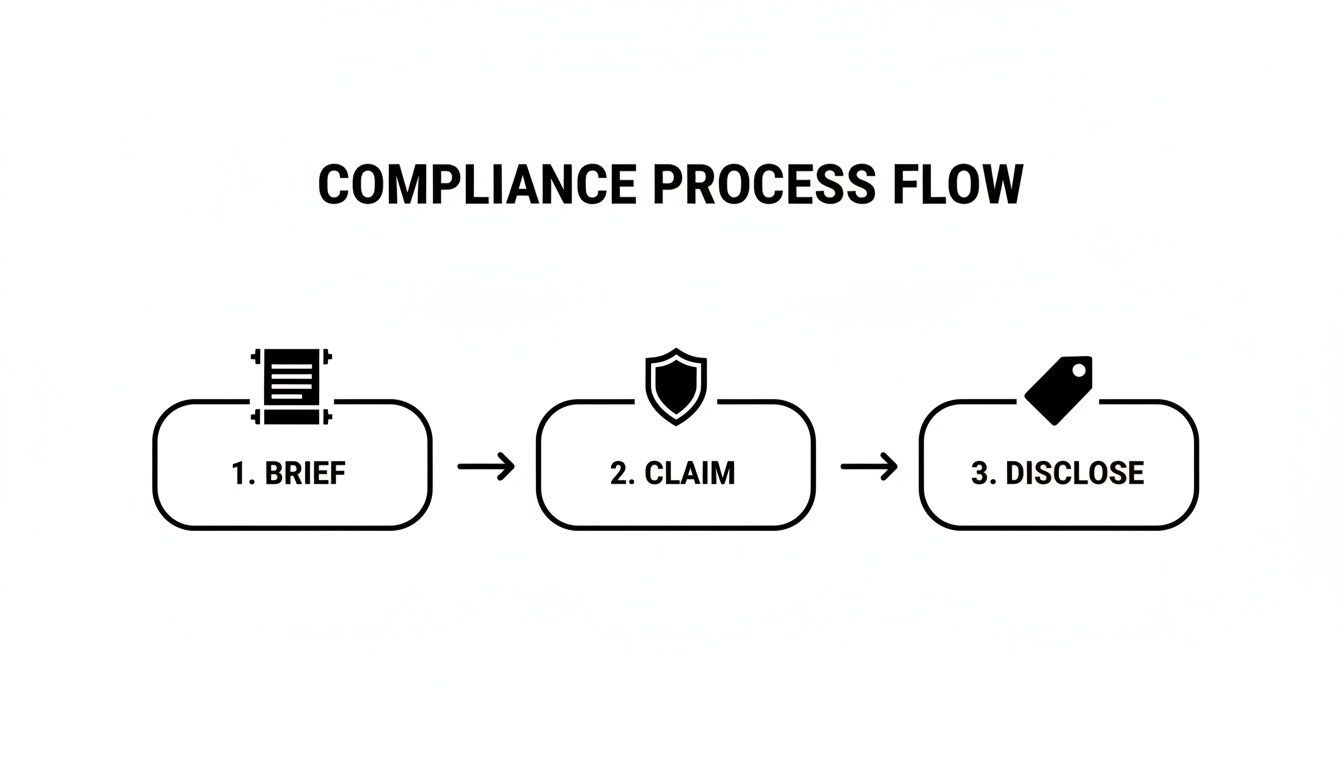
These three stages—Brief, Claim, and Disclose—are the foundation of a safe and effective partnership. They ensure every creator knows the rules of engagement right from the start.
Speeding Up Discovery to Find Brand-Safe Creators
Spending hours manually scrolling through hashtags and profiles is not only tedious but also incredibly inefficient. This is where modern creator platforms can be a game-changer, automating the heavy lifting of discovery and vetting.
Good platforms let you instantly filter creators by their niche, location, engagement metrics, and even their history of brand collaborations. This means you can build a shortlist of brand-safe, verified creators who are a perfect match for your brief in minutes, not weeks.
This approach lets you move faster and with much more confidence. Instead of getting bogged down in manual research, you can pour your energy into what really matters: building genuine relationships with creators who will become true, long-term advocates for your brand.
Bringing Your Campaign to Life
Alright, you’ve done the groundwork and have a solid list of potential creators. Now for the exciting part: moving from a spreadsheet into the real world. Launching an influencer campaign, especially for a wellness brand, is about more than just shipping out some freebies. It's about building a genuine partnership that makes sense to the creator’s audience and hits your business goals.
That very first message you send is crucial. It sets the tone for everything that follows. Creators, particularly the good ones you actually want to work with, get bombarded with generic, copy-pasted offers every single day. Yours needs to be the one they don’t immediately delete.
The secret? Show you’ve actually paid attention. Drop a specific comment about their content—a recent post you enjoyed or a story that resonated. It instantly proves you’re not just another brand casting a wide, impersonal net.
How to Craft Outreach That Actually Gets a Reply
Keep your initial message short, respectful, and focused on mutual value. This isn't the time to send a long list of demands. Your goal is to start a conversation by showing them why a collaboration would feel natural and exciting for their community.
A winning outreach message usually includes these four things:
A genuine, personal compliment: Go beyond "I love your feed!" Try something like, "Your recent post on morning routines really struck a chord. It's clear you value starting the day with real intention."
A quick 'hello' from your brand: Briefly introduce your company and what you stand for. More importantly, connect your mission to what you see in their content.
The "what's in it for them": Be clear about the nature of the partnership. Are you offering a product exchange, a paid collaboration, or a long-term ambassadorship? Frame it as an opportunity, not just a transaction.
A simple next step: Don't overwhelm them. End with an easy, low-pressure call-to-action, such as, "If this sounds like a potential fit, I'd love to share the details on our new magnesium complex."
This approach shows you respect their craft and immediately makes you stand out as a brand worth talking to.
The Anatomy of an Effective Creative Brief
Once a creator is on board, the creative brief is your most critical document. For any supplement or wellness brand, it does double duty: it needs to inspire fantastic content and keep you on the right side of compliance. The trick is to provide firm guardrails without killing the creator’s organic style.
A great creative brief empowers, it doesn't dictate. It gives creators the essential information they need to succeed while leaving them the creative freedom to produce content that resonates with their audience.
Your brief should be thorough but easy to scan. Use clear sections, bullet points, and bold text to make sure the crucial bits can’t be missed.
Here’s a look at what should go into a brief designed for wellness creators:
The Campaign’s Core Goal: Get specific. Is it about driving sales for a new product launch? Building a library of authentic user-generated content (UGC)? Or boosting brand awareness in a very specific community?
Key Messages: Give them 2-3 core talking points to work with. For a sleep supplement, for example, you might focus on "supporting a natural sleep cycle" or "waking up feeling refreshed, not groggy."
Mandatory Disclosures: This part is absolutely vital. You must clearly state that #ad or a similar clear disclosure needs to be right at the start of the caption. Take a moment to explain why this is so important for transparency and staying compliant with ASA rules.
Content Do's and Don'ts: Think of this as your compliance safety net. It’s where you prevent massive headaches later on.
Do: Provide a list of approved, compliant phrases like "supports," "maintains," or "promotes." Encourage them to show how the product fits into their overall healthy lifestyle.
Don't: This is even more important. Explicitly forbid words like "cure," "treat," "fix," or "prevent." Tell them they must not mention specific diseases or make any kind of medical claim. Giving clear examples here is a must.
Visual Direction: Give them a feel for your brand's aesthetic (e.g., bright and airy, natural tones, earthy) but don't micromanage. The best content comes from encouraging the creator to shoot the product in their own authentic space.
Choosing the Right Campaign Model
Not every collaboration should look the same. The model you pick depends entirely on your budget, your goals, and the type of creators you're working with.
Campaign Model Comparison
Campaign Model | Best For | Pros | Cons |
|---|---|---|---|
Product Seeding | Nano-influencers, gathering initial UGC, and product testing. | Low cost, highly authentic content, builds initial relationships. | No guarantee of posting, less control over messaging. |
Paid Posts | Micro to mid-tier creators, driving targeted sales, and new launches. | Guaranteed exposure, specific deliverables, trackable results. | Higher cost, can sometimes feel less authentic if not executed well. |
Ambassadorships | High-performing creators, building long-term trust and loyalty. | Deep brand integration, consistent content, higher audience trust. | Significant investment, requires strong relationship management. |
From my experience, a hybrid approach often yields the best results for wellness brands. Start with a round of product seeding to see which creators are genuinely enthusiastic about what you offer. From there, you can cherry-pick the top performers and elevate them into paid campaigns or even long-term ambassadorships.
This strategy helps you build an ecosystem of true advocates, turning influencer marketing into a powerful and sustainable way to grow your brand.
Measuring Success and Calculating True ROI
Likes and views are nice ego boosts, but they don't pay the bills. If you want to build an influencer programme that lasts, you have to prove it’s delivering real, measurable results. This is where we stop talking about vanity metrics and start speaking the language your finance team understands: cold, hard numbers.
The entire game boils down to attribution. You must be able to draw a straight line from a creator’s post to a website click, a product purchase, or another valuable action. Without that data, you’re just guessing. The good news? Setting up a solid tracking system is far less complicated than it sounds.
Setting Up for Success with Trackable Links and Codes
The bedrock of any measurable influencer campaign is built on two simple, yet incredibly powerful, tools: UTM parameters and unique discount codes.
Let me be clear: every single creator you partner with needs their own unique set of tracking assets. Never, ever use a generic link or one code for an entire campaign. If you do, you’ll have no idea who is actually driving results and who isn't.
Here’s how to set up your tracking for crystal-clear insights:
Unique Discount Codes: Give each creator their own distinct code, something easy for their audience to remember like "SOPHIE15". This lets you track every sale they drive right from your e-commerce backend and gives their followers a tangible reason to buy now.
UTM-Tagged Links: Every link you provide a creator—for their Instagram bio, a blog post, a YouTube description—needs to have UTM parameters. These are just little snippets of text tacked onto the end of a URL that tell Google Analytics (or any other analytics tool) precisely where that traffic came from.
A huge part of this is understanding how to measure influencer marketing ROI beyond just that final purchase. It's about seeing the entire journey, from that first tap on a Story to the final checkout click.
Building Your ROI Dashboard
Once your tracking is up and running, all this rich data can be fed into a central dashboard. This becomes your mission control, giving you a real-time, at-a-glance view of your programme's performance.
At a minimum, your dashboard should show you:
Clicks per creator: Who is best at getting people to your site?
Code redemptions: How many sales has each creator’s unique code generated?
Conversion rate: Of the people who clicked a creator's link, what percentage actually bought something?
Revenue generated: The big one. Real pounds and pence tied directly back to individual creators and their content.
This level of detail is what transforms your influencer marketing from a fuzzy brand-building exercise into a performance-driven sales channel. For a deeper dive, check out our in-depth guide to measuring influencer marketing ROI that actually works.
Calculating Your True Return on Investment
Now for the number that really matters. A simple formula is all you need to figure out just how profitable your influencer efforts are.
(Revenue Generated - Total Campaign Cost) / Total Campaign Cost x 100 = ROI %
It looks straightforward, but the devil is in the details of the "Total Campaign Cost". This is more than just what you paid the creator. To get a true ROI, you have to factor in everything:
Creator fees and any commission payments
The cost of goods for gifted products
All shipping and handling costs
Your team's time spent finding, vetting, and managing the creator
Let's run a quick example. Say you spent a total of £1,000 on a campaign, all costs included. That campaign then generated £4,000 in tracked sales. Your ROI would be a very healthy 300%. This is the kind of concrete data that proves the immense value of a well-run influencer strategy.
The Halo Effect of Repurposed Content
But wait, there's more. The ROI doesn't stop with the initial sales. One of the most significant—and often overlooked—benefits of influencer marketing is the goldmine of authentic User-Generated Content (UGC) you get. When you repurpose that content in your paid social ads, on product pages, or in your email marketing, it continues to deliver value long after the campaign ends.
In fact, with social media being the top channel for reaching UK supplement buyers—27% say social ads are most likely to capture their attention—this is a massive opportunity. Integrating genuine influencer content makes those ads feel less like ads and more like trusted recommendations, which can seriously boost performance.
By tracking the performance of ads that feature UGC against your standard brand creative, you can actually measure this "halo effect." You’ll often find that influencer content lowers your customer acquisition costs and improves conversion rates, adding a whole other layer of provable ROI to your programme.
Scaling Your Programme and Repurposing Content

A few successful campaigns are great, but they're just the beginning. The real magic happens when you stop thinking in terms of one-off posts and start building a long-term, self-fuelling growth machine. Sustainable growth isn't about chasing viral moments; it's about creating a consistent and reliable programme.
The first move is to look back at your past campaigns. Pinpoint the creators who actually moved the needle—the ones who drove sales and produced fantastic, on-brand content. Don't let those relationships go cold. Instead, bring them deeper into your brand's world with long-term partnerships or ambassadorships. These dedicated advocates will give you a steady stream of authentic content and build far more trust with their audience than any sporadic collaboration ever could.
Turning Your Influencer Programme into a Content Engine
Your influencer programme should be your primary source of authentic user-generated content (UGC). Honestly, this stuff is marketing gold. It has a level of credibility that your own polished brand creative just can't compete with. The trick is making sure you have the rights to use it everywhere.
This is non-negotiable: your creator contracts must include a clause that gives you clear usage rights for their content across your marketing channels. This one step transforms a single influencer post into a versatile marketing asset you can deploy for months to come.
The real return on an influencer partnership isn't just the initial post; it's the authentic content you get to keep. When you repurpose that UGC across your paid ads, product pages, and emails, you multiply your ROI and turn a campaign into a long-term asset.
Once you have the permissions sorted, you can put this content to work. UGC is incredibly powerful for boosting conversions and slashing customer acquisition costs because it serves as undeniable social proof.
Paid Social Ads: Try swapping out your sleek studio shots for real photos and videos from your creators. We've seen ads featuring genuine UGC achieve significantly higher click-through rates and lower costs because they feel like a friend's recommendation, not a corporate advert.
Product Pages: Embed influencer reviews, photos, and unboxing videos directly onto your product pages. Seeing someone just like them using and loving your supplement can be the final push a potential customer needs to click "add to basket."
Email Newsletters: Showcase creator content in your email campaigns. This shows your products in a real-world context and adds a layer of authenticity that builds community and drives sales.
Building a Self-Sustaining Growth Loop
By strategically reusing UGC, you create a powerful, self-perpetuating growth loop. Think of it this way: the content from your initial influencer campaigns fuels your paid ads. Those ads drive more sales. You then reinvest the revenue from those sales back into your influencer programme, allowing you to partner with more creators who generate even more high-quality content.
This cycle turns influencer marketing from a budget line item into a scalable, performance-driven channel. For a deeper dive into sourcing content that truly delivers, check out our guide on how to get creator content that converts for e-commerce. This approach ensures every marketing effort builds on the last, delivering consistent growth and measurable returns over the long haul.
Answering Your Lingering Questions
Even with a solid plan in place, a few key questions always seem to pop up when brands first dive into wellness influencer marketing. Let's tackle the ones I hear most often so you can move forward with confidence.
What’s the Going Rate for a UK Wellness Creator?
This is the million-dollar question, isn't it? The truth is, there's no single price tag. A creator's rates depend entirely on their audience size, how engaged their community is, and exactly what you’re asking them to do.
As a general guide, you can expect to pay a micro-influencer (those with around 10k-50k followers) anywhere from £150 to £500+ for a single post. For nano-influencers who are just starting out, a product-only or 'gifting' arrangement can be a great way to begin a partnership.
My best advice? Always ask for their media kit. It’s your starting point for any negotiation and gives you real data on their past performance, so you’re not just guessing.
How Do We Stay on the Right Side of Compliance?
Navigating the rules can feel daunting, but it really boils down to two non-negotiables. Getting this right from day one is essential for building trust and protecting your brand.
First, the partnership must be crystal clear. This means the creator has to use a label like #ad right at the beginning of their caption. It can't be buried at the end or hidden in a sea of other hashtags.
Second, you must avoid specific, unproven medical claims. An influencer can absolutely share their personal experience, but they can't cross the line into making medical statements.
Good: "I love this supplement after a workout. It contains magnesium, which is known to support muscle recovery."
Bad: "This supplement cures post-workout muscle soreness."
When in doubt, always refer back to the ASA's official guidelines. Think of them as your rulebook. Sticking to them is the bedrock of any successful and ethical wellness campaign.
When Will We Actually Start Seeing Results?
You'll likely see an initial flurry of activity—clicks, new followers, and maybe even a few discount code uses—within hours of a creator's post going live. That's the exciting part!
But the real value of influencer marketing is a slow burn. The true return on investment unfolds over time as awareness builds, trust deepens, and you start collecting authentic user-generated content (UGC) you can use elsewhere. To get a proper sense of a campaign's impact, you need to be tracking its performance for at least 30 to 90 days.
Ready to turn influencer marketing into a repeatable, ROI-proven growth channel? Sup combines AI with a human team to launch, manage, and attribute creator campaigns. Find your ideal creators and launch a campaign in minutes.

Matt Greenwell
Share