You brief a creator, approve the content, watch it go live, and then wait for the sales report. The post gets decent comments, a few saves, maybe some story reshares, but the actual business impact is hard to pin down. Reach is inconsistent. Attribution is fuzzy. Your paid social team cannot properly test the creative because it sits in someone else’s organic feed. Your local venues or stores need repeatable results, not one-off wins.
That is where most influencer programmes stall.
Influencer Whitelisting: What It Is and Why Your Brand Needs It is not really a question of whether creator content works. It is a question of whether you can turn creator trust into a channel your team can control, optimise, and scale. For brands managing multiple locations, seasonal offers, or aggressive growth targets, that distinction matters a lot.
The End of Unpredictable Influencer Marketing
A lot of teams are still running influencer campaigns like sponsorships. They pay for content, hope the creator’s audience responds, and judge success from a mix of views, screenshots, promo code use, and gut feel. That can work for awareness. It breaks down when finance asks what the campaign delivered.
The frustration is easy to recognise. A restaurant group launches local creator partnerships across several sites. One creator drives strong footfall. Another gets plenty of engagement but no measurable bookings. A third produces excellent content, yet the post underperforms because the platform never really distributes it. The team ends up with creative assets but no reliable way to scale the winners.
Influencer spend is no longer experimental
This is happening at the same time influencer marketing has become too important to treat casually. The industry is projected to grow to $32.5 billion by 2025, 86% of US marketers plan to partner with influencers in that year, and 26% of agencies and brands allocate more than 40% of their marketing budgets to influencer partnerships, according to LoudCrowd’s 2025 influencer marketing trends overview.
That level of spend changes the standard. Once a channel takes this much budget, leadership expects media discipline. They want targeting, creative testing, attribution, and repeatability.
What changes with whitelisting
Whitelisting solves the biggest weakness in standard influencer campaigns. It lets the brand run paid ads through the creator’s identity, instead of relying only on the creator’s organic reach. The content still feels native to the audience, but the brand gains the levers that matter in performance marketing.
That changes three things at once:
Distribution becomes deliberate. You are no longer hostage to organic reach.
Creative becomes testable. You can put budget behind the assets that work.
Results become more measurable. The campaign can sit inside the same media framework as your other paid activity.
For hospitality and multi-location brands, this is especially important because local audience fit matters so much. One creator may resonate in one catchment area and flop in another. Teams that need location-specific performance should read this breakdown of restaurant influencer marketing data because it highlights just how uneven results can be when campaigns are not built with operational discipline.
If influencer content is producing good reactions but inconsistent business outcomes, the problem is usually not the creator. It is the delivery model.
Understanding Influencer Whitelisting Through an Analogy
Think of influencer whitelisting like this. The creator builds the race car. They know how to make it look right, sound right, and earn trust from the people watching. Your brand then gets permission to drive that car on a bigger track, with a clear route, proper telemetry, and the budget to keep testing laps.
Without whitelisting, you are standing at the side of the track hoping the car wins on its own.
With whitelisting, you are still using the creator’s credibility, but now your paid media team controls targeting, placements, spend, and optimisation. This marks a fundamental shift.
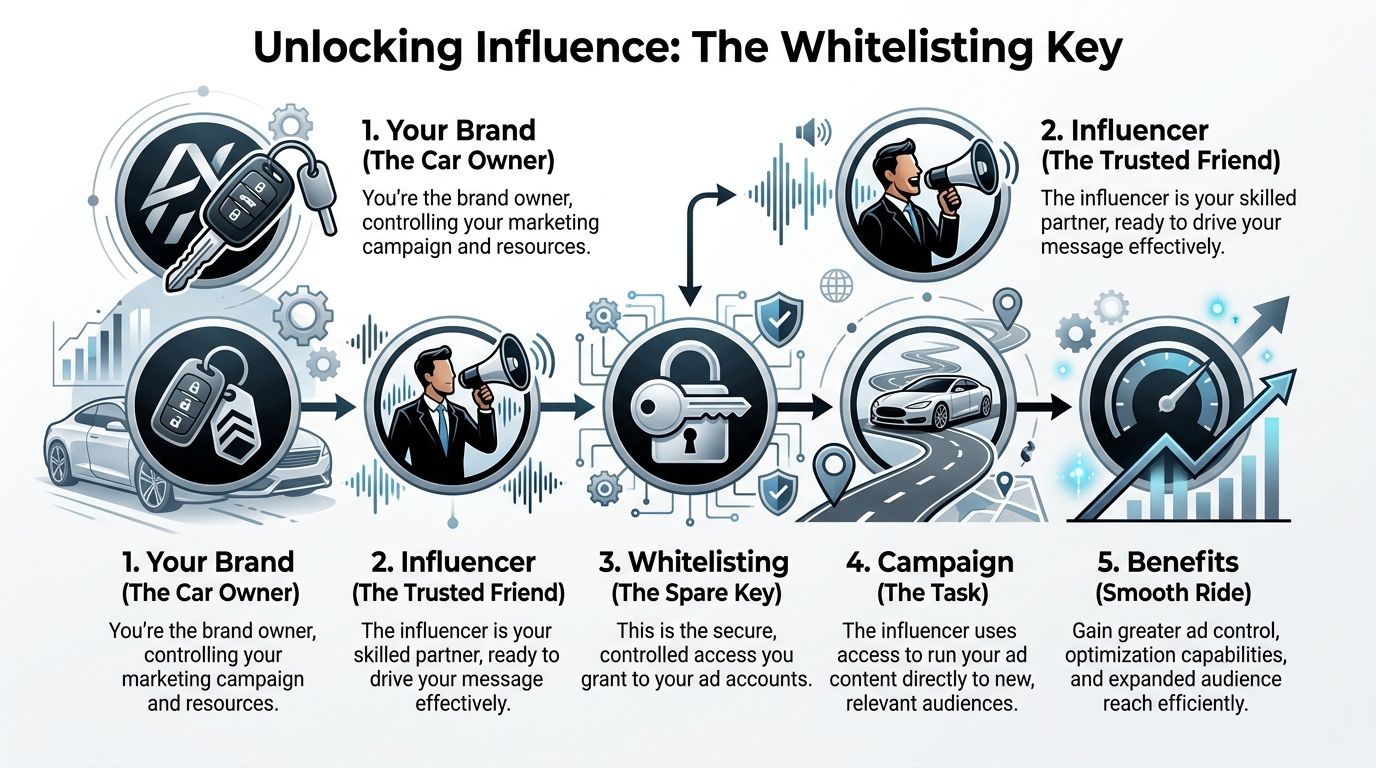
Influencer whitelisting is when a creator gives a brand permission to run paid ads through the creator’s social identity, using approved content while the brand controls media delivery and optimisation.
What it is not
A lot of marketers confuse whitelisting with a boosted post. They are not the same.
A boosted post is still relatively limited. You are usually putting money behind an existing piece of content with fewer controls than a proper ad workflow. Whitelisting is closer to licensed media access. The creator authorises use of their account identity for advertising purposes, and the brand runs the campaign with full paid social intent.
The terms that matter
Some of the language around whitelisting sounds more technical than it is. The key concepts are straightforward:
Ad permissions means the creator authorises the brand to use their account identity for ads.
Dark posting means the ad can run without appearing as a normal organic post in the creator’s public feed.
Creator handle delivery means the ad appears to come from the creator, not the brand account.
Approved content use means the brand can amplify agreed creative under the terms of the partnership.
Why the analogy matters in practice
The race car analogy matters because it clarifies responsibilities.
The creator is not there to replace your media team. Their job is to create trust, relevance, and strong creative. Your team’s job is to decide who should see it, where they should see it, and how long the campaign should run.
That is why strong whitelisting programmes usually outperform ad hoc creator deals. The best ones do not blur the lines between creator work and paid media work. They combine both.
The operating model that tends to work
In practice, whitelisting works best when teams do four things well:
Choose creators for message fit, not vanity A polished profile means very little if the creator cannot carry your offer naturally.
Treat the content like paid creative Hooks, visual pacing, offer clarity, and call-to-action all matter.
Separate content approval from media launch Content sign-off and audience targeting should be distinct decisions.
Build permissions into the campaign from day one Retrofitting usage rights after the fact usually slows everything down.
The Measurable Performance Uplift of Whitelisting
The commercial case for whitelisting is strong because it improves the metrics performance teams watch.
Brands using whitelisted influencer ads have seen a 20 to 40% reduction in cost per action, compared with 5 to 10% CPA reduction from traditional paid ads. Whitelisted campaigns also deliver 3 to 5% engagement rates, versus the 1 to 2% typical of conventional paid ads, and return on ad spend has improved by 1.5 to 2 times through whitelisting’s targeting advantages, according to Awisee’s analysis of influencer whitelisting performance. The same source notes that LYMA Life achieved a 6.84 ROAS, 4.8 million impressions, and more than 103,000 clicks through performance-led influencer whitelisting partnerships.
Those are not small gains. They point to a different kind of media asset.
Why the uplift happens
Whitelisting works because it combines two things that rarely sit together in normal campaigns. It keeps the social proof of creator content and adds the control layer of paid media buying.
Three mechanics usually drive the uplift.
Better audience control
Organic influencer posts reach whoever the platform serves them to. Whitelisted ads let the brand choose audience segments more deliberately. That matters when you need to target by behaviour, geography, funnel stage, or previous site interaction.
For multi-location brands, this is one of the biggest advantages. A venue in Manchester and a venue in Bristol may need different creators, different copy, and different local targeting even when the offer is similar.
More useful creative testing
A standard influencer collaboration often gives you one asset and one shot. If it works, great. If it misses, you learn very little.
Whitelisting changes that. Your team can test different hooks, thumbnails, placements, and calls to action while keeping the creator identity intact. You are no longer measuring just the post. You are measuring the creative system around it.
Less ad fatigue
Brand-run ads often fatigue faster because audiences recognise the format. Creator-led ads tend to feel closer to native content, which gives the media buyer more room to extend the lifespan of a good concept.
Good whitelisting is not just “creator content with budget behind it”. It is paid social execution using creator trust as the delivery vehicle.
Traditional influencer post vs whitelisted ad campaign
| Metric | Traditional Influencer Post | Whitelisted Ad Campaign |
|---|---|
| Reach | Depends on creator’s organic distribution | Brand can scale distribution with paid targeting |
| Control | Limited once the post is live | Brand controls spend, targeting, placements, and optimisation |
| Testing | Usually one post version | Multiple creative and audience variations can be tested |
| Attribution | Often partial or unclear | Stronger tracking through paid media setup |
| Engagement | Typical brand and conventional ad benchmarks apply less favourably | 3 to 5% engagement, compared with 1 to 2% for conventional paid ads | | Efficiency | Less predictable | 20 to 40% lower CPA reported for whitelisted influencer ads |
What does not work
There are also clear failure patterns.
Weak creators with paid spend behind them still underperform.
Great content without a clear offer often generates attention but not action.
No testing framework means you never learn why an ad worked.
No rights or permissions discipline creates delays just when you need to scale.
Teams get the best results when they treat whitelisting as a performance channel, not a creator side project.
Your Technical Guide to Whitelisting on Meta and TikTok
The setup is not hard, but it is detailed enough that sloppy process creates avoidable delays. The most common bottleneck is not the ad account. It is creator-side permissions, missing business settings, or unclear expectations about what the brand can and cannot do.
The fix is simple. Build a repeatable checklist and use it for every creator.
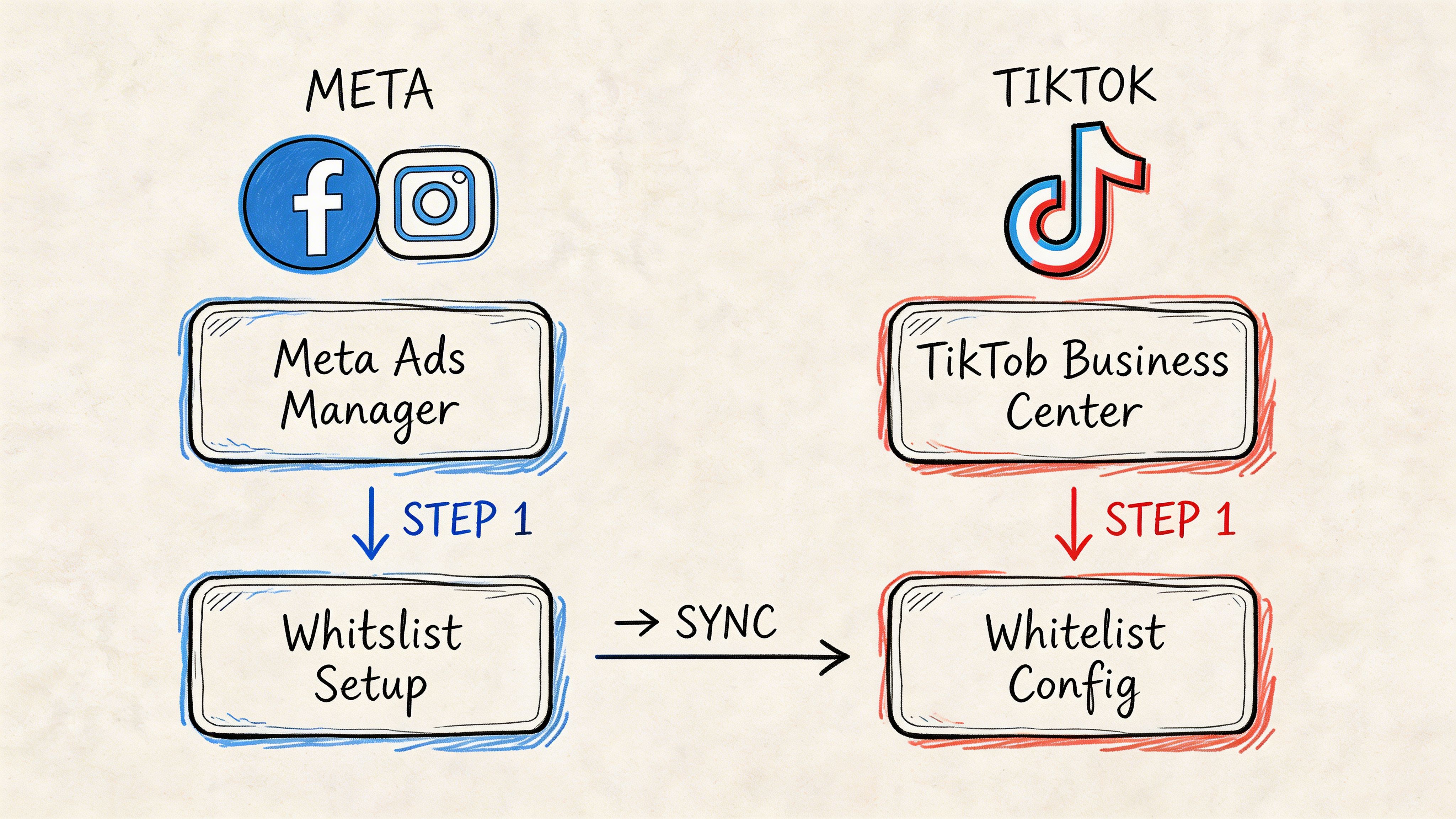
Whitelisting on Meta
On Meta, whitelisting usually runs through Instagram and Facebook account permissions inside Business Manager.
The creator first needs an Instagram Business or Creator account linked to a Facebook Page. That link matters because the permissions flow through Meta’s business infrastructure, not just the Instagram app.
From the brand side, the process works like this:
Go to Business Settings
Open Users > Partners
Enter the creator’s Business Manager ID
Request the relevant asset access
Once approved, assign permissions such as Create Ads and View Page Performance
Once that access is in place, the brand can run ads directly from the creator’s handle using approved organic content or campaign-specific creative. The ads appear more like native creator posts to the audience while still benefiting from platform targeting and attribution tools.
The performance upside is meaningful. On Meta, ads run from micro-influencers achieve 3 to 5x higher engagement than brand-run ads due to perceived authenticity, as noted in GRIN’s guide to influencer content whitelisting.
Meta workflow mistakes to avoid
The issues I see most often are operational, not strategic.
No pre-flight account check If the creator has not linked Instagram correctly, access stalls.
Permissions that are too broad or too vague Grant the exact access needed for campaign execution. Nothing more.
No content approval lock Make sure the approved asset version is clear before media launch.
For teams planning reuse across channels, this guide on how to repurpose influencer content for paid social ads is useful because it forces the right question early. Which assets are meant for organic collaboration, and which are meant to become media assets?
Whitelisting on TikTok
TikTok uses a different mechanic. The key format is Spark Ads.
The creator must enable Ad Authorization inside Profile > Settings and Privacy > Creator Tools > Ad Settings on a Creator or Business account. That permission allows the brand to boost the creator’s content as an ad while retaining the creator’s handle and native TikTok look.
This works well because the ad still feels like TikTok content. It does not force a polished brand style into a platform that usually punishes it.
Here is the embedded walkthrough if you want to see the setup visually.
On TikTok, whitelisted Spark Ads deliver 2.5x higher click-through rates than organic posts alone, and UK TikTok for Business data showed an 18% conversion uplift for hospitality brands using location-matched nano-influencers, based on the same GRIN-cited fact set referenced earlier.
What strong TikTok whitelisting looks like
TikTok rewards content that earns attention quickly. The first seconds matter. The creator needs to be credible on camera, fast to the point, and relevant to the audience you are trying to reach.
That is why content standards matter as much as permissions. If your team needs a sharper brief for creator-style paid assets, this resource on how to make UGC that converts is worth reviewing before you brief creators.
Platform setup is the easy part. The harder part is pairing the right permission flow with the right creative standard.
Navigating Legal Agreements and Content Rights
Whitelisting is not just a media setup. It is a legal arrangement.
A surprising number of brands treat permissions as a casual extension of an influencer brief. That approach might survive a small campaign. It becomes risky once you involve paid amplification, multiple locations, regulated categories, or creators producing claims that could trigger scrutiny.
Why standard influencer contracts fall short
A normal influencer agreement often covers deliverables, posting dates, and payment. That is not enough for whitelisting.
Once a brand starts running paid ads through a creator’s identity, the agreement needs to deal with content rights, ad permissions, approval processes, disclosure requirements, and liability if the ad copy or creator claims cross a line. Many teams discover too late that their paperwork in such cases is built for content sponsorship, not performance media.
For UK-based brands, that risk is sharper. The legal and compliance complexity is significant under stricter ASA expectations, and for multi-location hospitality brands the overlap between GDPR, advertising standards, and location-specific liability creates a meaningful gap that standard agreements often fail to address, making custom legal frameworks important for compliance, as discussed in Influence Hunter’s coverage of whitelisting and brand safety.
Terms worth defining before launch
The contract should answer practical questions, not just legal ones.
Usage rights Which assets can be used in paid media, and on which platforms?
Access duration How long can the brand run ads from the creator’s handle?
Edit permissions Can the brand change headlines, copy, thumbnails, or calls to action?
Disclosure rules Who is responsible for making sure required partnership labels appear?
Restricted claims What can the creator say about pricing, product benefits, age-restricted offers, or regulated services?
Revocation process What happens if the creator wants access removed or the brand wants the campaign paused?
The risk is higher for hospitality and regulated categories
Restaurants, chains, alcohol brands, fintech companies, and health-adjacent products all carry extra complexity. A location-specific offer can trigger different issues than a national ecommerce campaign. Age-gating, local promotion rules, privacy expectations, and platform disclosures can all change the risk profile.
That is why content rights need to be paired with content governance. Approval should cover not only whether the ad looks on-brand, but whether it is safe to run.
For teams sorting this out internally, this guide to getting influencer content rights for your marketing is a helpful starting point because it frames rights as an operational requirement, not a legal afterthought.
If the ad can scale, the contract has to scale with it.
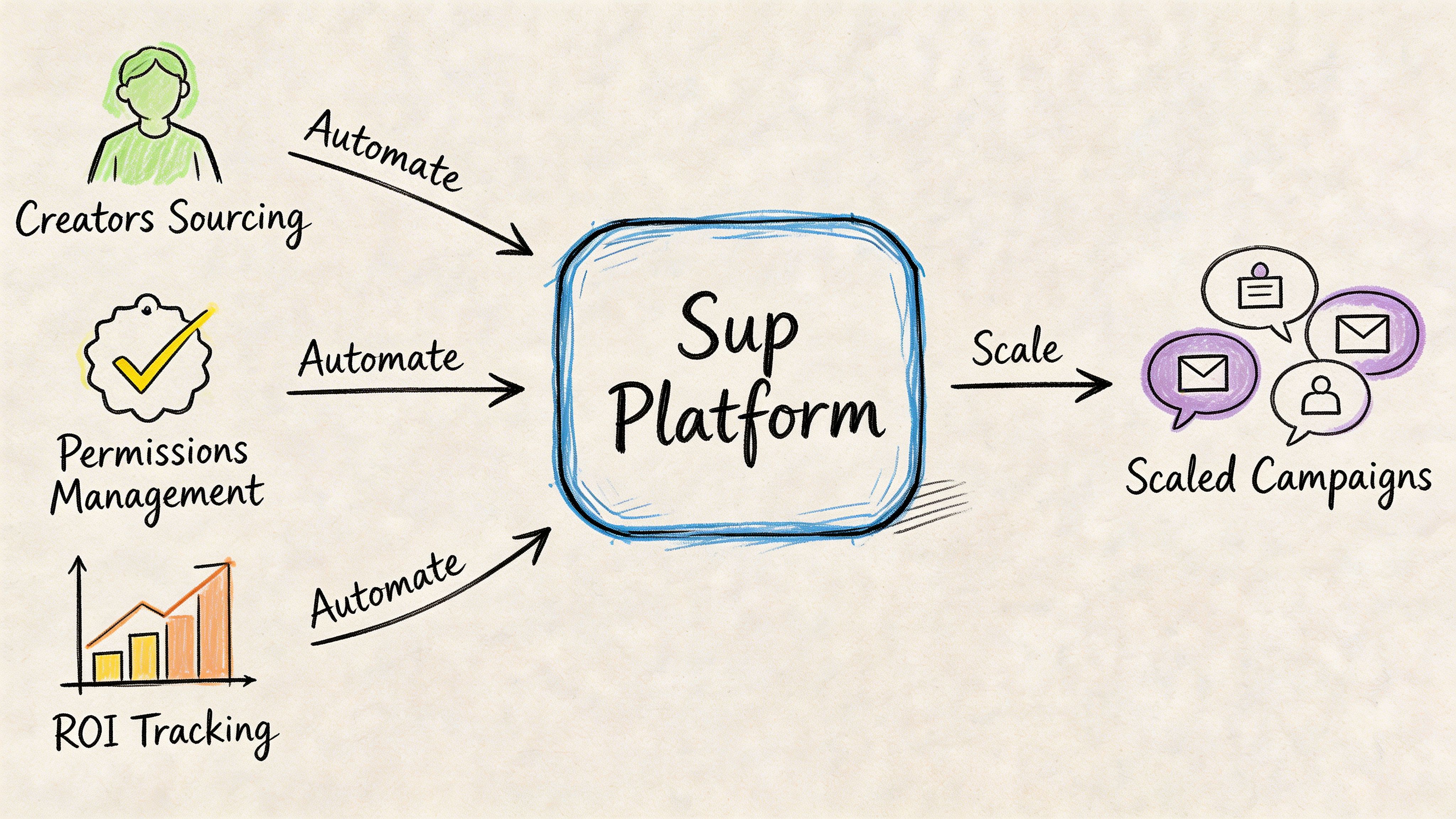
How Sup Automates and Scales Your Whitelisting Strategy
Most whitelisting advice breaks at the point where brands try to operationalise it. Finding the right creators is one workflow. Managing outreach is another. Permissions sit somewhere else. Attribution often lives in a spreadsheet patched together with promo code exports, booking reports, and ad screenshots.
That fragmentation is the primary reason many teams never scale the channel properly.
The operational problem behind most stalled programmes
Multi-location businesses feel this first. A single campaign is manageable. A network of venues, each needing local creators, local tracking, local follow-up, and usable reporting, gets messy quickly.
The friction usually shows up in a few places:
Creator sourcing becomes slow Teams spend too much time finding people who are relevant and available.
Campaign setup is inconsistent One manager briefs creators one way. Another uses a different structure.
Attribution breaks across online and offline actions Clicks are visible. Redemptions, bookings, and venue-level revenue are harder to connect.
Why attribution is the bottleneck
The hardest part of whitelisting is rarely proving that creator-led ads get attention. The harder part is tying that activity to business outcomes, especially in hospitality.
The attribution complexity of whitelisting is a major challenge when brands need to track offline conversions or connect activity to POS systems and reservation platforms. Existing guidance often does not explain how to link whitelisted campaigns to real sales, which is why automated systems use unique promo codes and integrated UTM links to track clicks, conversions, and revenue in one place, as described in this discussion of whitelisting attribution challenges.
What a centralised workflow changes
Platform-led execution matters here. When creator discovery, campaign setup, asset management, and attribution sit in one workflow, whitelisting stops being a collection of manual tasks and starts behaving like a repeatable channel.
A strong system should help with:
Matched creator sourcing Especially important for local campaigns where geography matters as much as niche.
Ready-to-launch campaign structure Briefs, outreach, deadlines, and tracking need to be standardised.
Content collection Teams need a central library for paid reuse and future campaigns.
Closed-loop reporting Views and clicks are useful, but redemption and revenue visibility is what unlocks budget.
Here is what that kind of reporting environment looks like in practice.
The strategic payoff
Once attribution is clear, budget conversations change. Teams can compare creators, offers, locations, and formats with more confidence. They can stop guessing which partnerships are working and start scaling the ones that are.
It is whether your team can run the channel with enough operational control to learn from it every month. This is the true threshold in influencer whitelisting. Not access. Not content volume. Not creator count.
Frequently Asked Questions About Influencer Whitelisting
What is the difference between whitelisting and dark posting
Whitelisting is the permission structure. Dark posting is one way to use it.
A creator can whitelist access to their account identity, and the brand can then run ads that do not appear as normal posts in the creator’s public feed. Dark posts are useful when you want testing flexibility without cluttering the creator’s organic profile.
Can you whitelist content after the original campaign ends
Sometimes, yes, but only if the agreement allows it or the creator approves new terms.
This is why experienced teams negotiate paid usage and access windows before the first post goes live. Trying to reopen rights conversations after a campaign performs well usually slows momentum and can raise the cost of reuse.
What happens when the whitelisting agreement expires
The brand should stop running ads through that creator identity once the access period ends, unless the agreement is renewed.
In practice, teams should set a review date before expiry and decide whether to extend, refresh creative, or archive the asset. Leaving this vague creates unnecessary legal and platform risk.
How should brands evaluate tools for running whitelisting at scale
Look at workflow, not just discovery.
The best tools help with creator sourcing, permissions, communication, content storage, and reporting in one place. If you are comparing the broader category, reviewing different influencer marketing platforms can help you understand how vendors differ in creator management, campaign operations, and analytics.
A good rule is simple. If the tool helps you launch campaigns but does not help you attribute outcomes, you are still carrying a reporting problem.
If you want to turn creator partnerships into a measurable growth channel instead of a series of one-off collaborations, Sup gives your team the infrastructure to do it. It helps brands source local creators, launch campaigns faster, manage outreach and approvals, and track performance through unique promo codes, UTM links, and a central dashboard built for real attribution.

Matt Greenwell
Share