TikTok Influencer Marketing for Restaurants: A Guide to Boosting Bookings

Matt Greenwell
Mar 8, 2026
Picture this: one video of your signature dish goes viral, and suddenly, thousands of local foodies are talking about your restaurant. That’s the very real potential of TikTok influencer marketing for restaurants. It’s your playbook for turning authentic, user-generated content into a full house and a healthy bottom line.
Why Your Restaurant Needs TikTok Influencer Marketing
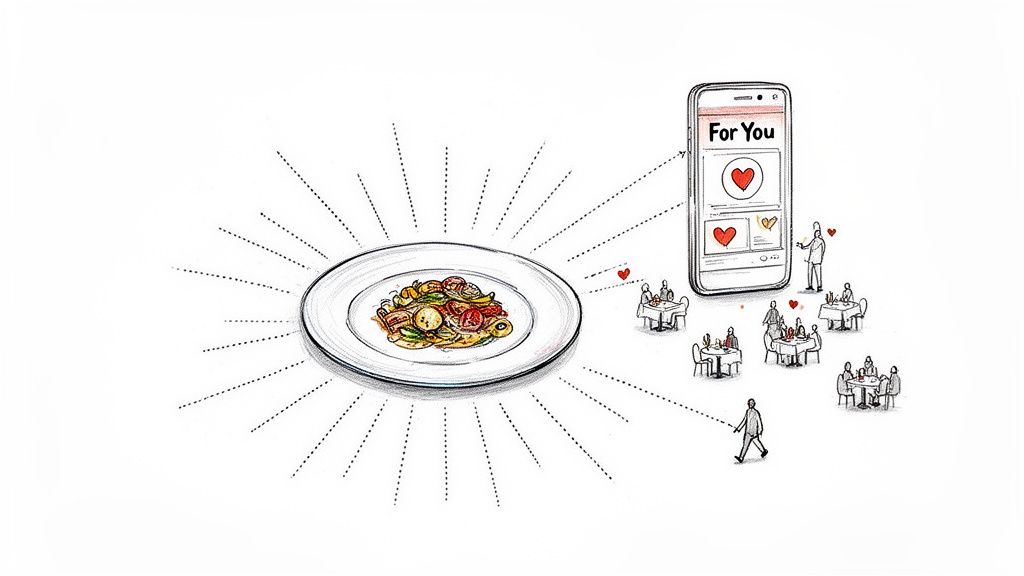
Let's be honest, the old ways of advertising are losing their flavour. When people, especially the younger crowd, are looking for a new spot to eat, where do they turn? It’s not magazines or local radio anymore. They’re scrolling through their 'For You' page on TikTok, hungry for recommendations from creators they genuinely follow and trust.
This isn’t a fleeting trend; it’s a fundamental shift in how people discover and choose where to spend their money. The UK influencer marketing industry is set to become a £5 billion powerhouse, with restaurants right at the centre of this boom. A staggering 66% of UK brands now run influencer campaigns on TikTok—a massive leap from less than 40% just a couple of years back. And with 84% of Gen Z following at least one influencer, you're tapping directly into an engaged and motivated audience.
A Quick Comparison
To put it into perspective, here’s a quick look at how TikTok influencer marketing stacks up against more conventional methods.
Feature | TikTok Influencer Marketing | Traditional Marketing (e.g., Print, Radio) |
|---|---|---|
Authenticity | High. Feels like a trusted friend's recommendation. | Low. Perceived as a direct, often impersonal, advert. |
Targeting | Hyper-local and interest-based via the algorithm. | Broad and less precise; difficult to target specific diners. |
Engagement | High. Users can like, comment, share, and save content. | Passive. One-way communication with no interaction. |
Cost | Flexible and often more cost-effective with high ROI. | High upfront costs with less predictable returns. |
Virality | Content has the potential to go viral organically overnight. | No potential for organic, exponential spread. |
The advantages are clear. For modern restaurants, TikTok offers a more dynamic and effective way to connect with potential customers.
Digital Word-of-Mouth on Steroids
At its heart, TikTok’s algorithm is simply word-of-mouth on a massive, digital scale. When a local food creator posts a video showcasing your incredible Sunday roast or a behind-the-scenes look at your cocktail-making process, it doesn't land like an ad. It feels like a genuine, enthusiastic tip from someone in the know.
That kind of authenticity is priceless. A print advert can tell people your food is good, but an influencer video shows them, creating social proof and a real desire to come and try it for themselves.
The real magic of TikTok is its power to create a sense of community and urgency around a dining experience. A single well-made video can fill your tables faster than any traditional campaign ever could.
To fully grasp the commercial benefits and get to grips with the platform's strategic importance, our complete guide to leveraging TikTok for business success is essential reading. It’s no longer an optional extra; it's a vital tool for driving visibility and, most importantly, getting more people through your doors.
Finding the Right Local Food Influencers
Let's get one thing straight: success on TikTok isn't about chasing the biggest food blogger you can find. It’s about finding the right one. You need to connect with creators whose followers are your ideal customers—real, local people who are genuinely searching for their next favourite place to eat.
This is where the real magic happens, not with massive celebrities, but with nano and micro-influencers. These are the trusted foodies in your own community. Their posts don't feel like a glossy advert; they feel like a recommendation from a friend, and that's the kind of authentic buzz that actually fills your tables.
The most effective restaurant influencer isn't the one with the biggest follower count. It's the one with the highest concentration of local, engaged followers who trust their taste and are likely to act on their recommendations.
Don't just take my word for it; the numbers back this up. Nano and micro-influencers on TikTok are absolute game-changers for UK restaurants, often seeing engagement rates over 60% higher than macro stars. A nano-influencer might pull in a 3.69% engagement rate, while a micro-influencer can hit a seriously impressive 12.4%. This is exactly the kind of interaction that drives real visits, which is why 70% of brands have shifted their focus to these smaller creators. For more on this, you can discover more insights about influencer marketing statistics.
Locating Your Ideal Foodie Partners
So, where do you find these local gems? It takes a bit of digital detective work, but the payoff is huge. Your first port of call should be TikTok itself.
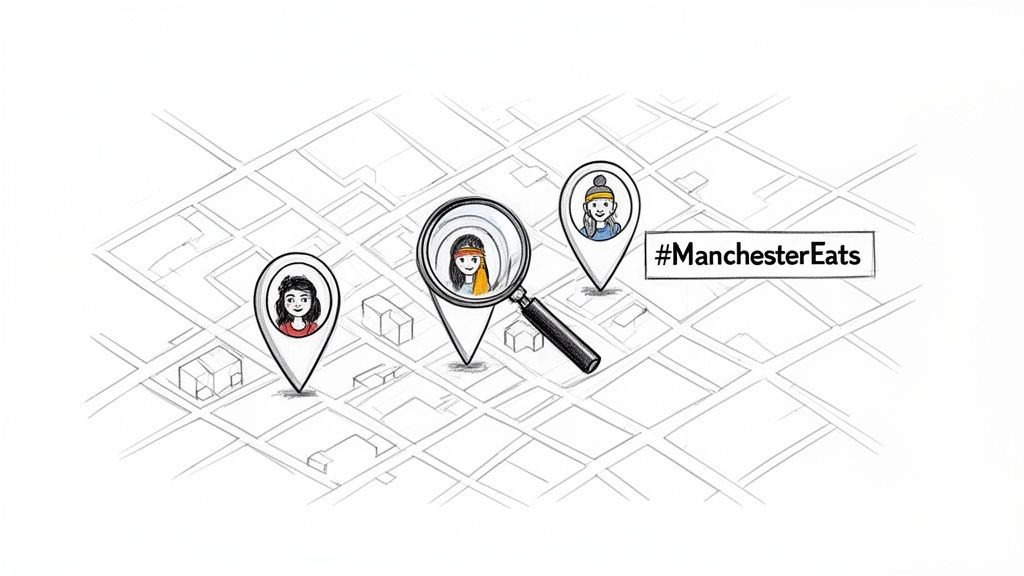
Dig into local hashtags: This is your best starting point. Search for tags like
#LondonFoodie,#BristolEats, or#GlasgowFood. See who pops up regularly and, more importantly, whose posts are getting genuine comments from local people.Check the geotags: Have a look at who’s tagging your restaurant, your competitors, or other popular spots nearby. You’ll often find up-and-coming food creators documenting their meals right on your doorstep.
Analyse their audience: When you find a promising creator, don't stop at the follower count. Dive into their comments. Are they from real people in your city, or are they from bots and other influencers halfway across the world? A local following is what you're after.
Streamlining the Discovery Process
Doing all this sleuthing by hand is effective, but let’s be honest—it’s a massive time sink. Sifting through profiles, vetting their content, and analysing their audience can take hours you just don’t have as a busy restaurant manager.
This is exactly why influencer marketing platforms were created. Think of them as a curated database that connects you straight to vetted, hyper-local creators who are already looking for brand partnerships.
Method | Pros | Cons |
|---|---|---|
Manual Search | It's completely free and you have total control. | Incredibly time-consuming; hard to verify audience data. |
Platform/Agency | Saves you hours of work; gives you access to vetted creators. | It requires a budget; you have slightly less direct control. |
Using a platform can shrink your search time from hours down to minutes. It serves up a pre-qualified list of creators who fit your restaurant's cuisine, vibe, and location perfectly. This means you can spend less time hunting for people and more time building relationships that will actually make a difference. For a deeper dive, you can learn more about finding local food influencers in our dedicated article.
Crafting Your Influencer Campaign Brief
So, you’ve found the perfect local food creators to work with. Fantastic. Now comes the part that can make or break your entire campaign: writing the influencer brief.
Think of it as your recipe. You’re outlining the key ingredients and what the final dish should taste like, but you’re trusting the chef—in this case, the influencer—to add their own unique flair and expertise to make it something special.
A vague request like, "can you do a video about our restaurant?" is a recipe for disaster. It leaves far too much to chance and almost always leads to content that misses the mark. A well-crafted brief, on the other hand, is a clear map. It guides the creator towards your goals without stifling the very creativity you hired them for. It’s the difference between a partnership that feels purely transactional and one that feels like a genuine collaboration.
This document sets clear expectations, spells out what success looks like, and protects both your restaurant and the creator. It’s the foundation you build on, aligning everyone before a single video is shot, ensuring the content you get actually drives real results.
Setting Clear and Measurable Goals
The first, and most critical, part of any brief is defining what you actually want to achieve. A fuzzy goal like "increase brand awareness" is practically impossible to measure, which means you’ll never know if your investment paid off. You have to get specific. What does a win really look like for your restaurant?
Start by translating your business needs into concrete, trackable objectives for the campaign.
Instead of: "Increase awareness."
Try: "Generate 500 clicks to our online booking page using the influencer's unique UTM link."
Instead of: "Get more people in the door."
Try: "Drive 25 new customer bookings using the promo code 'TIKTOK20' within the first two weeks of the post going live."
Instead of: "Promote our new menu."
Try: "Generate at least 15 user-generated content (UGC) posts from customers trying the new seasonal pasta special."
Setting these specific, measurable targets turns a hopeful shot in the dark into a proper marketing strategy with a clear return on investment.
A great campaign brief doesn't stifle creativity; it channels it. By providing clear goals and guardrails, you empower influencers to produce their best work while ensuring it aligns perfectly with your business objectives.
Defining Creative Guardrails and Mandatories
While you want to hand over the creative reins, you still need to protect your brand and make sure the most important messages get across. This is where you set out your creative guardrails and mandatory inclusions. This isn’t about micromanaging their every move; it's about providing the essential direction they need to succeed.
Think of guardrails as the bumpers in a bowling lane—they just keep the ball heading towards the pins, not dictate the exact spin or speed the bowler uses.
Essential elements to include in your brief:
Key Talking Points: What are the one or two things they absolutely must mention? Is it your family’s fifty-year history in the neighbourhood? Your commitment to farm-to-table ingredients? Your new bottomless brunch deal? Keep this list short and punchy.
Visual "Do's and Don'ts": Give some simple visual direction. For example, "Do capture the vibrant colour of our cocktails against the dark bar" or "Don't film in the back corner where the lighting is poor."
The Offer and Call-to-Action (CTA): Be crystal clear. State the exact offer (e.g., "15% off with code FOODIE15") and the precise CTA you want them to use (e.g., "Book your table now through the link in my bio!").
Mandatory Disclosures: This is completely non-negotiable. You must instruct the creator to use clear and obvious disclosures like #ad, #sponsored, or TikTok's own branded content toggle. This is a legal requirement in the UK to ensure everyone is transparent with the audience.
Tracking Links and Codes: Provide the unique UTM link and/or discount code they need to use. And please, double-check that it works before you send it over!
To give them the best shot at success, it’s also a good idea to share what you know works. Pointing them towards a guide on how to make viral TikTok videos, for instance, can give them a strategic edge that helps you both. For even more tips on what to put in your brief, check out our deep-dive guide on how to get food influencers to promote your restaurant.
Managing Your Campaign from Outreach to Approval
Right, you’ve picked your creators and your campaign brief is looking sharp. This is where the rubber meets the road—moving from planning to actually getting things done. The aim here is to ditch the chaotic DMs and messy spreadsheets for a smooth, repeatable process that gets results without driving you, or the creator, mad.
It all kicks off with how you reach out. You have to remember, popular food creators get hit up with collaboration requests constantly. Your message needs to cut through the noise. A lazy "Hey, wanna collab?" will get you nowhere. Show them you've actually looked at their profile, be direct about the opportunity, and attach that campaign brief you worked so hard on. It shows you're serious and professional.
Navigating Negotiations and Compensation
Once a creator shows interest, you'll start talking terms. When it comes to TikTok influencer marketing for restaurants, compensation isn't just about cash. It's a value exchange, and the key is finding a balance that feels fair to everyone.
You'll generally come across three common setups:
Gifted Collaboration: Perfect for nano-influencers or those just starting out. A complimentary meal for them and a friend is often a great trade for a TikTok or two. It's a fantastic, low-cost way to get some authentic content on the board.
Fixed-Fee Collaboration: Once you get into the micro-influencer tier and above, you should expect to pay a fixed fee. This isn't just for a video; it’s for their creative work, their time, and direct access to the loyal audience they’ve built. The rates can swing wildly depending on their follower count, engagement, and exactly what you're asking for.
Hybrid Model: This is often the sweet spot. It's a combination of a gifted experience plus a smaller fixed fee. The creator gets paid for their work, but they also get to experience your restaurant properly, which almost always leads to better, more genuine content.
The secret to a good negotiation is just being straight with people. Be upfront about your budget and what you can offer. A fair deal builds respect from day one and can be the start of a brilliant long-term partnership.
That campaign brief you're sending out? It’s the foundation for this entire conversation. Think of it in three simple parts.
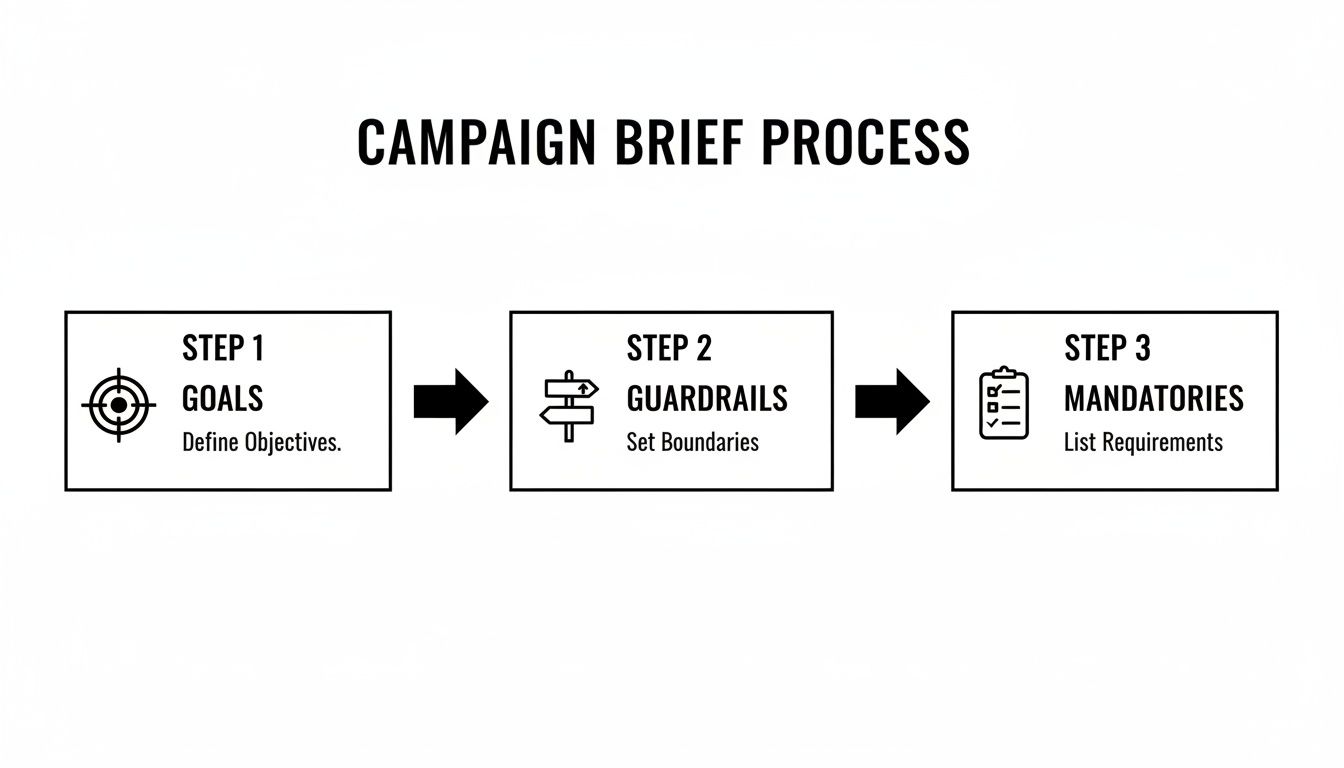
From the very first email, the creator will know your objectives (Goals), the creative do's and don'ts (Guardrails), and the absolute must-haves for the post (Mandatories). No confusion, no nasty surprises.
Establishing a Smooth Management Workflow
With the terms agreed, it’s all about logistics. I’ve seen more restaurant-influencer collaborations fall apart because of sloppy management than for any other reason. You absolutely need a system.
First up, get their visit booked. Chat with the creator to find a time that works for them, but also think about when your restaurant can really shine. A chaotic Saturday night might have a great buzz, but a slightly less manic weeknight could give them the space to capture amazing content without being jostled.
Clear communication is everything. Pick one place for all your campaign chats—email is usually best—and stick to it. This stops vital details from getting swallowed by Instagram DMs. A few days before their visit, send a quick message to confirm the date, time, and who they should ask for when they arrive.
Finally, agree on a simple content review process. This is not your chance to art-direct their video or rewrite their captions. It’s a quick final check for three things:
Are all the mandatories there (like the #ad disclosure)?
Is the unique promo code or tracking link correct and working?
Are there any factual mistakes about your menu, location, or offers?
Show them you respect their creative freedom by giving feedback quickly, ideally within 24-48 hours. This keeps the momentum going and builds goodwill. For restaurant managers juggling a million things, platforms like Sup can be a lifesaver by automating this whole workflow, from the first email to the final approval, saving you hours of admin on every campaign.
Measuring the ROI of Your TikTok Campaigns
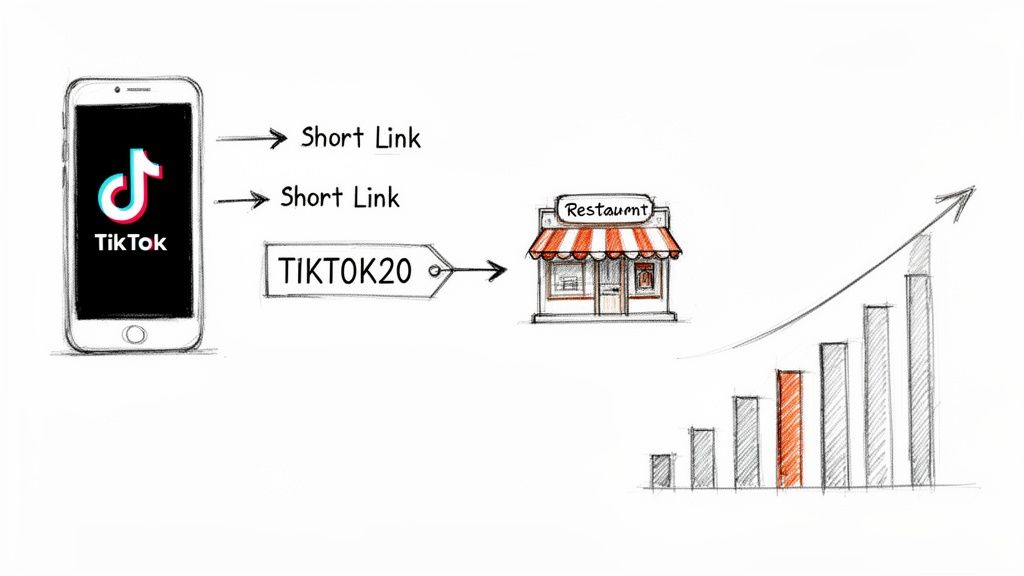
So, your last influencer campaign got thousands of views and likes. That’s great, but did it actually fill seats? In the restaurant business, likes don't pay the bills. It's all too easy to get caught up in "vanity metrics" that look impressive but don't translate into actual revenue.
Let's cut through the noise. The goal is to connect the dots between a creator’s video and a customer walking through your door. It’s the difference between hoping your marketing is working and knowing it is. This section will show you how to do just that, with simple but powerful tracking methods.
How to Track What Truly Matters
A viral video is fantastic for brand awareness, but a video that drives a flood of bookings is what really moves the needle. To measure the true success of your TikTok influencer marketing for restaurants, you need to track the actions that directly impact your bottom line.
This means setting up a solid tracking system before your campaign launches. Here are the two most effective tools in your arsenal:
Unique Discount Codes: This is the classic, and for good reason—it works. Give each influencer their own unique code (like ‘SOPHIE20’ or ‘TASTE15’). When a customer uses that code for a discount on their bill or online order, you know exactly who sent them. Simple and direct.
UTM-Tagged Booking Links: Don't let the acronym intimidate you. A UTM is just a small piece of code you add to a URL to see where your web traffic comes from. Give each influencer a unique booking link to put in their bio. Your reservation system (or even Google Analytics) will then show you precisely how many clicks and, more importantly, how many confirmed bookings each creator generated.
These two methods create a clear, undeniable line from an influencer’s content to a paying customer.
You don't need a massive analytics team to prove your marketing is working. A well-organised spreadsheet with unique promo codes and trackable links is often all it takes to see which partnerships are actually delivering the goods.
The Key Metrics on Your Dashboard
To truly understand performance, you need to look beyond surface-level numbers. Here’s a breakdown of the metrics that matter, from initial engagement right through to business results.
Key Metrics for Restaurant Influencer Campaigns
Metric | What It Measures | How to Track It |
|---|---|---|
Reach & Impressions | How many people saw the content. | TikTok Analytics |
Engagement Rate | How much the audience interacted with the content (likes, comments, shares). | (Likes + Comments + Shares) / Views |
Link Clicks | How many people were interested enough to click the booking or menu link. | UTM-tagged links in your analytics platform. |
Code Redemptions | The number of customers who used a specific influencer's discount code. | Your Point of Sale (POS) system. |
Bookings/Orders | The number of direct reservations or orders driven by an influencer. | UTM tracking for online bookings; code redemption for walk-ins. |
Cost Per Acquisition (CPA) | How much you spent to get one new customer. | Total Campaign Cost / Number of New Customers |
Return on Investment (ROI) | The ultimate measure of profitability. | The formula outlined below. |
By tracking this full funnel of metrics, you get a complete picture of your campaign's health and can spot exactly where to optimise for better results next time.
Calculating Your Return on Investment
Once you have your data, calculating your Return on Investment (ROI) is straightforward. It’s the clearest way to see if your spend was worth it.
Here’s the formula:
ROI = [(Revenue from Campaign - Cost of Campaign) / Cost of Campaign] x 100
Let's walk through an example. Say you paid an influencer £200 for a collaboration. By tracking their unique discount code, you see their followers spent a total of £1,000 at your restaurant.
ROI = [(£1,000 - £200) / £200] x 100
ROI = [£800 / £200] x 100
ROI = 4 x 100 = 400%
A 400% ROI means for every £1 you invested in that campaign, you generated £4 in net revenue. Now that’s a number you can take to the bank. This kind of data-driven approach is vital for making smarter decisions and focusing your budget on the creators who deliver real results.
For a deeper dive into this crucial topic, you can check out our guide on how to measure influencer marketing ROI and learn what really makes a difference.
Squeezing Every Last Drop Out of Your Campaign Wins
Getting a great influencer post live feels like a victory, but it's really just the starting whistle. The initial buzz is brilliant, but the real, lasting value comes from what you do with that content after it's been posted. Think of a fantastic creator video as a prime marketing ingredient. Your job is to use it to its full potential, turning a single win into ongoing momentum for your restaurant.
This is the point where you shift your thinking from one-off campaigns to building a powerful, self-sustaining marketing machine. A viral video has a shelf life, but the authentic, high-quality footage can keep working for your brand for months if you have a smart plan. It's all about looking beyond the initial post and maximising the return on every single partnership.
Repurposing Content for Maximum Impact
The very best TikTok influencer marketing for restaurants will leave you with a goldmine of what we call user-generated content (UGC). This is genuine, customer-focused marketing material you didn't have to film or produce yourself. But here’s the catch: to use it, you absolutely must secure usage rights in your initial agreement with the creator. This is a non-negotiable step.
Once you have those rights, you can get incredibly creative. That amazing video showing off your signature cocktail doesn't just have to sit on the creator's profile. You should be putting that high-performing content to work everywhere.
Your Website: Embed the video on your homepage or menu page. It provides instant social proof and shows visitors what the experience is really like.
Your Social Media: Share the video across your own Instagram, Facebook, and even TikTok accounts, always tagging the original creator.
Digital Ads: The best-performing UGC can be turned into fantastic video ads for platforms like Meta or TikTok. Use them to target local audiences who look like the creator's followers.
Email Newsletters: Drop the video into your next email blast to give your subscribers a compelling reason to come in and book a table.
Repurposing influencer content is like a chef turning one great ingredient into multiple dishes. It stretches your marketing budget, extends the content's life, and builds your restaurant's credibility across every channel you use.
From One-Offs to an Ambassador Programme
After you’ve run a few successful campaigns with local creators and have your process down, you'll naturally start thinking bigger. One-off collaborations are a great starting point, but trying to manage five, ten, or even twenty at once—especially if you have multiple locations—can quickly become a chaotic mess of spreadsheets and emails.
This is the perfect time to build a proper ambassador programme. Instead of one-time projects, you forge long-term relationships with a core group of creators who are genuine fans of your restaurant. These ambassadors become your consistent advocates, regularly creating content and talking about your restaurant to their loyal local audiences.
The Right Tools for Scaling Up
As your programme grows, so does the admin. Trying to juggle outreach, negotiations, content approvals, and payments is simply not sustainable with manual methods. To grow without getting overwhelmed, you'll need the right tools for the job.
This is where influencer management platforms come in. They bring the entire workflow—from finding creators to paying them—into one central place. A platform like Sup can automate your outreach, handle the back-and-forth of scheduling, and track all your results on a single dashboard. This saves an enormous amount of time, freeing you up to focus on what really matters: building relationships and figuring out what's driving results. It turns influencer marketing from a series of scattered tasks into a repeatable, scalable, and profitable way to grow your restaurant.
Your Top Questions About Restaurant Influencer Marketing Answered
Alright, let's talk about those last few nagging questions you might have before diving into the world of TikTok influencer marketing. It’s totally normal to feel a bit hesitant before putting your time and money on the line. We’ll clear up the most common concerns right here, so you can get started with confidence.
Think of this as a final, practical chat to iron out the details. We’re covering the big three: what it costs, how to handle potential bad feedback, and the legal rules you can't afford to ignore.
How Much Should I Actually Budget for My First Campaign?
Let's get straight to the money question—it's the one everyone asks. The great news is, you don't need a massive budget to get started. In fact, you can kick things off with very little financial outlay.
For your first run, I always recommend focusing on gifted collaborations. This means reaching out to local nano-influencers (creators with 1,000 to 10,000 followers). Often, the offer of a complimentary meal for two is more than enough to get a fantastic, authentic TikTok video made for your restaurant. It’s a brilliant way to test the waters, build some local buzz, and see what works without a big risk.
Once you’ve seen the results and feel more comfortable, you can start exploring paid posts. These can range from £50 to a few hundred pounds, all depending on the creator's following and engagement rates.
Start small and prove the concept to yourself first. A gifted meal is a low-risk investment that can pay for itself many times over in content and customers, while giving you priceless insights for bigger campaigns down the road.
What if an Influencer Has a Bad Experience?
This is a completely fair concern, but it happens far less than you'd imagine, especially when you set things up properly. Professional food creators see themselves as partners. Their goal is to find and share places they genuinely love, not to tear businesses down.
If something isn't quite right during their visit—say a dish is served cold or there’s a long wait—a true professional will almost always give you that feedback privately. This gives your team a chance to make it right then and there. To get ahead of this, just make sure your staff knows when an influencer is coming in so everyone can be on their A-game. A clear brief and good communication are the best ways to ensure everything goes smoothly.
What Are the Legal Rules for Disclosure in the UK?
This part is absolutely non-negotiable. In the UK, both the Advertising Standards Authority (ASA) and the Competition and Markets Authority (CMA) have strict rules. Any time money or a free product (like a meal) is exchanged for a post, it must be crystal clear to anyone watching that it's an advert.
The creator must use obvious identifiers like #ad, #advert, or #sponsored right at the beginning of their caption. Vague terms like "gifted" or "collab" just don't cut it anymore. TikTok also has a built-in branded content toggle, which is another excellent tool to ensure you’re compliant. Make sure this is a mandatory point in your campaign brief—no exceptions.
Ready to put all this into practice without the usual headaches? Sup is built to manage the entire process for you. We mix smart technology with a real human touch, helping you find vetted local creators, track your return on investment in real time, and save 95% of the time it would normally take. Let us help you launch campaigns that put bums on seats.
Get started with Sup and see how easy it is to grow your restaurant.
Matt Greenwell
Share