For many UK brands, a powerful influencer platform like Upfluence can feel like a double-edged sword. On one hand, you have a vast feature set; on the other, a hidden cost of overwhelming complexity. The search for an Upfluence alternative often boils down to a single, crucial need: influencer marketing without the headache.
A simpler, ‘done-with-you’ approach is gaining ground, replacing steep learning curves and tedious manual outreach with guaranteed, measurable results.
Is Your Influencer Platform Too Complicated?
It’s no secret that influencer marketing has become a powerhouse for e-commerce and DTC brands across the UK. The market was valued at a staggering £1.05 billion in 2023, a figure that reflects a 42% year-on-year growth. But this boom has exposed a central challenge.
While sophisticated platforms are readily available, their feature-heavy, do-it-yourself models often swamp smaller teams. You can dive deeper into this trend and how it’s shaping platform choices in this detailed analysis of the UK market.
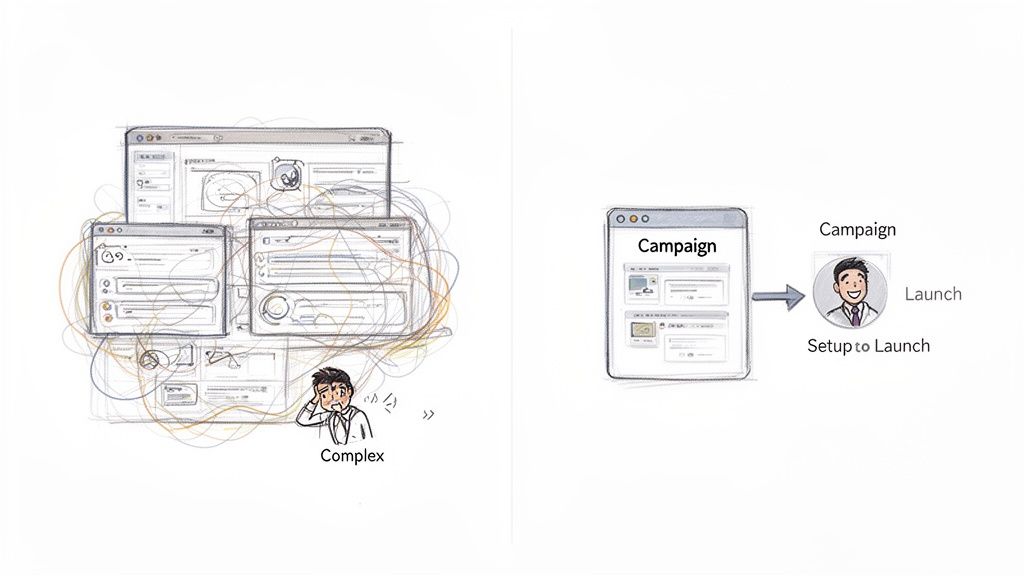
The Hidden Costs of Complexity
I hear this all the time from marketing managers, whether they're running an e-commerce startup or a multi-location restaurant chain. They feel bogged down. The initial promise of an all-in-one solution quickly evaporates when you’re faced with a brutal learning curve, endless hours of manual creator outreach, and opaque pricing.
The problem isn't a lack of features; it's an excess of them. When your platform demands a dedicated team member just to run it, you have to seriously question the ROI. This is especially true for businesses that need to be agile and can't afford to lose weeks to onboarding and campaign setup.
The DIY, feature-heavy model often hinders growth rather than enabling it. The real cost is not just the subscription fee, but the time, resources, and momentum lost to unnecessary complexity.
A New Approach to Influencer Marketing
So, what if you could get the results without all that friction? This is precisely where a ‘done-with-you’ model emerges as a compelling alternative to Upfluence. Instead of handing you a blank canvas and a complex toolkit, this approach simplifies the entire process from start to finish.
This new breed of platform, like our own here at Sup, is built from the ground up for efficiency and clear ROI. The focus shifts from wrestling with software to what actually matters: building relationships and driving real outcomes.
Here’s a quick look at how the two philosophies stack up:
Feature | The Complex DIY Model (Upfluence) | The Simple 'Done-With-You' Model (Sup) |
|---|---|---|
Onboarding | Lengthy setup and training required | ~20-minute setup, intuitive interface |
Creator Sourcing | Manual database searches and vetting | AI-powered matching with human verification |
Campaign Launch | Requires manual brief creation and outreach | Pre-built campaigns, automated communication |
ROI Tracking | Complex analytics needing configuration | Built-in, real-time attribution from day one |
Ultimately, choosing an influencer marketing platform is about finding a true partner—one that helps you hit your goals with the least amount of friction. For brands tired of being bogged down by complexity, the answer lies in platforms designed to deliver results, not just features.
Comparing Upfluence To A Simpler Alternative
When you start looking for an Upfluence alternative, it’s usually not about finding a slightly different feature list. It’s about wanting a whole new way to run influencer campaigns. You’re likely tired of the complex, do-it-yourself grind and looking for something more automated, efficient, and focused on clear results.
This is where you see two completely different mindsets at play. On one hand, you have the traditional, all-in-one toolkit from platforms like Upfluence. They give you everything you could possibly need, but you're the one who has to build the car and drive it. On the other hand, you have a ‘done-with-you’ platform like Sup, designed from the ground up to take the heavy lifting off your plate so you can actually focus on strategy.
Let's unpack what that really means for the day-to-day tasks that take up your team's time.
Workflow Comparison: Upfluence vs. Sup
To get a clearer picture, it helps to see the two approaches side-by-side. The table below breaks down the core differences in how you'd actually get work done on each platform, from finding creators to seeing your results.
Key Workflow | The Upfluence Approach (Complex DIY) | The Sup Approach (Simple Done-With-You) |
|---|---|---|
Onboarding & Setup | Weeks-long process with multiple training sessions required before you can confidently start. | A single 20-minute onboarding call. You can set up your first campaign the same day. |
Creator Sourcing | Manually search a vast database, apply filters, and vet each profile yourself. | Define your ideal creator, and the platform's AI matches and vets relevant influencers for you. |
Campaign Management | Build everything from scratch: outreach emails, contracts, tracking links, and follow-up reminders. | Use pre-built campaign templates that automate outreach, agreements, and scheduling. |
Attribution & Reporting | Requires manual setup of tracking links and potential integration with other tools for a full picture. | Attribution is built-in. Unique codes and links are created automatically, offering real-time sales and ROI data. |
As you can see, the difference isn't just in the features offered, but in the entire philosophy of how your time should be spent. One demands your constant manual input, while the other aims to eliminate it.
Onboarding Speed And Initial Setup
First impressions matter, and how quickly you can get a new tool working for you sets the stage for everything else. This is one of the most immediate differences you'll feel.
Upfluence is a powerful enterprise tool, and with that power comes a hefty onboarding process. You're often looking at multiple training sessions, custom configurations, and a learning curve that can take weeks before your team is truly comfortable launching a campaign.
A simpler alternative is built for speed. The entire point is to get you up and running in minutes, not months.
Upfluence Approach: A long onboarding that requires dedicated training and a bespoke setup. Launching your first campaign can easily take several weeks.
Sup Approach: A quick, 20-minute onboarding process. The platform is designed to be intuitive, letting you jump right in and build your first campaign almost immediately.
This initial time sink has a real knock-on effect. A sluggish start can throw your campaign timelines off and kill your team's momentum, whereas getting set up quickly allows you to be more agile, test ideas, and learn faster.
Creator Sourcing And Vetting
Finding the right people to partner with is the heart of any good campaign. Upfluence gives you a massive database and some impressive search filters, but the work of finding gems is still very much a manual job. Marketers end up spending hours scrolling through profiles, checking for authenticity, and managing all the initial outreach themselves.
This is where a simpler tool brings a major efficiency boost by flipping the script from searching to matching.
Key Insight: It’s not about who has the bigger database; it’s about the intelligence used to navigate it. Automated matching based on your specific needs—niche, location, past performance—saves dozens of hours compared to endless manual filtering.
With an engine like Sup, you simply describe your perfect creator—say, a London-based food blogger with great engagement on TikTok—and the system automatically finds and verifies people who fit the bill. A job that used to be a laborious search now becomes a simple, automated step. No more sending hundreds of DMs or losing track of conversations in a spreadsheet.
This screenshot from a popular industry blog nails the frustrations many users have with these complex platforms.
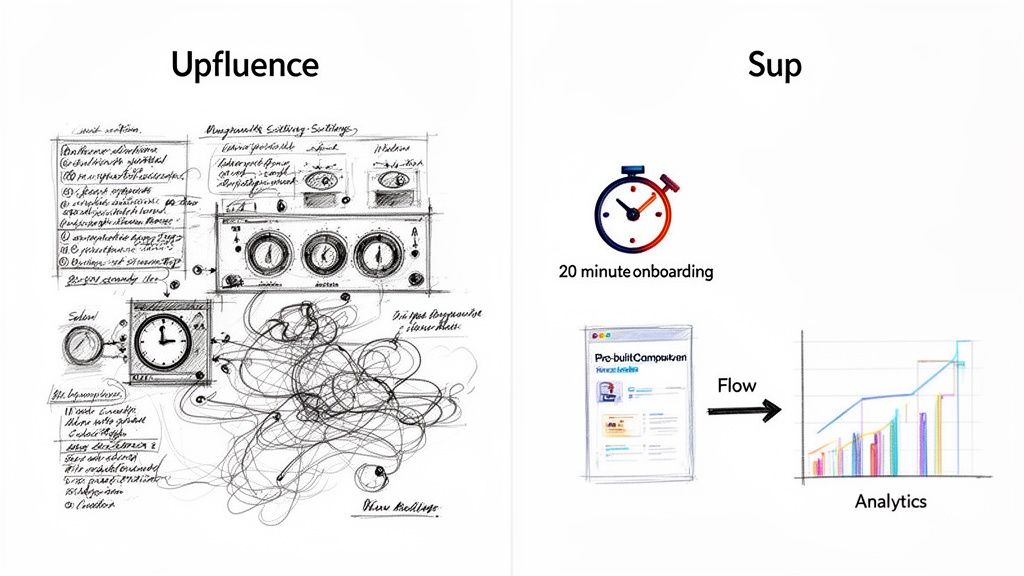
The image says it all. While powerful, these tools often come with a frustrating learning curve and performance issues that send people searching for more flexible and user-friendly options.
Campaign Management And Execution
Once you've found your creators, the real work begins. Managing the campaign is another area where the two approaches couldn't be more different.
On a traditional platform, you're responsible for every little detail. You have to write the outreach messages, negotiate the terms, create unique tracking links for everyone, and chase them for updates. If you're a multi-location business trying to work with local influencers, or a DTC brand launching a new product, this manual approach becomes a nightmare to scale.
Let's walk through what this looks like for a UK-based DTC brand launching a new skincare line:
Upfluence Workflow:
Manually search for 50 beauty micro-influencers across the UK.
Individually email or DM each one with a personalised pitch.
Negotiate rates and contracts one by one.
Create and distribute 50 unique discount codes and UTM links.
Manually track who has posted and follow up with those who haven't.
Sup Workflow:
Choose the "Product Seeding" campaign template.
The system identifies and contacts 50 vetted beauty influencers on your behalf.
Automated outreach handles the initial messages and gets agreements sorted.
Unique promo codes and tracking links are automatically generated and assigned.
The platform sends posting reminders and collects the content for you.
This simpler, automated workflow can cut down the time you spend on admin by up to 95%. That gives the marketing manager freedom to focus on what really matters—building relationships and analysing what’s working—instead of being buried in operational tasks. It's this exact search for influencer marketing without the complexity that leads brands to a new way of working.
Performance Reporting And Attribution
At the end of the day, you have to prove your work is paying off. Upfluence has a powerful analytics suite, but just like its other features, it can be a beast to configure correctly. To get meaningful attribution data, you might find yourself connecting other tools and manually stitching together the customer journey.
A more streamlined alternative has attribution baked directly into the workflow from the very beginning. There’s no complicated setup because the system is already designed to track outcomes automatically.
Every single creator collaboration is tied to a unique promo code and tracking link. This gives you a clear, real-time dashboard showing exactly what's happening. You can see instantly which influencers are driving views, clicks, sales, and, most importantly, revenue. This built-in clarity makes it incredibly simple to show ROI and make smarter decisions for your next campaign—which is the whole point of a true Upfluence alternative.
How To Measure Influencer Marketing ROI
Moving past a simple feature list, the real difference between platforms often comes down to results. For any marketer, proving a return on investment (ROI) is the end game. But getting to that clear, provable ROI can either be a straight line or a tangled mess, and your tools make all the difference.
While powerful platforms like Upfluence boast extensive analytics suites, they can also demand a lot of setup and technical know-how to get meaningful data. It's a common frustration: marketing teams end up drowning in metrics but struggling to connect specific influencer posts to actual sales, which completely undermines the programme.
The Challenge of Attribution
To really gauge what your influencer campaigns are achieving, you have to get your head around understanding marketing attribution. It’s the process of giving credit where credit is due—pinpointing which touchpoints actually led a customer to make a purchase.
For UK marketing agencies, this is a massive headache. In fact, a staggering 72% name ROI tracking as their biggest challenge with influencer campaigns, pointing the finger at poor attribution tools. The same report found that only 41% of campaigns are even using basic tools like promo codes or UTMs effectively. This shows a huge gap between what marketers want to achieve and what their tools allow them to do.
With a complex system, you’re often stuck manually creating unique tracking links for every influencer, then painstakingly trying to piece together data from different sources. It's not just slow and tedious; it's a recipe for error, making it incredibly difficult to justify your budget or figure out what’s actually working.
Simplified Attribution That Just Works
This is where a simpler tool like Sup changes the game. It doesn't treat attribution as an add-on; it's built right into the campaign workflow from the very start. The best part? It requires zero manual setup from you.
Every single creator collaboration automatically uses a two-pronged tracking approach:
Unique Promo Codes: Each influencer gets their own discount code. This makes it dead simple to see every sale they drive, right from your own e-commerce dashboard.
UTM Tracking Links: Every link an influencer shares is automatically tagged with the right UTM parameters. You can trace the customer's entire journey, from their social post all the way to your website.
This dual-method system gives you a complete, real-time view of the entire sales funnel. You can instantly see impressions, clicks, how many times a code was used, and—most importantly—the actual revenue each influencer has generated.
The most effective way to measure ROI isn't about having more charts and graphs. It's about having integrated, trustworthy data that tells a clear story from the content right through to the conversion. When attribution is simplified, it removes the guesswork and lets you focus on performance with real confidence.
From Vague Metrics To Real Revenue
Let’s put this into a real-world context. Imagine a London-based café wanting to promote its new brunch menu by working with local food bloggers.
The Complex Approach: The marketing manager spends hours creating separate UTM links for each blogger's Instagram story. Later, they have to manually pull click data and try to match it up with booking numbers, essentially just hoping to spot a trend.
The Simple Approach: With Sup, each blogger receives a unique booking link and a special code for a free coffee with their meal. The café’s dashboard immediately shows exactly how many table bookings and code redemptions each influencer drove, all in real-time.
That level of clarity is a game-changer. You’re no longer operating on vanity metrics like likes and comments. Instead, you're working with cold, hard data that ties influencer activity directly to business outcomes, whether that’s online sales for an e-commerce brand or bookings for a restaurant.
This integrated system delivers the clarity that performance-focused marketers need. When you can confidently show a £4 return for every £1 spent, as many Sup users do, influencer marketing stops being an experiment and becomes a reliable engine for growth. To learn more, take a look at our guide on how to measure influencer marketing ROI effectively.
Which Influencer Platform Is Right for Your Business?
Choosing an influencer platform isn't a one-size-fits-all decision. The right tool depends entirely on your business, your goals, and how much time your team can realistically spend managing it. While a powerhouse platform like Upfluence looks impressive with its endless features, that complexity can quickly become a bottleneck for businesses that need to move fast and see clear results.
Often, the best Upfluence alternative is a platform that’s built for your specific job. A simpler, ‘done-with-you’ approach can deliver far better outcomes because it’s designed for a particular task, whether that’s getting locals into your restaurant or scaling a product seeding campaign.
This decision tree gives you a quick visual guide to see whether a complex or simple path makes more sense for your ROI goals.
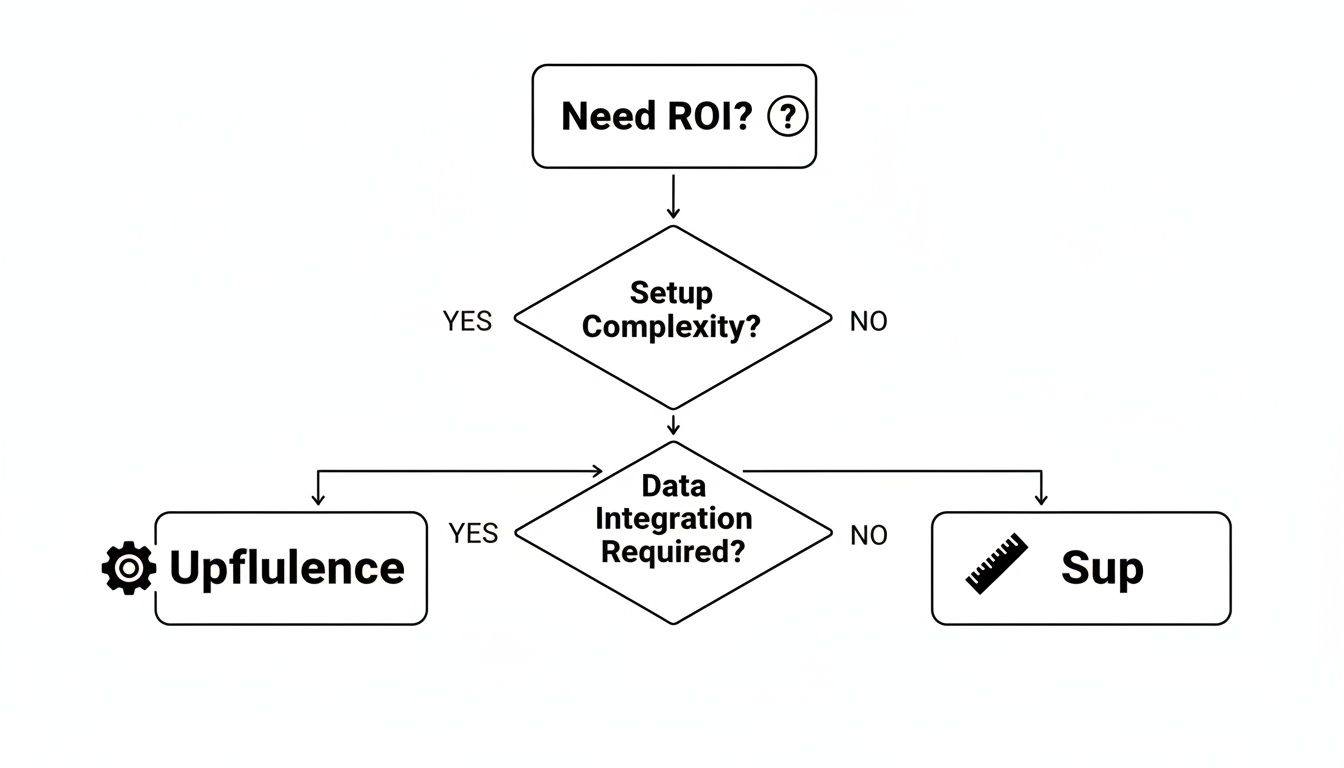
As the flowchart shows, there’s a clear fork in the road. If you need straightforward, built-in ROI tracking, a simpler platform gets you there faster. On the other hand, a platform with more intricate analytics usually demands a much heavier setup.
Restaurants And Hospitality
For cafés, restaurants, and hotels, the goal is simple: get more people walking through the door. You measure success in filled tables, new bookings, and local word-of-mouth. This calls for a hyperlocal strategy, focusing on nano-influencers who have a real, trusted voice in their community.
A massive, complex platform is often overkill. You don’t need a global database of creators; you need to find the best food bloggers in a specific London neighbourhood. A focused tool automates that discovery, connecting you with local creators who can actually drive footfall.
Real-World Example: A London café wants to pack its weekend brunch service. Instead of spending weeks digging through Instagram, they use Sup to automatically find and partner with ten local foodies. Each creator gets a unique booking link, and the café sees a 22% increase in brunch reservations over the next month, all tracked without lifting a finger.
E-commerce And DTC Brands
Direct-to-consumer brands live and die by their ability to scale. Your main goals are usually to scale product seeding, generate masses of user-generated content (UGC), and, most critically, track sales. A platform that gets you bogged down in manual outreach and reporting is a serious growth killer.
This is where a simpler Upfluence alternative really comes into its own. By automating the outreach, fulfilment, and tracking, you can run campaigns with dozens or even hundreds of creators without having to hire a full-time manager.
For e-commerce, it's all about volume and velocity. A platform that handles the campaign logistics for you frees you up to focus on creative strategy and turning that top-performing UGC into powerful ad campaigns, multiplying your ROI.
Think about it: a UK-based sustainable fashion brand could send its new collection to 50 micro-influencers in just a few days. The platform handles all the back-and-forth and gathers the content, giving them a library of authentic assets ready for paid social ads that drive direct sales. Making this choice correctly from the start is vital, and you can get more detailed advice in our article on how to choose between influencer marketing platforms.
Marketing And PR Agencies
For agencies, time is money. You deliver value through strategy and results, not by getting stuck in the weeds of campaign admin. A complex, DIY platform forces your team to become software operators, pulling them away from the high-value work that clients pay for.
A ‘done-with-you’ engine, however, acts more like an operational partner. It automates the tedious jobs—sourcing, outreach, follow-ups, reporting—so your account managers can focus on client relationships and big-picture strategy. The built-in attribution provides the clean, concise ROI reports clients love, making it easy to prove your agency's worth.
Multi-Location Chains And Franchises
Scaling influencer marketing across dozens of locations brings its own unique headache. You need to find hyper-local creators for each branch, a task that’s nearly impossible to do manually without a massive team. For UK-based chains, local micro-influencer campaigns are gold, yet 65% struggle with manual sourcing.
Here, automation isn't just a nice-to-have; it's essential. Nano-influencers (under 10k followers) deliver 22x higher engagement than macros in the UK, driving 28% more conversions for local businesses. Simplified tools automate this local discovery and track metrics like a 22% increase in bookings for hospitality and an average 4.2x ROI. You can dig into more of the data behind these trends in this insightful report on influencer marketing platforms.
By matching the platform to your business model, you sidestep the common pitfalls of unnecessary complexity and turn influencer marketing into a predictable, scalable, and profitable way to grow.
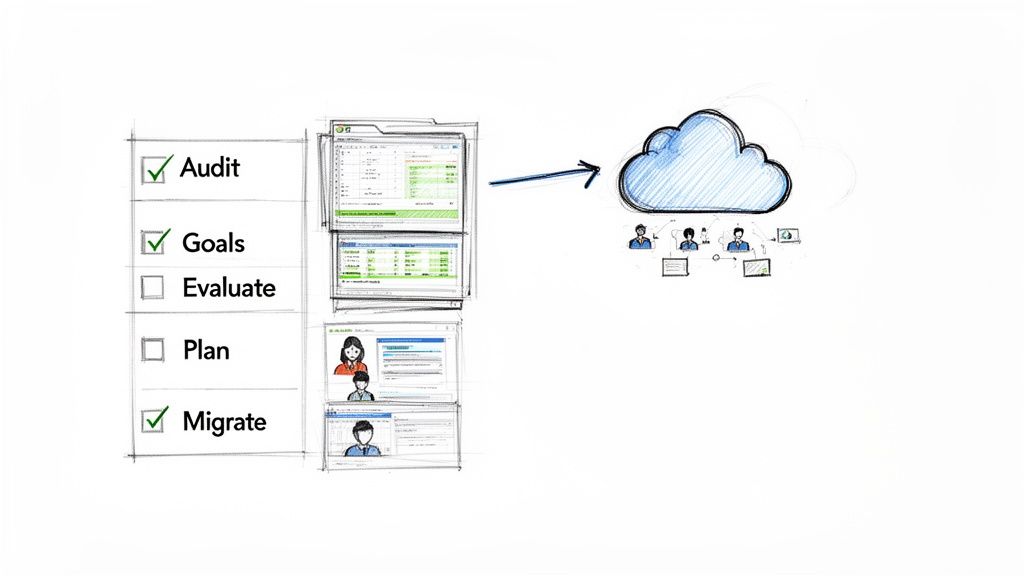
Your Migration Checklist For A Simpler Platform
Thinking about moving on from a complex system or a mess of spreadsheets? The idea can feel overwhelming, but switching to a simpler Upfluence alternative doesn't have to be a major headache. With the right game plan, the transition can be surprisingly smooth and, frankly, a huge relief.
This isn't about a massive, disruptive overhaul. Instead, think of it as a series of straightforward steps that will lead you to a much more effective influencer marketing programme.
Audit Your Current Process
Before you even think about new tools, you need to take an honest look at your current setup. It’s the only way to know what you’re really trying to fix.
Time Tracking: Get specific. How many hours a week is your team really spending on manual work like finding creators, sending outreach emails, and pulling reports?
Performance Review: Look at your past campaigns. Who were your star performers? What did those successful partnerships have in common?
Pain Points: What are the biggest bottlenecks and frustrations? Is it the glacial pace of outreach, the inability to prove ROI, or just the sheer complexity of your current software?
This audit gives you a solid baseline. You’ll go from a vague feeling of "this could be better" to a concrete list of must-haves for your new platform.
Define Your Migration Goals
Now that you know the problems, you can set clear goals for the solution. These shouldn't be fuzzy aspirations; they need to be measurable targets that directly address the pain points you just uncovered.
For example, "save time" is a weak goal. A strong goal is "reduce campaign administration time by 80%."
A successful migration isn't about finding a platform with the most features. It's about finding the right one that helps you achieve your specific outcomes. Know what success looks like before you start your search.
Here are a few examples of what strong migration goals look like:
Launch our first new campaign within 48 hours of getting access to the platform.
Achieve a clear, real-time view of sales attribution for 100% of our creators.
Source and secure 20 new hyper-local influencers every month, automatically.
These goals become your compass, guiding you as you evaluate different platforms.
Migrate Your Existing Relationships
One of the most common worries we hear is, "What happens to all our existing creators?" A good platform should make this part easy. You’re not starting from zero; you're just moving your trusted partners into a better home.
Most modern platforms let you import your creator lists without any fuss. Once they’re in the new system, you can manage everything—communications, payments, and performance tracking—all in one place, right alongside any new creators you find.
This is also a great opportunity to make sure all your legal agreements are in order. You can learn more by checking out our complete guide to influencer contracts and agreements.
Ultimately, switching to a simpler platform is a strategic move for growth. By following this checklist, you can turn a daunting task into a simple plan, setting your brand up for a far more efficient and profitable future in influencer marketing.
Why Simplicity Is The Future Of Influencer Marketing
There’s a clear message we’re hearing from UK brands: the old way of doing influencer marketing is broken. For years, the prevailing wisdom was that more features meant more power. But in reality, this has often led to overwhelming complexity, countless wasted hours, and a frustrating lack of clarity on ROI. Choosing a simpler Upfluence alternative isn't about settling for less; it's about taking a smarter, more direct route to getting real results.
This modern approach is all about freeing your team from the manual grind of outreach, negotiation, and spreadsheet chaos. The aim? To make influencer marketing as predictable and scalable as the rest of your performance channels.
Embrace a Less Complex Future
By automating the most repetitive and time-consuming tasks, a 'done-with-you' platform like Sup enables brands to get campaigns live in minutes, not weeks. This efficiency can save up to 95% of your team's time, turning what was once a high-effort, low-visibility chore into a reliable engine for growth. This is part of a wider trend where creators and marketers are adopting smart tools, such as those that produce AI-generated video descriptions, to focus on what truly matters.
The real measure of a platform’s value isn’t how many features it boasts, but how quickly and reliably it delivers business outcomes. Simplicity is the ultimate accelerator for growth.
This shift finally gives businesses of all sizes—from a local London café to a national e-commerce brand—the power to make influencer marketing a consistently profitable and even enjoyable part of their strategy. It’s a return to focusing on what’s important: building genuine relationships and watching the results roll in.
For any UK brand feeling stuck in complexity and ready to prioritise results, the next step is simple. It's time to see how a more straightforward approach can completely change your influencer marketing efforts.
Frequently Asked Questions
Switching influencer marketing platforms can feel like a big step, so it’s natural to have questions. Here are some straightforward answers to the things we’re most often asked by UK brands looking for a simpler, more effective Upfluence alternative.
What’s The Difference Between A 'Done-With-You' Platform And An Agency?
Think of a traditional agency as a chauffeur. You hand over the keys to your influencer strategy, they do all the driving, and you pay a hefty retainer, often without seeing exactly how they get from A to B.
A ‘done-with-you’ platform like Sup is more like having a co-pilot. We give you the high-tech dashboard and automated systems to run things smoothly, plus the expert guidance when you need it. You stay firmly in the driver’s seat, making all the strategic decisions. It’s the ideal blend of in-house control and expert support, without the agency price tag.
Can I Bring My Existing Influencers Onto A New Platform?
Absolutely, and you should insist on it. Moving your roster of trusted creators is a non-negotiable, and any good platform will make this dead simple.
Once you’ve imported your list, you can manage everything—briefs, communication, content approval, and payments—all in one place. This is where you really start to see the benefits, as you’re no longer juggling spreadsheets for your established partners and a separate tool for finding new ones.
The real win when you switch platforms is getting a single source of truth. You finally have one unified system to manage every creator relationship and accurately measure your programme's collective ROI.
What ROI Can A UK E-commerce Brand Typically Expect?
This is the million-dollar question, isn't it? While it always varies a bit by industry, we see a very clear trend with UK e-commerce brands who use a streamlined, attribution-first platform. By using precise tracking like unique discount codes and UTM links, you take all the guesswork out of it.
Many of our clients consistently see a return of £3 to £5 for every £1 spent on their influencer campaigns. Because you get such clear data on what’s actually driving sales, you can quickly double down on what works and scale your programme with confidence.
How Long Does It Realistically Take To See Campaign Results?
The days of waiting weeks just to get a campaign off the ground are over. With a simpler platform, you should be able to get your first campaign live in less than an hour.
You’ll see the first wave of results—content going live, initial likes and comments—within just a few days. The crucial sales data will start rolling in as soon as influencers share their tracked links and codes. Within the first 2-4 weeks, you’ll have a crystal-clear picture of who your top-performing creators are.
Ready to see how Sup can save you time and prove your influencer marketing ROI? Book a quick demo today and find out how simple your next campaign could be.

Matt Greenwell
Share