
Most advice about Earned Media Value, or EMV, treats it like the answer to influencer measurement. It is not. EMV is useful, but only when you stop treating it as revenue and start treating it as an estimate.
That distinction matters when a founder, finance lead, or head of marketing asks the obvious question: “Did this creator campaign make us money?” A deck full of views, reach, and a big EMV figure can sound impressive. It still does not prove sales, bookings, repeat orders, or customer value.
What is Earned Media Value in Influencer Marketing? At its simplest, it is a way to estimate what the organic exposure from creator content would have cost if you had bought comparable attention through paid media. That makes it helpful for benchmarking visibility. It does not make it a substitute for attribution.
The brands that use EMV well do two things at once. They calculate it consistently, and they pair it with direct tracking such as UTM links, promo codes, and revenue reporting. With this approach, influencer marketing stops looking like a soft brand channel and starts behaving like a measurable growth channel.
What Is Earned Media Value and Why Is It So Misunderstood
The biggest mistake in influencer marketing measurement is simple. People talk about EMV as if it were cash in the bank.
It is not. EMV is a modelled value. It estimates what earned exposure might be worth based on the paid media cost required to generate similar reach or engagement. That can be useful. It can also become misleading fast when teams present it as proof of business impact.
Why teams keep overrating EMV
EMV is attractive because it translates messy creator activity into a familiar number. A finance team understands currency. A board slide with a single value looks cleaner than a pile of screenshots, post links, and campaign notes.
The problem is that a clean number can hide a weak measurement setup.
A creator can produce a post that drives strong reach and decent engagement, and the campaign can still fail commercially. If the audience is wrong, the message is weak, or there is no clear path to purchase, EMV will not tell you that. It only tells you that attention happened.
Practical rule: If your report ends at EMV, you have measured exposure, not performance.
What EMV is trying to do
EMV tries to answer one question. “What would this organic visibility have cost us if we had to buy it?”
That is a sensible question. Influencer content can generate impressions, shares, saves, comments, and brand mentions that behave differently from standard paid ads. Some of that value sits in trust. Some sits in distribution. Some sits in the content itself, which you may later reuse elsewhere.
What creates confusion is the leap from “this had media value” to “this drove profitable growth”.
Those are different claims.
A lot of teams also inherit inflated expectations from trend-heavy industry content. If you want a broader view of how marketers discuss the channel, this roundup of influencer marketing statistics is useful context. The important part is knowing which figures describe channel momentum, and which metrics help you make budget decisions.
The better way to think about it
EMV is best used as a directional valuation metric. It helps you compare creators, content formats, and campaigns on a common scale. It helps explain why influencer activity has value beyond last-click sales.
It becomes misunderstood when brands ask it to do jobs it was never built for. It cannot tell you margin. It cannot tell you incrementality on its own. It cannot tell you whether one creator brought in better customers than another unless you connect it to attribution.
That is the core problem. EMV is not broken because it exists. It becomes a problem when teams use it alone.
Understanding EMV in the Influencer Marketing Ecosystem
Influencer marketing sits across three familiar buckets: owned media, paid media, and earned media.
Your website, email list, and brand social accounts are owned. Your Meta ads, TikTok ads, and sponsored placements are paid. The attention and advocacy you get from creators, customers, reviews, reposts, and organic mentions fall into earned media.
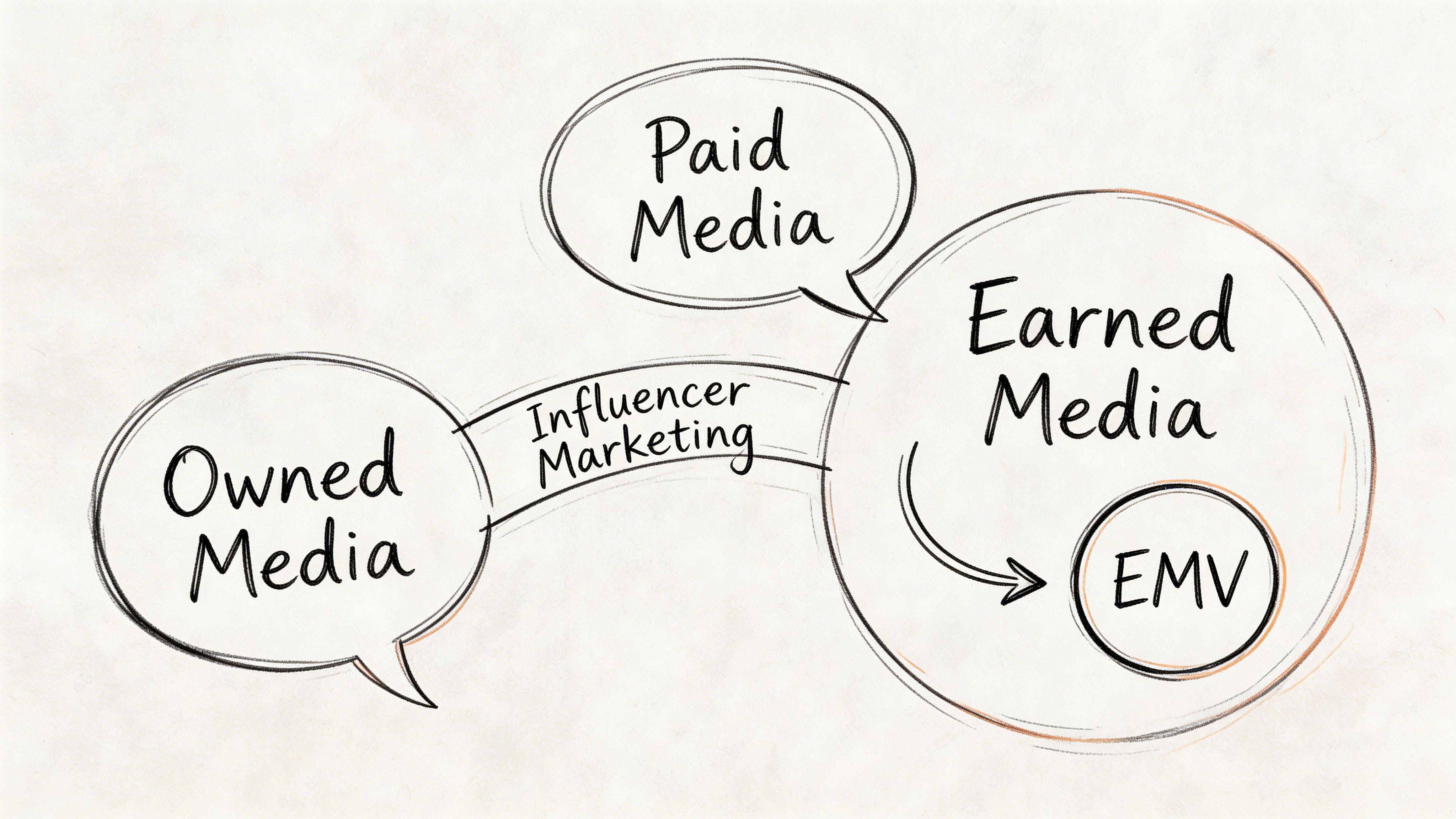
Where influencer content fits
When a creator posts about your brand and that content earns views, shares, saves, comments, and discussion, you are receiving attention you do not fully control in the same way as an ad. Even if the collaboration itself is paid, the output often creates a layer of earned distribution and trust that behaves differently from straight media buying.
That is why EMV exists. It gives marketers a framework for valuing that earned layer.
A useful analogy is PR. If a newspaper features your business on the front page, you did not buy an advert, but the exposure still has value. EMV applies a similar logic to creator content. It asks what that organic attention was worth in paid-media terms.
Why the concept sounds stronger than it is
The idea is intuitive. The execution is messy.
Different platforms reward different behaviours. Different audiences respond differently to the same creator. A post can generate large reach but weak buying intent. That is one reason EMV often looks more precise than it is.
There is also a market-level warning sign. According to Inbeat’s discussion of earned media value, global claims put influencer EMV at £180bn equivalent in 2026, while UK brands saw only 15% year-on-year EMV growth versus 22% budget hikes, linked to algorithm shifts favouring authentic UGC. That gap matters because it shows how platform changes can weaken the relationship between spend and reported media value.
Why brand owners should still care
EMV still has a place because brand building rarely shows up neatly in last-click reporting. Creator content can introduce a product, shape perception, add social proof, and supply useful assets for later channels. Those effects matter, especially for ecommerce and hospitality brands where discovery and trust play a large role.
A strong practical lens is to view EMV as one layer inside a broader social strategy. If you are thinking through broader channel planning, this guide to social media marketing strategies for e-commerce is a worthwhile companion because it frames creator activity within the rest of your acquisition mix.
A simple mental model
Use this framing:
| Media type | What it means | Typical example |
|---|---|
| Owned | Channels you control | Website, email, brand Instagram | | Paid | Distribution you buy | Meta ads, TikTok ads, sponsored placements | | Earned | Attention others generate around you | Creator mentions, reposts, reviews, social buzz |
EMV belongs in that third column. It is not a revenue metric. It is a way of putting a price tag on earned attention so you can compare it with the rest of your media mix.
Common Methods for Calculating EMV
Most EMV formulas appear more complex than they are. Under the hood, many of them boil down to one idea: value the attention generated by creator content using a paid-media benchmark.
The most common UK formula is straightforward. According to Tribe Group’s explanation of earned media value, a standard approach is EMV = (Total Impressions / 1,000) × Platform-Specific CPM × Quality Multiplier. The same source notes a UK Instagram CPM around £4.50 to £7.50, with a 1.5 to 2.0 quality multiplier for earned content, and reports that micro-influencer campaigns often generate 3.2x higher EMV per post, with an average of £2,750, than macro-influencers.
The three moving parts
Impressions
Impressions are the number of times the content was displayed. In simple terms, this is your raw visibility.
For EMV, impressions are often the base unit because they are widely available and easy to compare with advertising benchmarks. The trade-off is obvious. Seeing content is not the same as caring about it.
CPM
CPM means cost per thousand impressions. This is the ad-market benchmark you use to estimate what similar visibility would have cost through paid media.
A common error occurs here. Teams pull a CPM from one platform, market, or campaign type and apply it everywhere. That inflates or distorts the result. A UK hospitality brand on Instagram should not blindly use a generic benchmark built around another channel or geography.
Quality multiplier
The quality multiplier is an attempt to account for the idea that earned creator content may be more valuable than a standard ad impression. That uplift usually reflects trust, engagement, or context.
This part of the formula is also the most subjective. One agency may apply a conservative multiplier. Another may stretch it. The more aggressive the multiplier, the more impressive the EMV figure looks.
Tip: The multiplier is where most EMV models become storytelling rather than measurement. Keep it disciplined.
A simple worked example
Say a restaurant pays a nano creator £200 for a post.
That post generates 50,000 impressions. If you value those impressions at £7.50 CPM and apply a 2x multiplier, the calculation is:
Impressions divided by 1,000 = 50
50 × £7.50 = £375
£375 × 2 = £750 EMV
That is not revenue. It is an estimate of equivalent media value.
The number can still be useful. It tells you the post likely generated more media value than the fee alone suggests. But you still need to know whether anyone clicked, booked, ordered, or came in-store.
Other calculation styles
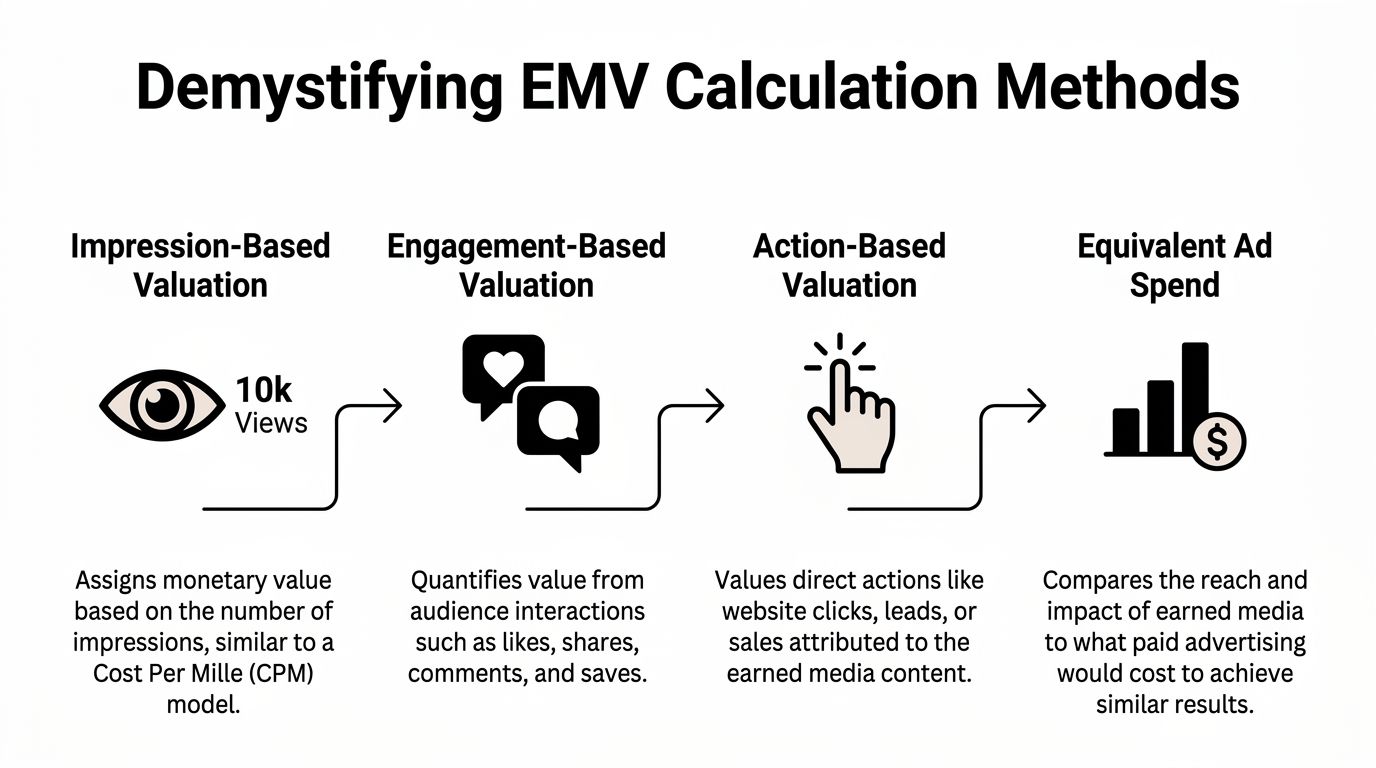
Not every team uses impressions alone. Some models weight engagement or direct actions more heavily.
Common approaches include:
Impression-based valuation Best when reach is the main objective and platform visibility data is reliable.
Engagement-based valuation Useful when likes, comments, shares, and saves are stronger signals than raw reach.
Action-based valuation Better for campaigns where clicks, leads, or purchases matter more than visibility.
Equivalent ad spend A broader framing that compares the creator output to what a comparable paid campaign would have required.
If your programme relies heavily on creator-made assets, it also helps to understand the broader mechanics of What is UGC Marketing. EMV often improves when the content itself is strong enough to travel beyond the original post.
What works and what does not
A practical setup looks like this:
What works | What does not |
|---|---|
One consistent formula used across campaigns | Switching formulas whenever you want a nicer result |
Platform-specific CPMs | One blended CPM across every network |
A documented quality multiplier | An unexplained multiplier chosen after results come in |
A separate conversion report | Treating EMV as final proof of ROI |
If you are reviewing agency decks, ask for the formula in plain English. If they cannot explain the CPM choice and multiplier logic, the headline number is not reliable.
The Strengths and Weaknesses of the EMV Metric
EMV gets praised too easily and dismissed too quickly.
Used well, it helps a brand judge the media impact of creator work in terms a founder, finance lead, or retail partner can understand. Used badly, it turns into a polished number that makes a campaign look valuable without showing whether it drove qualified traffic, purchases, or repeat customers.
Where EMV helps
EMV is strongest as a comparison tool.
If you are evaluating several creators, markets, or campaign waves, EMV gives you a shared frame for judging output. That matters when conversion data is delayed, retail sales come in late, or the goal includes visibility that will never show up neatly in last-click reporting.
It also helps in situations where attention has real business value before revenue is fully visible. Product launches, pop-up events, store openings, waitlist campaigns, and PR-heavy collaborations often need a top-funnel read before the full sales picture is available.
For operator teams, that is practical. You can spot who generated disproportionate visibility, which content themes traveled, and whether a campaign earned more media exposure than a paid placement of similar scale would likely have delivered.
Where EMV breaks down
EMV does not measure commercial impact. It estimates media value.
That distinction matters because brands do not fund influencer programs to collect estimated value on a spreadsheet. They fund them to create demand, acquire customers, and grow revenue. EMV cannot tell you whether the people who engaged were in-market, whether they clicked through, or whether they bought.
It also breaks down when teams treat all reach as equal. A niche creator with a highly relevant audience may drive stronger sales than a larger creator with better headline EMV. If the formula overweights impressions or applies loose multipliers, the reporting can reward visibility and miss buying intent.
That is where a lot of teams go wrong. They present EMV as proof, when it is only context.
A side-by-side view
Strength | Weakness |
|---|---|
Creates a common valuation language | Does not prove sales or profit |
Useful for benchmarking creator output | Highly sensitive to formula choices |
Helpful for awareness reporting | Misses audience quality if used alone |
Can support budget conversations | Can be inflated by weak multipliers |
The reporting trap
I see the same mistake in brand reviews all the time. A campaign posts strong EMV, healthy impressions, and good engagement rates, so the team assumes performance was strong. Then leadership asks a harder question. Which creators drove sessions, code redemptions, new customers, higher average order value, or revenue?
If the answer is unclear, EMV has been asked to do a job it cannot do.
The practical fix is simple. Keep EMV in the report, but pair it with attribution. Use creator-level UTMs, unique promo codes, tracked landing pages, and post-purchase survey data. That gives the brand two views at once: estimated media impact and verified business impact. This guide on how to measure influencer marketing with metrics that work is useful for building that measurement stack properly.
Key takeaway: EMV is useful for valuing exposure and comparing creator output. It is unreliable as standalone proof of ROI.
The practical conclusion
Use EMV to benchmark awareness. Use attribution to prove contribution.
If a report stops at EMV, it describes attention. If it adds traffic quality, assisted conversions, promo code use, and revenue by creator, it starts to explain business results. That is the standard influencer measurement needs if the goal is to defend budget and scale what works.
Connecting EMV to Measurable ROI and Conversions
EMV does not prove ROI. It helps explain exposure.
That distinction matters because brands do not fund influencer programs to buy a nice-looking report. They fund them to drive demand, acquire customers, and grow revenue. If EMV is the only number on the page, the team still cannot answer the question that matters in budget reviews. Which creators influenced sales, and how much?
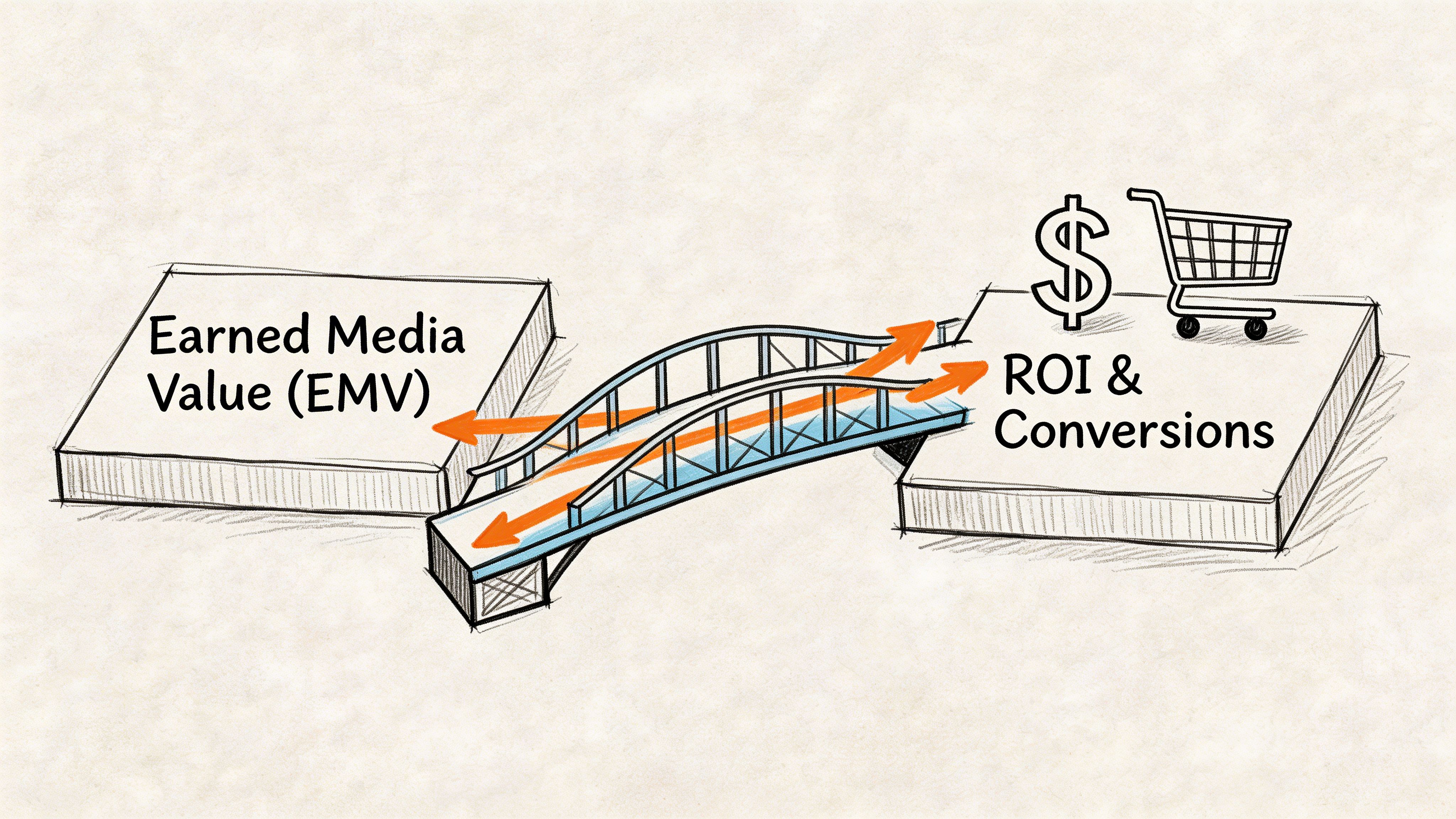
The simplest bridge from visibility to revenue
The gap between media value and business value is usually a tracking problem, not a theory problem.
Three tools close that gap in real campaigns:
UTM links These show which creator, platform, and campaign drove the visit.
Unique promo codes These tie creator exposure to a redemption at checkout or in-store.
Affiliate or tracked landing pages These give each creator a clean route to conversion.
The tools are simple. Execution is where teams slip. Naming conventions get messy, codes get shared across creators, links break, and reporting rolls everything up too early. Clean creator-level setup matters more than adding another metric to the dashboard.
Why EMV and attribution should sit in the same report
EMV estimates the value of attention. Attribution measures actions you can verify, such as clicks, redemptions, orders, bookings, and revenue.
Used together, they solve different parts of the same problem. EMV helps explain whether a creator generated meaningful visibility. Attribution shows whether that visibility turned into traffic, customers, or sales. If a creator posts strong engagement but drives no sessions or conversions, the campaign may still have awareness value, but it should not be presented as proven commercial success. If another creator has modest social metrics but produces efficient sales through tracked links or codes, that creator often deserves more budget.
That is the trade-off many teams miss.
What stronger measurement looks like in practice
A useful influencer report should answer five separate questions, not flatten everything into one headline number:
Question | Best measurement method |
|---|---|
Did the content get seen? | Impressions, views, reach |
Did people care? | Saves, shares, comments, engagement quality |
Did they act? | Clicks, landing page visits, code redemptions |
Did they buy or book? | Orders, bookings, revenue |
Were they valuable customers? | Repeat purchase behaviour, customer value over time |
This structure helps brands avoid two common mistakes. The first is giving EMV too much authority. The second is judging influencer performance only on last-click sales, which can undervalue creators who drive discovery earlier in the journey.
For a more detailed framework, this guide on how to measure influencer marketing ROI with metrics that work lays out the attribution side more clearly.
After the campaign launches, it also helps to educate internal stakeholders on what these reports mean in practice.
What works in real campaigns
The right tracking setup depends on how people buy.
Restaurants and hospitality often get cleaner evidence from creator-specific booking links or simple dine-in promo codes.
Ecommerce brands usually need UTM-tagged links, creator landing pages, and checkout-level code tracking.
Multi-location businesses improve reporting when codes are mapped by creator and by location, so the team can see where demand showed up.
A practical rule works well here. Ask every creator campaign to prove two things. Did it earn attention, and did it move someone closer to revenue?
That keeps EMV in the report without asking it to do a job it was never built to do.
Practical Ways to Use EMV for Campaign Measurement
Most brands do not need a more complex EMV model. They need a more disciplined one.
The goal is not to produce the biggest possible number. The goal is to make influencer reporting more useful for decisions about budget, creators, content, and channel mix.
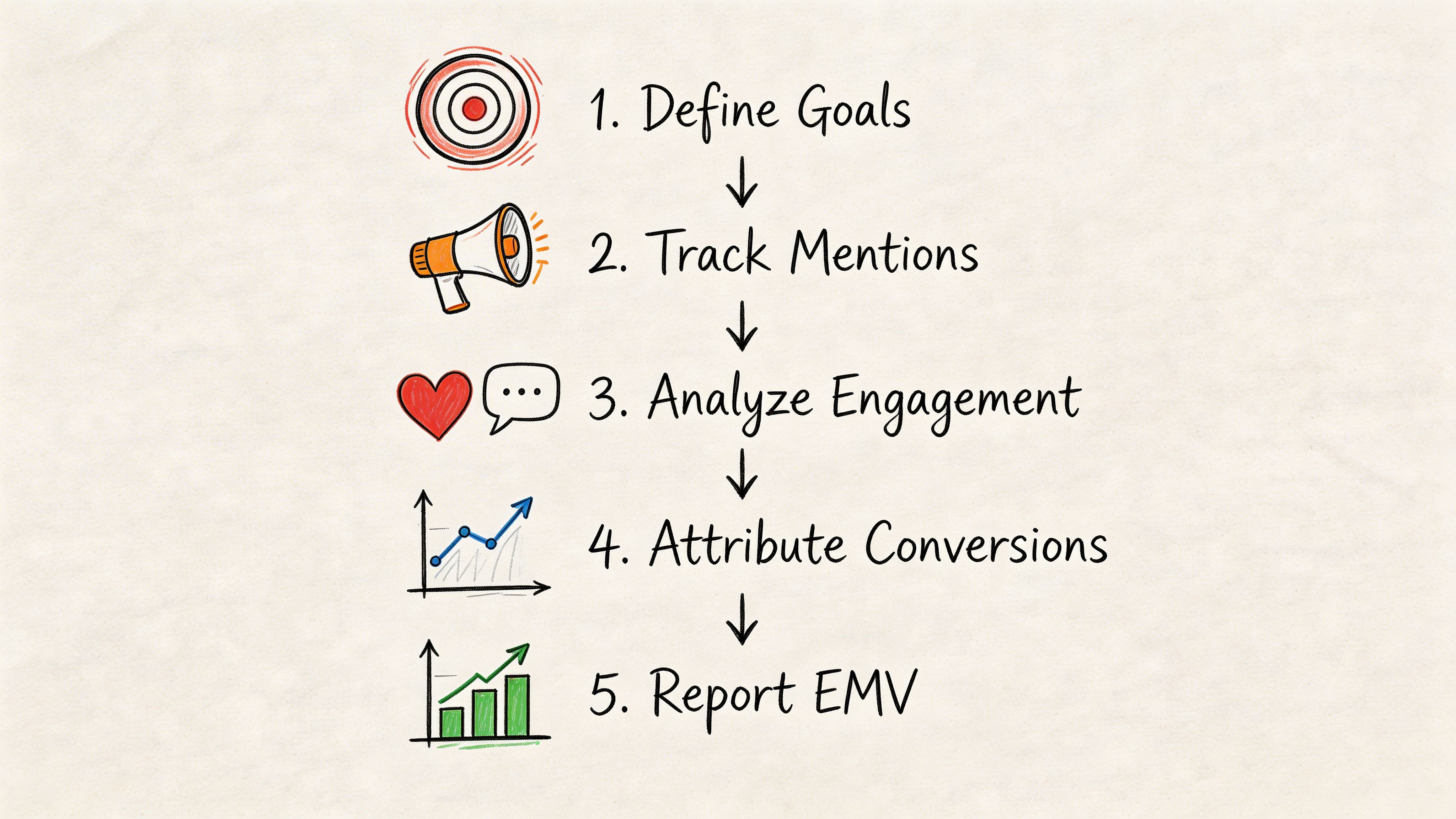
Five practical rules
Use EMV for comparison, not accounting
Treat EMV as a way to compare creators, formats, or campaigns. Do not treat it as booked revenue.
When teams use it comparatively, the metric becomes much more stable. You can see which content style generated stronger estimated media value without pretending that estimate is the same thing as sales.
Lock your formula before launch
Pick your CPM assumptions and quality multipliers before the campaign goes live. Write them down.
That protects the integrity of the report. If the assumptions change after results come in, people stop trusting the metric.
Pair every EMV report with direct attribution
Many teams improve results quickly with this approach. UK-specific data cited by Influencer Hero’s EMV guide shows EMV in 2025 averaging £12.40 per 1,000 impressions for DTC and hospitality, and that campaigns using unique promo codes and UTM links can attribute 22% of this EMV directly to conversions. The same source gives an example of a £200 nano-creator post yielding £750 in EMV, a £3.75 return per £1 spent, versus a 2.8:1 UK average.
The lesson is not that every campaign will hit that result. The lesson is that attribution changes the quality of the conversation.
Report the content value separately
Creator campaigns often produce useful assets beyond the initial post. A strong video or image set can support paid social, landing pages, email, or local organic content.
That value matters, but it should not be buried inside EMV. Keep media value and asset value separate so you can judge each one clearly.
Review by creator, not just campaign
Campaign-level averages hide weak performers and make good performers harder to scale. A creator-by-creator view tells you who drove views, who drove clicks, and who drove sales.
A lean scorecard that works
A useful campaign scorecard often includes:
Estimated media value from a consistent EMV formula
Engagement quality through saves, shares, comments, and response context
Traffic signals through clicks and landing page behaviour
Commercial outcomes through bookings, orders, or redemptions
Content reuse potential based on how usable the asset is after the post goes live
Tip: If a creator produced average EMV but exceptional conversions, keep them. If they produced flashy EMV but weak action, be cautious.
That is the practical way to use EMV. Keep it. Standardise it. Then force it to sit next to outcome data.
Frequently Asked Questions About EMV
Are there tools that calculate EMV automatically
Yes. Many influencer platforms and agency dashboards can estimate EMV automatically once impressions, engagement data, and campaign inputs are available.
Automation helps because reporting gets messy fast when you are collecting screenshots, creator posts, promo code usage, and payment records across multiple campaigns. According to Archive’s overview of earned media value versus paid media, creator content produced $236 billion in EMV globally in 2024, UK brands are using micro-influencers who deliver $5.20 to $6.50 ROI per dollar spent, 71% of marketers planned budget increases in 2025, and 79% of marketers cited measurement as the top challenge. That is why automated dashboards matter. They reduce reporting friction.
The important caveat is this: automatic EMV is only as credible as the assumptions behind it. Always ask what CPM, multiplier, and engagement weighting the tool uses.
Does EMV differ between Instagram and TikTok
Yes. Platform behaviour matters.
Instagram and TikTok produce different patterns of reach, engagement, content lifespan, and audience intent. That means the paid-media equivalent also differs. A creator post on TikTok may generate fast visibility and broad discovery. An Instagram post may create a different type of interaction or buying journey.
The practical takeaway is simple. Do not use one blended benchmark across platforms unless you have a very good reason.
Is EMV still relevant in 2026 and beyond
Yes, but in a narrower role than many teams give it.
EMV remains useful for valuing earned attention and benchmarking creator output. It is still a practical reporting layer for brand campaigns, local awareness pushes, product launches, and creator comparisons. What is changing is the expectation around proof.
Brand owners now expect clearer links to clicks, redemptions, orders, and customer value. That means EMV survives best as part of a hybrid measurement model.
What is the biggest mistake brands make with EMV
They confuse estimated value with proven value.
If a campaign report highlights EMV but cannot show traffic, code use, or sales, the business will eventually question the channel. That is not a flaw in creator marketing. It is a flaw in the reporting setup.
Should small brands use EMV at all
Yes, but lightly.
For smaller brands, the cleanest use of EMV is creator comparison. It helps you see who generated disproportionate media value relative to fee. But small brands usually need cash-flow clarity more than headline valuation, so conversions should carry more weight in decision-making than EMV alone.
What is a sensible final view of EMV
Use EMV to estimate attention. Use attribution to prove outcomes. Use both to make better decisions.
That is the balanced answer to “What is Earned Media Value in Influencer Marketing?” It is not a vanity metric by default, and it is not a complete ROI metric either. It becomes useful when you stop asking it to do everything.
If you want to run creator campaigns with tracked promo codes, UTM links, real-time reporting, and a done-with-you workflow that ties influencer activity back to clicks, conversions, bookings, and revenue, take a look at Sup. It is built for restaurants, ecommerce brands, agencies, and multi-location teams that want influencer marketing to be measurable, repeatable, and easier to scale.

Matt Greenwell
Share