Let's be honest, the marketing world is flooded with buzzwords. So, what exactly is a KOL, or Key Opinion Leader, and why should you care?
A KOL isn't just another influencer. They are genuine experts in their field—think of a seasoned dermatologist, a sharp financial analyst, or a professional chef with decades of experience. Their opinions matter because they’re built on a foundation of authority and credibility, not just a high follower count.
What Is a KOL and Why Do They Matter?
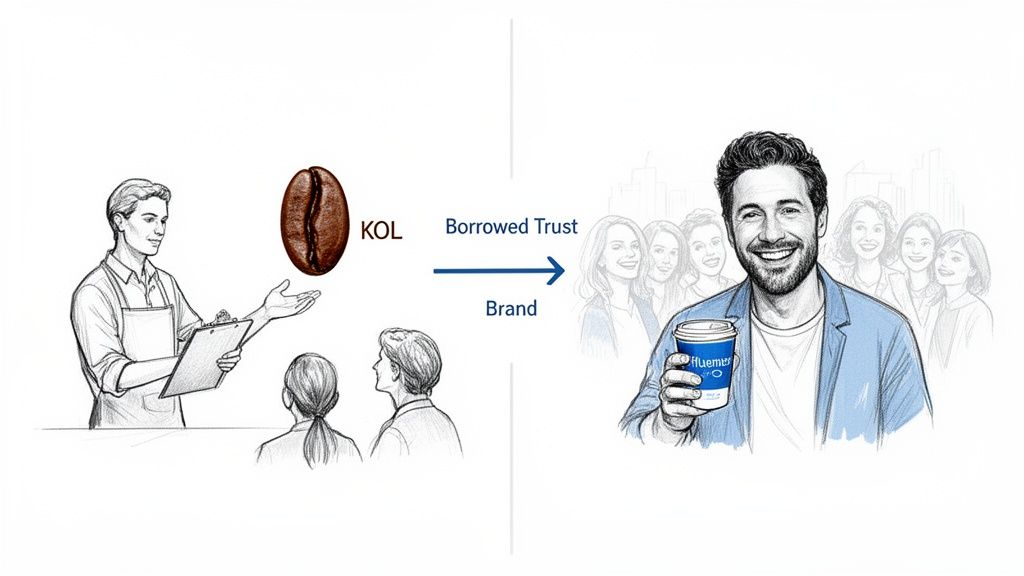
To really grasp the difference, let’s use an example. Imagine a lifestyle influencer posting a picture holding a branded coffee cup. That might create some awareness, sure. But now, picture a world-renowned coffee expert who recommends a specific bean, detailing its unique flavour profile and single-origin story. That’s a completely different ball game.
The expert’s recommendation creates genuine trust and directly influences people to buy, not because it’s trendy, but because a respected authority has given it their seal of approval.
The Power of Borrowed Trust
This brings us to a powerful concept known as “borrowed trust.” When a respected figure endorses your product, their hard-won credibility transfers over to your brand. It’s a shortcut that bypasses the natural scepticism most customers have towards advertising.
This ability to build a personal brand around authentic expertise is precisely what makes a KOL so valuable today.
This isn’t some niche tactic anymore; it’s a cornerstone of modern marketing. Just look at the numbers. The UK influencer marketing market is projected to rocket from USD 3.1 Billion in 2025 to an incredible USD 28.3 Billion by 2034. This explosive growth shows just how much brands are relying on credible voices for real, measurable results.
A KOL's value isn't just in their reach; it's in their reputation. They provide the expert validation that turns a curious browser into a confident buyer.
Ultimately, this shift towards expert-led marketing is happening because today's customers are exhausted by generic ads. They crave recommendations from people they actually trust. A KOL provides that essential vote of confidence, transforming your marketing from a simple sales pitch into a valuable conversation.
KOLs vs Influencers: The Crucial Distinction for Your Brand
It’s easy to see why people throw the terms ‘KOL’ and ‘influencer’ around as if they mean the same thing. On the surface, they both have an audience that listens. But lumping them together is a huge missed opportunity, and knowing the difference is key to getting your brand strategy right.
Here’s the simplest way to think about it: while every Key Opinion Leader (KOL) can be an influencer, very few influencers ever truly become a KOL.
Where Does Their Authority Come From?
The real difference lies in where their authority comes from. An influencer’s power is typically born online. They build a large, loyal following around their personality, their lifestyle, or their knack for creating entertaining content. They’re fantastic for generating buzz and getting a lot of eyes on your product. Think of a popular travel vlogger showing off a new hotel – their appeal is built on aspiration and personality.
A KOL, on the other hand, earns their influence in the real world, long before they might even have a social media profile. Their authority comes from their profession, their credentials, and their deep, hands-on experience in a specific field. When a KOL shares an opinion, people listen because they are a respected, credible expert.
Let’s take a practical example. A fitness influencer posts a workout video that goes viral, racking up millions of views. It's great for reach and gets people excited to try a new exercise.
Now, imagine a chartered physiotherapist with 15 years of clinical experience breaks down the biomechanics of that same exercise. They explain how to do it correctly to avoid injury. That recommendation carries a completely different kind of weight, doesn't it? That physiotherapist is a KOL. Brands who partner with them aren't just paying for views; they're borrowing genuine, hard-earned credibility.
The core idea is this: Influencers build an audience; KOLs command respect. Influencers are masters of popularity, while KOLs are masters of their subject.
This distinction has a direct impact on your marketing goals. An influencer campaign is your go-to for making a big splash, launching a trendy product, or driving a massive conversation. A KOL strategy is what you use to build lasting brand trust, educate a thoughtful audience, and get an expert's seal of approval on your product’s quality.
KOL vs Influencer vs Creator At a Glance
To make this even clearer, we’ve broken down the fundamental differences between Key Opinion Leaders, general influencers, and the user-generated content (UGC) creators who are becoming so important. This table will help you match the right kind of partner to what you're trying to achieve.
Attribute | Key Opinion Leader (KOL) | Influencer (Macro/Mega) | Creator (Micro/Nano) |
|---|---|---|---|
Primary Authority | Professional expertise, credentials, and reputation. | Large-scale online reach and relatable persona. | Niche community engagement and authenticity. |
Main Goal | To educate, validate, and build deep trust. | To generate mass awareness and broad reach. | To foster authentic connection and drive sales. |
Audience Relationship | Based on respect for their knowledge and credibility. | Based on aspirational appeal and entertainment. | Based on relatability and a shared interest. |
Best For | Technical products, B2B, healthcare, finance. | Fashion, beauty, lifestyle, and consumer goods. | Local businesses, restaurants, niche ecommerce. |
Choosing the right partner isn't about picking the person with the most followers. It's about aligning their unique source of authority with your specific business goal, whether that's broad awareness, deep trust, or authentic connection.
The Real-World Business Impact of a KOL Strategy
Let's move past the theory. What does a smart KOL strategy actually do for your bottom line? In a world where most of us have become experts at ignoring ads, Key Opinion Leaders offer a refreshingly effective way to cut through the noise and consumer scepticism. The secret lies in a powerful concept I call 'borrowed trust'.
Think of it this way: a brand can tap into a KOL’s hard-earned credibility to gain instant validation with their audience. This isn’t about chasing vanity metrics like likes; it’s about driving real, tangible results. A local restaurant partnering with a respected food critic is a perfect example. That single collaboration can drive actual bookings and build a lasting reputation far more effectively than any generic ad ever could.
This diagram shows exactly where KOLs fit in the grand scheme of things. They sit right at the top, and for good reason.
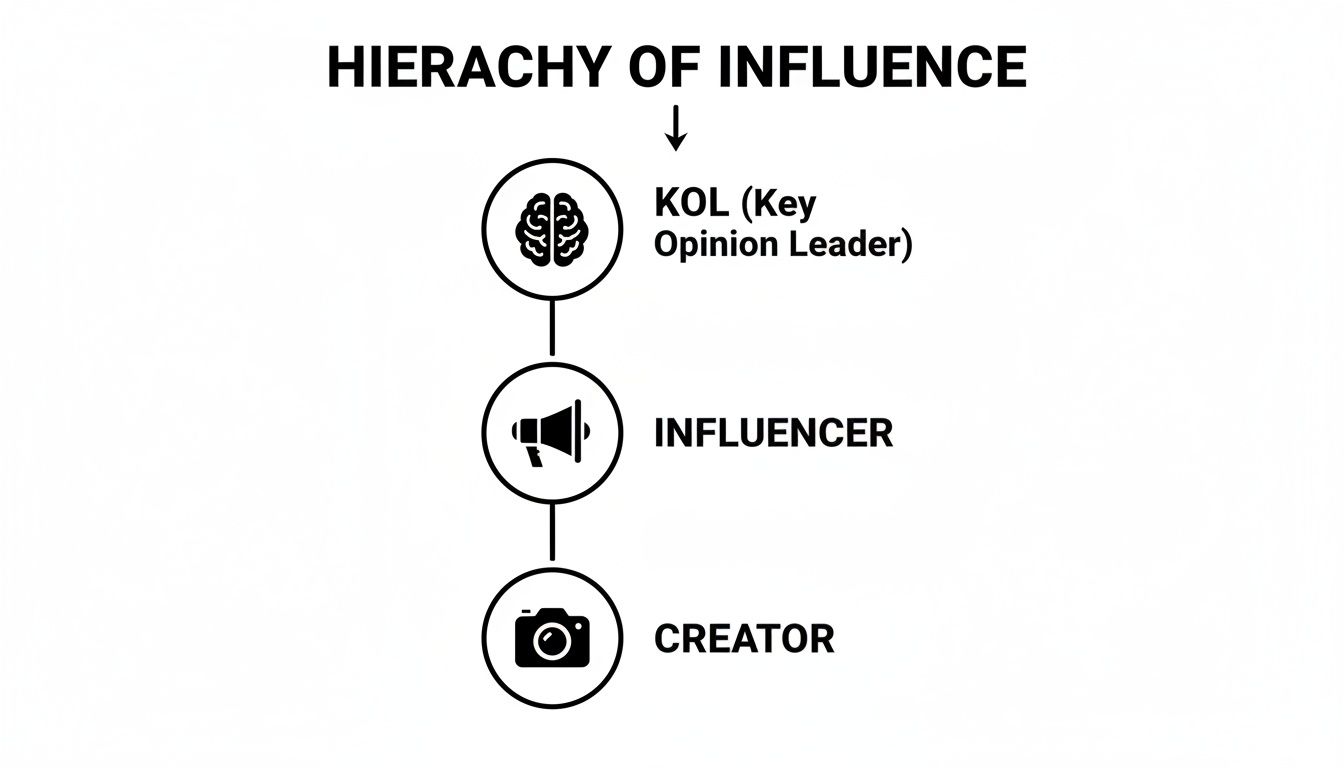
While influencers and creators are brilliant at building communities, KOLs command respect through proven expertise. This is what makes their recommendations so much more profound.
Turning Credibility Into Commercial Success
This direct line to consumer trust isn't just a hunch; it's backed by some pretty compelling numbers here in the UK. We're seeing a huge reliance on these expert voices to guide purchasing decisions. In fact, a staggering 86% of consumers make at least one purchase based on an influencer recommendation every year. That’s a clear, direct link from a recommendation to a sale.
For UK brands, especially those trying to connect with younger generations, a KOL strategy is no longer a 'nice-to-have'. It's essential. Consider this: one in four UK adults has been swayed by these partnerships, and for Generation Z, that number rockets to over 50%. The ROI is right there.
This all comes down to trust. Around 69% of consumers trust what influencers and KOLs say, and nearly half—49%—actively rely on their recommendations before buying something. This is particularly true for younger audiences, with 84% of Gen Z and 68% of Millennials following their content. If you want to dive deeper into the stats, you can find more UK consumer data on Sproutsocial.com.
The takeaway is simple. Campaigns driven by genuine KOLs don't just perform well; they often lead to higher conversion rates and help build a more resilient brand reputation, all because they’re built on a foundation of genuine authority and trust.
How to Measure the Real ROI of Your KOL Campaigns
Likes and shares are nice, but they don't keep the lights on. If you really want to know if a Key Opinion Leader (KOL) is making a difference, you have to look beyond the surface-level buzz and get serious about tracking the financial impact. For most marketers, this is where things get tricky, but it's the only way to prove your efforts are paying off.
The first step is to build a solid game plan for tracking results. This isn’t about guesswork; it’s about connecting the dots. The whole point is to draw a clear line from a KOL's content straight to a business goal, whether that’s a new customer, a product sale, or a dinner reservation.
Tracking Conversions and Clicks
The best tools for this are actually quite simple. When you give each KOL their own unique tracking assets, you can see exactly what they're delivering without drowning in spreadsheets.
Here’s what you absolutely need to use:
Unique UTM Links: Think of these as special tracking codes added to the URLs you give your KOLs. When they share the link, your analytics tools can tell you precisely how many people clicked, where they came from, and what they did on your site.
Custom Discount Codes: For any ecommerce brand, this is the gold standard. Giving a KOL a unique code like "EXPERT15" provides undeniable proof of a sale. Every time a customer uses it at checkout, you know exactly who to thank.
Once you have this kind of data, you stop hoping for results and start building a predictable growth engine. The proof is in the numbers, with credible voices consistently outperforming old-school advertising. In fact, research shows influencer marketing can bring in an average return of £5.78 for every £1 spent. You can see why it’s become such a reliable strategy. To dig into the numbers, you can explore detailed influencer marketing statistics on Influee.co.
Measuring Beyond the Sale
A sale is fantastic, but a great KOL partnership delivers so much more. You also have to pay attention to the "softer" metrics that point towards long-term brand growth and future sales. For example, is the conversation around your brand becoming more positive since the collaboration started?
By focusing on both direct conversions and brand-level metrics, you gain a complete picture of your return on investment. A single campaign can drive immediate sales while simultaneously building the trust that fuels future growth.
Don’t just count the comments; read them. Are people asking genuine questions about your product? Are they tagging their friends, telling them they have to try it? That kind of high-quality engagement is a sign that the KOL's recommendation truly hit home, building trust that will continue to pay off long after the campaign is over. For a deeper dive, check out our guide on measuring influencer marketing ROI and what actually moves the needle.
Finding and Partnering With the Right KOLs for Your Niche
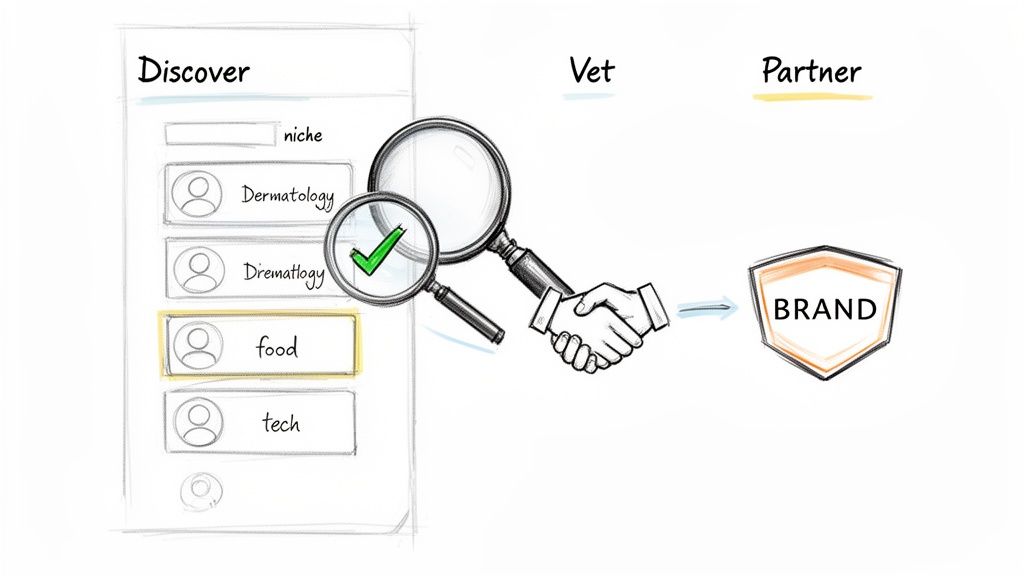
Alright, you’ve got your strategy mapped out. Now for the hard part: finding the perfect Key Opinion Leader (KOL) to bring it to life. This is where theory meets reality, and honestly, it can feel like you're searching for a needle in a haystack.
The old way of doing this is a massive time-sink. You end up manually scrolling through social media for hours, trying to figure out if a potential partner’s followers are real people or just a sea of bots. Then you’re juggling messy spreadsheets for outreach and setting endless reminders for follow-ups that inevitably get lost. This approach isn’t just inefficient; it rarely uncovers the best-fit experts for your brand.
A Modern Approach to KOL Discovery
Thankfully, we've moved past those days. AI-powered tools have completely changed the game, especially for businesses that depend on local expertise. Think about it: a restaurant in Manchester needs a food critic who is known and trusted in Manchester, not a big-name food blogger from London.
The right platform lets you zero in on verified micro-KOLs, filtering them by their specific niche and where they're based. This is a huge advantage. It means you can connect with genuine experts who hold real influence within the community you’re trying to reach. For any local business, that level of precision is what drives actual footfall and rings the till.
Once you find someone promising, your first message has to cut through the noise. They get dozens of collaboration requests, so a generic pitch is a dead end. A great starting point is to look at some influencer media kit examples to see how pros present themselves. Personalisation is everything.
Adaptable Outreach Template
Subject: Collaboration Idea: [Your Brand] & [KOL's Niche]
Hi [KOL Name],
I’m [Your Name] from [Your Brand], and I’ve been following your work on [Platform] for a while. I particularly loved your recent post about [Specific Topic] because [Genuine Compliment or Insight].
We are launching [Product/Service] and believe your expertise in [Their Niche] would provide incredible value to your audience. We'd love to explore a partnership, starting with sending you our [Product] to experience firsthand.
Would you be open to a brief chat next week?
Best, [Your Name]
Negotiating and Managing Partnerships
After you’ve made contact, the real conversation begins. With micro-KOLs, partnerships can be anything from gifted products in exchange for an honest review to paid work with specific deliverables. No matter the arrangement, always get it in writing with a simple contract that outlines expectations, timelines, and compensation.
This is also where the admin work piles up—shipping products, tracking content, and measuring results. This is precisely where platforms like Sup can save teams up to 95% of their time. For industries like beauty, having a tight process is crucial. You can learn more about finding the perfect creator for beauty brands in our detailed guide.
From KOL Chaos to a Cohesive System
Anyone who’s run a professional KOL strategy knows the feeling. It often feels like you're trying to juggle a dozen moving parts at once. You’re drowning in DMs, wrestling with disorganised spreadsheets, and manually chasing down results. It’s a recipe for even the best-laid plans to simply fall apart.
But what if you could swap all that manual chaos for a predictable system that actually grows your business?
This is where a proper, end-to-end platform changes the game. Instead of losing hours to repetitive admin, you can automate the whole process—from discovering the right Key Opinion Leader (KOL) in the first place, all the way to proving the financial return of your campaign. Suddenly, KOL marketing stops feeling like a chore and starts acting like a reliable, ROI-focused part of your marketing mix.
Good platforms are designed to do the heavy lifting, freeing you up to think about the bigger picture instead of getting bogged down in admin.
Building and Managing Campaigns at Scale
The single biggest hurdle most brands face is scale. Juggling one or two collaborations with a spreadsheet is manageable, but try scaling that to ten, fifty, or a hundred. The whole system breaks. A dedicated platform is what allows you to run multiple campaigns at the same time without everything descending into chaos.
You can find verified creators by niche and location, build campaigns with tracking baked in from the start, and put your communications on autopilot. For agencies, this is a total game-changer. You can learn how to scale influencer campaigns without hiring more staff once you have the right workflow.
By automating discovery, outreach, and follow-ups, your team can save up to 95% of the time normally wasted on manual tasks. This frees you up to do what really matters: building relationships and getting results.
Imagine seeing all your attribution data in one clean, simple dashboard. This screenshot shows exactly how a platform like Sup gives you a real-time view of performance.
This central hub instantly shows you the clicks, conversions, and revenue tied to each KOL, completely removing the guesswork. It’s proof that any brand can get sophisticated, measurable results without the huge overhead, turning the question of 'what is KOL marketing?' into a clear answer: a predictable engine for growth.
Frequently Asked Questions About KOL Marketing
Even when you’ve wrapped your head around the concept of a KOL, figuring out the practical next steps can feel a bit daunting. Let's walk through some of the most common questions brands have before they dive in, covering everything from budgets to timelines.
How Much Does It Cost to Work With a KOL?
This is often the first question on everyone's mind, and the honest answer is: it really depends. You might see a globally recognised expert charging thousands of pounds for a single piece of content, but that's far from the only path.
Don't overlook the power of smaller, niche experts. Many brilliant micro-KOLs (those with between 1,000 and 10,000 followers) who are deeply trusted in their specific field are often happy to collaborate in exchange for gifted products or a more modest fee. This makes KOL marketing surprisingly accessible, whether you’re a local restaurant or a growing ecommerce shop.
At the end of the day, it's not about spending the most money; it's about getting the best return. A carefully chosen micro-KOL can deliver incredible value because their audience genuinely hangs on their every word.
Which Platforms Are Best for KOL Marketing?
Instead of asking which platform is "best," the real question is, "Where does my audience go to get expert advice?" The answer to that will point you in the right direction.
Instagram and TikTok: These visual platforms are absolute gold for brands in food, beauty, fashion, and travel. If what you do looks great on camera, this is your playground.
LinkedIn: For anyone in B2B, tech, or professional services, LinkedIn is the undisputed king. It’s the natural home for connecting with industry-specific KOLs, from financial analysts to marketing gurus.
The goal isn’t to be everywhere at once. It’s about showing up in the right place—that sweet spot where your audience’s attention and the KOL’s credibility perfectly align.
How Long Does It Take to See Results From a KOL Campaign?
You can see some results almost immediately. Once a KOL’s post goes live, you can start tracking things like clicks on a unique link or sales made with a special discount code within hours.
But the true magic of a KOL partnership unfolds over time. The real prize is the lasting trust, authority, and reputation you build in your niche. Think of it less as a one-off sprint and more as a long-term strategy. A consistent, ongoing KOL programme will always outperform a single campaign when it comes to sustainable growth.
Ready to transform your KOL marketing from a manual chore into a scalable growth engine? Sup discovers verified creators, launches campaigns with automated tracking, and provides a single dashboard to measure your ROI in real time. Learn how Sup can streamline your entire workflow.

Matt Greenwell
Share